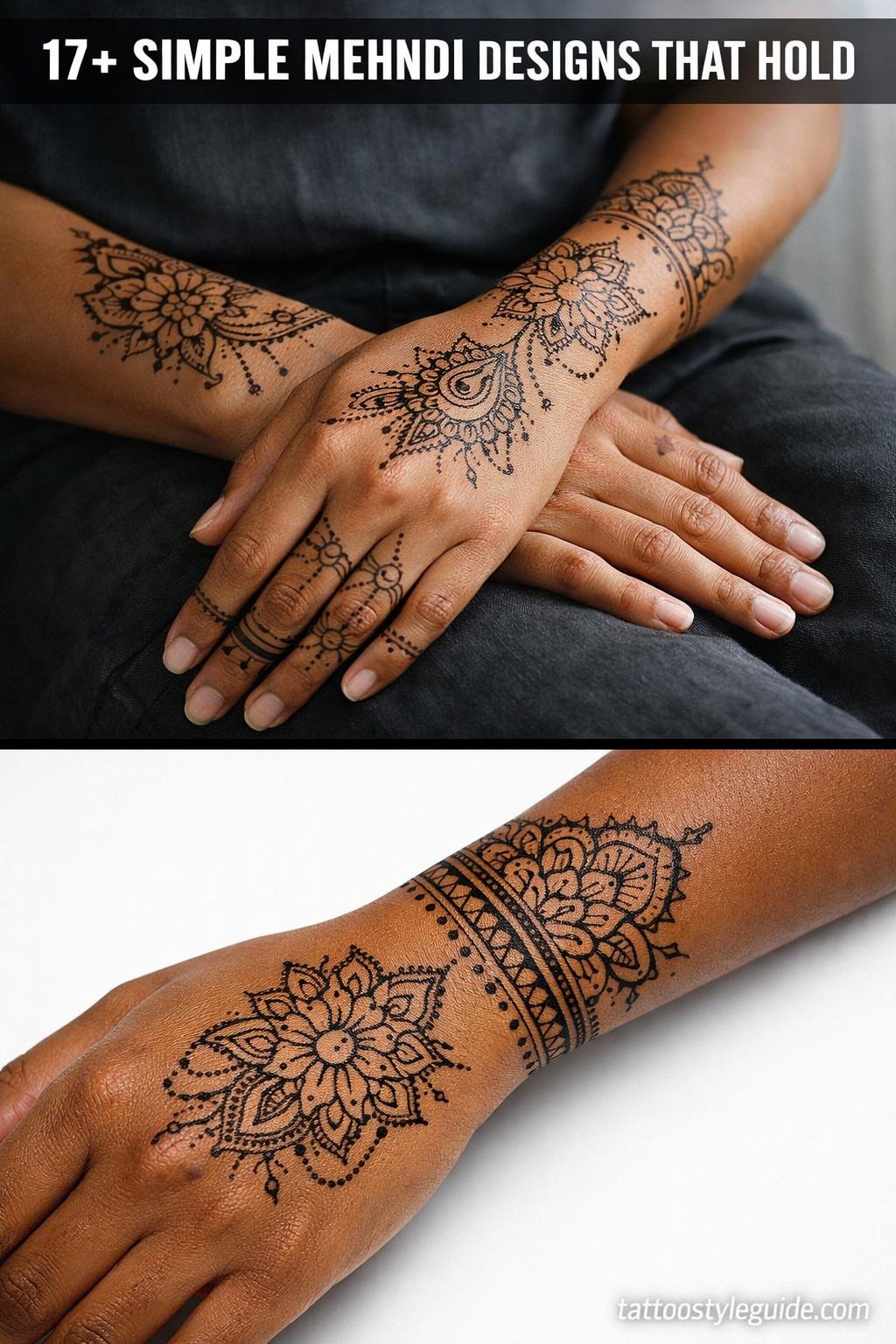
Simple mehndi structures translated into permanent ink are harder to execute than dense traditional henna, not easier. Negative space does the compositional heavy lifting, and any wobble in a single vine line has nowhere to hide. The designs that hold their integrity long-term are the ones built on weight hierarchy: one dominant stroke, deliberate stations, intentional negative space.
Stylish Mehndi Designs For Front Hand: Geometry Does the Work
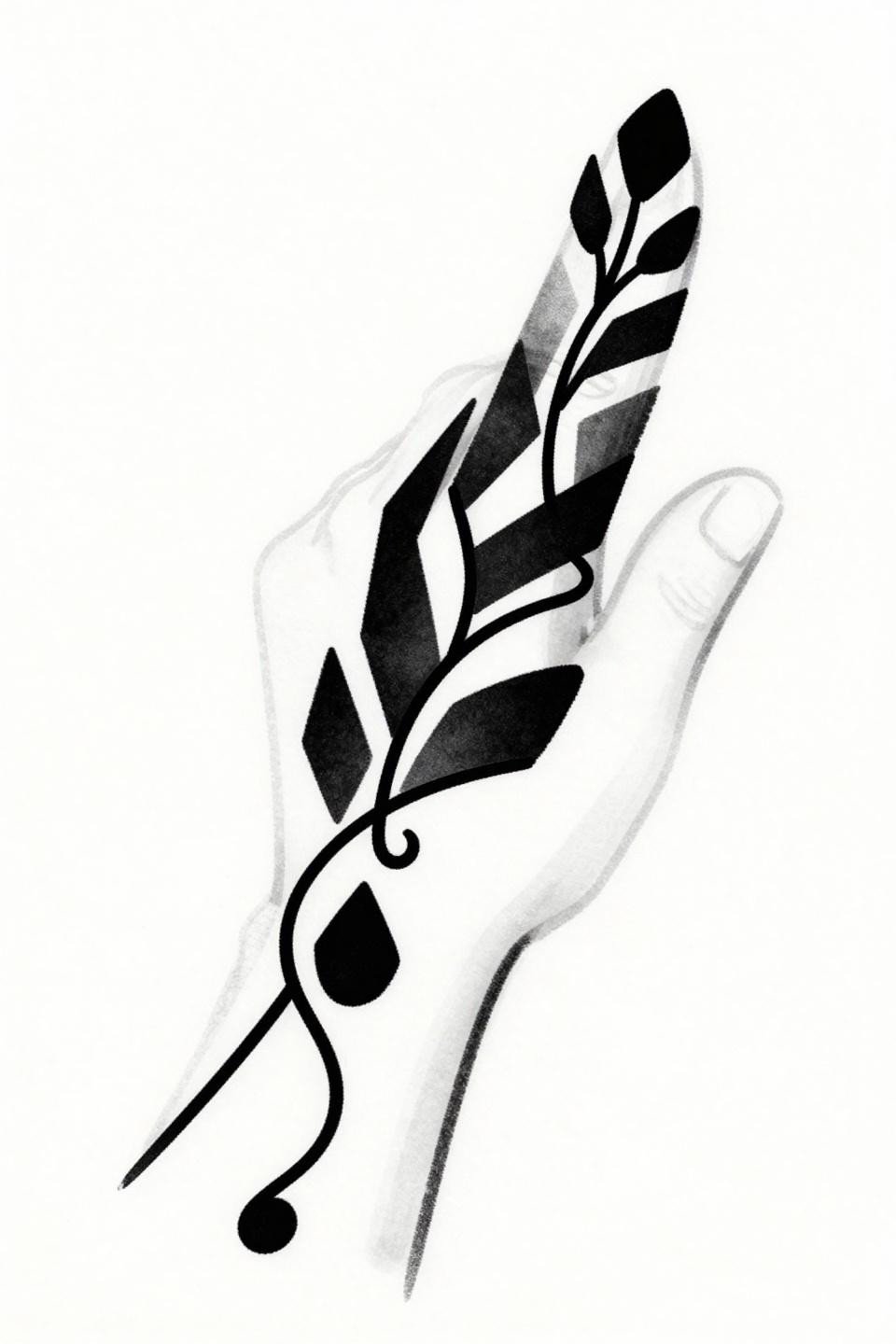
The latest simple mehndi designs with the most longevity on front-hand placements are built on this exact structure: a single dominant vine with weight, geometric anchor stations at the knuckles, and negative space carved out deliberately rather than filled in as an afterthought. The 2.5pt bold scroll line visible here is the right call for front-hand work specifically. Thinner outlines under 1pt on the front hand face friction from daily activity and begin to blur by year two.
Sharp angular brackets read more precisely than organic curves on the front hand because flat skin panels at the knuckles give the linework a stable surface. Any rotary machine run at consistent speed handles these hard 90-degree angles without the corner drag you see from coil setups not tuned for precision linework.
Aesthetic Mehendi Designs: Dotwork Density as a Compositional Tool
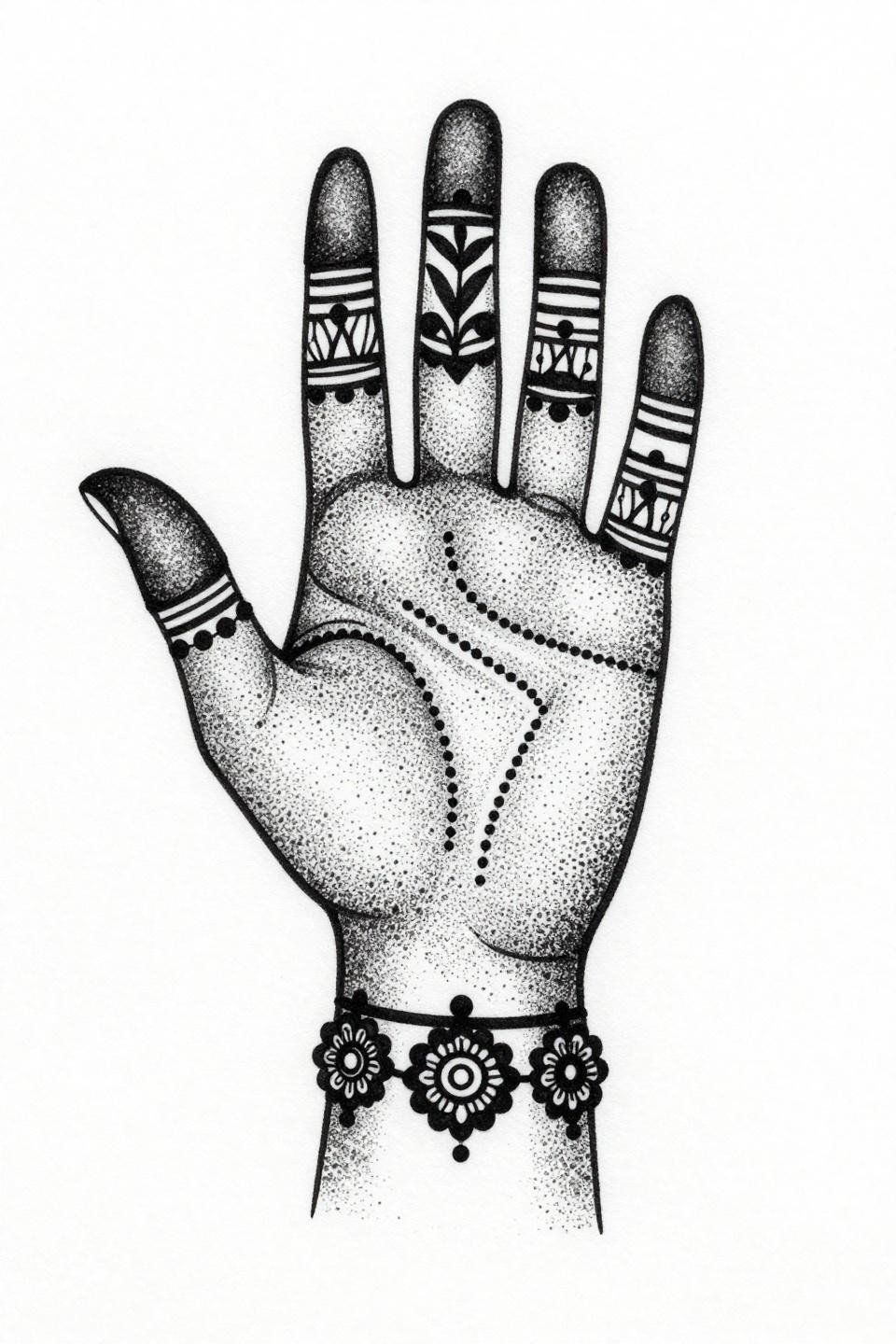
The 80-percent-density stipple fade at the wrist cuff thinning to 20-percent open field at the fingertips is the correct density map for aesthetic mehendi designs built on dotwork. Reverse that gradient and you get a top-heavy design that fights the hand’s natural visual weight. A 3RL needle at consistent depth, no more than 1.5mm penetration, is the technical baseline for this stipple quality. Going deeper to speed up the session creates ink pooling that destroys graduation.
Parallel line accent shading on the rosette petals, as seen here, adds structural contrast without introducing a new technique to the session. The combination of stipple field and parallel hatching reads as multi-dimensional even in pure black, which matters for olive and darker skin tones where pure stipple at low density can read flat after healing.
New Simple Mehndi Designs: Tribal Structure with Maximum Negative Space
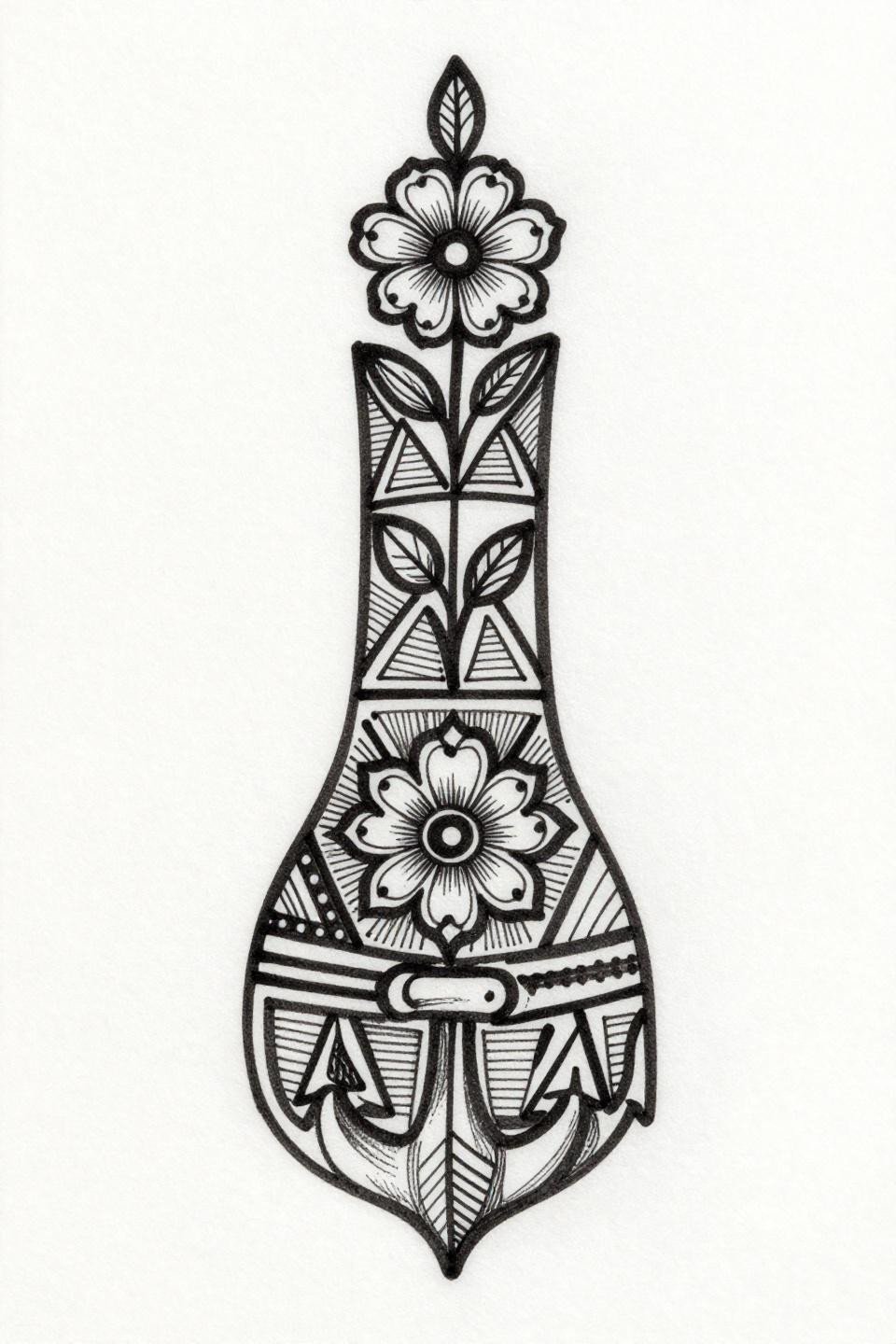
New simple mehndi designs drawing from tribal geometry are being executed with more precision than the tribal revival work of a decade ago. The 3pt outlined rectangular bracket at the wrist is structurally sound: thick-outlined anchors at the wrist cuff resist the spreading and softening that affects hairline work in that high-flex zone within two to three years. Triangular floral pods with parallel interior shading are a clean solution to adding visual density without crosshatching, which muddies quickly in small-scale work.
Hard 90-degree angles throughout a design require a steady hand at corners. Any artist whose portfolio shows corner drift, where the line thickens or trails slightly past the turn point, will produce that same artifact here. Check for it specifically in reference photos before booking.
Mehandi Designs Aesthetic: When Bold Color Anchors a Simple Structure
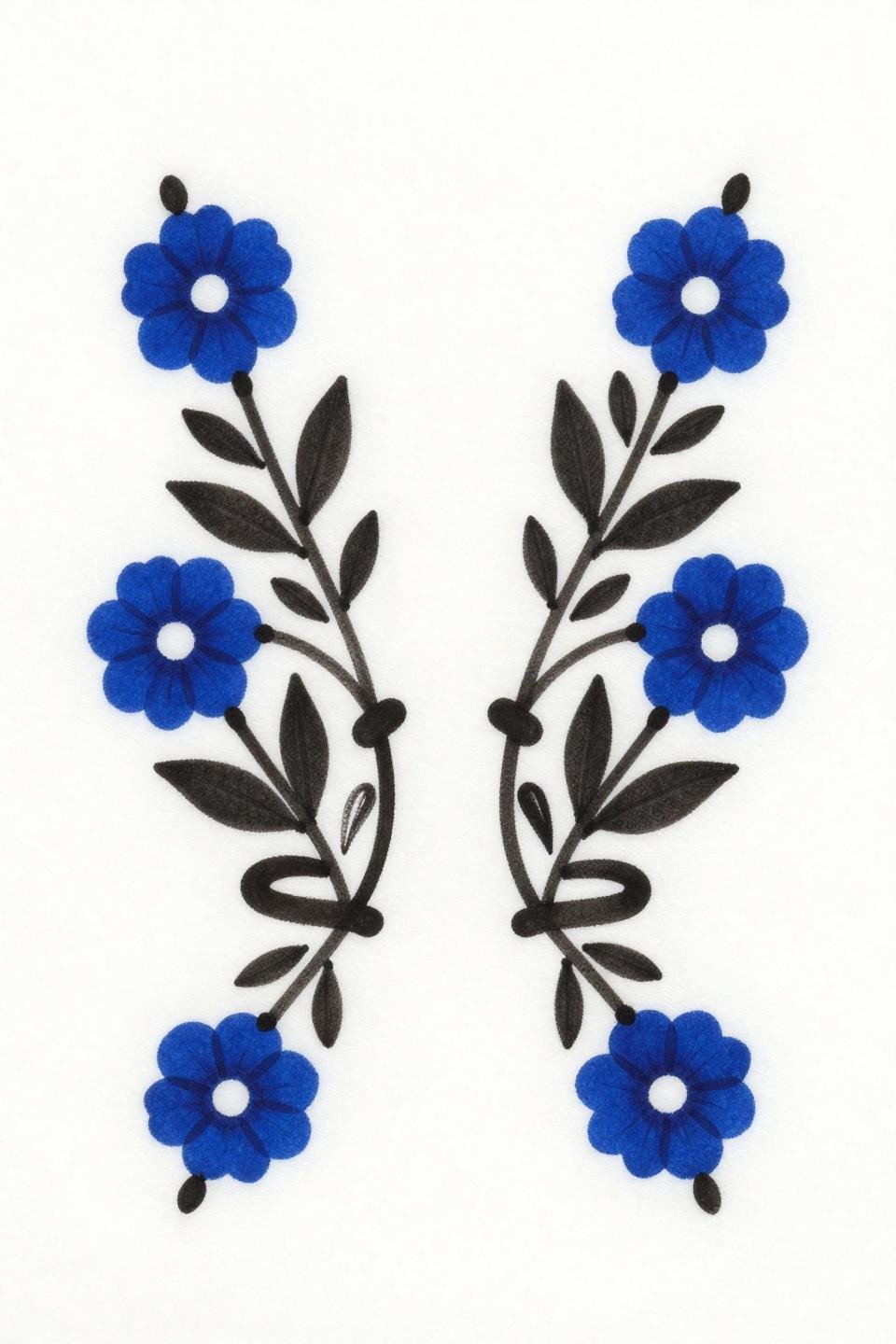
Cobalt blue in solid block fills within a bold-outlined traditional structure is one of the more stable color choices for mehandi designs aesthetic, specifically because cobalt-based blues heal truer than some pigment-heavy alternatives and maintain contrast against the black outline for longer. The symmetrical double-vine composition anchored at a thick cuff works on the wrist because the cuff’s outline weight, 2.5pt here, is heavy enough to survive the flex and sun exposure that wrist tattoos accumulate over years.
Zero hairline strokes in this composition is a deliberate longevity decision, not a style limitation. Hairlines at the wrist on color pieces tend to disappear by year five, leaving color fills floating without their interior detail. Designing without them from the start avoids that degradation entirely. See henna designs for everyday wear for more reference on color mehndi structures built for permanence.
Simple Beautiful Mehndi Designs: Art Nouveau Organic Line at Its Technical Limit
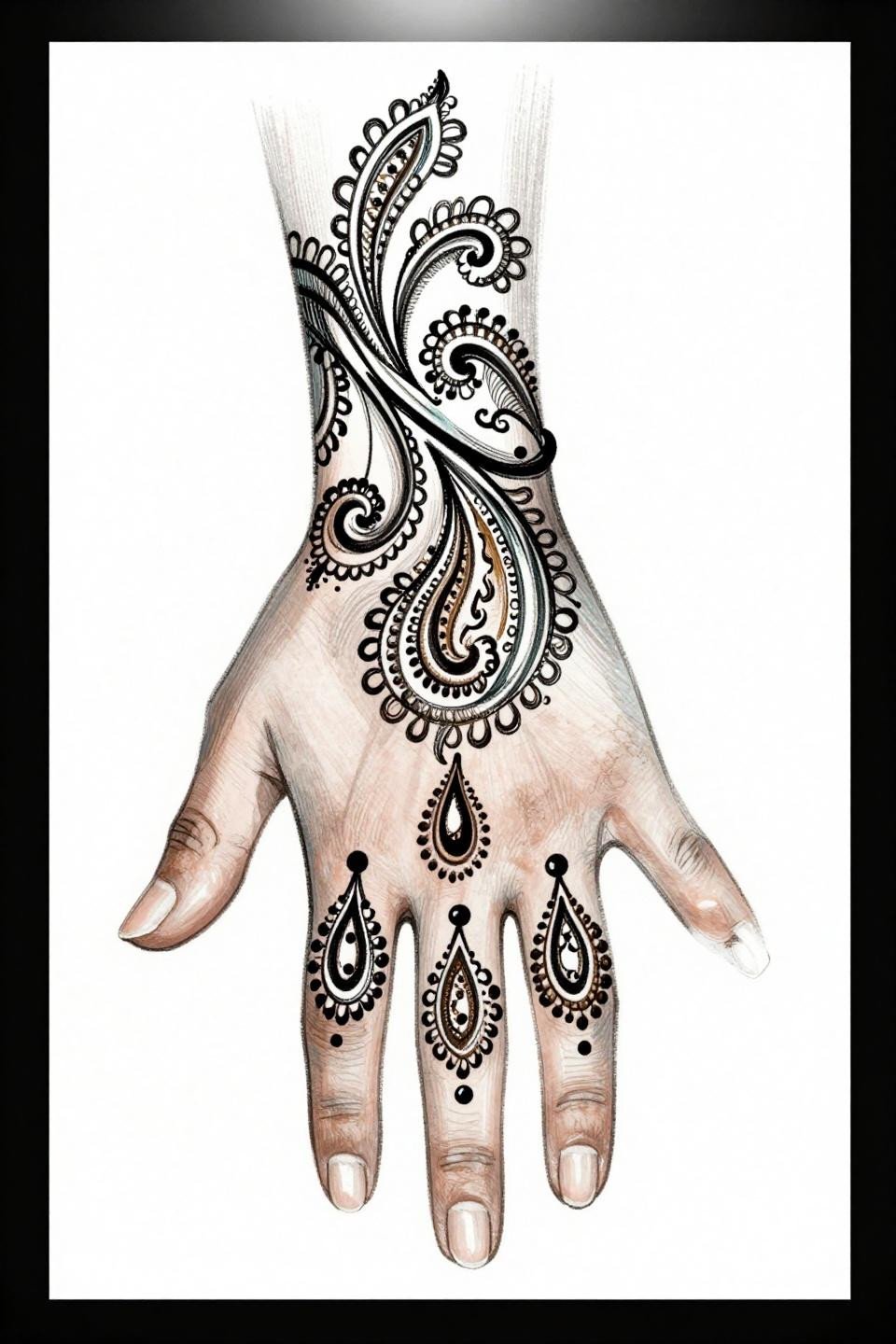
Simple beautiful mehndi designs built on art nouveau organic line require the most consistent hand speed of any style in this collection. The 1pt flowing stroke that defines the paisley vine here looks effortless on paper. In practice, speed variation across the stroke length creates visible thicks and thins that are intentional in calligraphy but read as errors in mehndi linework. Whip shading on the paisley interiors, where the needle flicks away from the skin at the stroke’s end, demands practiced muscle memory, not just technique knowledge.
The warm teal accent on the primary vine is a smart compositional choice that does not require a color session. A single accent color applied to the dominant structural element only lets the monochrome work carry the design while giving the eye one point of distinction. On fair skin, this reads cleanly from day one. On medium and deeper tones, increase the accent saturation slightly to maintain the same visual separation.
Trendy Mehndi Designs: Crimson Block Fill Against Maximum Negative Space
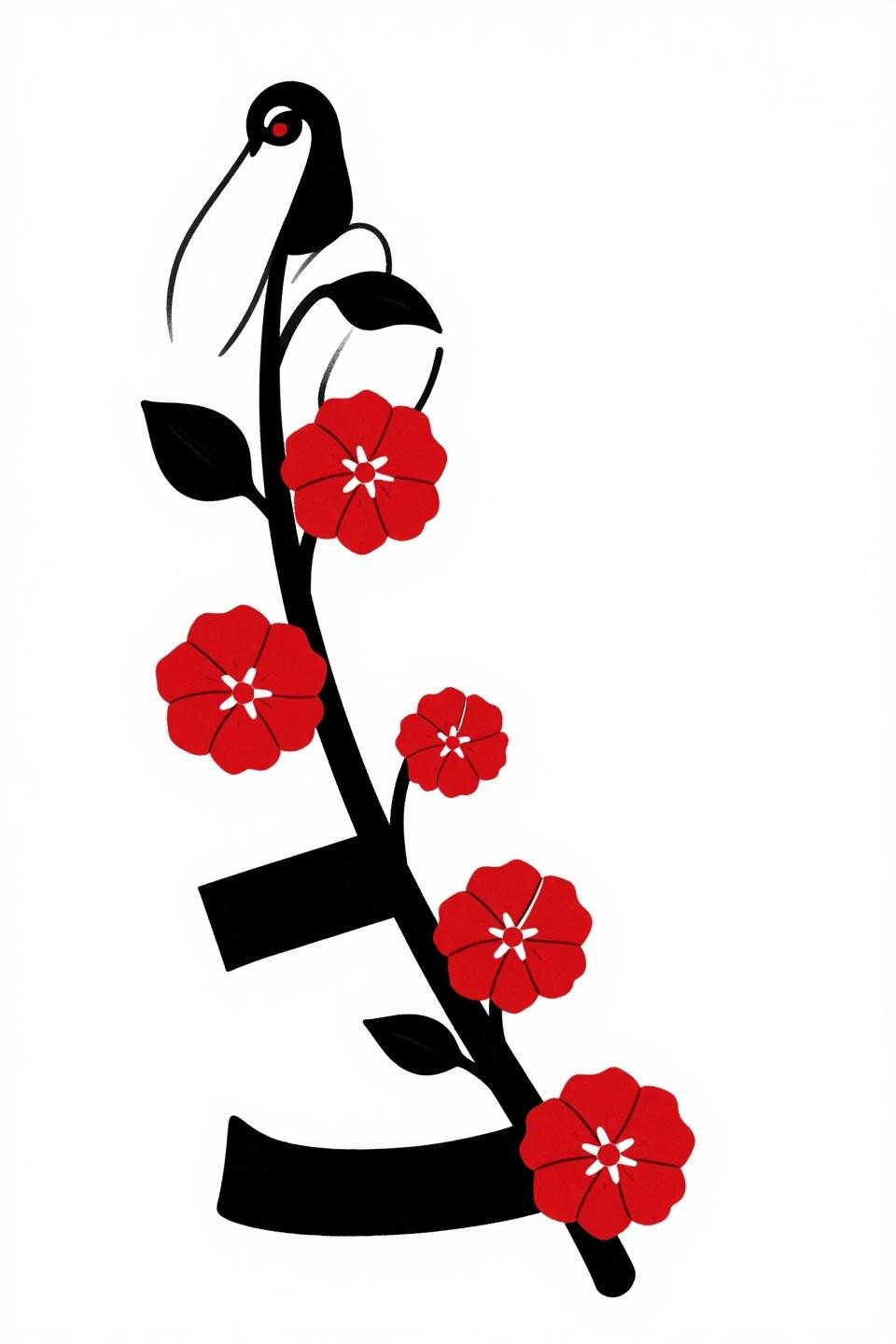
Trendy mehndi designs using red and black with maximum negative space are drawing from American traditional flash logic, and it holds up technically. The 2.5pt outline weight combined with solid crimson block fills creates a piece that reads at distance and at close range equally well. Crimson pigments in solid fills heal more consistently than gradients or washes of red, which are prone to patchiness on the hand’s varied skin thickness zones.
The isolated floral nodes at knuckle stations, rather than continuous vine fill, is the structural decision that makes this design scalable. A continuous dense vine would require significantly longer needle time on the front hand, increasing swelling and complicating healing. Isolated stations with breathing room between them heal faster and more evenly.
Simple Mehndi Designs Easy: Old-School Structure for First-Time Hand Work
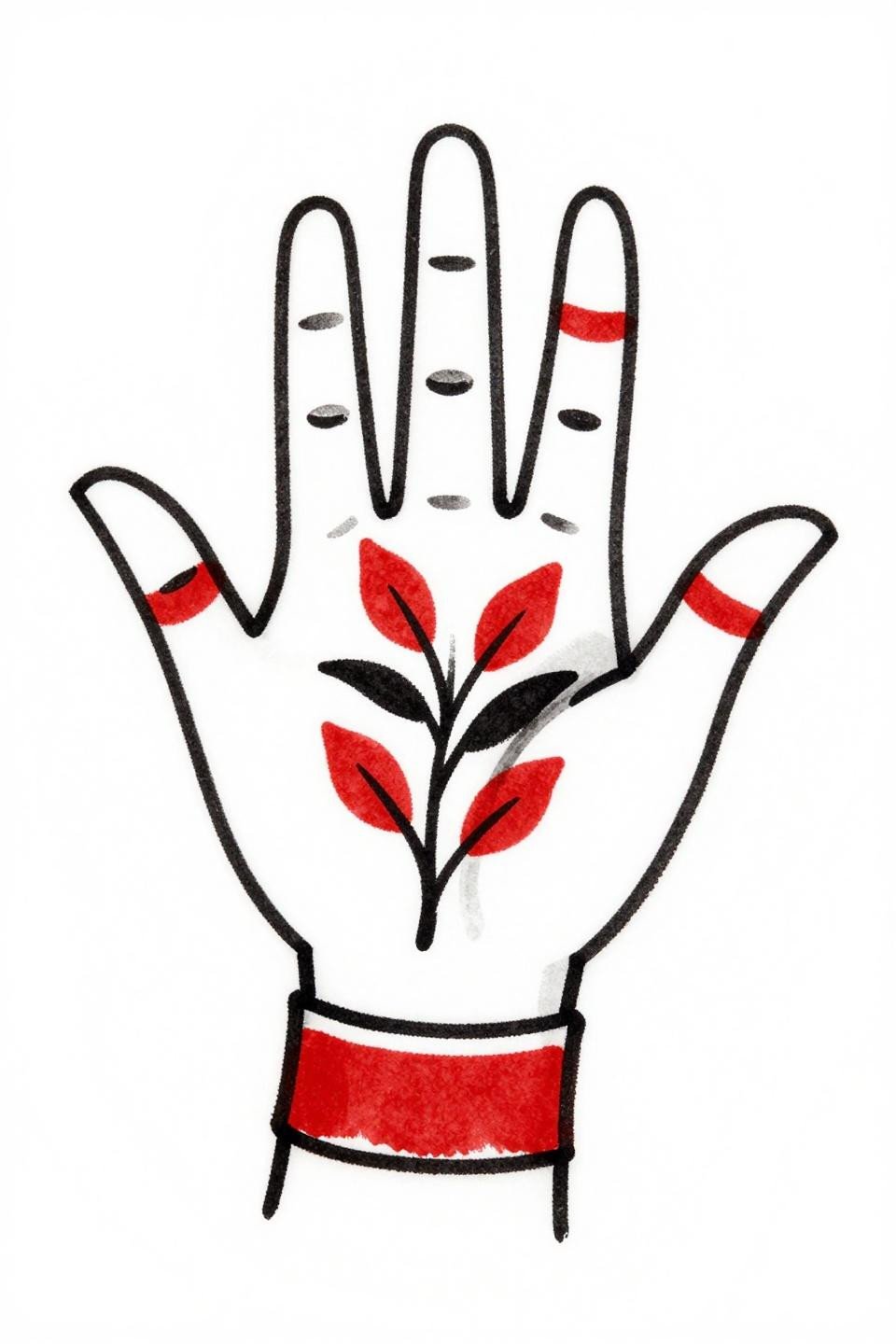
Simple mehndi designs easy enough for a first hand tattoo are not simpler to execute on the artist’s end. Bold 3pt outlines at this scale require confident needle pressure consistency, and the chunky leaf stations with solid red fills demand clean edge packing without bleeding outside the outline. The old-school sailor aesthetic serves practical purposes here: maximum contrast between bold black outlines and red fills means the design holds legibility even as skin texture changes with age and sun exposure.
Front palm placement is the most challenging skin zone on the hand. The skin here is thick, callused on working hands, and heals differently from the back of the hand. Expect at least one touch-up pass within the first year for front palm work. Plan for it upfront rather than treating it as a correction. Modern mehndi designs inspiration covers placement-specific healing expectations in more depth.
Simple Stylish Mehndi Designs: Neo-Traditional Precision on an Asymmetric Layout
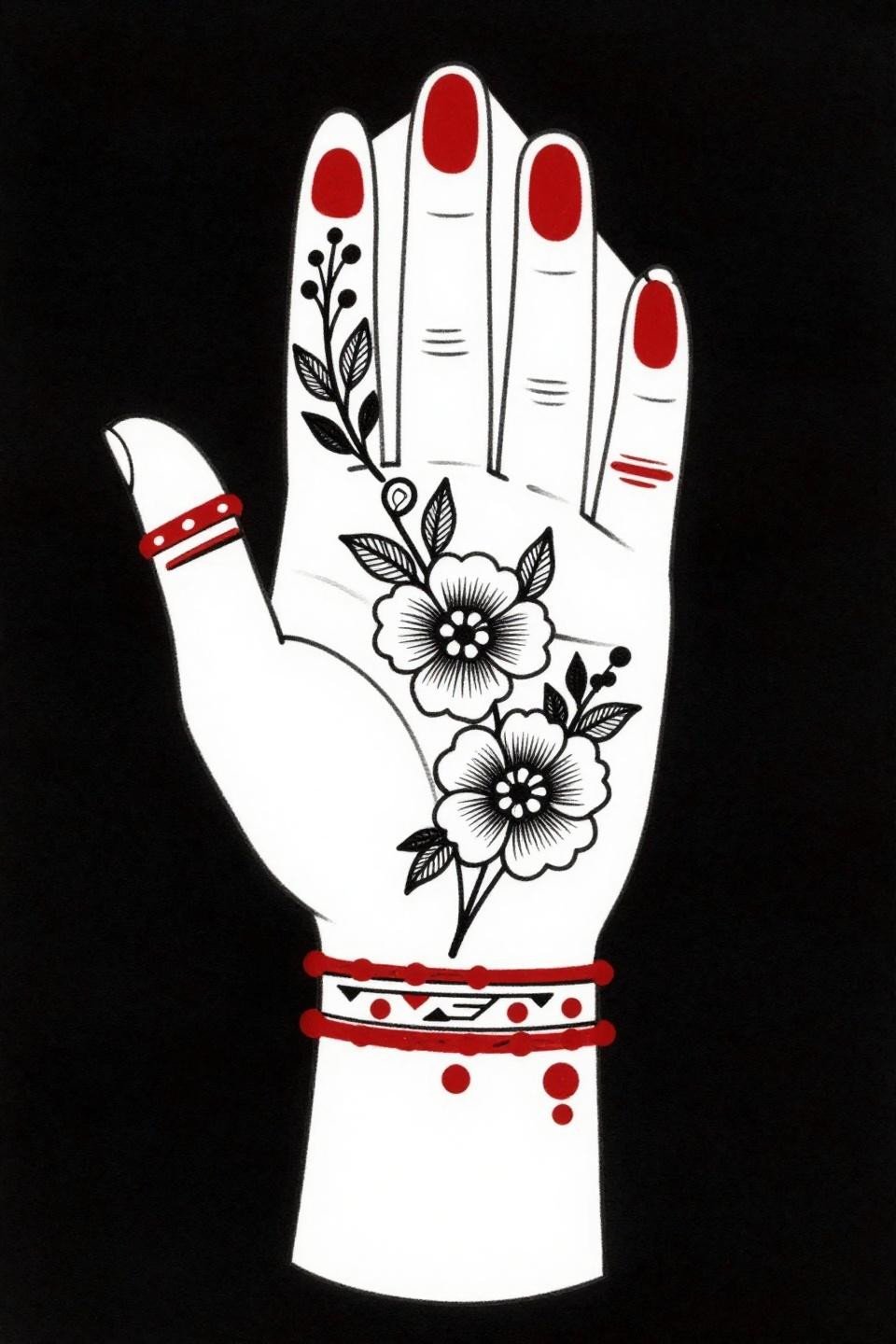
Simple stylish mehndi designs with neo-traditional execution use the diagonal composition to solve a structural problem: a centered vertical vine on the front hand competes with the hand’s natural symmetry and looks mechanical. An asymmetric diagonal, anchored off-center at the wrist bracket, creates visual movement that follows the hand’s natural gesture. The 2pt geometric bracket at the wrist reads as an intentional frame rather than a border, which is the neo-traditional technique signal to look for in reference work.
Parallel line shading in the floral petals, rather than solid fill or stipple, gives the artist’s hand more control over density at small scale. At petal sizes under 8mm, solid fill risks pooling. Parallel hatching at 0.5mm spacing achieves comparable visual density with cleaner edges and more predictable healing.
Very Simple Mehndi Designs: Hairline Trails and Wrist Cuff Minimalism
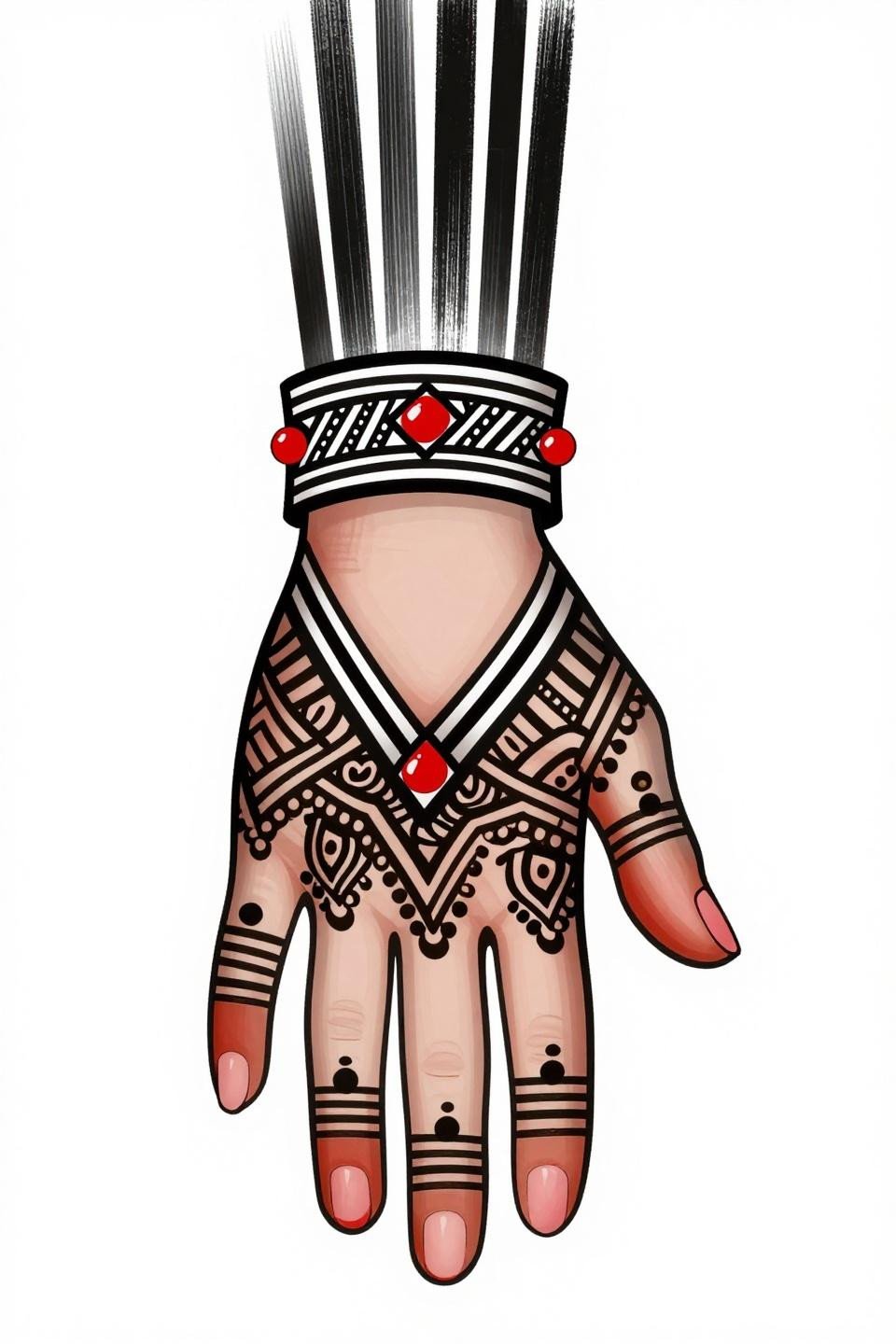
Very simple mehndi designs built on hairline vertical trails from a bold wrist cuff are a calculated risk. The 2pt closed outline on the cuff bracket will hold for decades. The hairline trails ascending toward the fingertips are a different story. Four hairline verticals with zero fill and zero gradient on a wrist-to-finger placement will begin to soften by year three, and on active hands, possibly earlier. That is not a failure of the design, it is the expected behavior of sub-1pt linework in a high-flex, high-friction zone.
The red accent nodes confined to the cuff corners only is the longevity-smart choice here. Keeping color off the hairline sections means the age of the hairlines does not affect the color’s integrity. The cuff remains crisp while the trail lines develop a softer quality that reads as intentional rather than degraded.
Simple Mehndi Designs Modern: Woodcut Boldness on the Back of Hand
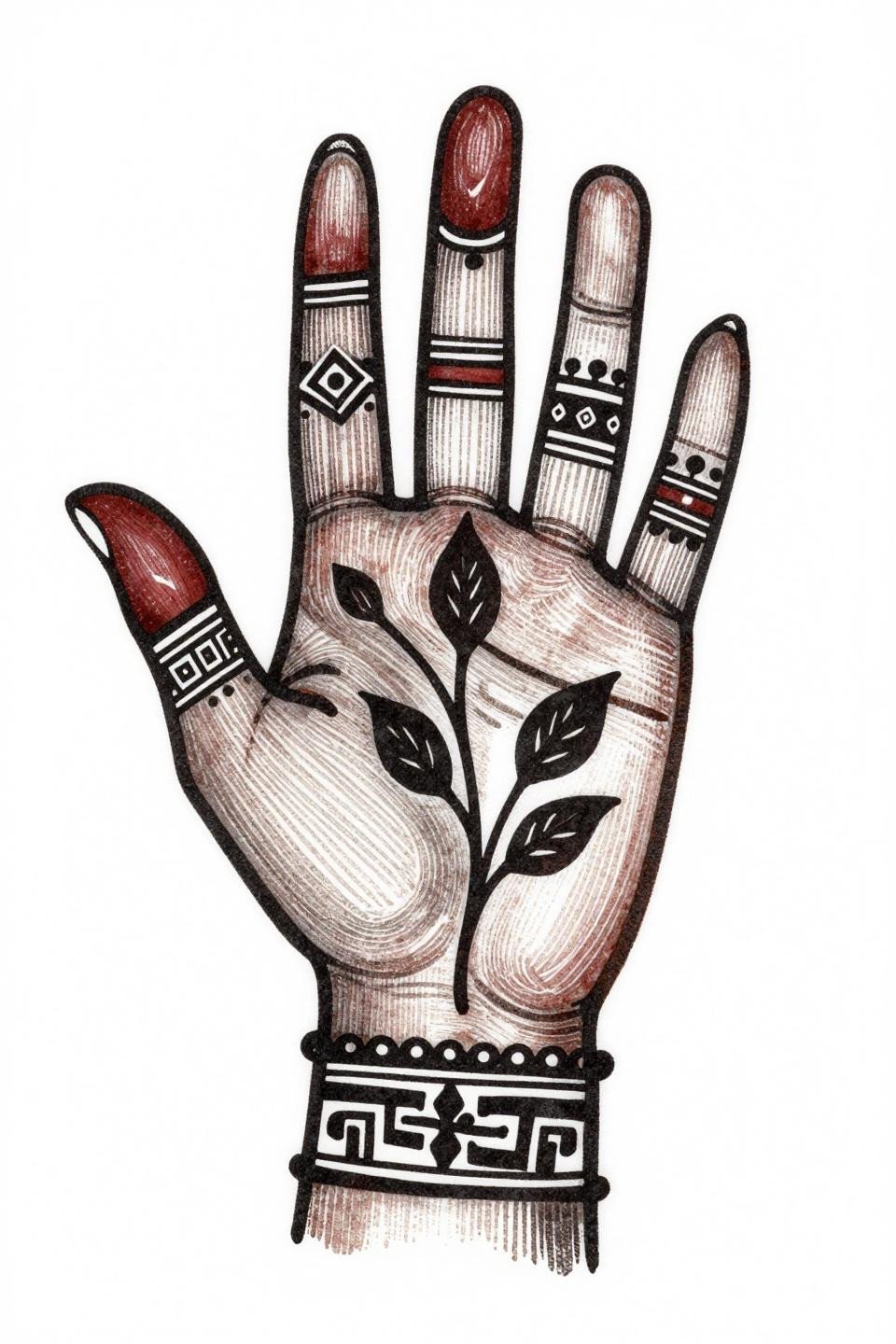
Simple mehndi designs modern in their reduction, placed on the back of hand, benefit from the back hand’s comparatively more stable skin relative to the front palm. The back of the hand still ages faster than protected placements like the upper arm, but bold 2pt outlines here will maintain legibility through decade-plus wear where hairline work would not. The woodcut aesthetic, defined by parallel line shading and decisive negative space, is forgiving of the slight line softening that all back-of-hand work undergoes over time.
The sparse, asymmetric layout is what allows this design to work at this scale. Crowded designs on the back of the hand create muddy merged linework by year five to seven. Spacing elements deliberately, as seen here with the single diagonal vine and isolated geometric nodes, gives each element room to age independently without the composition collapsing.
Stylish Mehndi Designs For Front Hand: Rosette Stations with Stipple Dot Centers
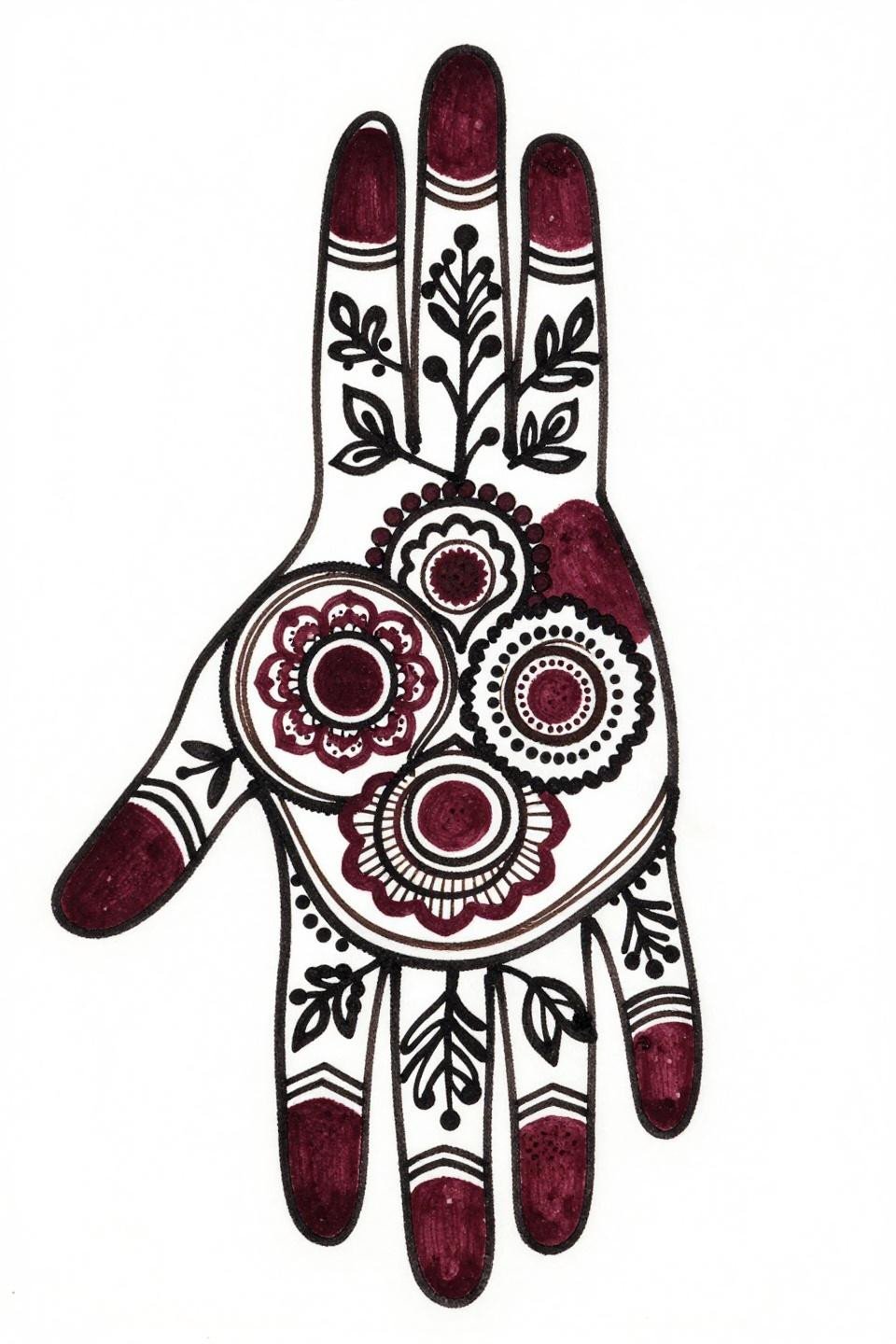
Stylish mehndi designs for front hand placement built on a single bold vine column with rosette stations are structurally sound for one reason: the primary vine’s 2.5pt weight anchors the composition through all the skin texture changes the front hand will experience. Stipple dot cluster centers in deep burgundy add dimension to the rosette stations without requiring gradient shading, which is technically demanding and unpredictable on the front palm’s varying skin thickness.
The contrast between thin ornamental fill lines and the thick primary vine outline is the technique signal to examine in an artist’s portfolio for this design type. If their reference work shows consistent line weight hierarchy, where thick and thin lines maintain their relative weights across the full piece, the rosette detail will heal cleanly. If the weights read as similar or inconsistent, the ornamental lines will merge with the primary outlines within the first two years.
Aesthetic Mehendi Designs: Japanese Fusion Geometry with Leaf Clusters
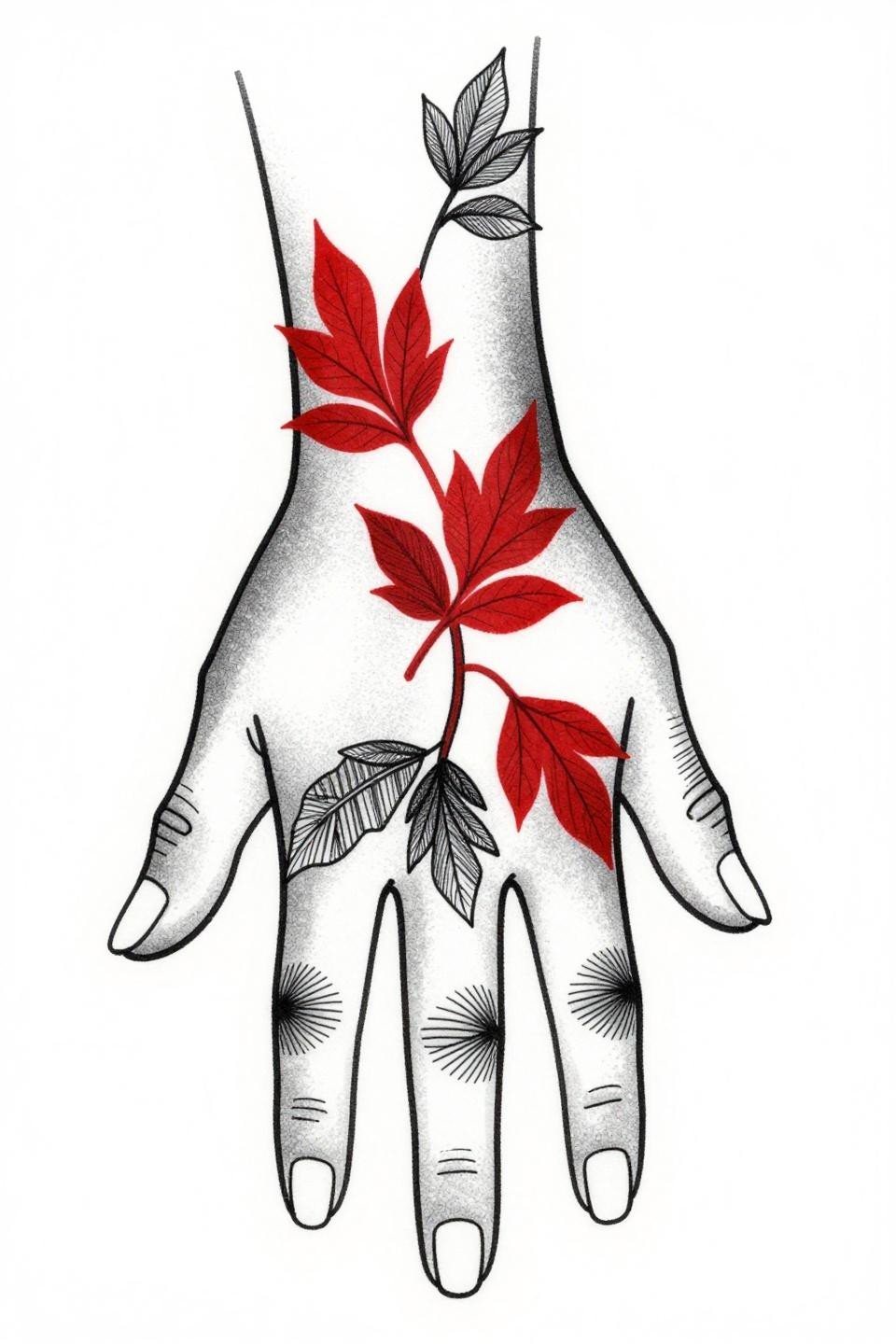
Aesthetic mehendi designs drawing from Japanese irezumi structure use the diagonal vine arc as a compositional device borrowed directly from Japanese sleeve work, where diagonal lines follow limb contours to create visual flow. On a hand layout, the diagonal vine crossing the palm center gives the design directionality that a vertical vine does not. Paired geometric leaf clusters at three knuckle points, with parallel line shading on the undersides only, build shadow logic into the design without introducing complex rendering.
The hairline stipple gradient fading leaf density toward the fingertips echoes Japanese bokashi technique adapted for small-scale work. On a 3RL needle at reduced speed, this graduation takes more passes than single-needle work but produces more stable long-term results because the 3RL deposits ink more consistently across the skin’s grain. The three crimson leaf tips are the accent restraint this kind of fusion design requires: more than three accent points would undercut the Japanese-influenced visual discipline.
New Simple Mehndi Designs: Dotwork Minimalism at 60 Percent Field Density
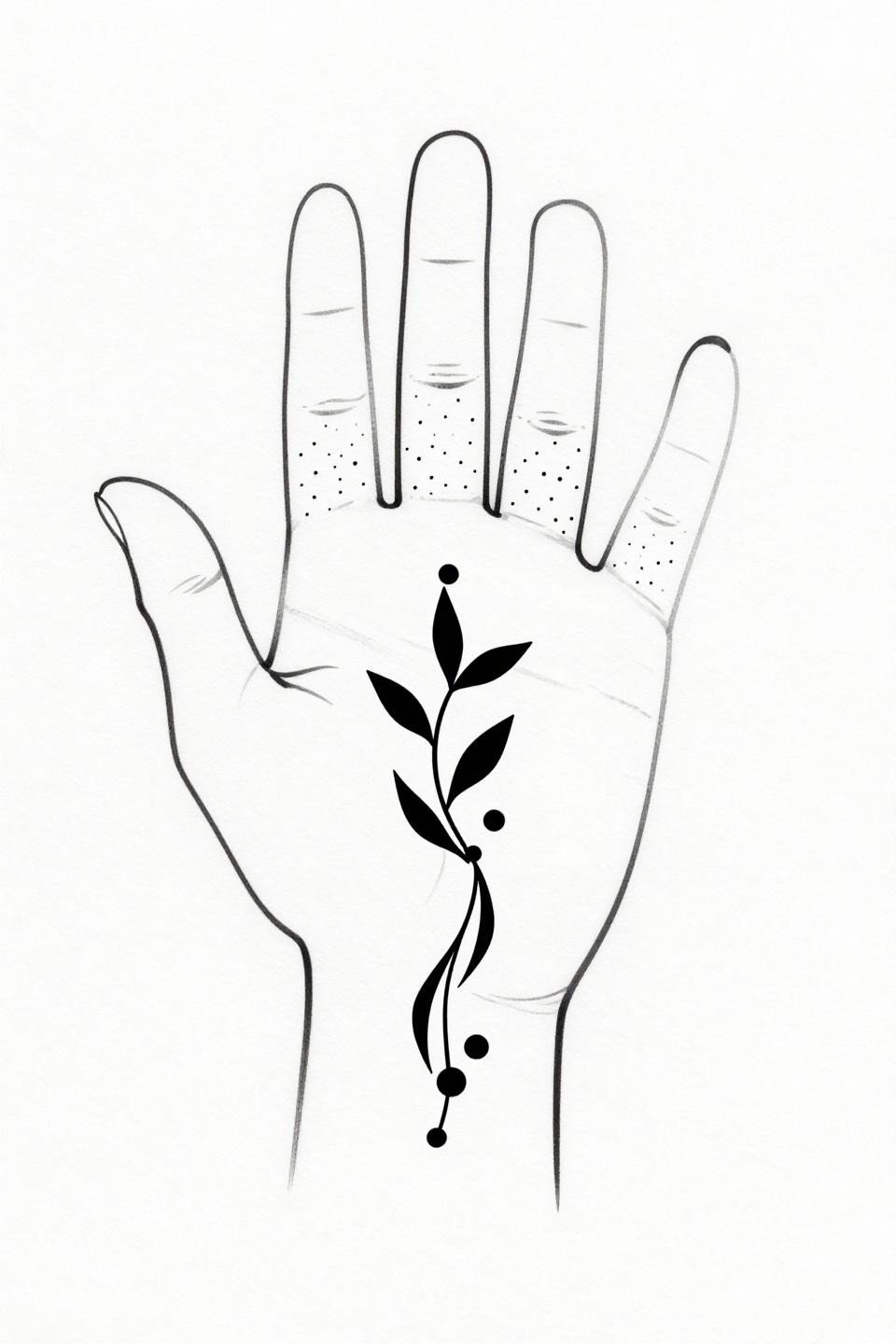
New simple mehndi designs built entirely on dotwork fields without outline structure are the most technically demanding entries in this collection. The 60-percent density field at the palm center thinning toward the fingertips requires consistent dot size and spacing across the entire session, and any variation in needle depth creates visible density irregularities. A 3RL single-needle setup is the standard for this quality of dotwork, running at lower voltage than outline work to maintain precise placement control.
The single 0.4mm geometric vine with hard 45-degree angle turns is the compositional spine that gives the dotwork field a visual anchor. Without it, a stipple field on the hand reads as texture without structure. The tight dot clusters at the finger bases add focal weight at the top of the composition, which balances the denser field at the palm center and prevents the design from reading as bottom-heavy.
Mehandi Designs Aesthetic: Fine Line Bracelet Cuff and Single Ascending Vine
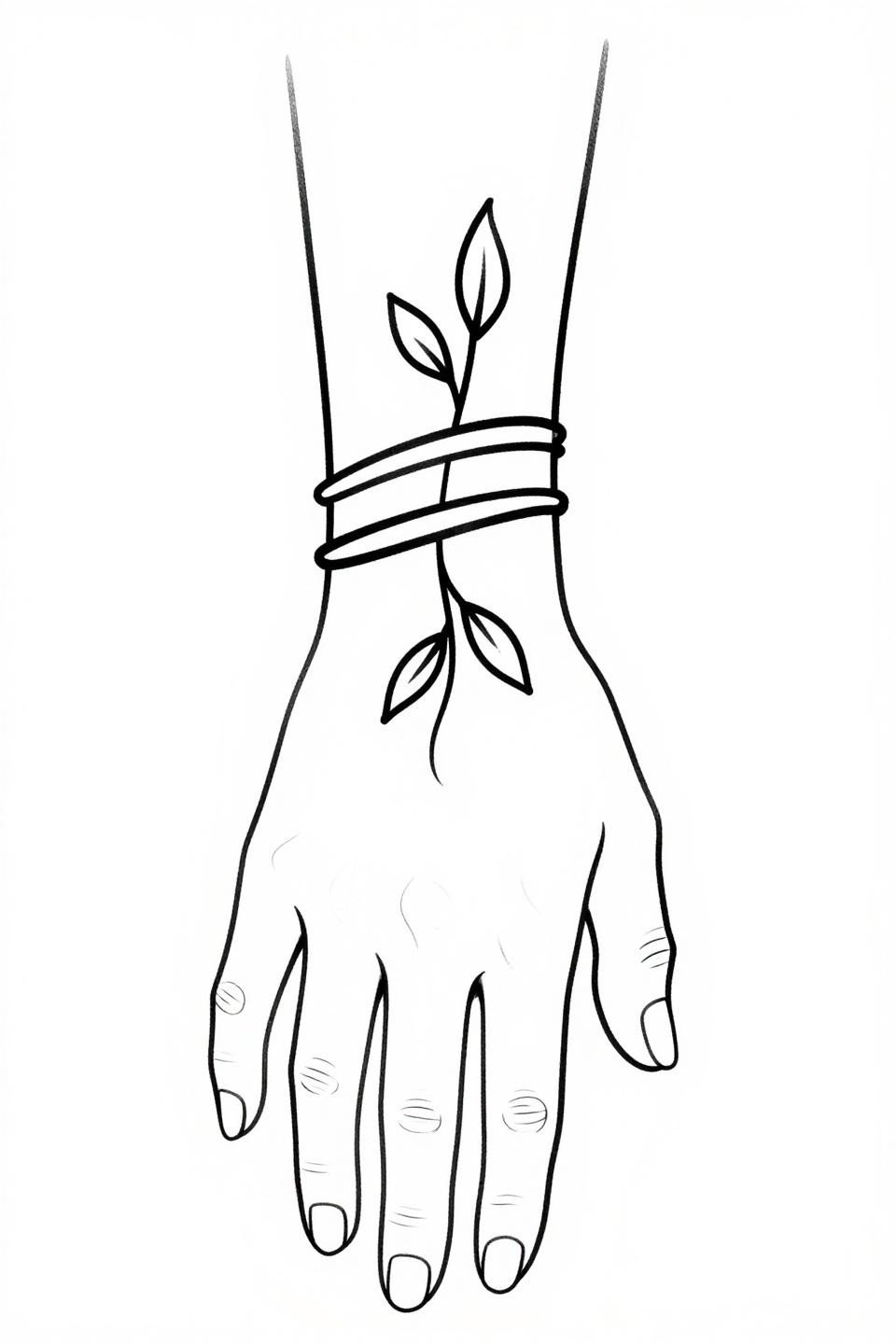
Mehandi designs aesthetic at the fine line extreme, built on 0.25mm hairline strokes with zero fill and zero shading, are the fastest designs in this collection to show age on the wrist. The inner wrist is a high-flex zone with significant sun exposure, and hairline work here faces both friction and UV degradation simultaneously. That is not a reason to avoid the design. It is a reason to choose an artist with documented healed reference work in this exact placement, and to commit to touch-up maintenance at the three-to-five year mark.
The bracelet cuff with three continuous scrolling loops is technically cleaner than a segmented cuff because the loops allow the artist to maintain consistent stroke speed across the full circumference. Stopping and restarting a continuous-looking line at the inner wrist is where most fine line artists produce visible seam points. Ask to see healed bracelet cuff work specifically before booking this design type.
Simple Beautiful Mehndi Designs: Terracotta Accent on Asymmetric Fine Line
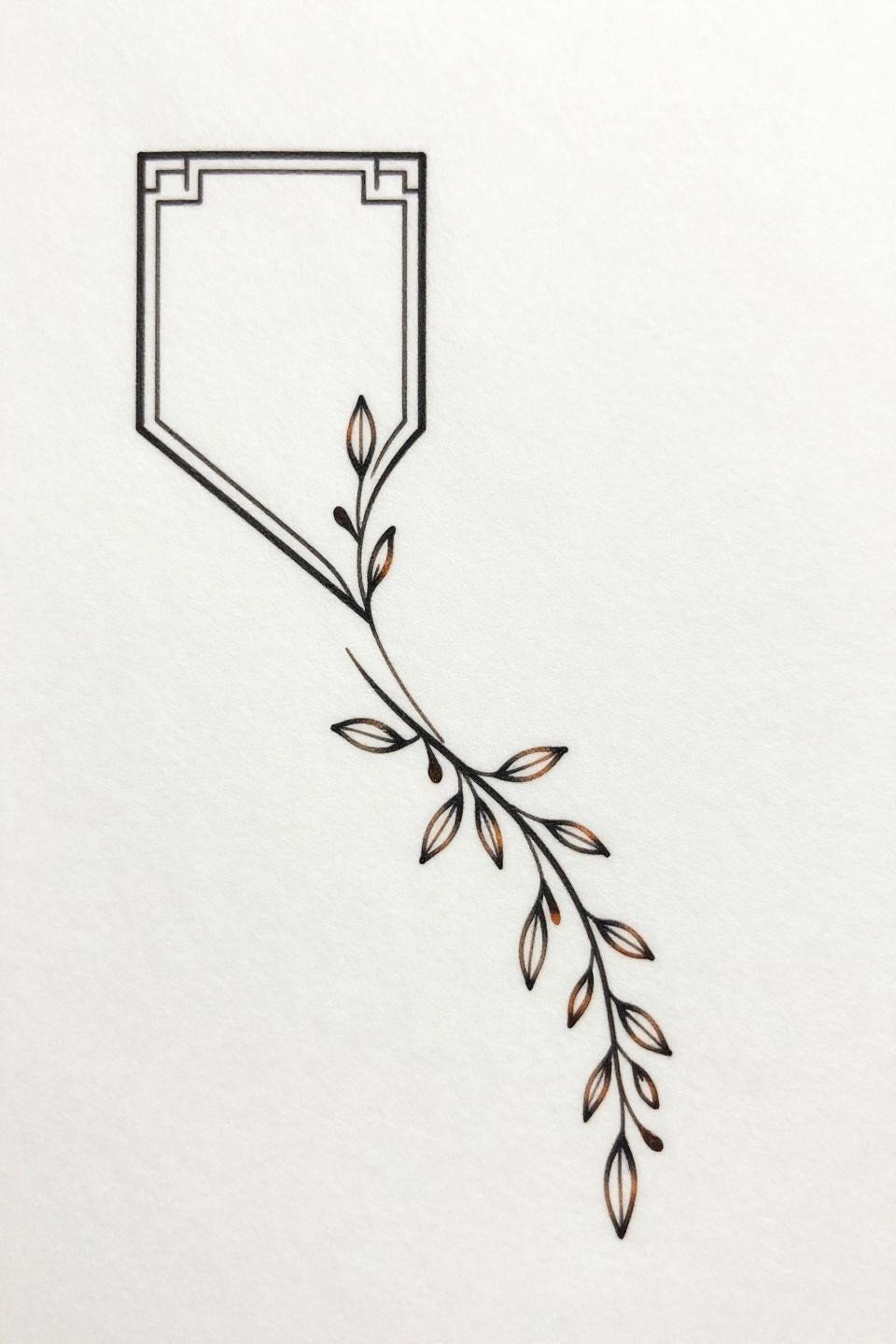
Simple beautiful mehndi designs using terracotta as an accent against 0.3mm black hairline work are playing a specific color game: terracotta pigments, which sit in the orange-to-red-brown range, have the fastest fade rate of commonly used ink colors on sun-exposed placements. On a front palm or wrist design, terracotta tendrils will lighten noticeably within two to three years. Plan this design knowing the accent will shift, not disappear entirely, but warm and soften while the black hairlines hold their contrast longer.
The asymmetric geometric corner brackets anchoring the upper composition are the structural decision that makes the crisp open negative space readable as intentional composition rather than incomplete design. On fair to light-medium skin, the contrast between hairline strokes and open skin is maximum. On deeper skin tones, increase line weight to 0.5mm minimum to achieve comparable visual separation.
Trendy Mehndi Designs: Geometric Lattice Grid with Continuous Vine Overlay
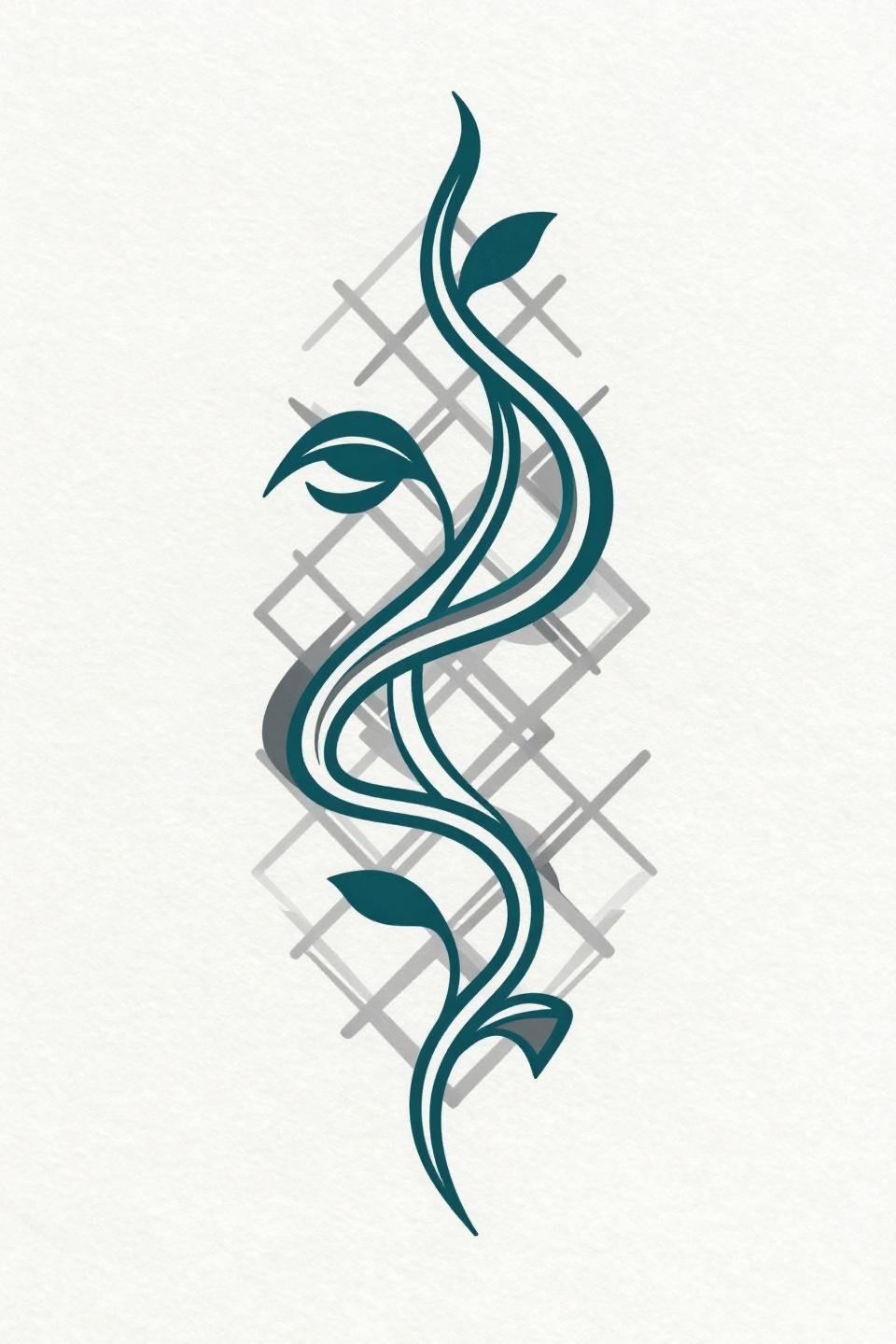
Trendy mehndi designs combining a geometric lattice grid with a continuous vine overlay are demanding in the execution because the two structural systems, rigid grid and organic vine, must maintain visual hierarchy throughout. The solution shown here is color differentiation: deep teal outlines for the lattice, monochrome vine for the overlay. The 2pt outline weight on the teal lattice is heavy enough to prevent the grid from reading as background noise against the vine’s organic movement.
Charcoal grey solid fills within the grid, rather than black, create a mid-tone layer that gives depth without requiring gradient technique. Flat fills at two distinct tonal values, teal outline with charcoal fill and black vine, produce a three-dimensional read from a purely flat technical execution. This is efficient design for the skin: fewer passes, cleaner healing, and a composition that holds its logic as the fills mellow slightly over years.
Simple Mehndi Designs Easy: Mandala Center with Full Fine Line Hand Coverage
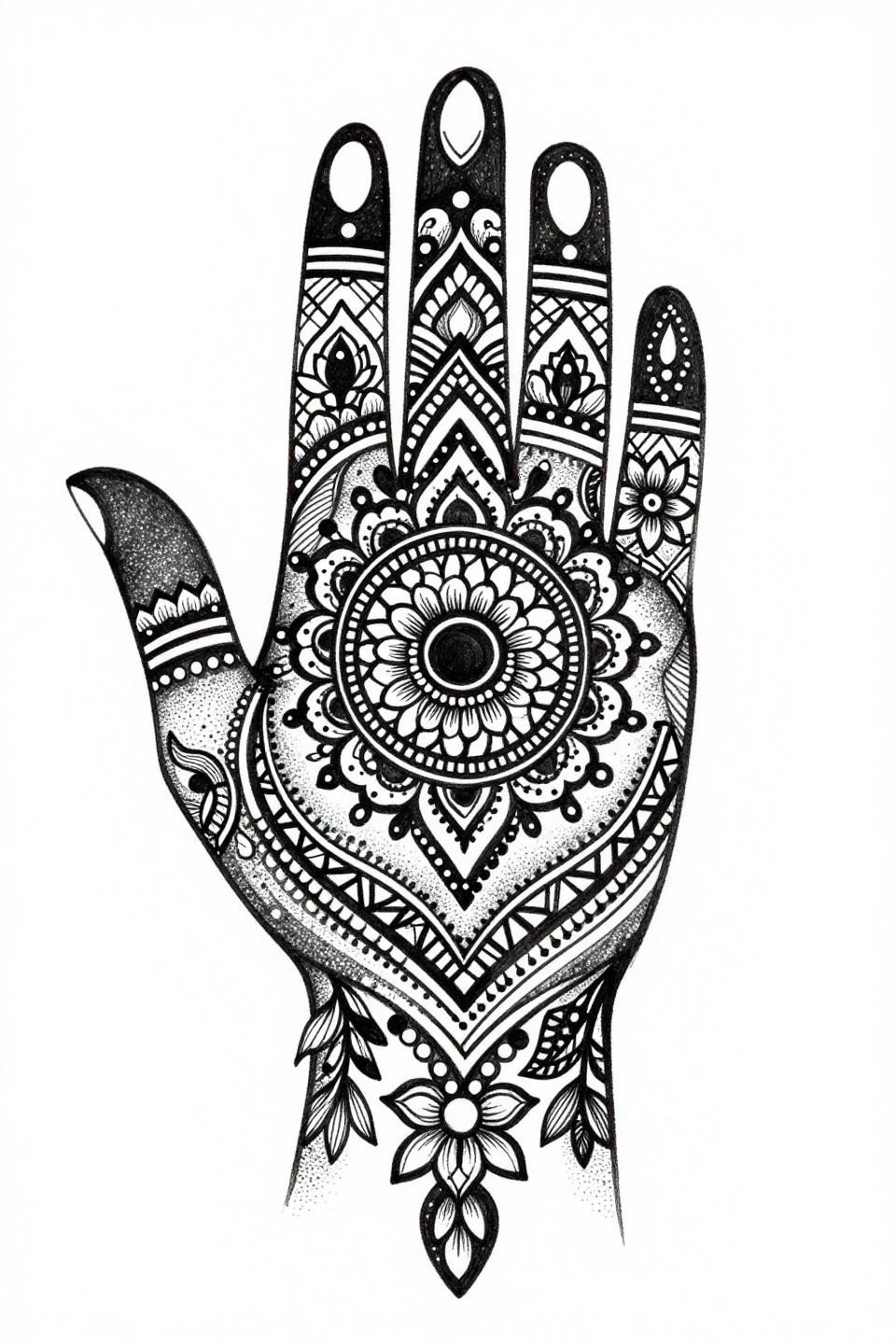
Simple mehndi designs easy in concept but complex in execution: mandala-centered full hand coverage with radiating paisley teardrops and lattice borders is the most ambitious structure in this collection. The 0.3pt hairline linework throughout, with 70-percent stipple density fading to open negative space at the edges, requires consistent needle pressure and speed across a session long enough that hand fatigue becomes a technical factor. Request to see an artist’s healed full-hand fine line work before committing to this scale.
The stipple density fade from center outward is the compositional technique that prevents this level of detail from becoming visually overwhelming. Dense at the focal point, open at the periphery, the eye reads a clear center-to-edge hierarchy. On darker skin tones, increase the density map by 15 to 20 percent throughout to achieve comparable contrast to the reference image, which is calibrated for fair skin presentation.
The 17+ references in this collection cover the full range of latest simple mehndi designs, from 0.25mm fine line bracelet work to bold 3pt traditional flash structures. Filter by placement and skin tone using the collection at henna designs for everyday wear. The reference your artist actually needs is a healed photo at your skin tone, not a fresh flash sheet. Start there, not at the design itself.