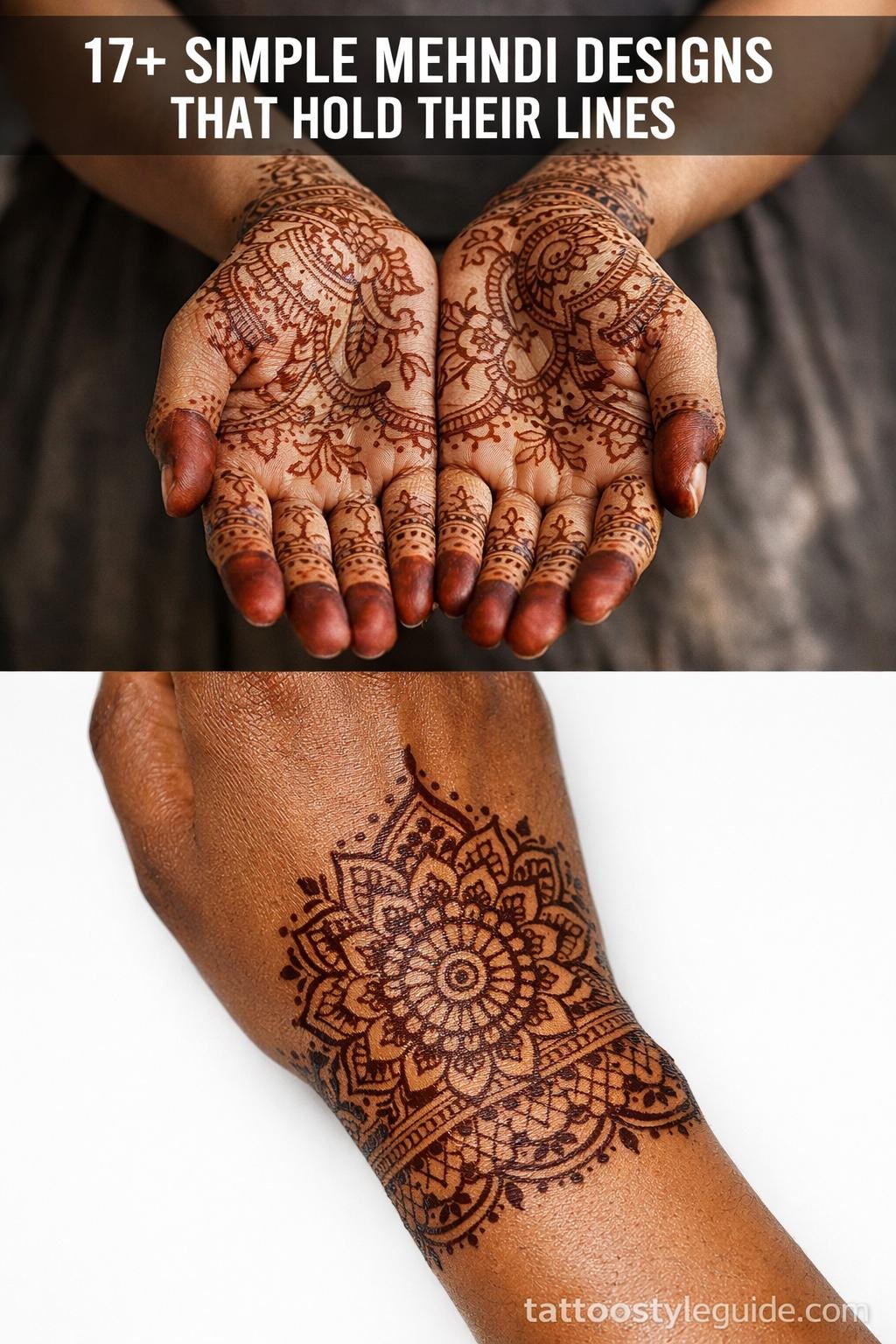
The simplest mehndi layouts outlast the dense ones. Collectors who’ve worn both know this: a single bold vine with three anchor points at the knuckles holds its read at ten years better than a fully packed palm that turns to grey noise by year five. Restraint is a technical decision, not an aesthetic one.
Stylish Mehndi Designs For Front Hand: Geometry That Does the Work
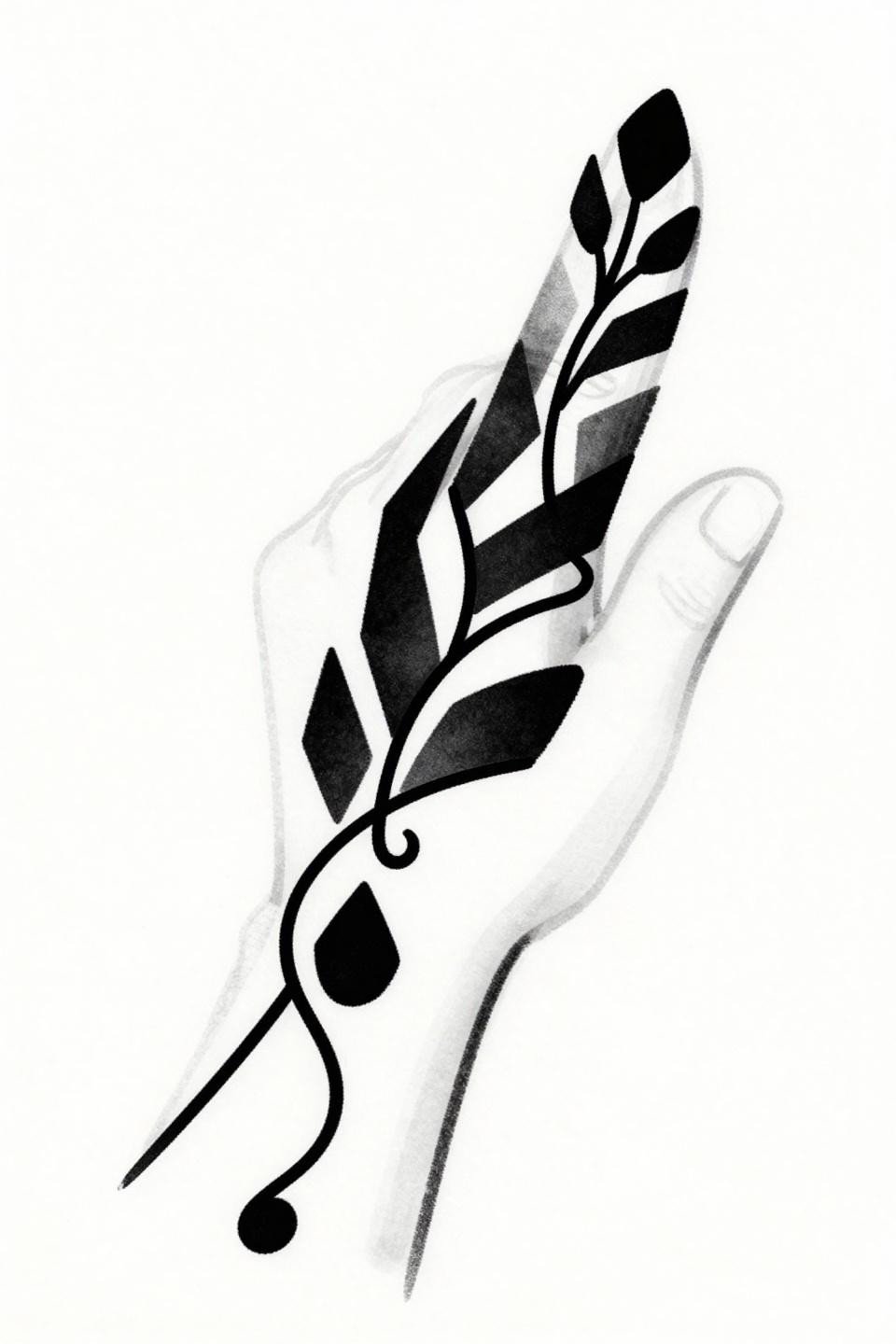
An asymmetric diagonal vine structure across the front hand is one of the strongest layout calls in latest simple mehndi designs. The single continuous line traveling from lower wrist corner to upper fingertips creates directional movement without requiring fill. Three geometric knuckle stations do the visual anchoring.
Executed with a 3RL needle at consistent 2.5pt line weight, this reads cleanly on every skin tone. The negative space carving is load-bearing here. Sharp angular brackets and solid chevron nodes give the eye stopping points so the open white field doesn’t feel empty. Artists who wobble on long diagonal strokes will expose the flaw immediately. Check their portfolio for unbroken 6cm-plus lines before booking.
Aesthetic Mehendi Designs: Dotwork Gradient That Actually Holds
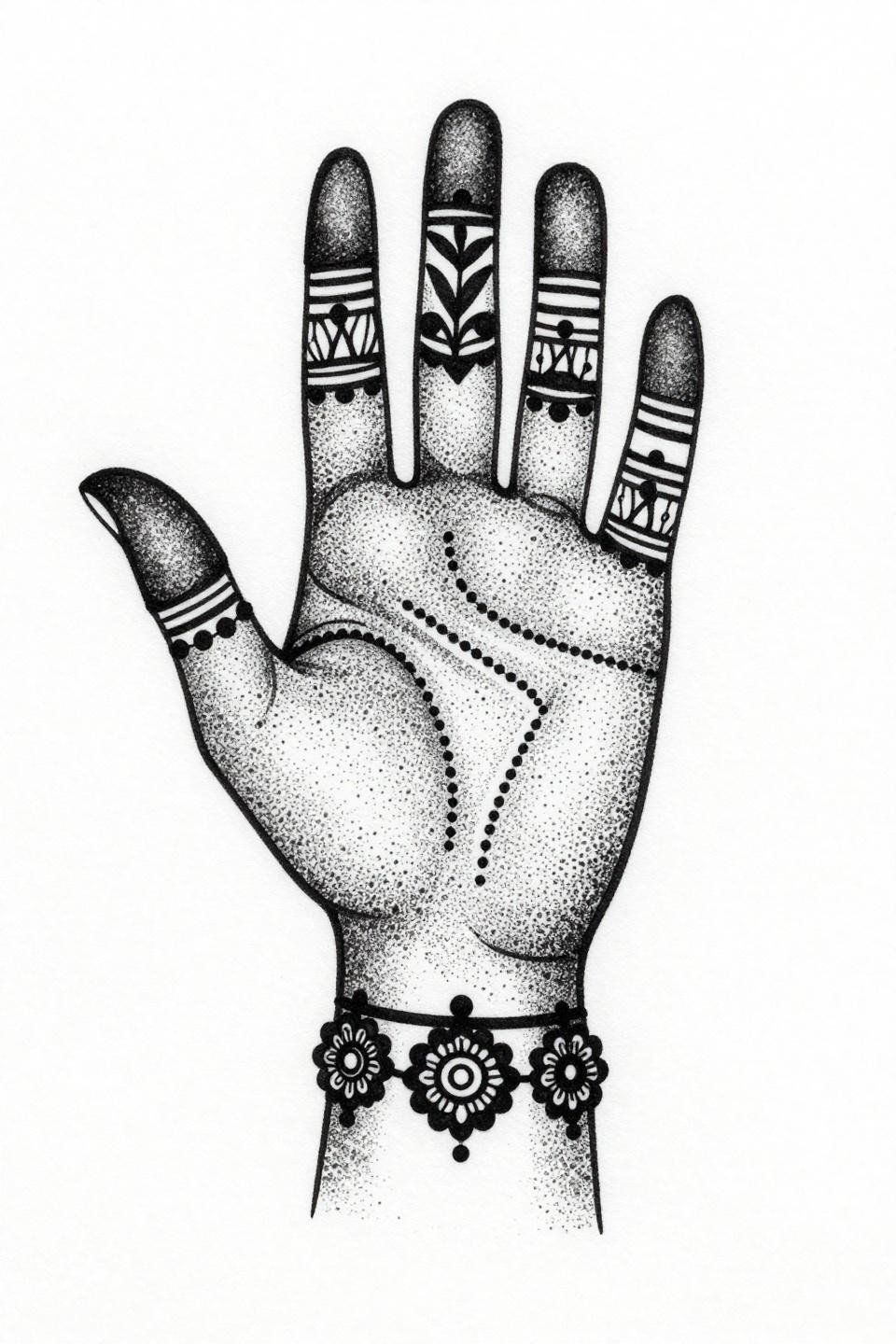
The dotwork stipple hybrid approach takes the aesthetic mehendi design format seriously as a longevity strategy. A single bold vine column anchored by a diamond wrist bracket gives structural spine. The 80 percent dot density at the wrist cuff fading to 20 percent open field at the fingertips creates graduation without gradient ink, which means no muddy healing.
Stipple work done with a 3RL single needle at consistent dot spacing is the quality signal here. Parallel line accent shading on the rosette petals adds a second texture language that breaks the monotony of pure dot fields. This technique heals predictably on medium and olive skin tones, where pure dotwork sometimes disappears if density is too low. A 20 percent open field at the fingertips is the correct call for placement on high-friction skin.
New Simple Mehndi Designs: Tribal Geometric Structure With No Apology
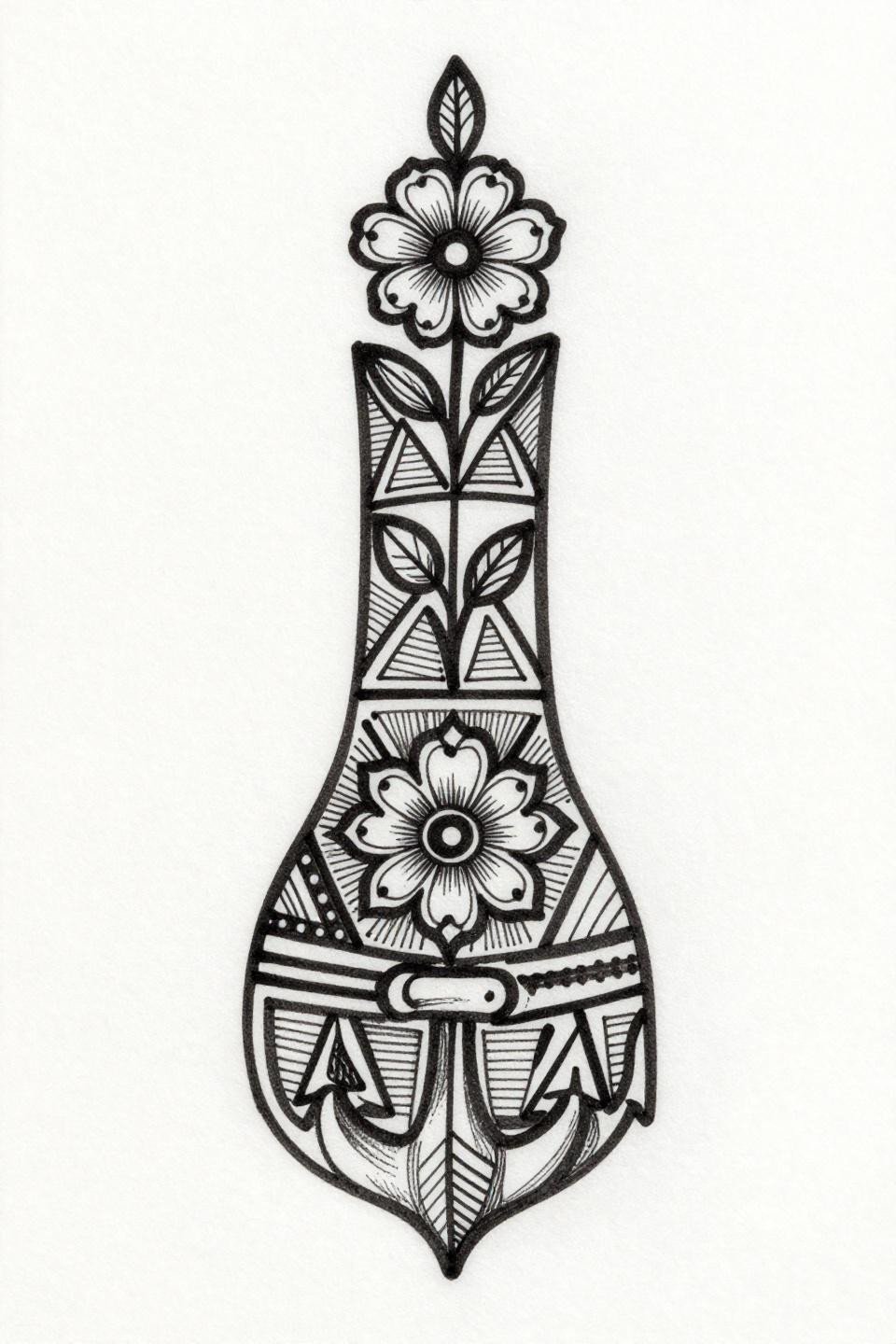
A thick 3pt outlined rectangular bracket at the wrist base is structurally honest. It tells you exactly what the design is before you read the rest of it. New simple mehndi designs that work this well formally don’t need decorative filler. The single straight vertical vine axis with stacked triangular floral pods reads from across a room.
Hard 90-degree angles throughout require ruler-quality precision from the artist. Any drift in the parallel interior shading lines on those triangular pods is impossible to hide. This is a blackwork piece executed with flat shader needles for the broader bracketed base and 5RS for the pod interior detail work. Maximum negative space between forms is not a shortcut. It’s a composition decision that makes each element carry full weight. For anyone researching henna designs for everyday wear, this geometric wrist format is the most wearable translation into permanent ink.
Mehandi Designs Aesthetic: The Case for Bold Cobalt on a Wrist Cuff
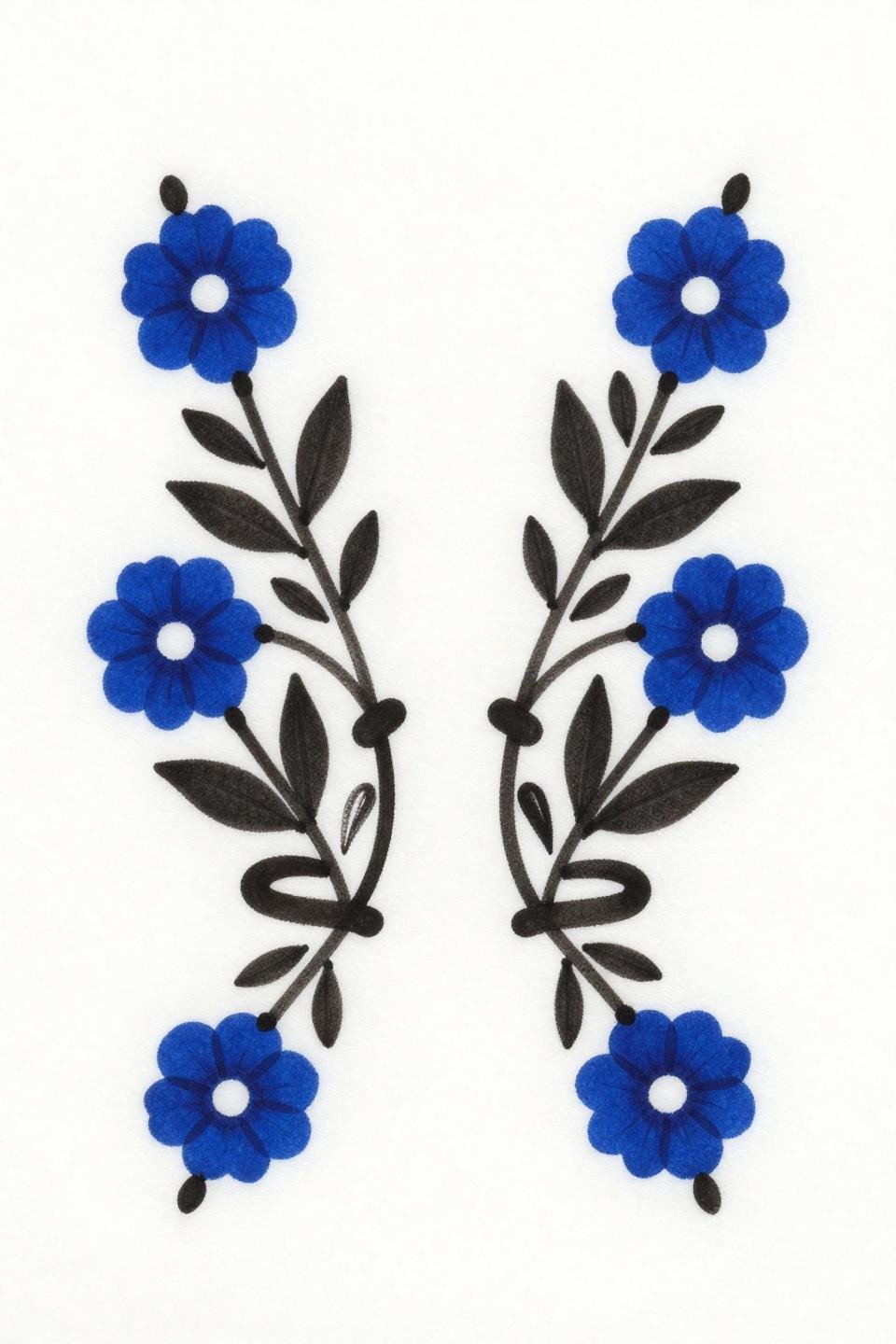
Two bold parallel vine stems ascending symmetrically from a thick banded cuff is a traditional flash composition applied directly to the mehandi designs aesthetic framework. Cobalt blue block fills at the floral nodes create maximum contrast against black 2.5pt outlines. This is a two-pass job: outlines first, then flat shader fills for the cobalt. No blending, no gradient.
The symmetric centered composition suits the front palm because the human eye reads symmetry as balanced on that plane. Cobalt blue in traditional-weight tattooing holds its saturation longer than lighter blues. Expect slight warmth shift by year five, but the outline weight keeps the design legible through that shift. On fair skin, this layout reads high contrast for decades. On darker skin, the cobalt reads as near-black in certain lighting, which changes the aesthetic reading entirely. Worth knowing before committing to color.
Simple Beautiful Mehndi Designs: Art Nouveau Paisley With Weight Control
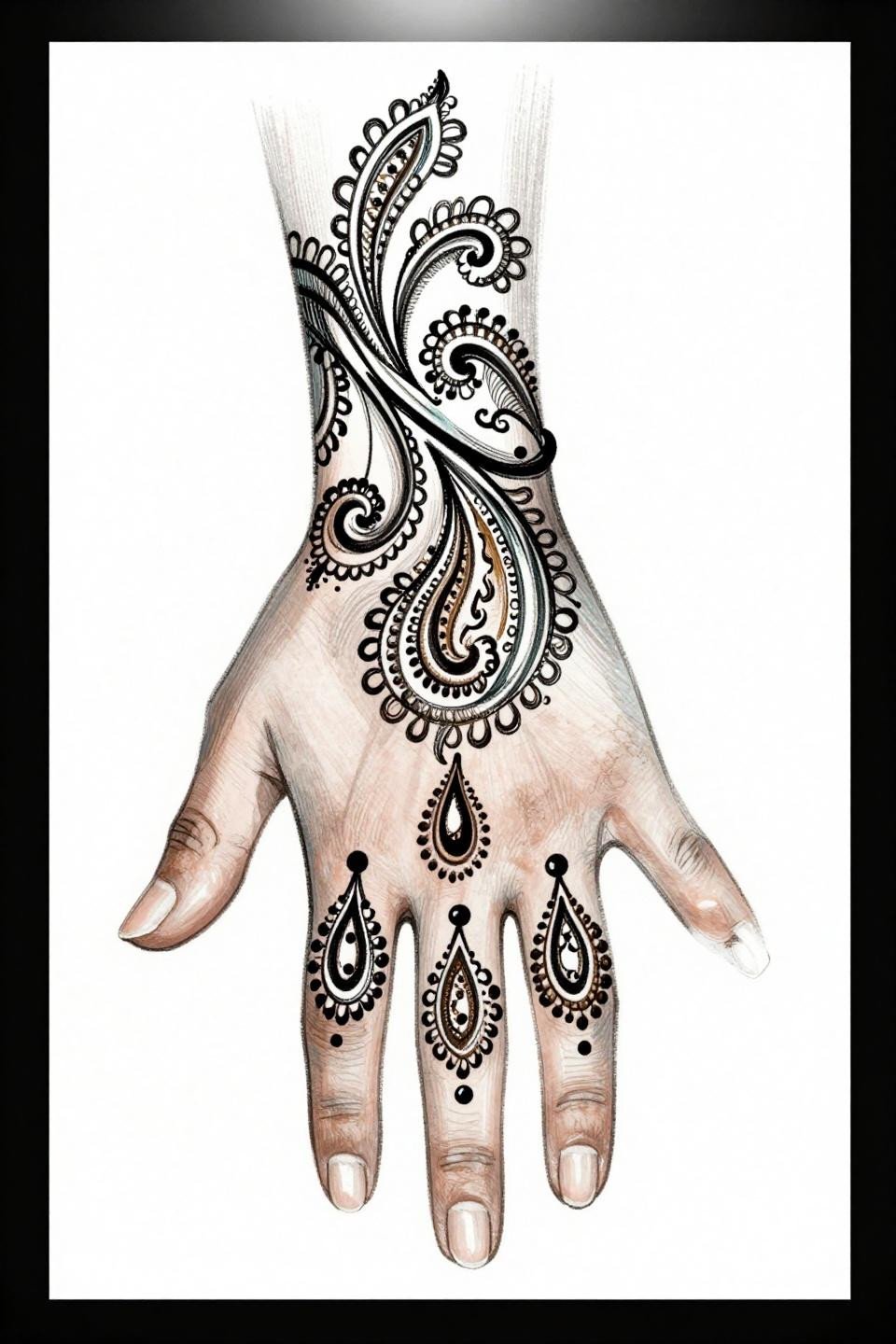
Simple beautiful mehndi designs that borrow from Art Nouveau handle the hand well because the organic vine logic follows the body’s natural line rather than fighting it. An asymmetric paisley ascending from wrist cuff through mid-hand to ring finger respects the anatomy. Three teardrop paisley stations give the eye three clear resting points before exiting at the fingertip.
Brush stroke organic linework at 1pt with whip shading on the paisley interiors is the technical execution here. A warm teal accent on the primary vine, held to that single element, keeps the color restrained enough that it reads as intentional rather than decorative. Whip shading done by an inexperienced hand produces uneven grey rather than clean graduated tone. Ask to see healed examples of whip shading specifically, not just fresh photos, before booking this style.
Trendy Mehndi Designs: Crimson Florals That Don’t Need to Explain Themselves
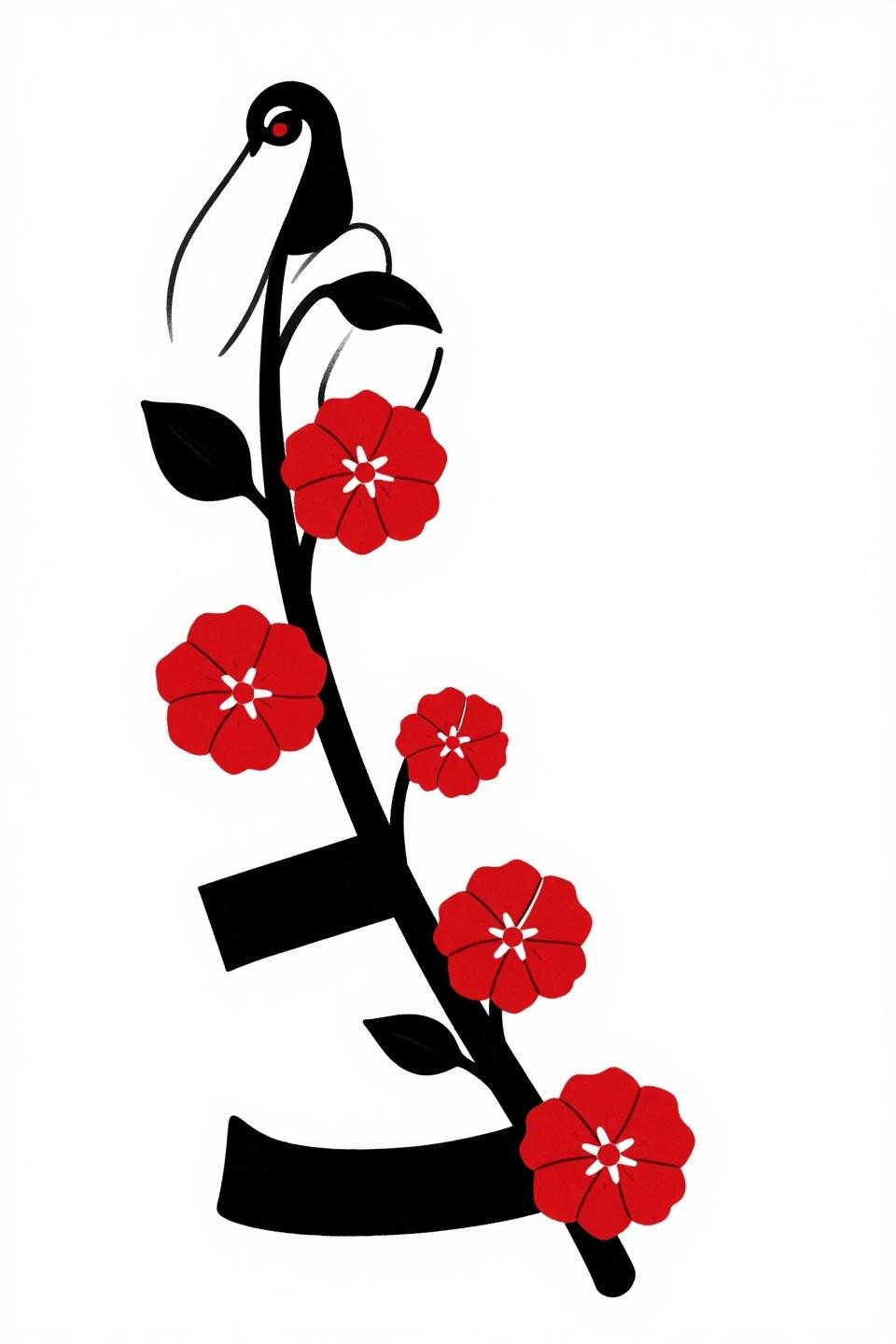
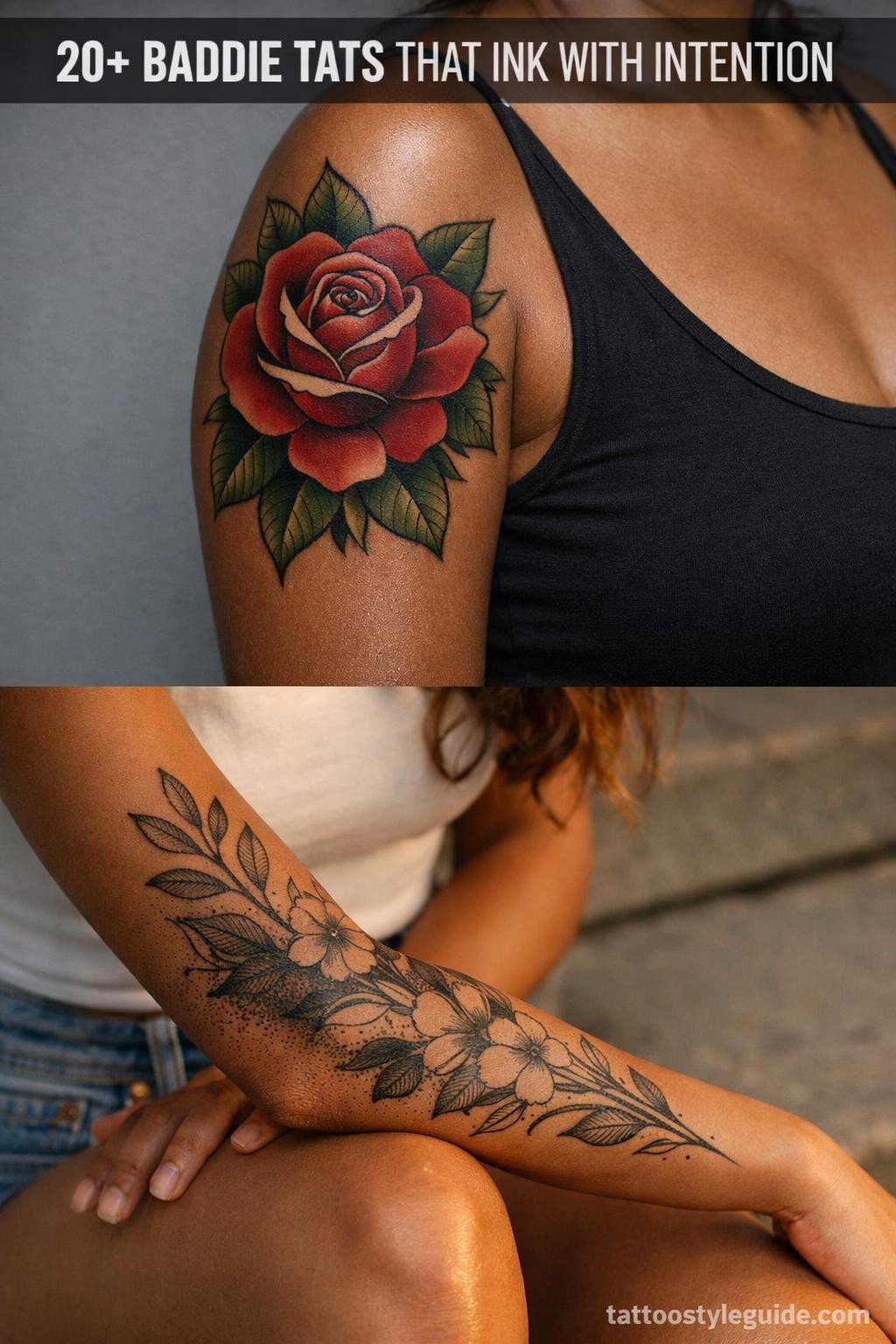
Bold geometric wrist cuff anchor, single confident diagonal vine, three isolated crimson-filled five-petal florals at knuckle stations. Trendy mehndi designs built on this traditional American flash logic age well because the 2.5pt outlines hold the crimson fill in place structurally. The fill cannot bleed past the outline weight.
Zero stipple, maximum negative space. This is the correct call for a first major hand piece. The simplicity of red and black on white skin reads as decisive. On brown and deep skin tones, crimson block fill can read darker, shifting toward burgundy, which is worth discussing with the artist during the design consult. The diagonal vine breaking the symmetry of the wrist cuff is what keeps this from reading as generic flash. That off-center tension is the whole point.
Simple Mehndi Designs Easy: Old-School Sailor Logic Applied to the Palm
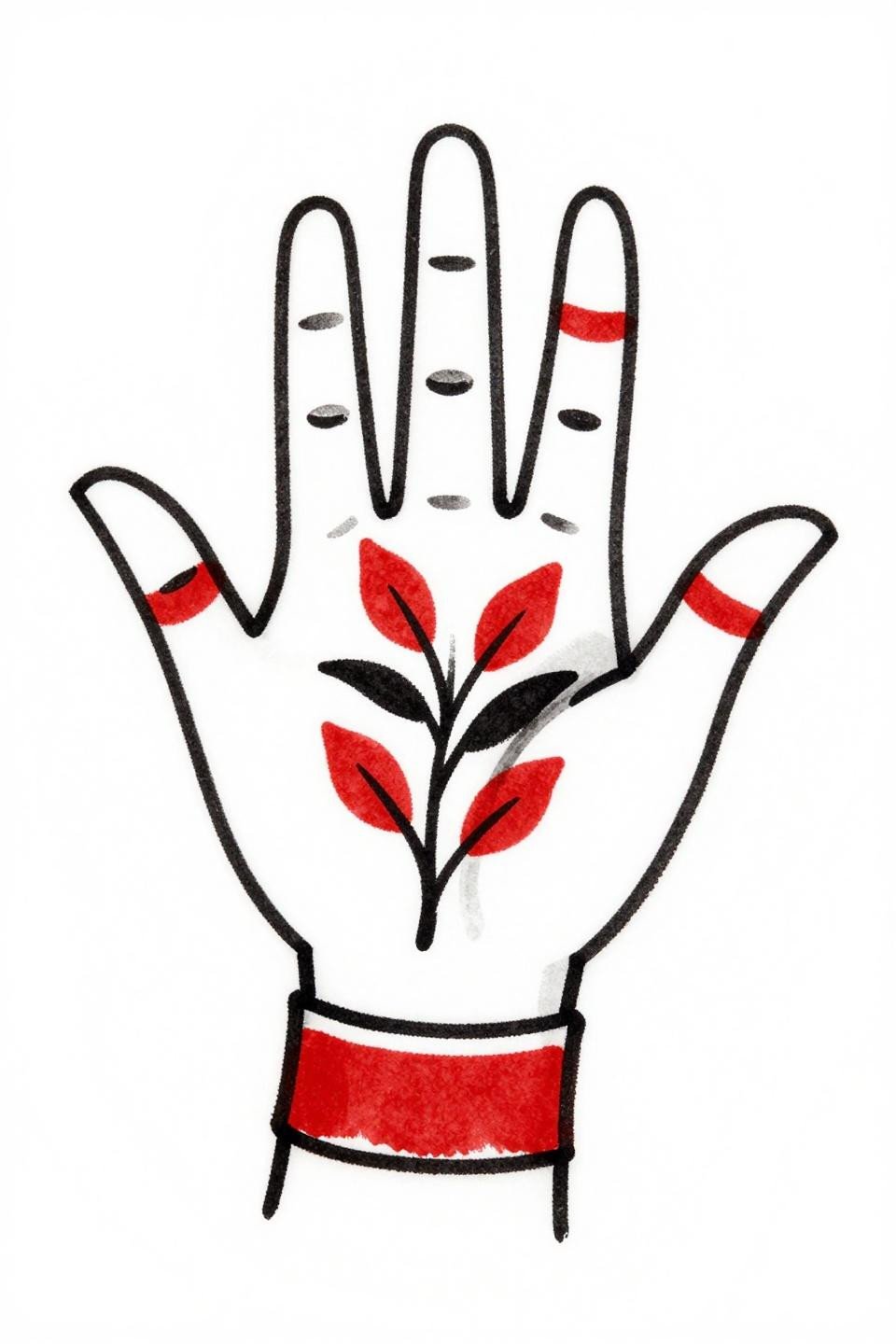
Old-school sailor traditional execution on a front palm layout is one of the most durable approaches in simple mehndi designs easy formats. Bold 3pt outlines, geometric wrist cuff bracket with solid red fills, single flowing vine spine, chunky leaf stations with solid fills. This is the maximum-contrast, zero-fine-detail approach, and it’s built for longevity.
Three passes minimum on the black outlines at 3pt weight using a 5RL needle is what gives this saturation density. The leaf fills done with a flat shader hold without patchiness on the second pass. Hand placement means this heals in three to four weeks with aggressive peeling in week one. The bold outline weight is insurance against the skin texture of the palm disrupting the design read during healing. Very simple mehndi designs built on sailor flash principles are never a compromise. They’re just technically smart.
Simple Stylish Mehndi Designs: Neo-Traditional Precision on an Asymmetric Diagonal
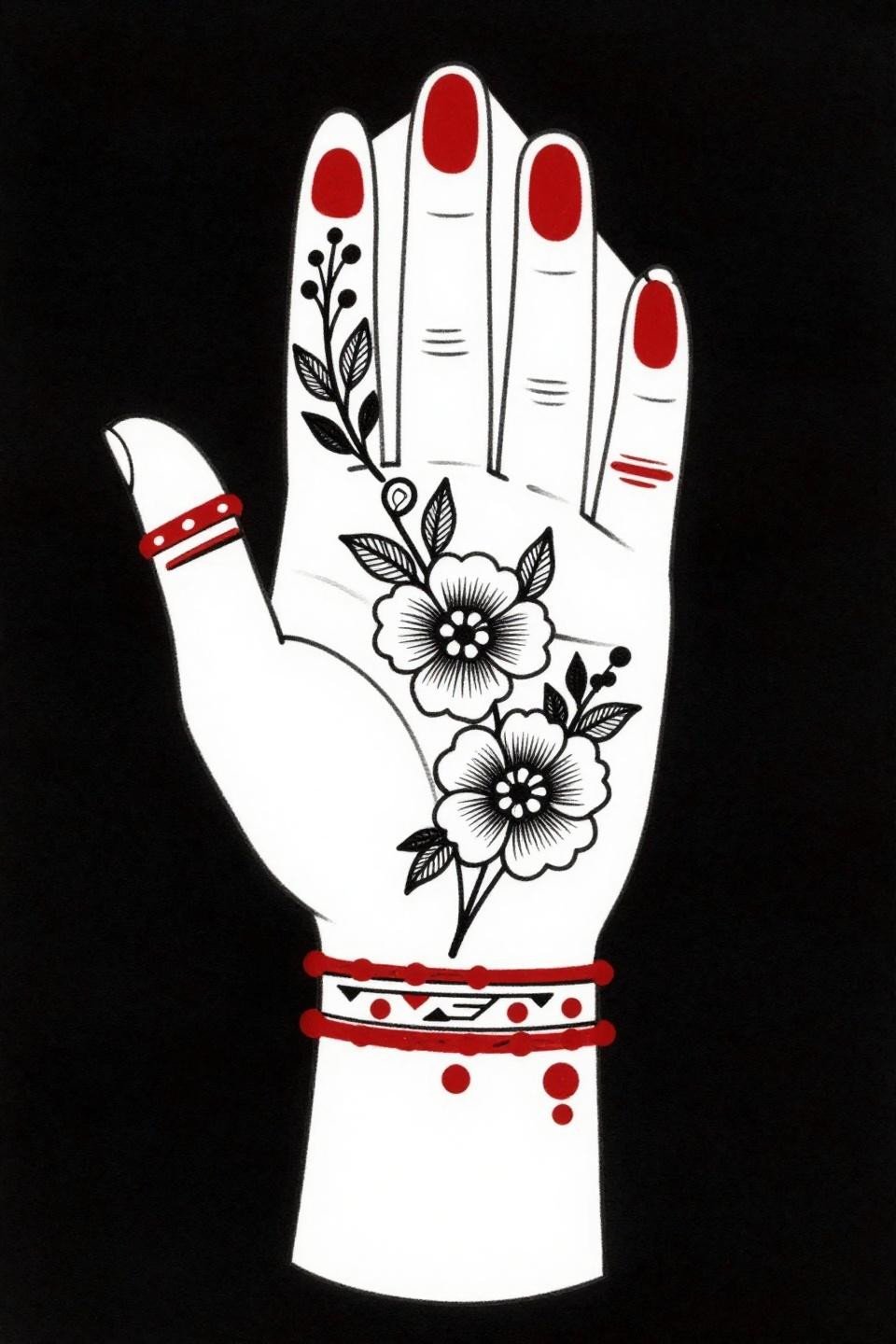
Neo-traditional precision applied to a simple stylish mehndi design layout gives you the best of both worlds: bold outline longevity with slightly more detail interior work than classic sailor flash allows. An asymmetric diagonal vine sweeping from lower-left wrist to upper-right fingertips breaks the expected central column format. The geometric bracket anchors off-center, which gives the composition tension.
Branching florals at each knuckle with parallel line petal shading are the neo-trad tell here. Executed with 5RL-7RL outlines and a curved mag for the parallel fill work, this approach keeps interior detail legible at the scale a hand piece requires. Deep crimson on the bracket corners is a punctuation choice: single color accent, held to one element, not scattered. Artists who overreach with neo-trad often add too many elements. This layout earns restraint by making every mark deliberate.
Very Simple Mehndi Designs: Hairline Trails and Geometry With Nothing to Hide Behind
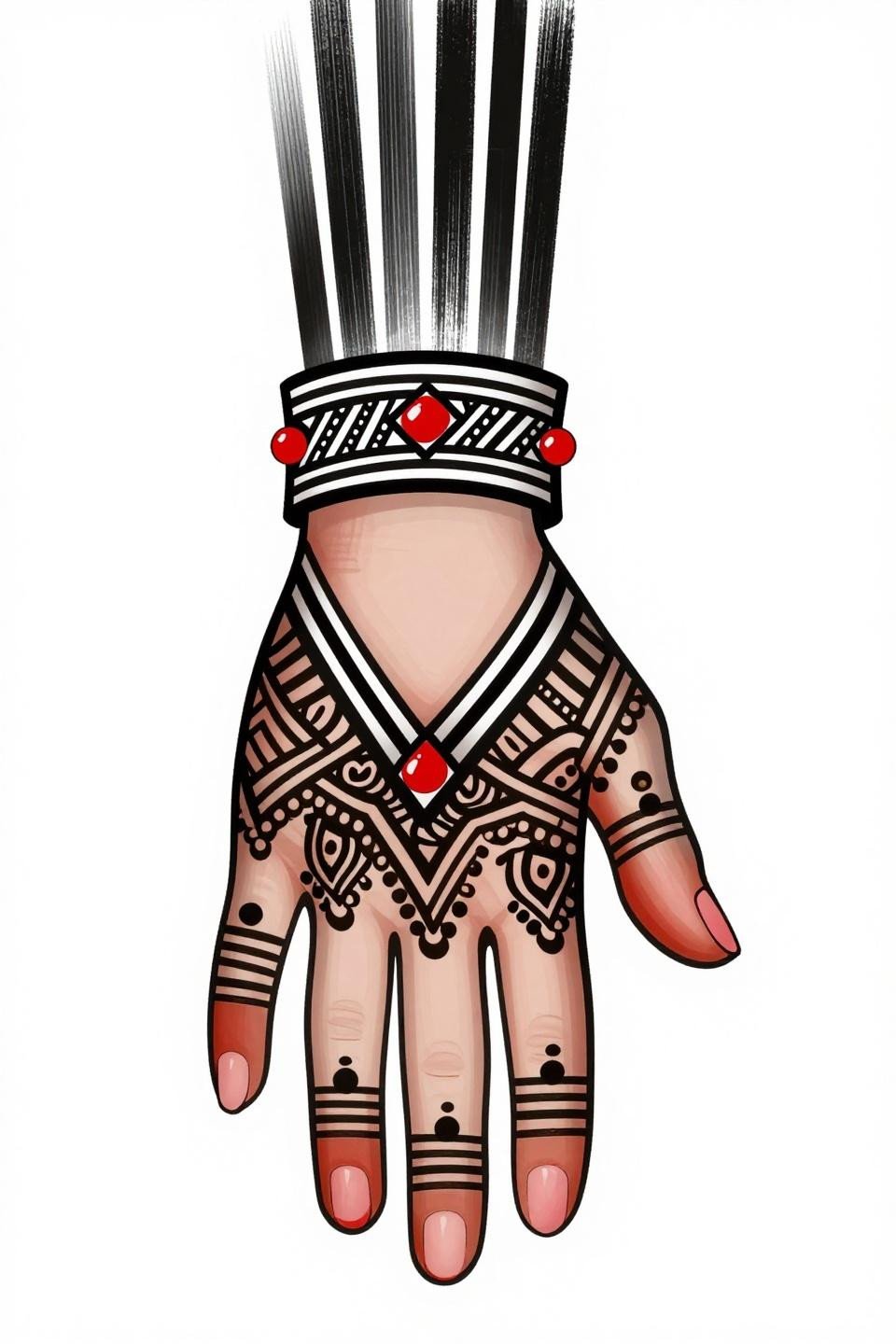
A geometric wrist cuff bracket with crimson-filled corner nodes and four hairline vertical trails ascending to the fingertips. Zero fill, zero gradient. Very simple mehndi designs at this level of reduction are technically demanding because there’s nothing to hide behind. The 2pt closed outline on the cuff bracket and 0.5mm hairline trails are two different line weights doing two completely different jobs.
The hairline trails executed with a 1RL single needle require consistent hand speed across the full length of the palm. Any hesitation produces a thick spot that kills the hairline read. Crimson appearing only on the cuff nodes is the correct restraint call. The eye travels the hairline trails upward and lands on the node accent as a starting point rather than a destination. This layout on light skin reads as graphic design. On dark skin, the hairline detail may require higher contrast ink or heavier line weight to maintain the same read.
Simple Mehndi Designs Modern: Woodcut Boldness on the Back of the Hand
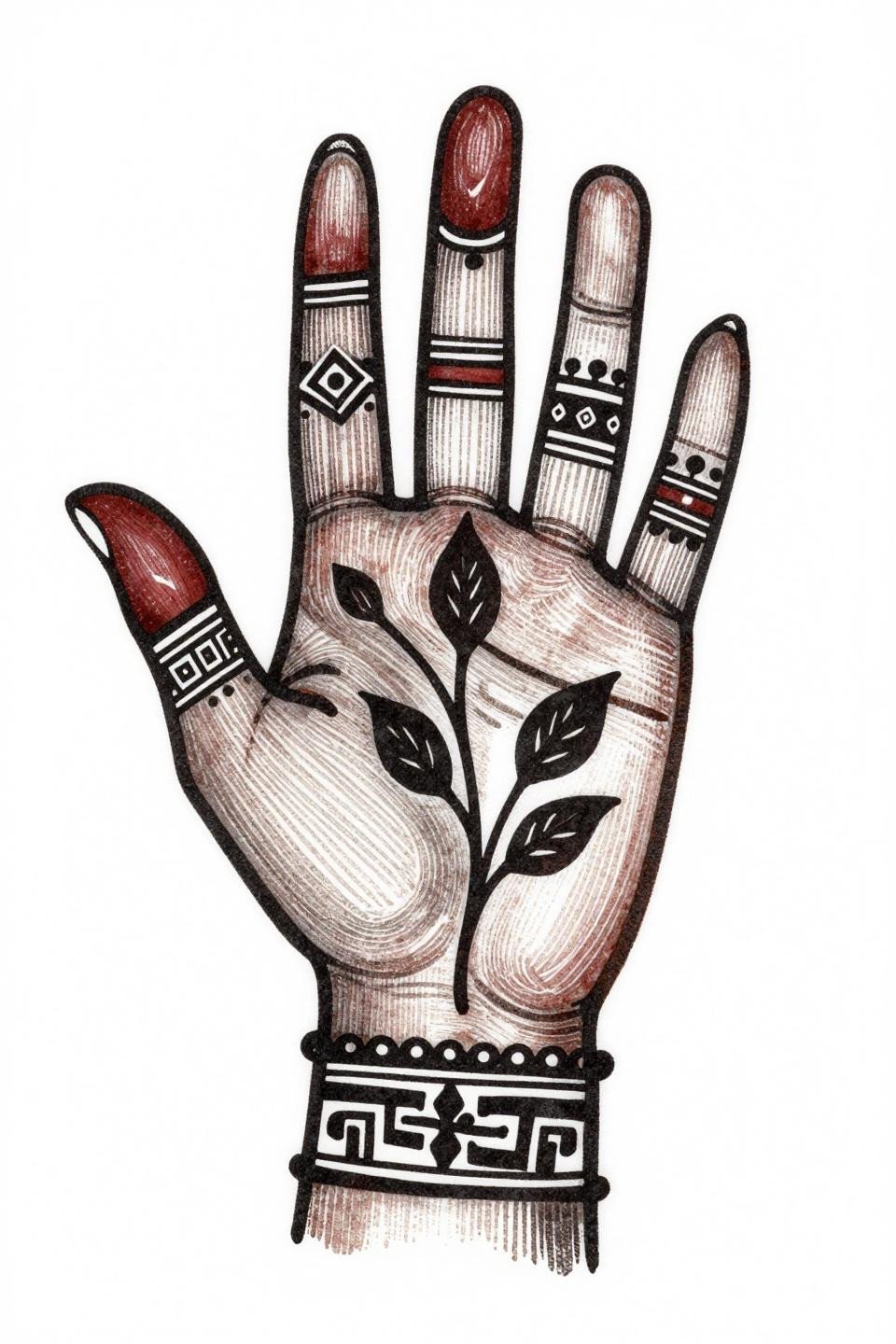
The back of the hand changes everything about placement logic. Simple mehndi designs modern formats that account for the back-of-hand skin behavior lean toward bold outlines and sparse composition rather than fine detail. A single diagonal vine from geometric bracket cuff at wrist to minimal knuckle station, asymmetric and sparse, is the correct call for that skin quality.
Parallel line shading with 2pt outlines reads from distance. The woodcut reference in this approach is technical: high contrast, bold mark, no gradient, no blending. Deep crimson on three geometric bracket nodes gives the piece its warmth without competing with the blackwork logic. Back-of-hand skin is thinner over the tendons and has more movement than the palm, which is why the minimal element count is smart. Fewer elements means each one has to survive on its own. Modern mehndi designs inspiration at this reduction level translates directly into permanent ink without adjustment.
Stylish Mehndi Designs For Front Hand: Burgundy Stipple Accent on a Column Layout
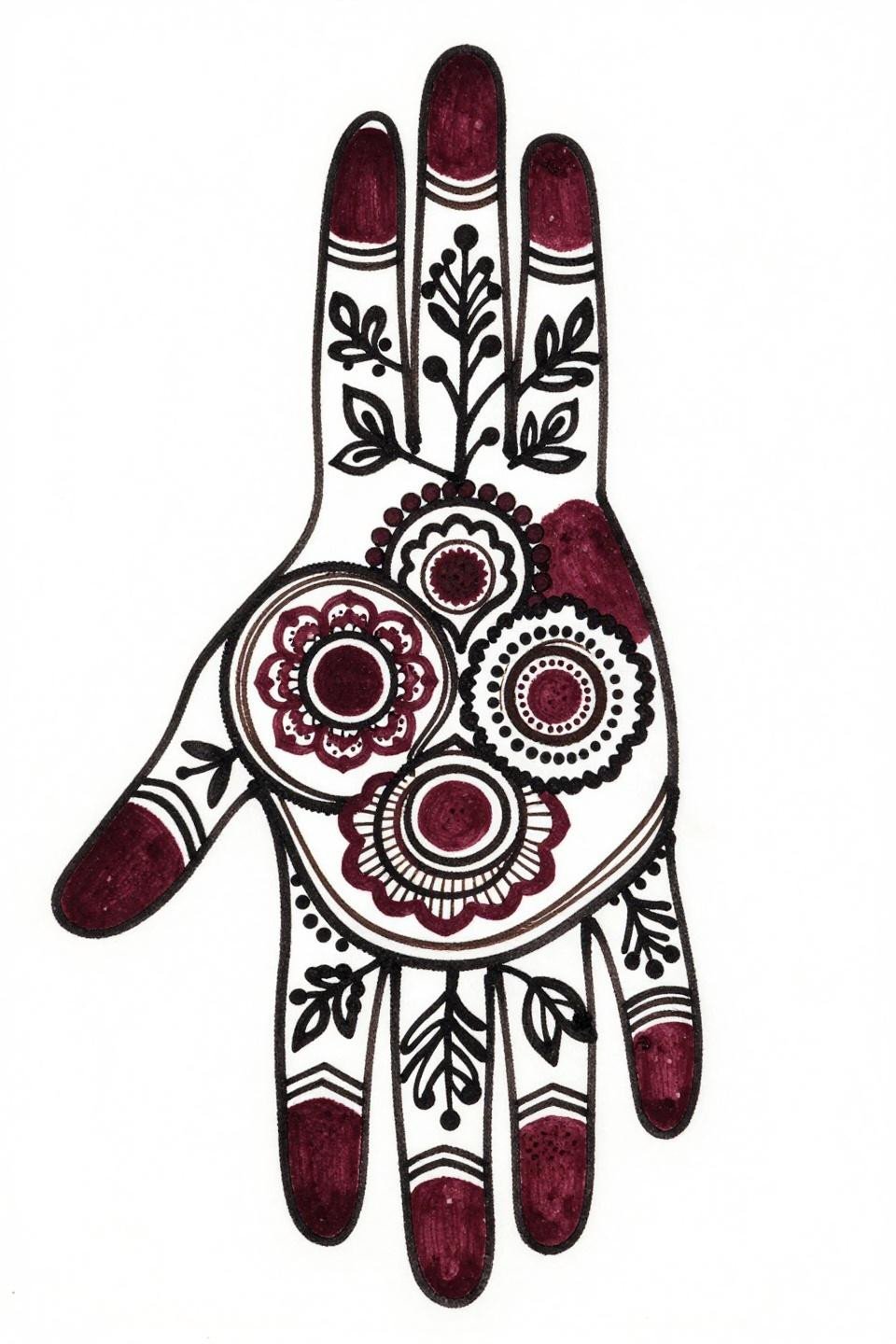
A single bold 2.5pt flowing vine column anchored at the wrist with geometric petal rosettes at knuckle stations is the front palm column format at its most efficient. Stipple dot cluster centers in deep burgundy add one layer of interior texture without breaking the overall graphic read. Thin ornamental fill lines contrasting against the thick primary outlines create line weight hierarchy.
The 3RL single needle stipple work at the rosette centers needs consistent dot density to hold that burgundy cluster read after healing. Fresh stipple always looks crisper than healed stipple. Budget one touch-up session at six months for this element specifically. The vine column layout is among the most durable stylish mehndi designs for front hand placement because it follows the natural axis of the hand rather than fighting the anatomy. Ornamental thin fill lines done with a 1RL needle require an artist who can maintain consistent pressure over the full stroke length.
Aesthetic Mehendi Designs: Japanese Fusion Geometry With Crimson Leaf Tips
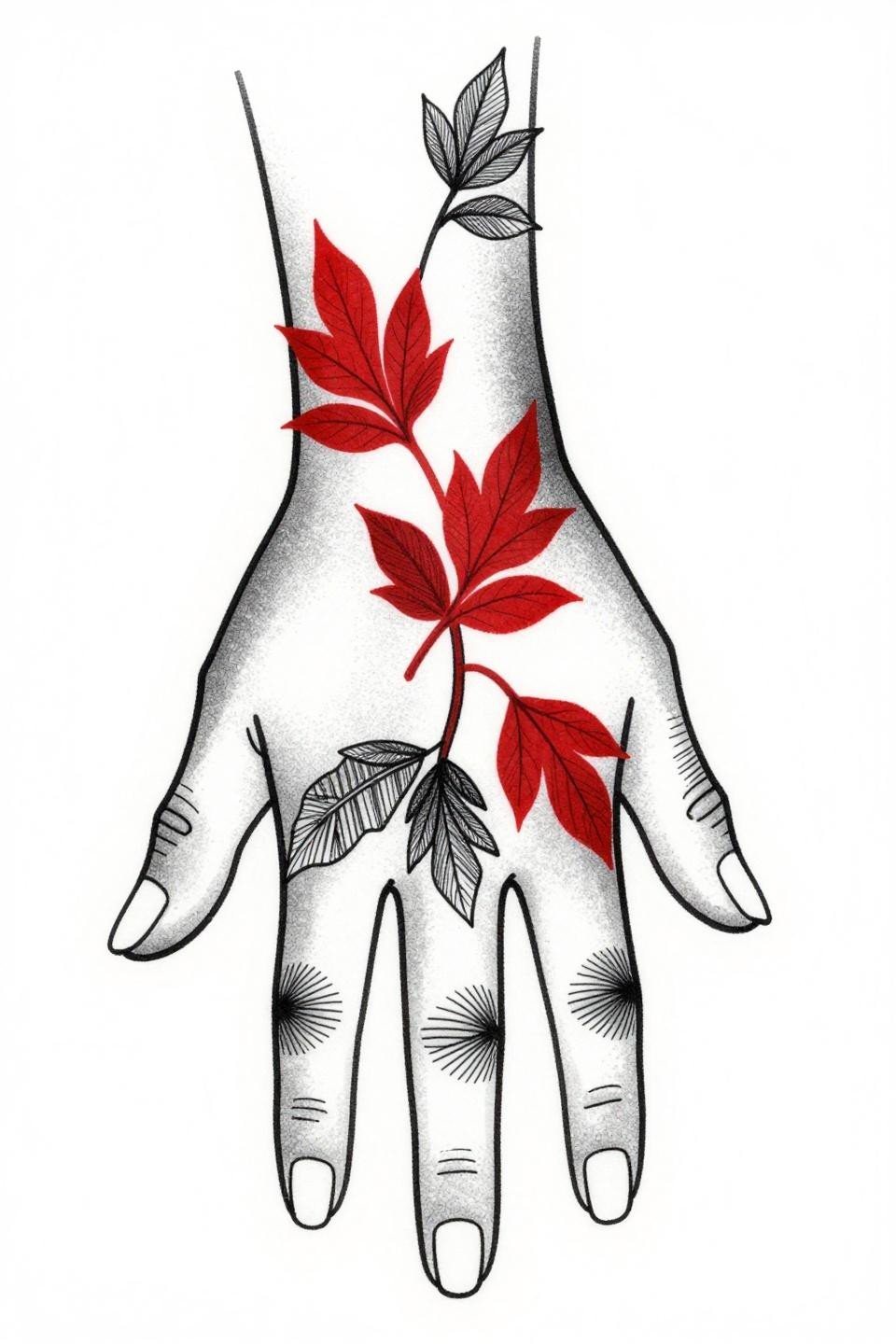
Japanese irezumi fusion applied to a mehndi hand layout produces one of the more technically sophisticated aesthetic mehendi designs in this collection. A single bold vine spine arcing diagonally from wrist crease across palm center toward ring finger, with paired geometric leaf clusters at three knuckle points, borrows the irezumi compositional logic without copying the iconography.
Parallel line shading on the leaf undersides and a hairline stipple gradient fading density toward the fingertips references the bokashi shading technique from traditional Japanese tattooing. Three crimson leaf tips as the single color accent keep the palette disciplined. The diagonal arc across the palm follows the hand’s natural gesture line, which means the design changes reading depending on hand position. Open palm reads differently than a relaxed hand. That movement responsiveness is an irezumi quality worth preserving in this format. Mixed needle groupings, 2pt outline with 14M curved mag for the gradient stipple fade, execute this correctly.
New Simple Mehndi Designs: Dotwork Lattice With Surgical Vine Angles
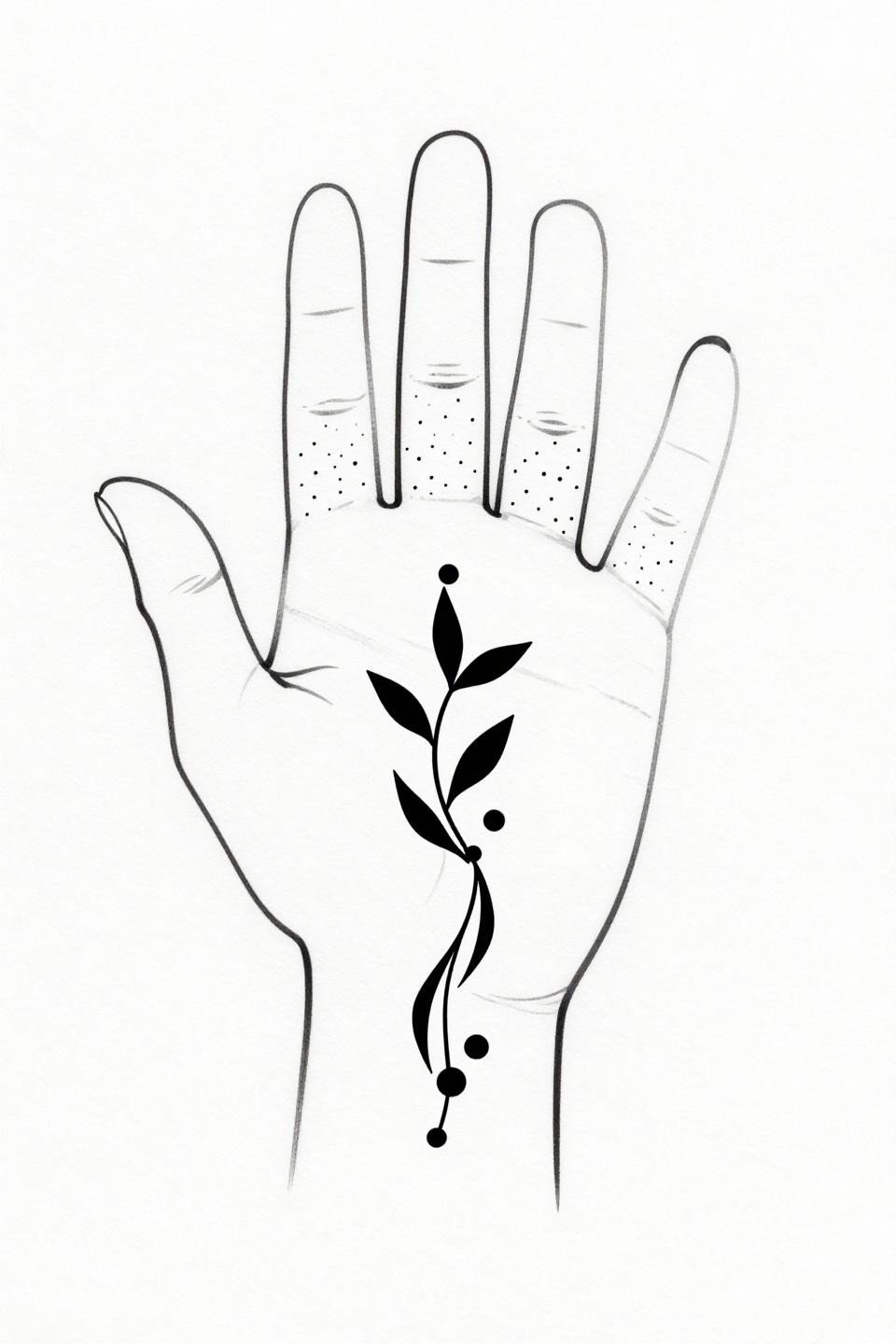
A 60 percent dotwork density field across the central palm thinning toward the fingertips, with a single 0.4mm geometric vine taking two sharp 45-degree angle turns from wrist to center. New simple mehndi designs built on dotwork logic are slow to execute and faster to misread as incomplete. The three tight dot clusters at ring, middle, and index finger bases are the anchor that tells you this is intentional.
Dotwork at 60 percent density on palm skin requires multiple passes with a 3RL single needle. Palm skin is notoriously difficult. It rejects ink more aggressively than any other placement. The design needs to be built for two-to-three touch-up sessions over the first year before reaching the intended density. Artists who warn you about this upfront know palm work. Artists who promise a clean single-session heal on palm dotwork don’t. Zero fill, zero gradient means every mark is visible. The 45-degree angle turns on the vine are the precision test. Any wobble shows immediately.
Mehandi Designs Aesthetic: Fine Line Wrist Bracelet at Maximum Restraint
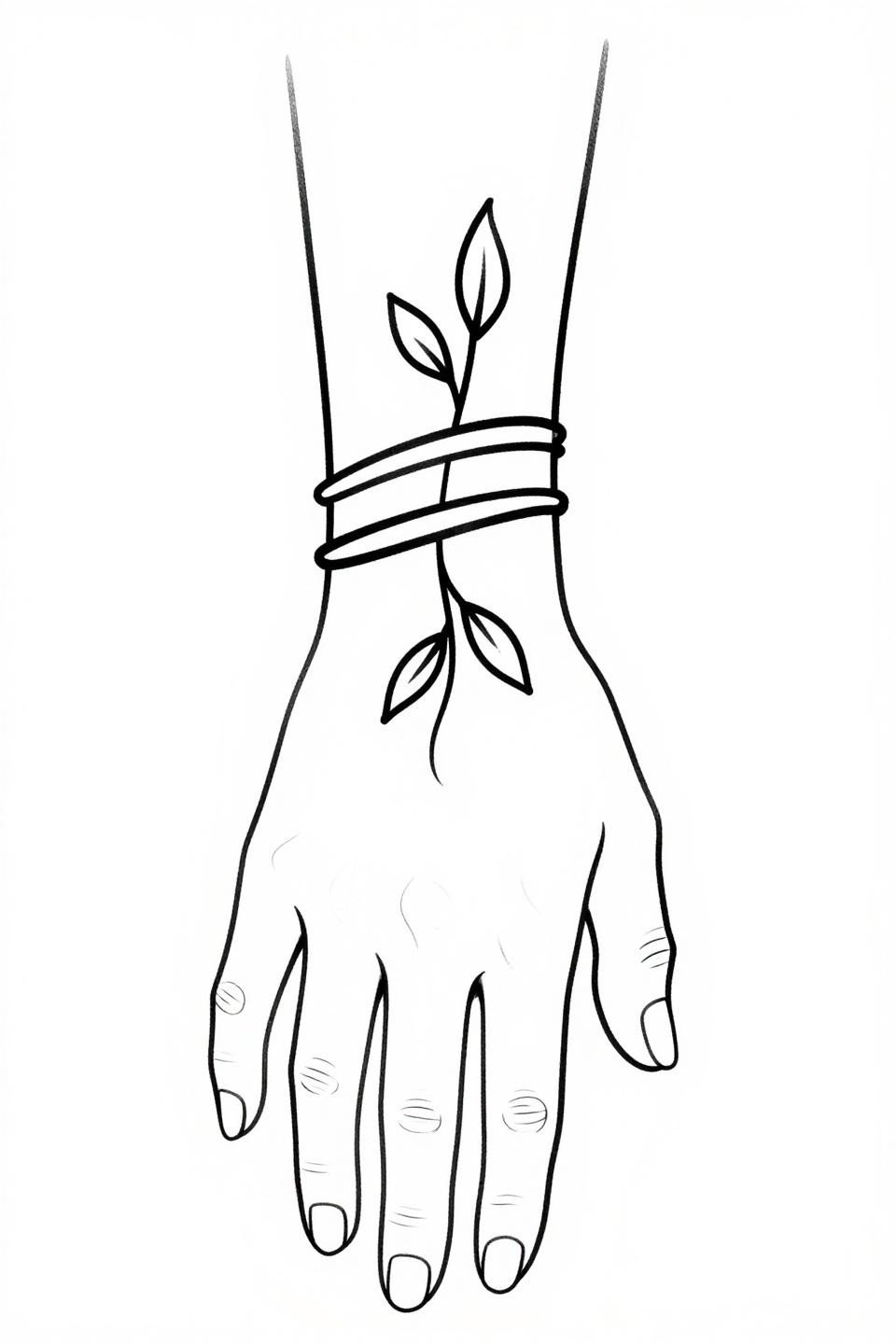
A fine line wrist bracelet built from three thin scrolling loops forming a continuous band, with a single unbroken vine ascending from wrist center to ring finger knuckle. Two micro leaf pairs along the stem. Pure 0.25mm hairline strokes, zero fill, zero shading. This is the mehandi designs aesthetic at its most pared back.
A 1RL single needle executing 0.25mm strokes is the technical call. The unbroken vine from bracelet to knuckle needs to read as one continuous mark, not a series of short strokes joined together. Speed consistency across the full length determines whether it does. Wrist placement for fine line work has the worst longevity of any placement on the hand. Expect softening at year two to three, with finger and wrist friction accelerating the fade. The bracelet element will soften fastest. The vine ascending toward the ring finger will hold longer because it crosses less friction-heavy skin. Plan for a touch-up at year two and this design stays legible through year five.
Simple Beautiful Mehndi Designs: Fine Line Geometry With a Terracotta Accent
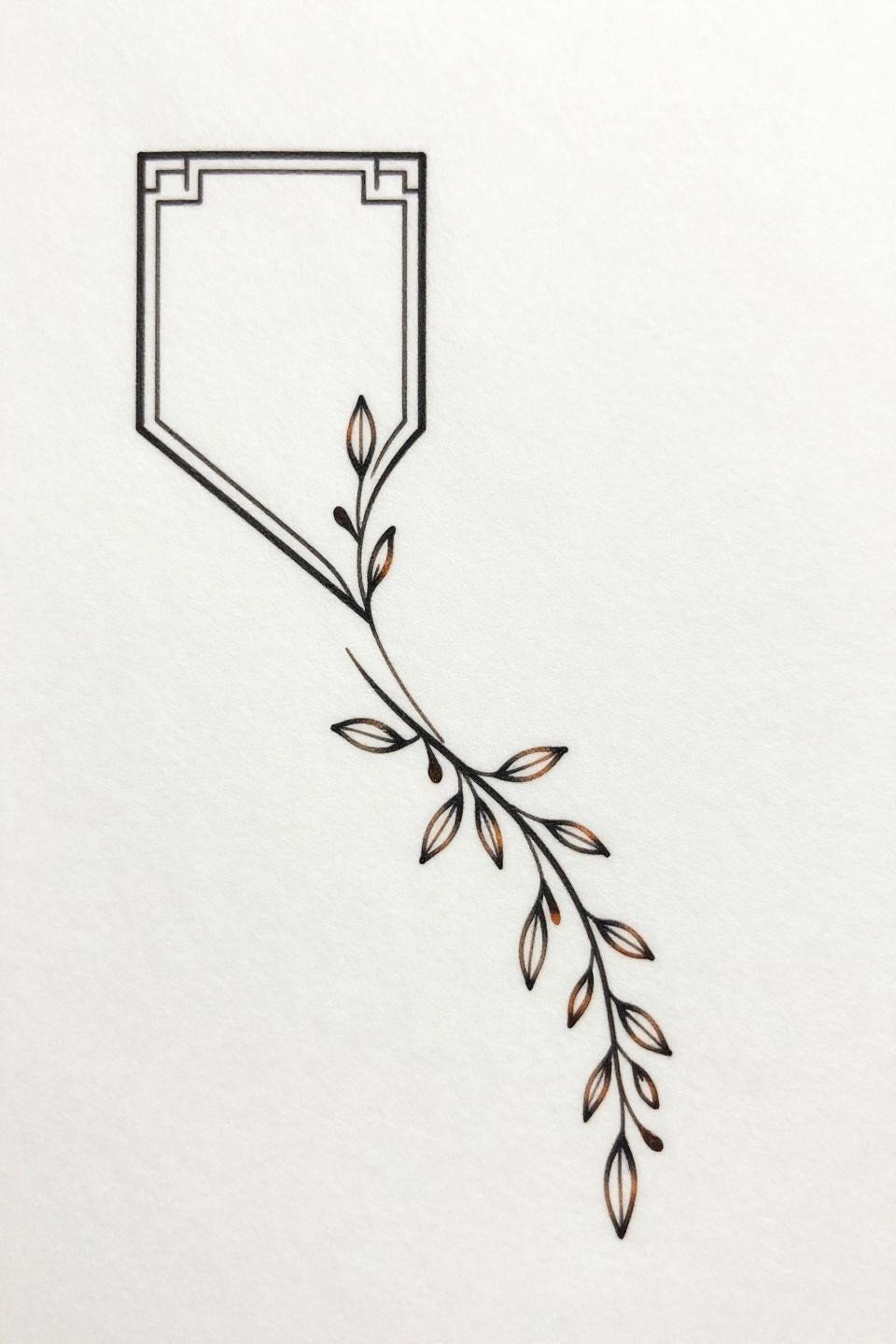
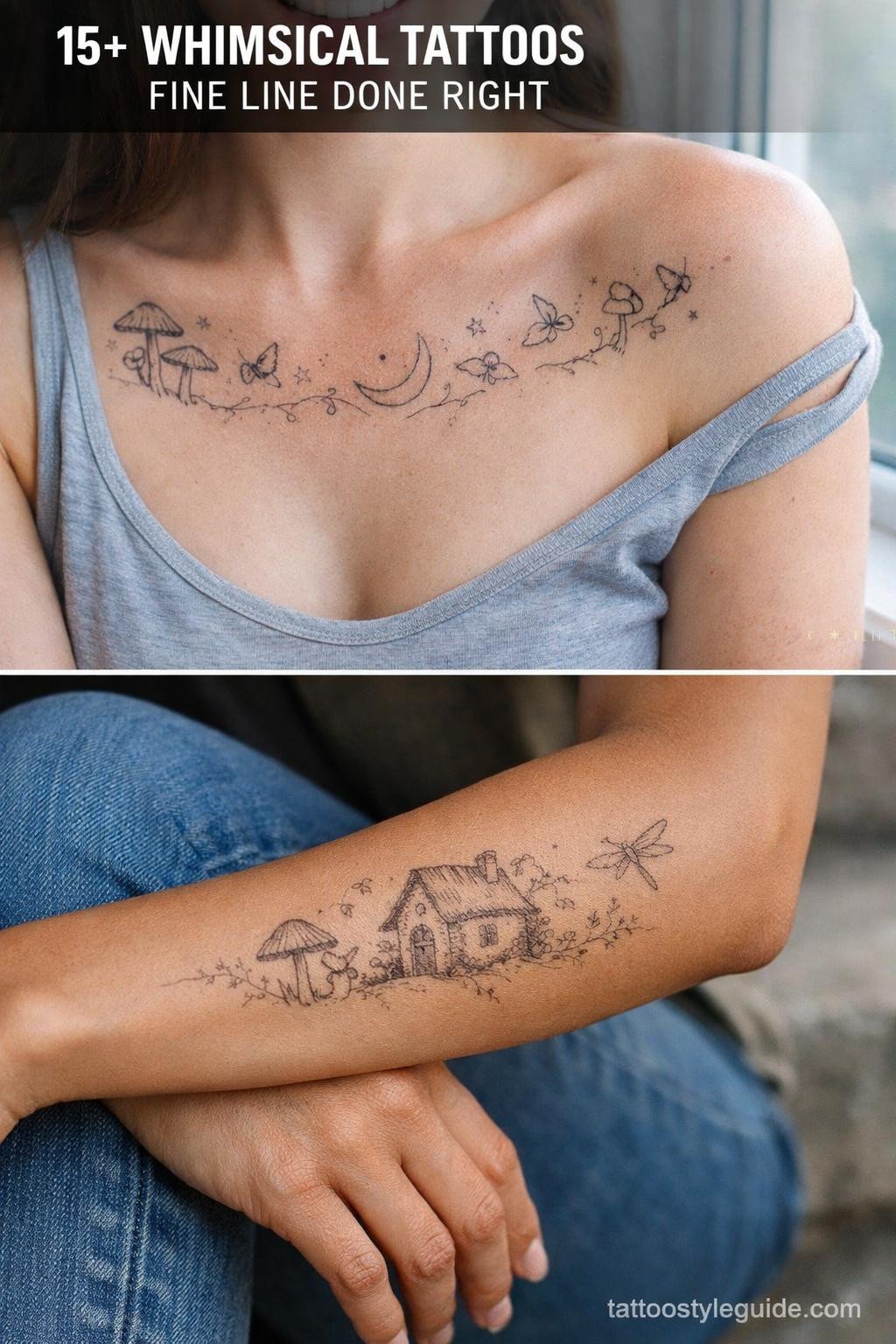
Asymmetric front palm layout, hairline geometric corner bracket motifs at upper left, single continuous vine descending diagonally toward wrist. 0.3mm hairline strokes, zero fill, crisp open negative space. Simple beautiful mehndi designs at this weight are almost exclusively a fair-to-medium skin tone conversation. On deeper skin tones, 0.3mm strokes read only in direct light, which changes the design entirely.
The terracotta accent on vine tendrils is the warmth pivot. Black hairline with a terracotta accent reads very differently from the same layout in all black. It references the henna color register directly, which is the point. For anyone crossing between temporary henna practice and permanent tattooing, henna designs for everyday wear in this fine line format hold well on protected placements like the inner wrist. On the dorsal hand and fingertip areas, the 0.3mm weight needs to step up to 0.5mm minimum to survive the friction load. Artists who refuse to adjust line weight for placement are not managing your long-term result. They’re managing their portfolio photo.
Trendy Mehndi Designs: Geometric Lattice Grid With a Continuous Vine Override
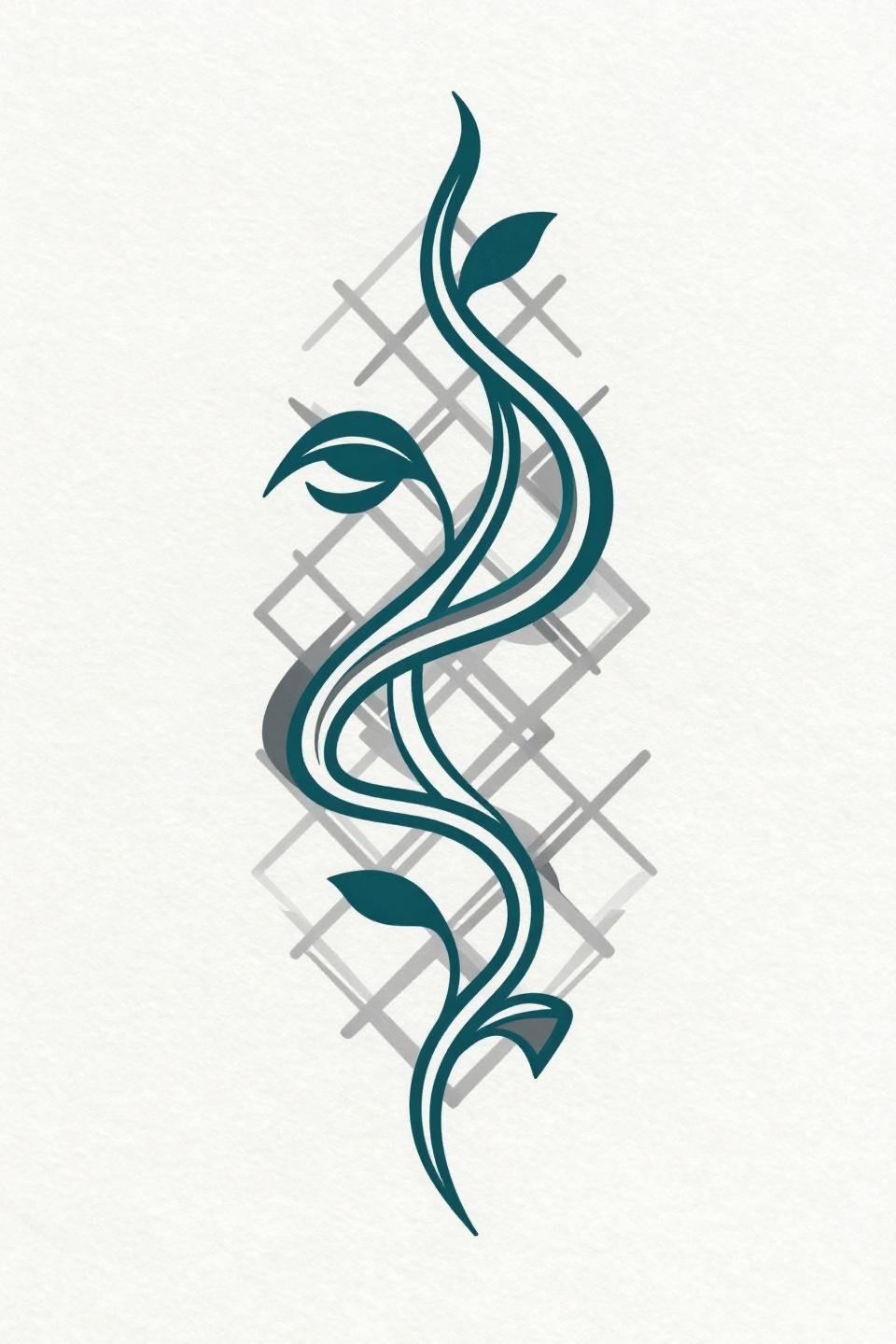
A geometric lattice grid overlaid with a single continuous flowing vine traveling upward in an asymmetric column. Bold 2pt deep teal outlines, charcoal grey solid fills, negative space white diamond clusters punched through the grid. Trendy mehndi designs that layer geometric structure with organic line are doing two different things simultaneously and requiring them to coexist without canceling each other.
The key technical decision is flat fills only, zero gradient. The charcoal grey solid fills and deep teal outlines create three tonal registers without any blending. Vector-precise linework executed with a 3RL needle and flat shader for the grey fields. Deep teal as an outline color instead of black shifts the warmth temperature of the whole piece. Teal ink in fine outline weight heals slightly warmer and more muted than it looks fresh, trending toward a blue-grey by year three. The bold 2pt weight slows that shift and keeps the design reading as intentional rather than faded. See more layout options like this in the modern mehndi designs inspiration collection.
Simple Mehndi Designs Easy: Mandala Center With Radiating Paisley and Geometric Border
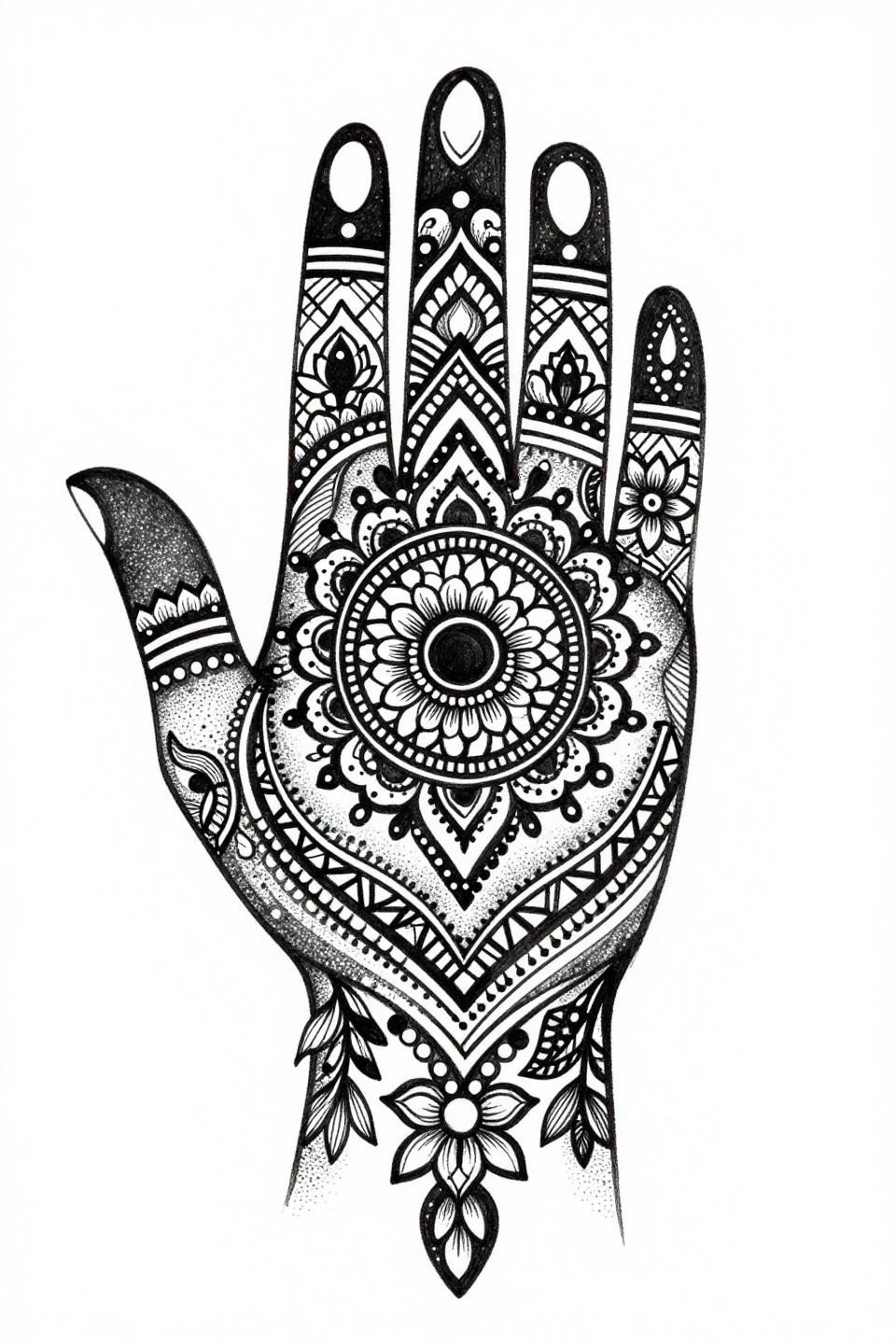
A mandala center with radiating paisley teardrops, trailing floral vines with lotus buds, and geometric lattice borders. Hairline 0.3pt linework with stipple dot shading at 70 percent density fading to open negative space. This is the most technically complex layout in this collection of simple mehndi designs easy formats, and it requires the longest session time to execute cleanly.
The 70 percent stipple density fading to open negative space is done correctly with a 3RL single needle at consistent dot spacing. The mandala center requires a rotary machine for the circular linework to avoid the vibration wobble that a coil machine introduces on tight curved strokes. Lotus bud detail work at this scale, below 4cm, starts approaching the degradation threshold for fine interior detail by year two to three. The geometric lattice border will hold longest because it carries the most line weight. The hairline paisley tendrils will soften first. This layout is the one in this collection that most rewards placement on a protected, low-friction area like the upper inner arm rather than the dorsal hand if permanence is the goal.
The 17+ references in this collection cover the full range from maximum-reduction hairline to bold traditional flash weight. Filter by the line weight closest to your skin tone and placement plan before booking. That’s the reference your artist actually needs, not a screenshot from a Pinterest board with no placement or skin context. The geometric and bold-outline layouts in this collection are the ones to take seriously as permanent tattoo references. The hairline fine line formats require an honest conversation with your artist about touch-up commitment before the first session.