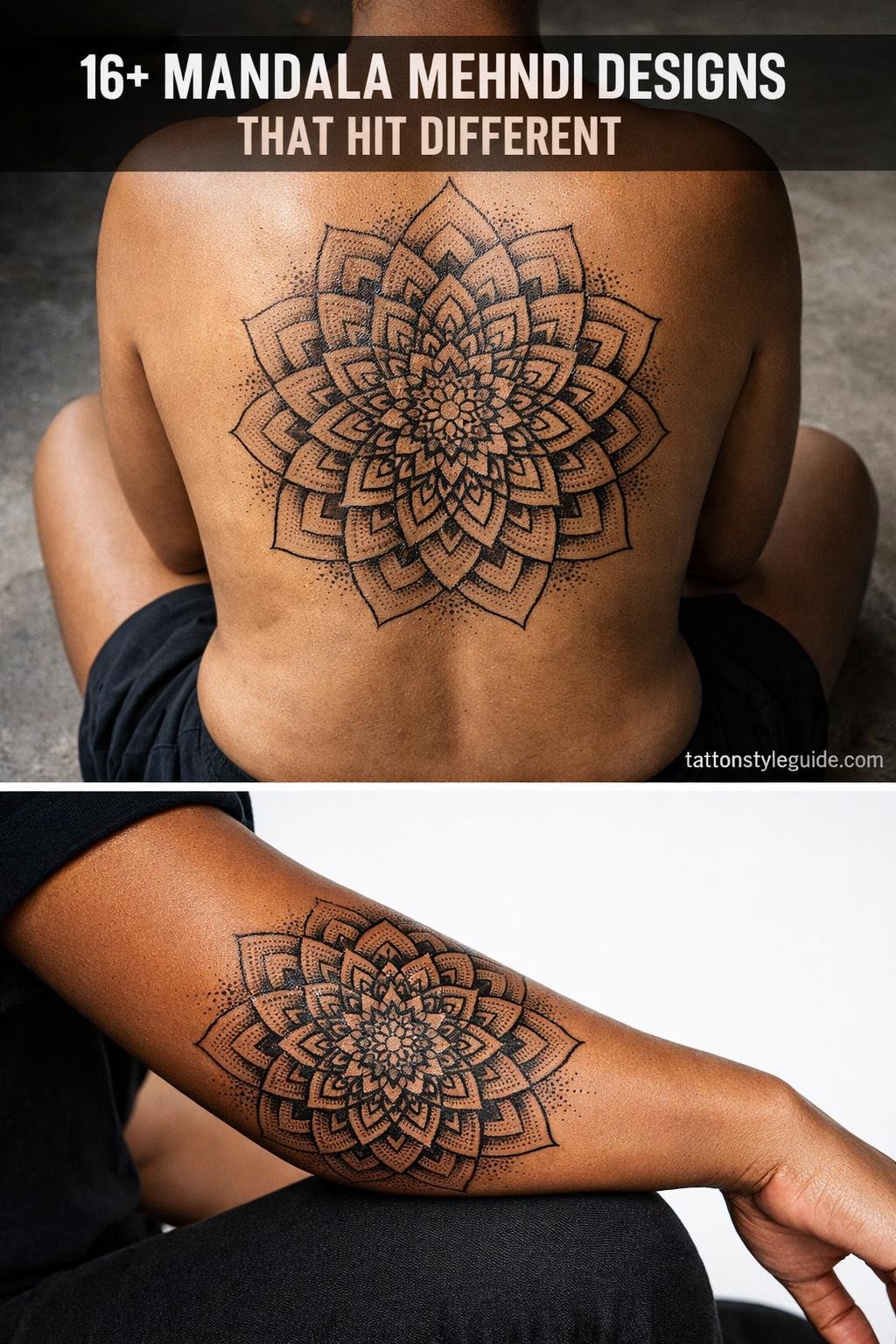
Mandala mehndi design is one of the few henna formats where technical failure is immediately visible. Off-center geometry, inconsistent ring spacing, uneven petal weight: the circle exposes every mistake. That’s what makes a well-executed mandala such a strong reference for permanent tattoo work.
The designs below span grey wash, dotwork, neo-traditional, tribal, and fine line. Each one demonstrates a different approach to radial symmetry and fill density. Use them to identify which technical language fits what you want on your skin.
Compass Star Center: Where Front Palm Mandala Clarity Starts
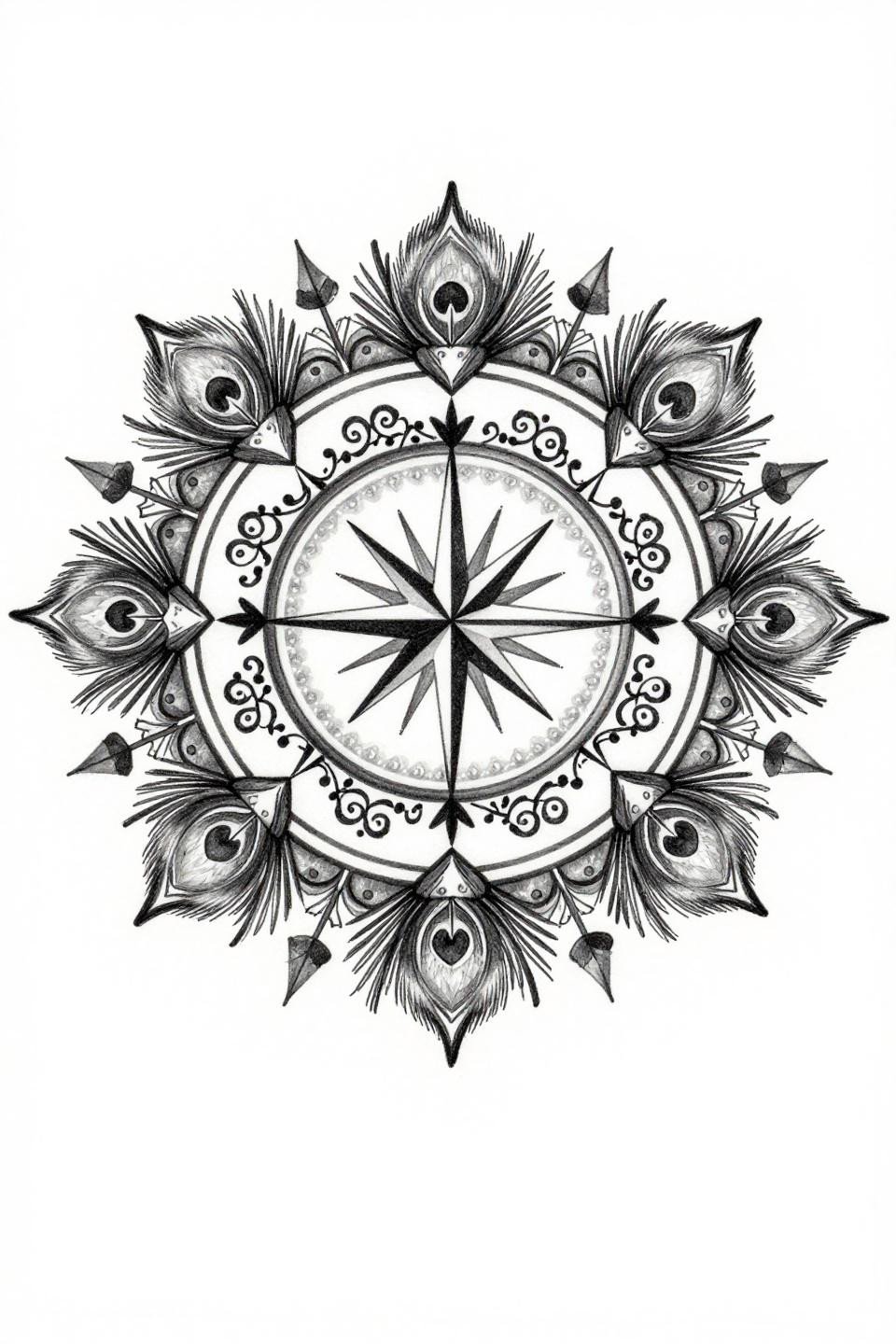
Chicano grey wash on a sixteen-pointed compass star, four nested concentric rings alternating vine spirals with geometric arrow clusters, outer perimeter of bell-shaped flower pods with peacock tail filaments and lacework diamond infill.
Whip shading dilution from dense black at the core to open grey at the outer ring is the technical signal here. On olive skin, this tonal gradient needs a bolder outer ring weight to hold contrast after healing.
Teal and Copper: Neo-Traditional Front Hand Geometry That Holds
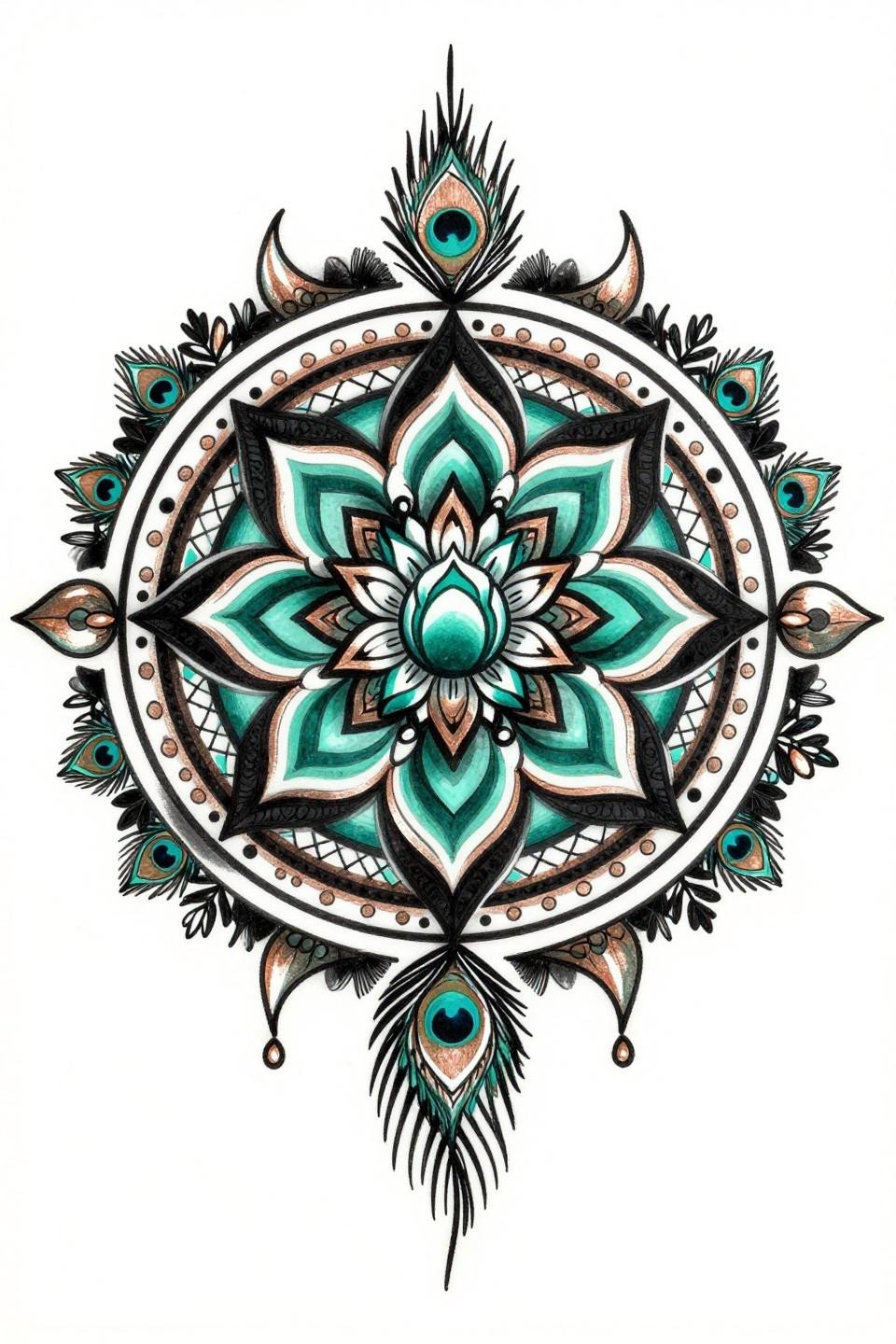
Neo-traditional twelve-petaled lotus at center, nested rings of vine spirals and diamond lattice, outer border of crescent moon clusters with peacock tail feather scales and micro-floral fills in deep teal with copper metallic accent.
Bold 2-3pt outlines at this weight are the longevity signal. Flat color fills between strong outlines age predictably, which is exactly what makes neo-traditional mandala work a reliable long-term investment for front hand placement.
Gestural Hatching Proves Precision Is Optional for Palm Work
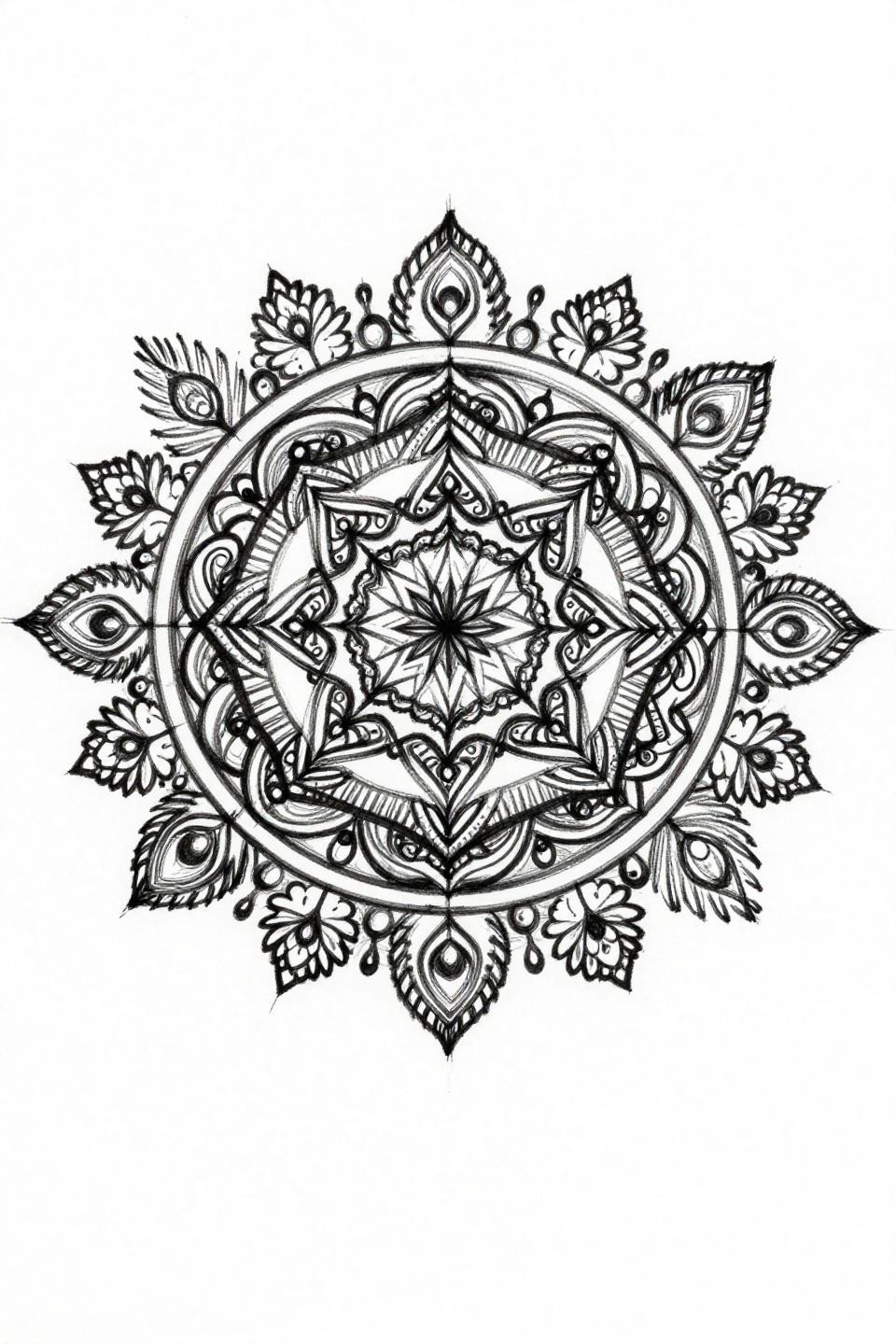
Sketch-raw style with a kaleidoscopic central starburst, nested fine-line vine spirals alternating with geometric clusters, outer border of suspended teardrop pods with peacock feather scales and micro-floral daisy fills executed in heavy gestural hatching.
The deliberately rough linework energy here reads as intentional only when the underlying geometry is locked in first. An artist who can’t draft a clean mandala cannot fake it with sketch style. Check their compass-work before committing to this approach.
Crimson on Black: When Old School Sailor Meets Radial Architecture
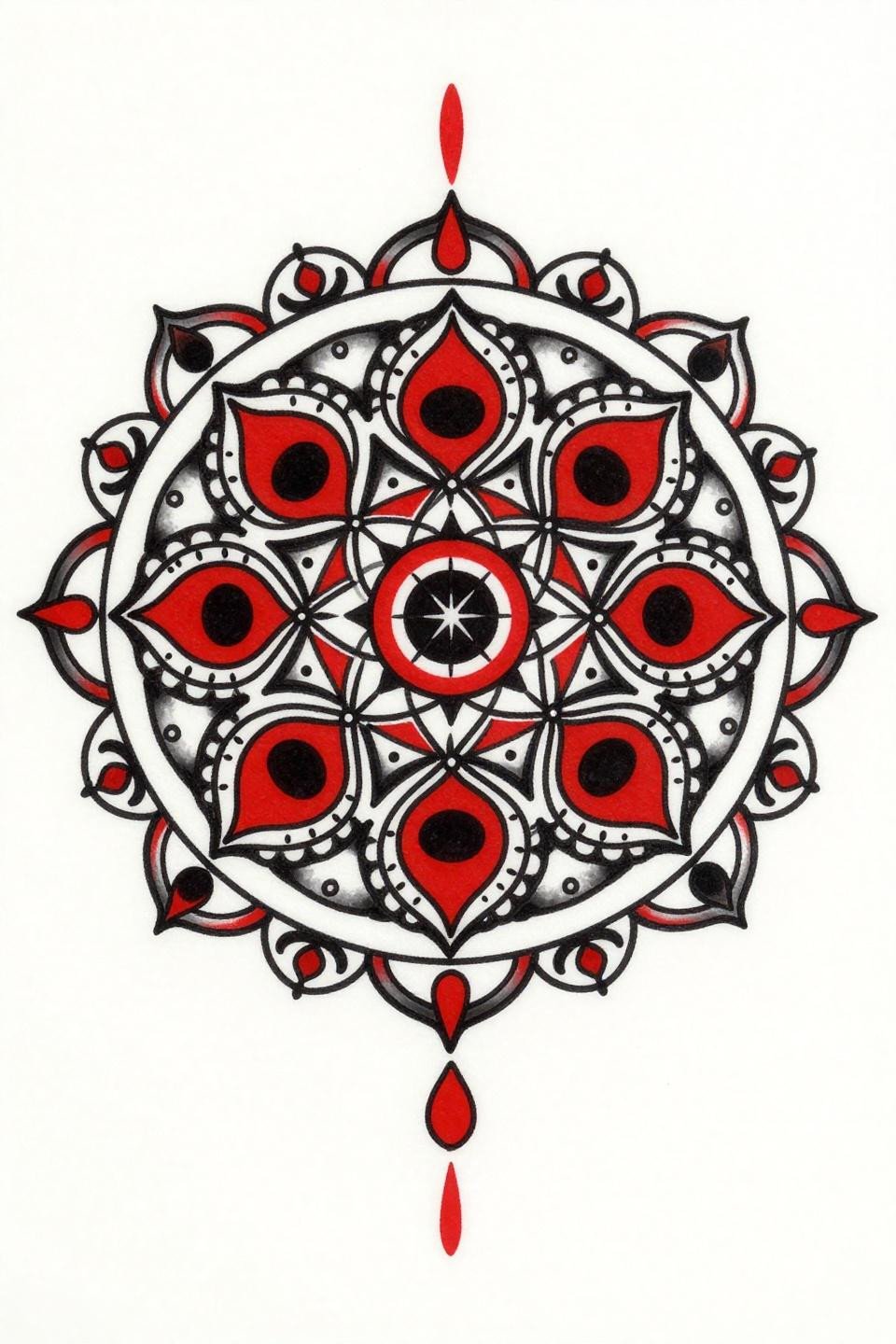
Old school sailor construction: sixteen-pointed star center, scalloped peacock eye petal rings alternating with geometric mehndi lattice, outer crescent moon clusters with vine tendrils and micro-diamond fills, crimson red accent on solid black, bilateral symmetry on vertical axis.
Two-color flat fill with 3pt outline weight is the most aging-resistant mandala format in this collection. Crimson shifts slightly warm over years, but the black structural geometry holds the read regardless.
Art Deco Geometry: Burnished Gold Signals an Aesthetic Commitment
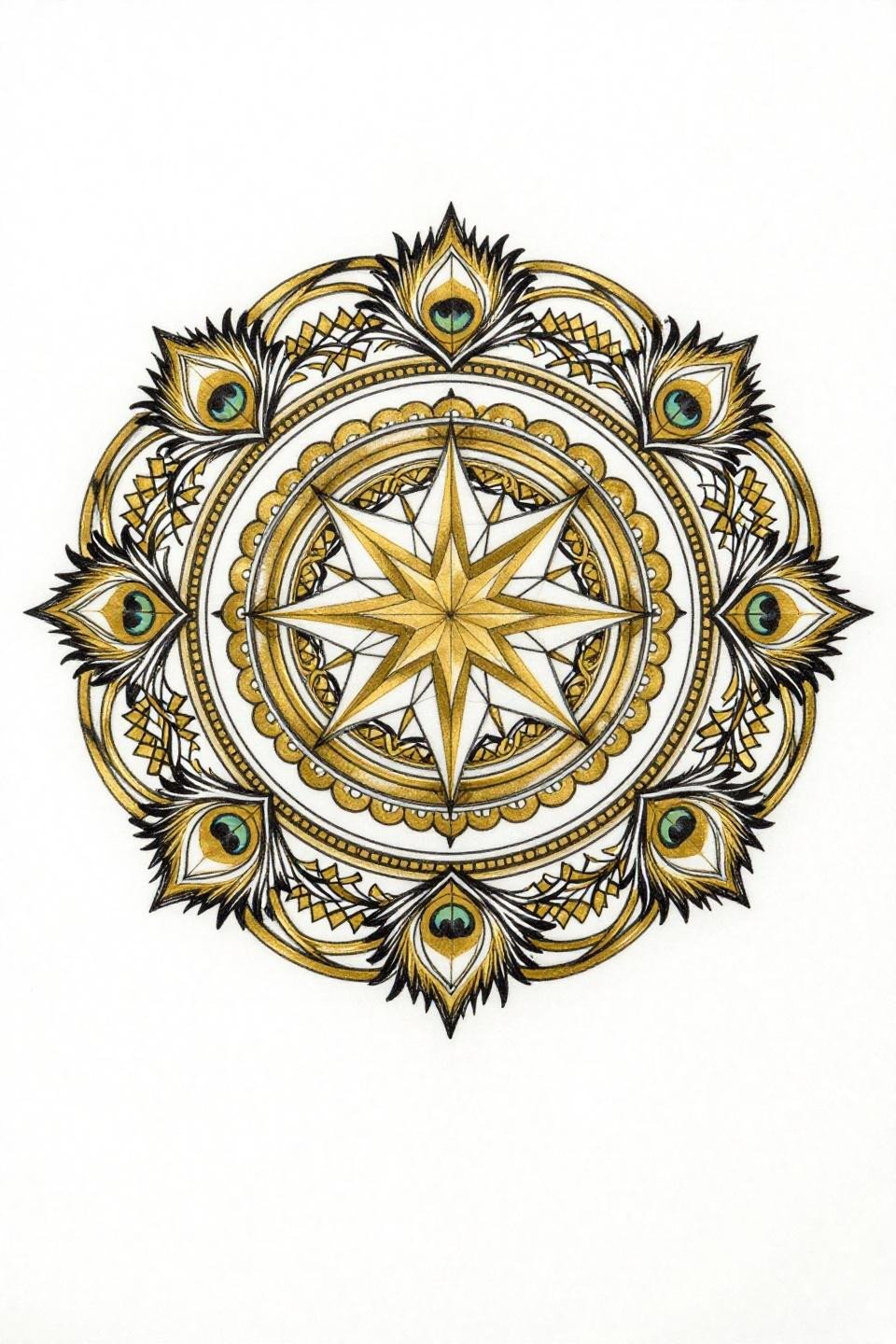
Art deco mandala with a sixteen-pointed starburst center, nested rings of fine chain lattice and scalloped arc clusters, outer border of peacock eye feathers with vine tendrils and geometric diamond fills in burnished gold and solid black, compass-drafted precision throughout.
For henna design ideas for everyday wear, this restrained two-tone palette translates better than saturated multi-color work because the graphic contrast reads clearly in all lighting conditions. Check out henna design ideas for everyday wear for more on that logic.
Trash Polka Mandala: Controlled Chaos as Compositional Strategy
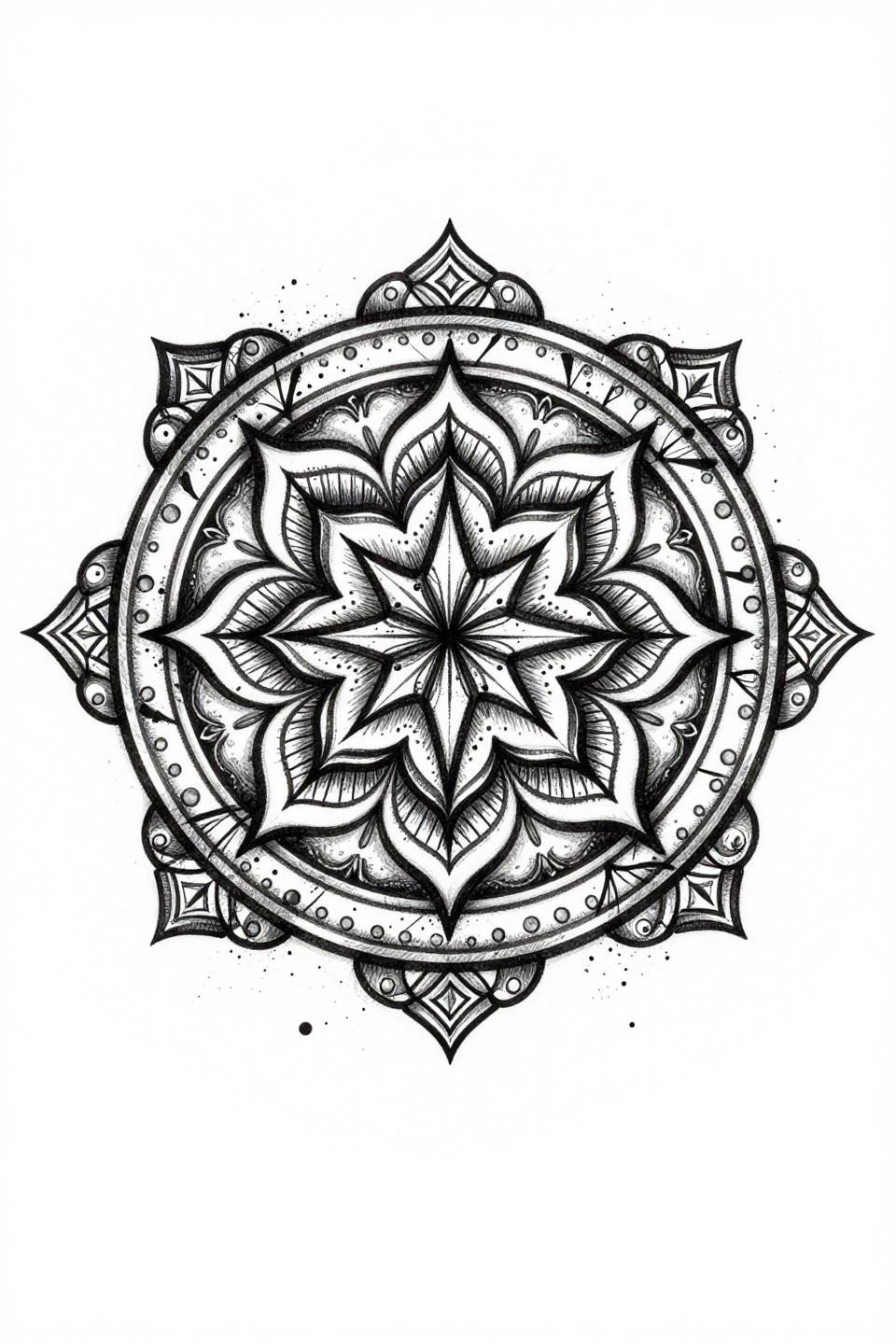
Trash polka applied to a mehndi mandala: sixteen-pointed star center, scalloped lotus petal rings with fine dotted lattice, outer crescent moon clusters with vine tendrils, aggressive ink splatter marks breaking the geometric symmetry in dense black with grey wash midtones.
The contrast between precision linework and splatter disruption only works when the underlying mandala draft is tight. Loose geometry plus splatter reads as unfinished, not intentional. This is a specialist execution, not a beginner commission.
Crosshatch Etching Reveals Depth That Flat Fills Cannot
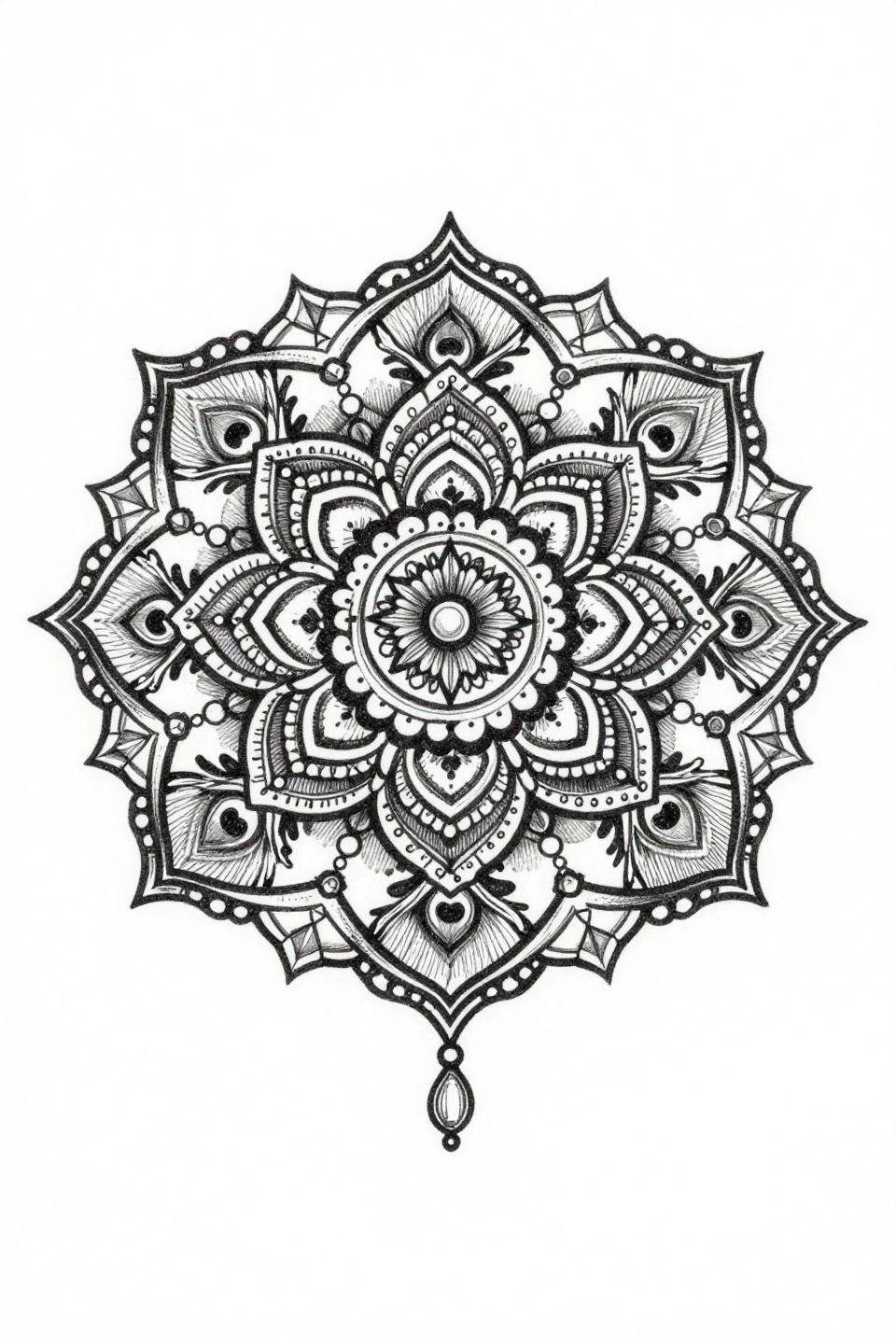
Etching woodcut style on a twelve-petaled central rosette, nested rings of mehndi lattice and scalloped arcs, outer border of suspended diamond chains with vine tendrils and peacock eye fills executed in parallel-line engraving and crosshatch shadow mapping.
Parallel-line crosshatch density creates tonal depth that grey wash cannot. On protected placements like sternum or upper back, this rendering style holds its mid-tone structure longer than open-skin locations where line spread accelerates.
Single Unbroken Stroke: The Hardest Mehndi Pattern Test for Any Artist
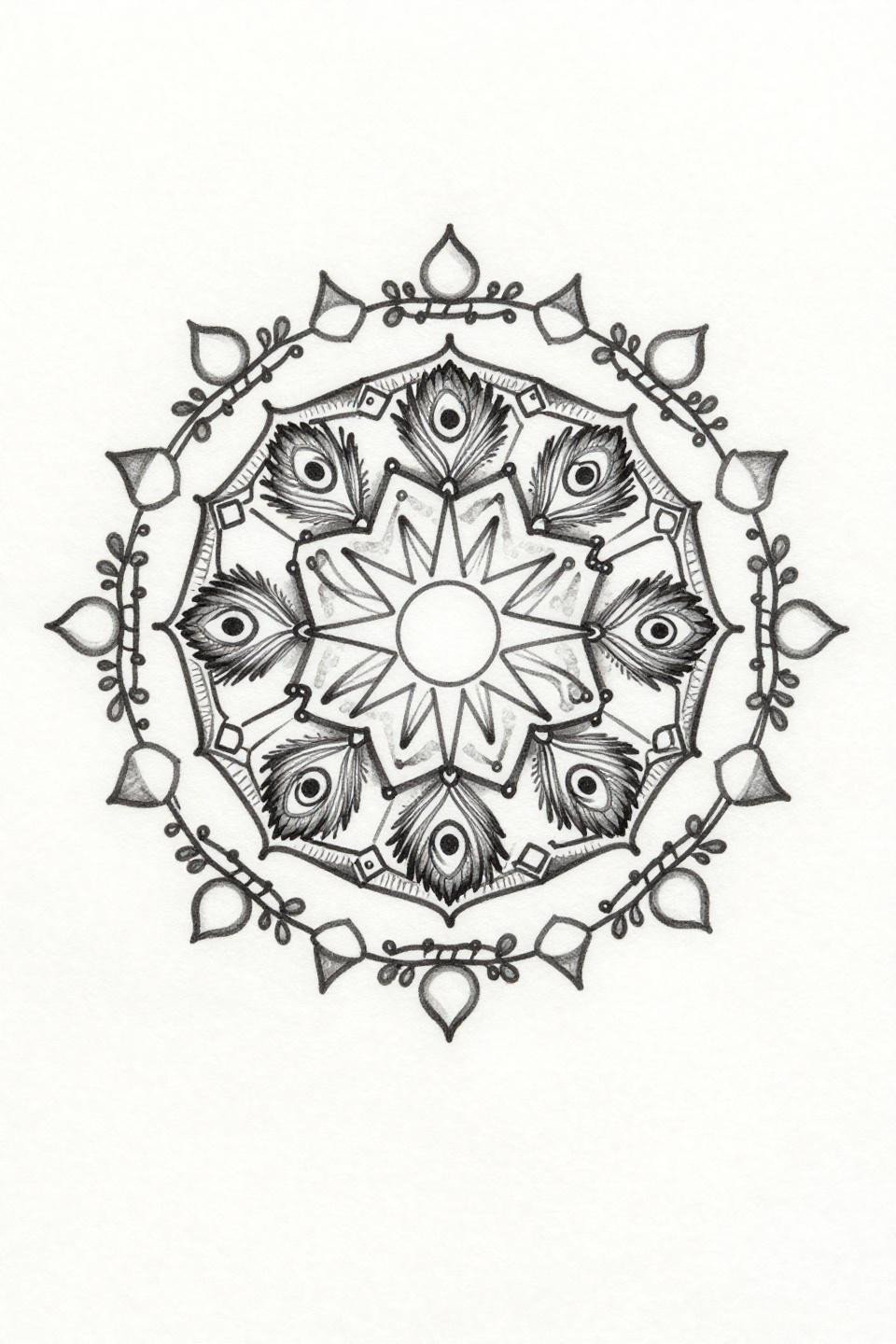
Single continuous line construction on an octagonal mandala: central sunburst star, eight petal chambers holding peacock eye motifs, interlocking hexagon and diamond chain borders, outer perimeter of crescent moons and teardrop clusters with vine tracery, all executed in one unbroken hairline stroke with no fills.
The single-needle 1RL continuous line format exposes hand control more than any other mandala style. No fill, no correction, no hiding behind density. An artist portfolio showing clean healed versions of this work is a serious skill signal.
Fine Line Negative Space: Where Modern Mehndi Meets Minimalist Permanence
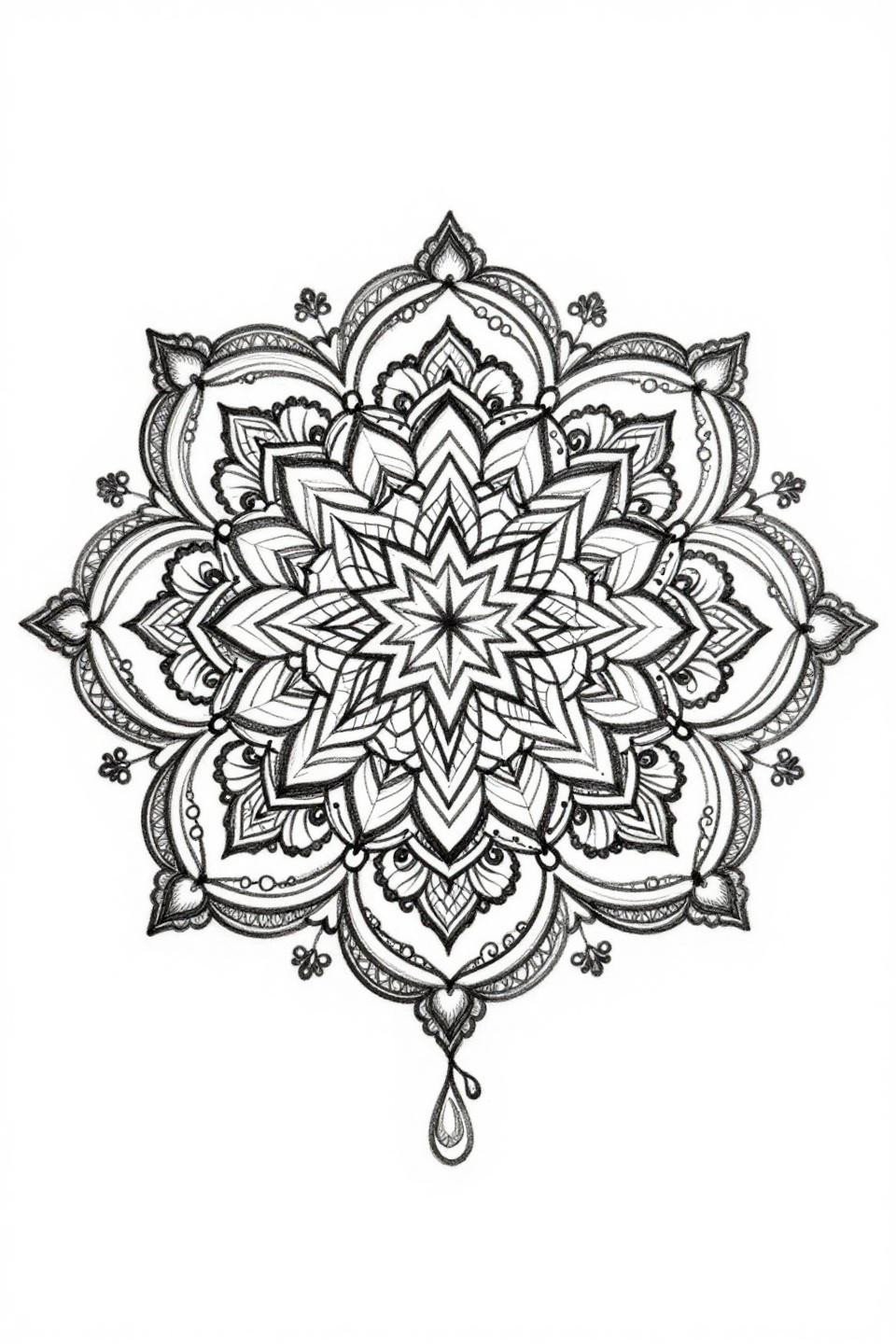
Fine line minimal construction on a twelve-pointed star center, concentric rings of scalloped petals and geometric lattice, outer border of suspended teardrop clusters with vine tendrils and micro-floral lace infill in hairline 0.5mm single-needle strokes with open negative space and no grey wash.
This is the format most likely to need touch-up at the three-to-five year mark. Open negative space with no anchoring fills means the design reads entirely on line weight. On lighter skin it holds longer. On olive and darker tones, slightly heavier line weight upfront extends the read. See more modern mehndi design inspiration that handles this balance well.
Watercolor Wash Mandala: The Round Design That Requires an Anchor
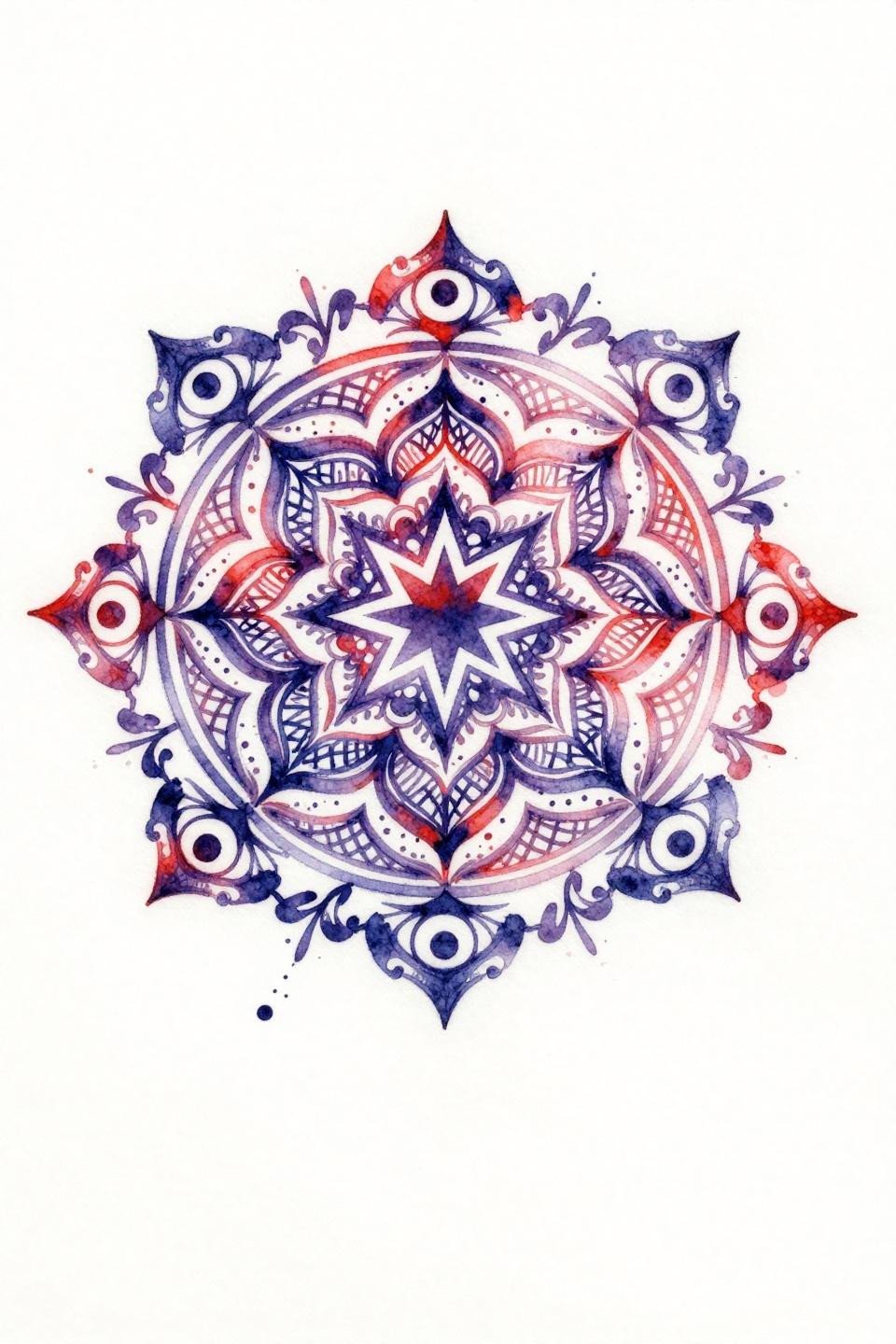
Watercolor splash on an eight-pointed star center, nested rings of scalloped lotus petals and fine lattice, outer border of peacock eye motifs with crescent moon clusters and vine tendrils in deep indigo and crimson washes bleeding at edges.
Watercolor without a defined black ink structural outline blurs by year three to five on any skin placement. This flash works as reference for the layout and color logic, not as a tattoo specification without artist-added linework anchoring each zone.
Irezumi Mandala: What Japanese Outline Weight Does for Symmetry Legibility
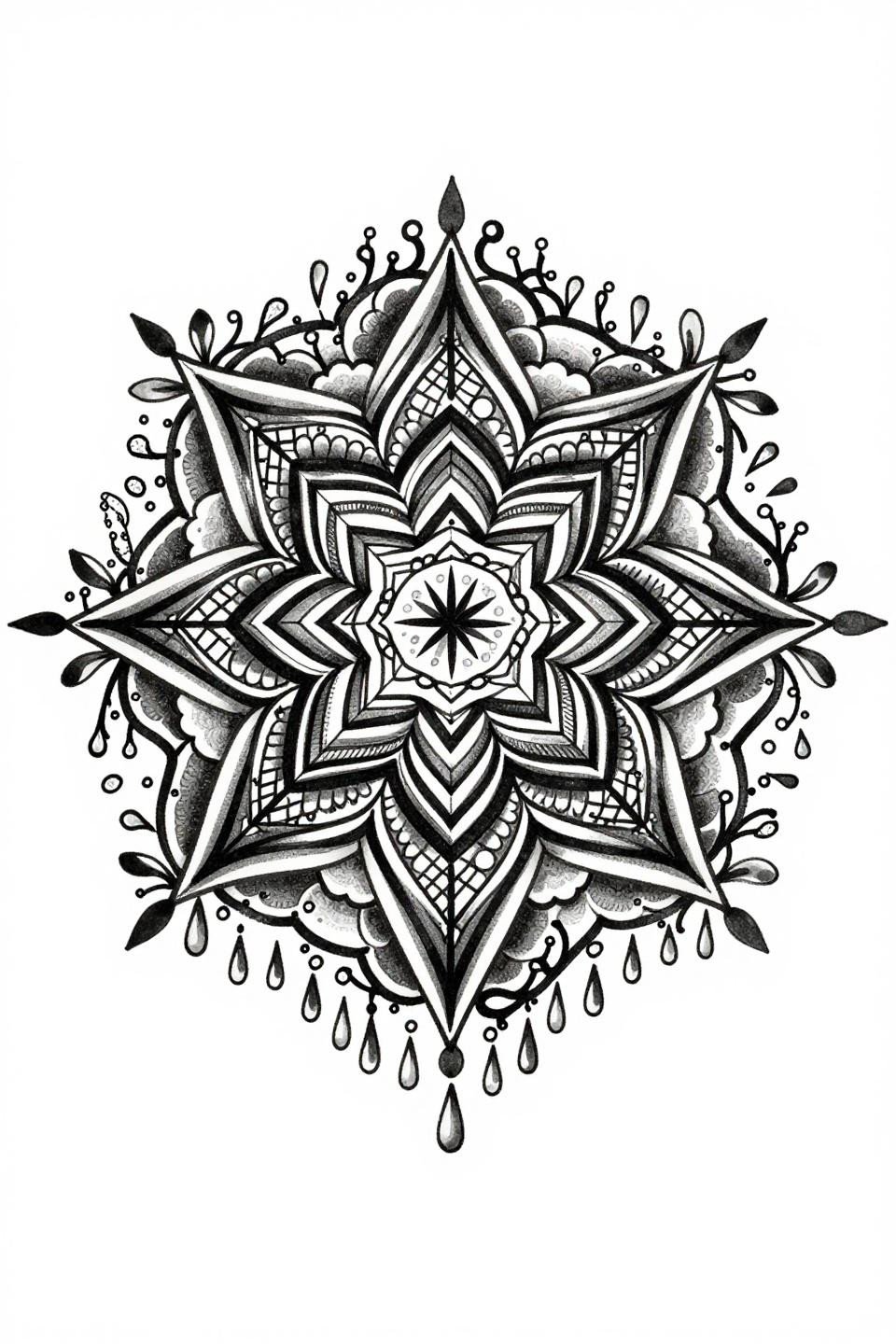
Japanese irezumi construction on a hexagonal star center, six concentric rings alternating scalloped petals and triangular geometric lattice, outer border of flowing mehndi vines with suspended teardrop clusters and micro-diamond fills, bold 2-3pt black outlines with flat black ink fills.
Flat fills with no patchiness separate veterans from beginners on this format. A single-pass flat black field that shows brush direction or skip marks in healed photos is the tell. Request healed shots specifically before booking irezumi-style mandala work.
Celtic Knotwork Mandala: Negative Space as the Design Element Itself
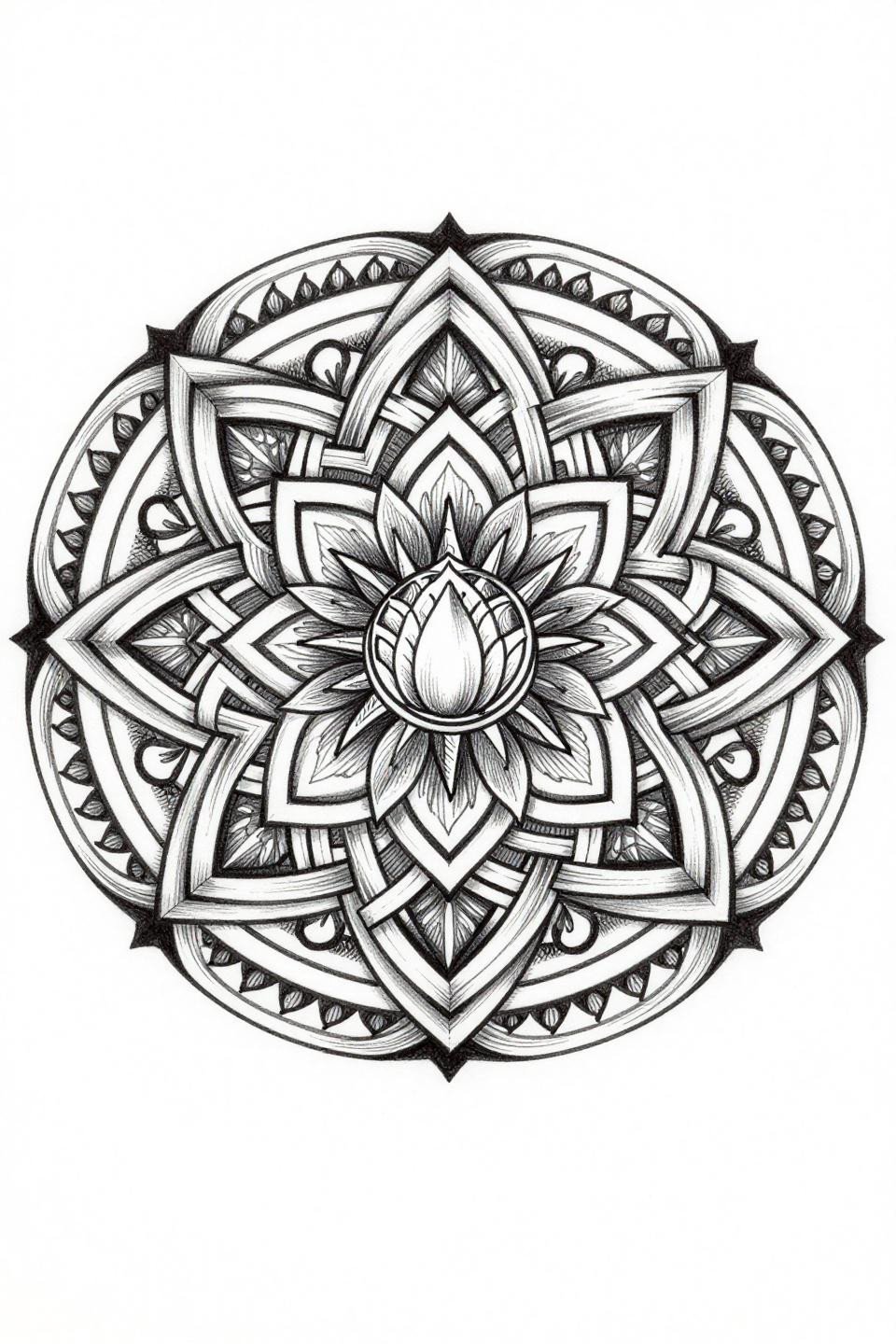
Celtic knotwork applied to a circular mandala: eight-petaled central lotus, nested rings of interlocking geometric chevrons and arrow points, outer perimeter of fine mehndi chains and teardrop fills creating lace-like negative space, executed in compass-drafted precision with crosshatch shadow mapping.
The lace-negative-space structure here is placement-sensitive. On the palm, where skin flexes constantly, fine lattice with open negative space holds its read longer than dense fill formats. For simple mehndi patterns for beginners, this construction logic applies even at lower complexity levels.
Tribal Angular Geometry: No Grey Wash Needed When Contrast Is Absolute
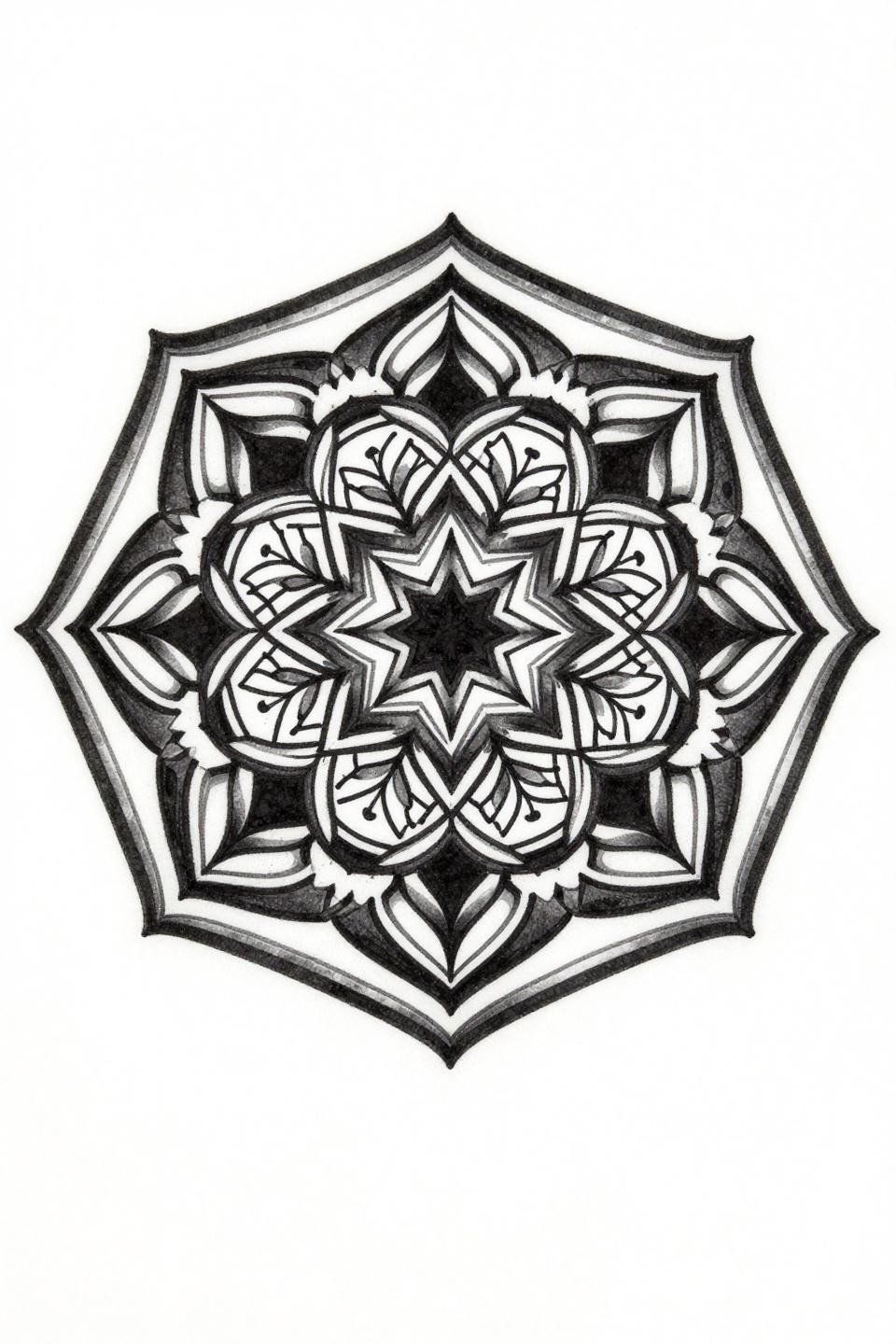
Tribal geometric mandala: eight-pointed star center, concentric rings of interlocking angular petals, sharp teardrop and crescent moon motifs radiating outward, dense mehndi lattice creating negative space flower buds, bold 2-3pt outlines with flat black fills and no grey wash midtones.
Blackwork at full saturation holds density indefinitely when the artist commits to layered passes. This is the highest-contrast format in the collection and the most forgiving across skin tones. What reads on light skin reads equally sharp on deep complexions.
Art Nouveau Curves: When Organic Flow Replaces Geometric Rigidity
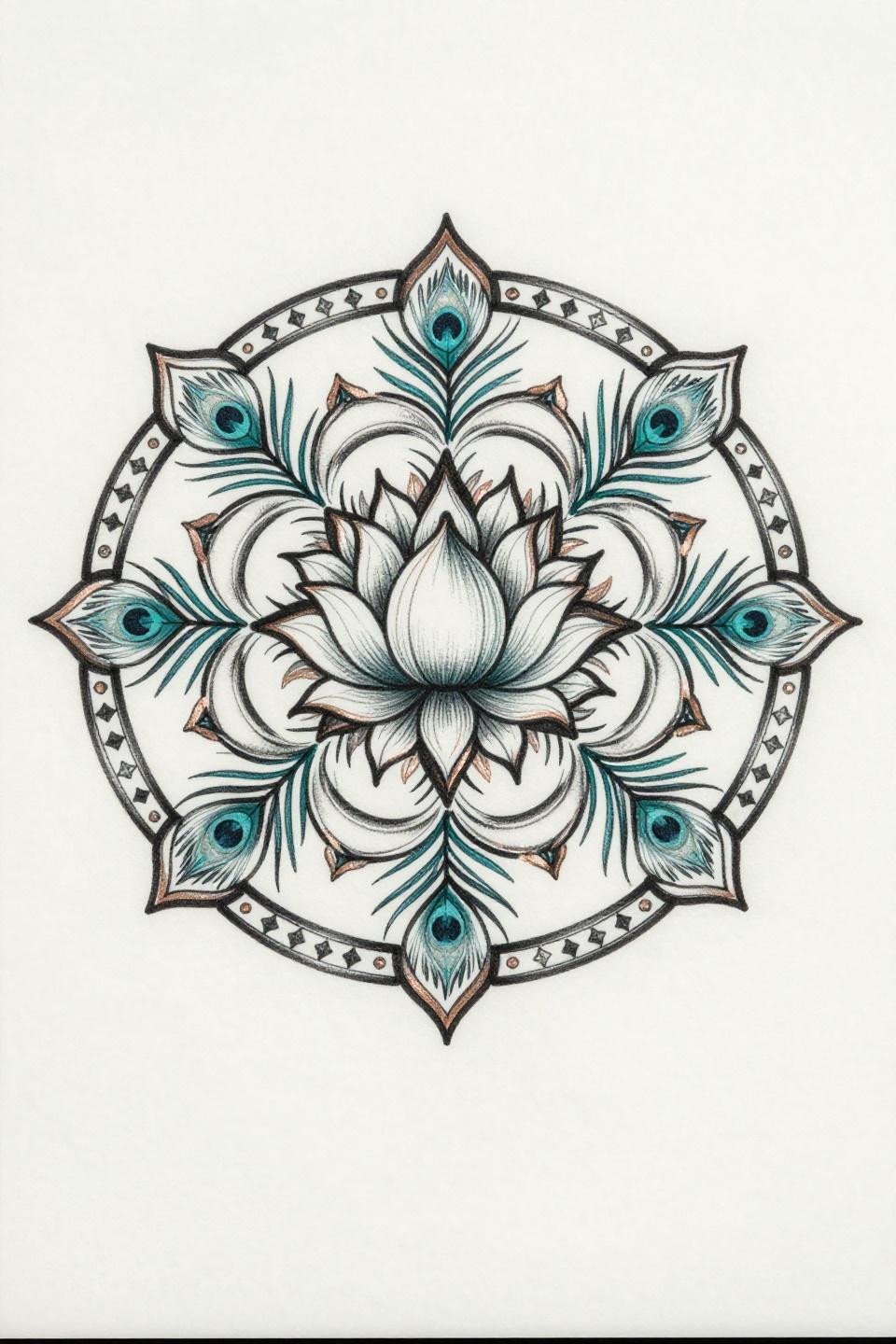
Art Nouveau radial mandala: central teardrop lotus bud surrounded by eight alternating peacock feather motifs, outer ring of interlocking diamond chains with micro-floral infill, executed in curved organic linework with whip shading contour strokes in deep teal with copper metallic accent.
The curved organic contour linework in this style demands consistent speed control from the artist. Any hesitation reads as wobble in flowing organic lines far more visibly than it would in straight geometric construction. This is senior-level work.
Botanical Precision: The Hexagonal Frame That Changes Mandala Geometry
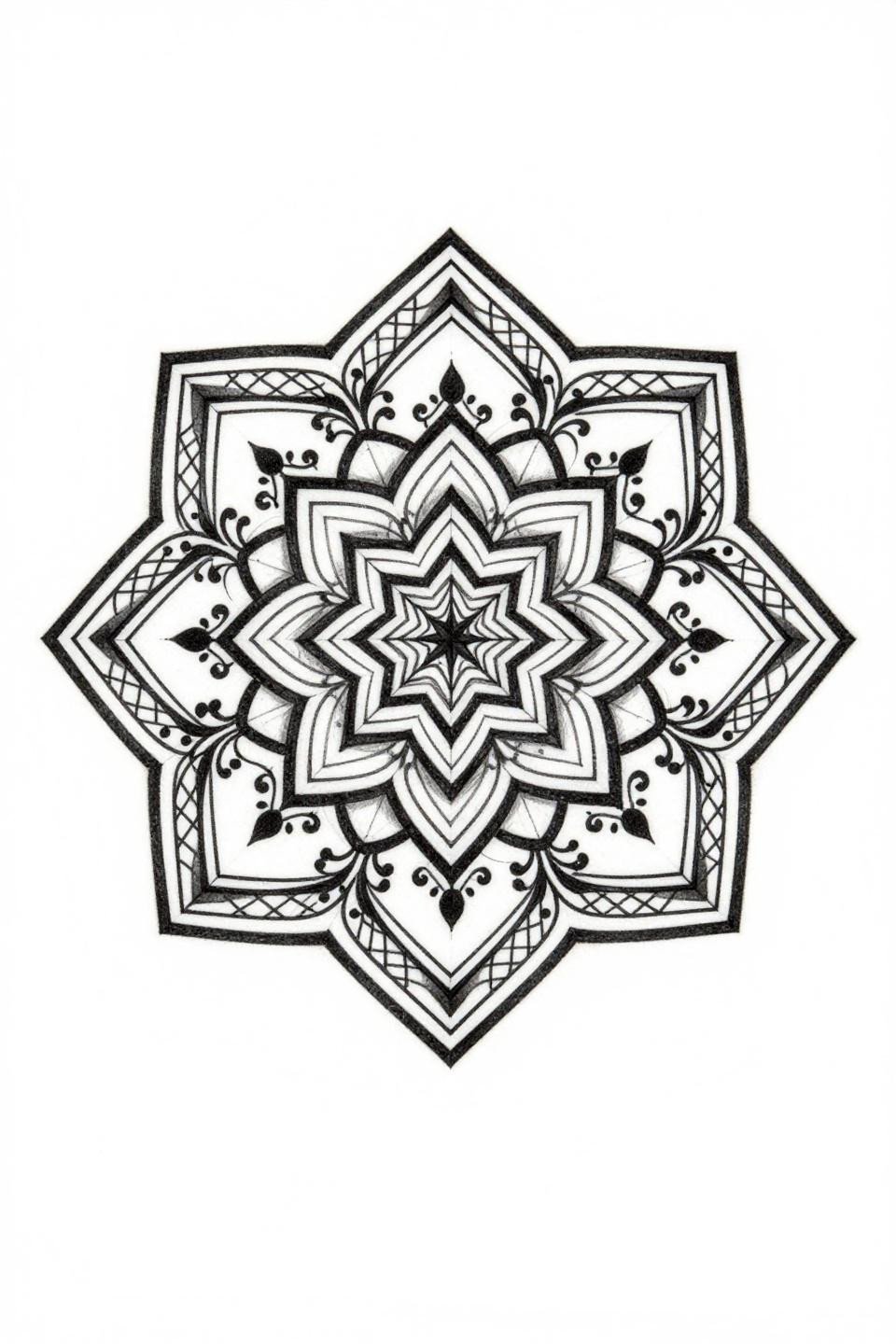
Botanical scientific approach on a hexagonal mandala with diamond frame: central star polygon, ornamental vine tendrils spiraling outward, fine linear mehndi lattice and teardrop motifs filling each panel, executed in vector-precision linework with sharp ruled edges and open negative space.
The diamond frame composition breaks radial convention by anchoring the design at four diagonal points rather than a true circle. This gives it directional read on the palm that circular formats cannot achieve. A useful distinction when placement orientation matters.
Dotwork Density Gradient: The Stipple Map That Ages on Its Own Terms
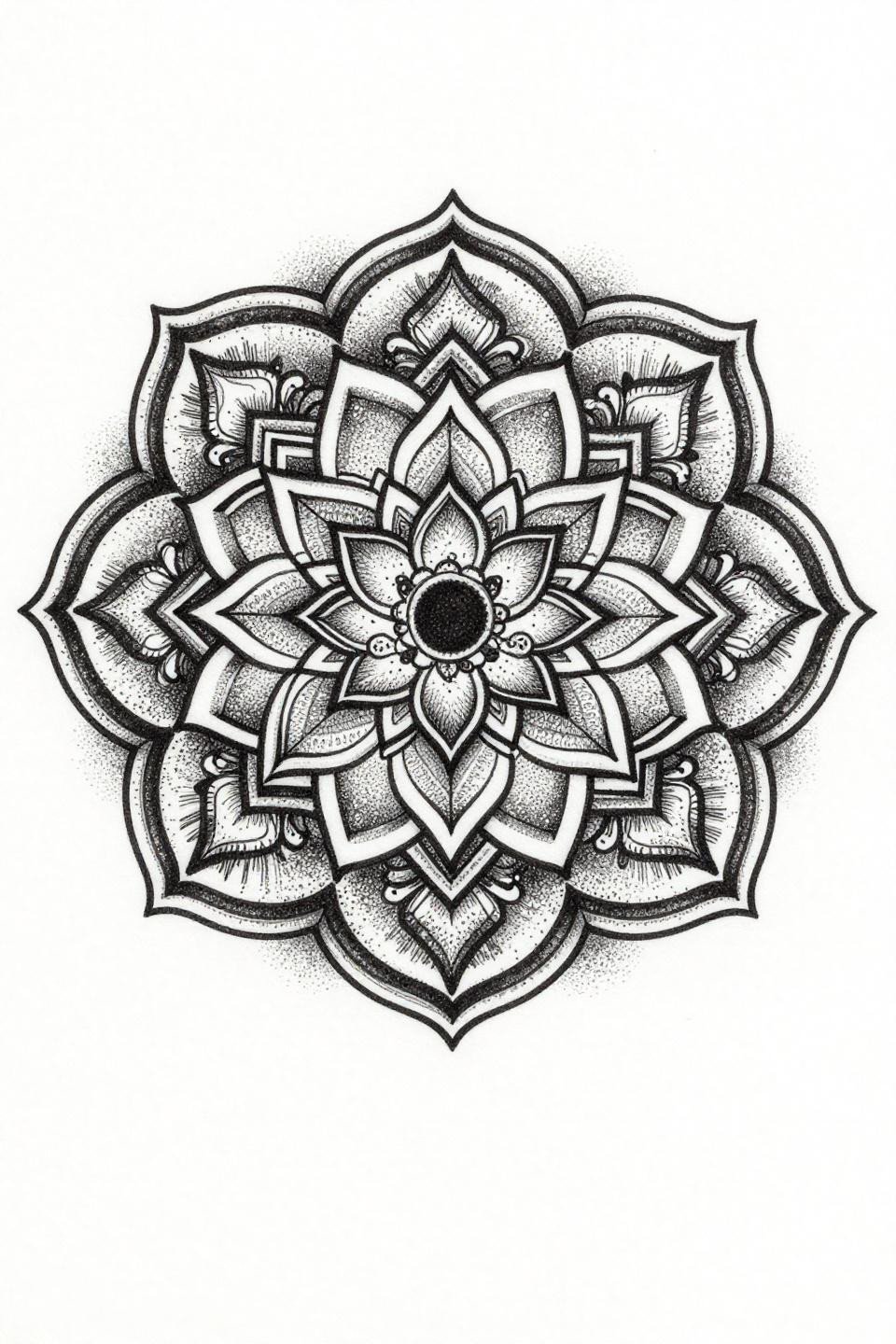
Stipple dotwork mandala: central lotus with symmetrical eight-petal array, radiating geometric rings with fine linear mehndi detail fills, dense dotwork gradient mapped from core outward in bilateral symmetry, no solid fills, tone built entirely from dot density variation.
Stipple density mapping from 90% at center to open at edges is the technical challenge here. Consistent dot size across the full gradient is the artist quality check. Irregular dots in healed work mean inconsistent hand speed, and that shows at every stage of aging.
Pick three to five of these references based on placement first, style second. Front palm work needs bolder line weight than upper back. Scale and skin tone determine which rendering approach survives. Send the shortlist to your artist and ask for healed examples in the same style before booking.