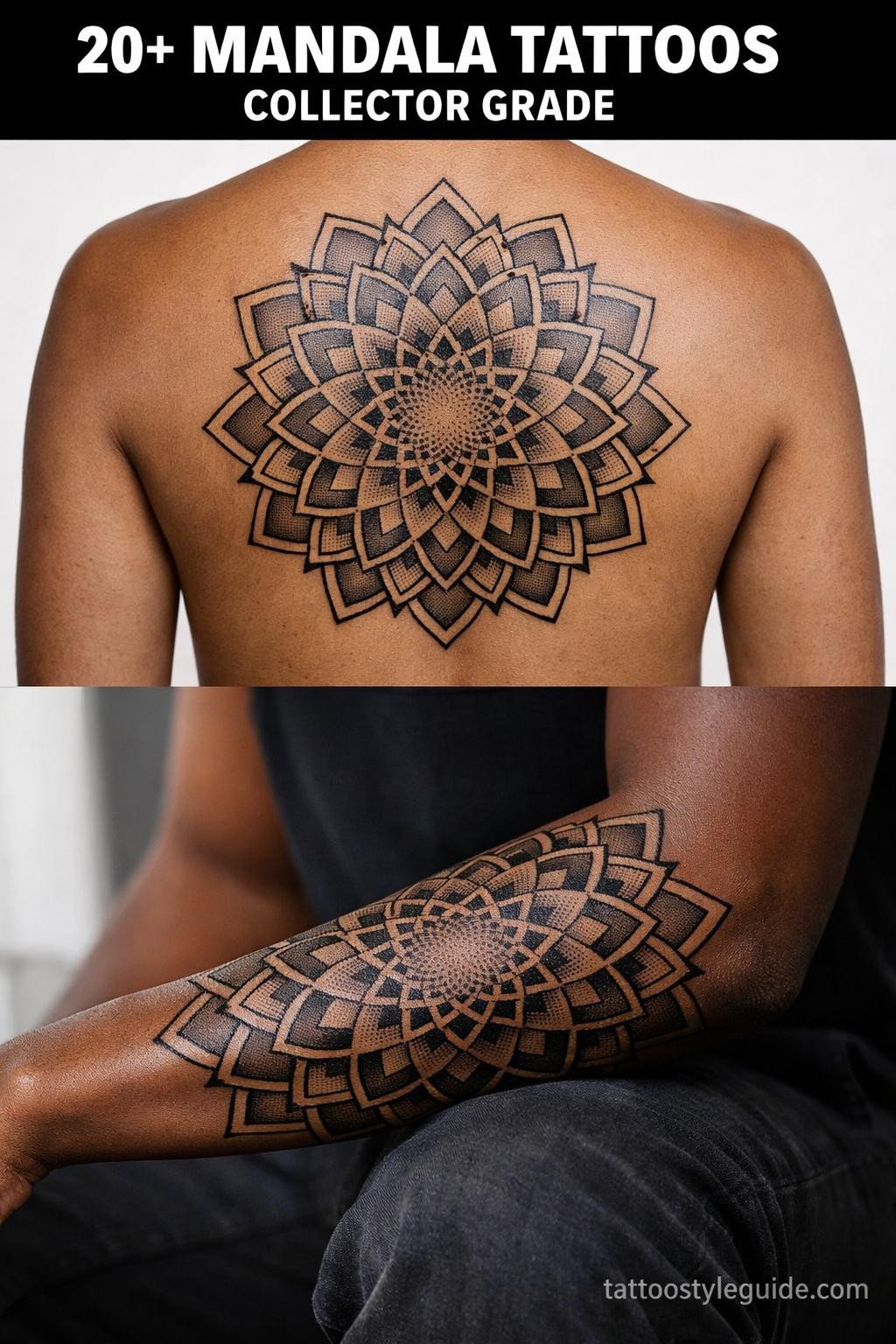
Mandala tattoo design is one of the most technically demanding styles in the genre, and most people underestimate why. The rotational symmetry has no margin: one ring that drifts 2mm off-axis reads as a mistake from three feet away.
What separates a strong mandala from a weak one is not complexity. It is geometric discipline at the linework level, specifically whether the artist can hold consistent arc tension across every ring without a compass guiding them in real time.
The 20 flash references below cover the full range, from traditional American half-mandalas to fine-line single-needle work, dotwork gradients, and Celtic knotwork formats. Each one signals something specific about what it demands from an artist.
Where a Half-Mandala Either Lands or Falls Apart
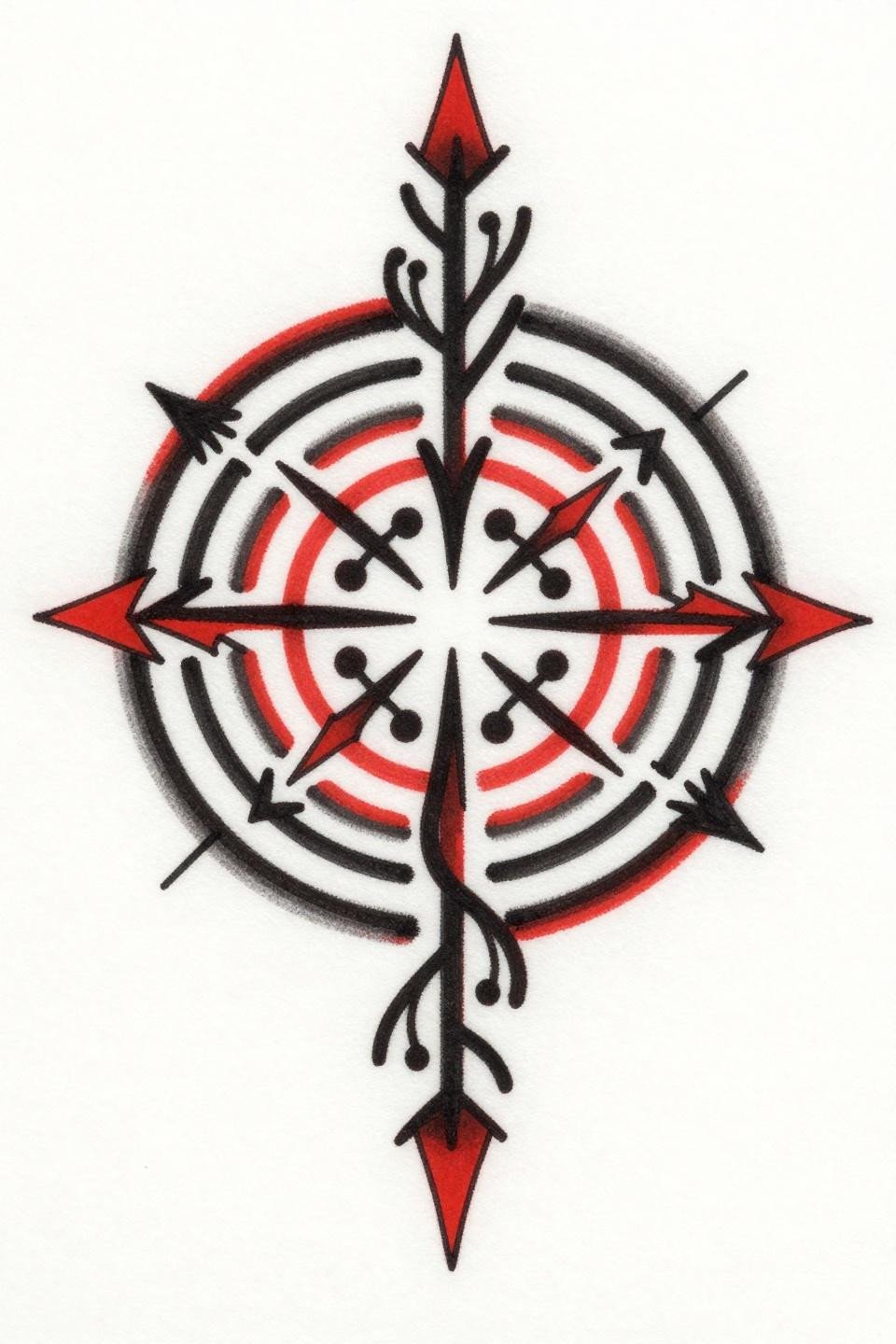
This half-mandala runs along a central vertical axis with alternating chevron rings and organic vine tendrils, finished with a crescent perimeter carrying radiating spike terminals. The crimson accent fill is used sparingly, which keeps the traditional American weight without pushing into full color flash territory.
The asymmetric flow at the outer edge is the placement tell: this composition is built for a sternum or spine line, where the straight axis anchors against the body’s natural center. Any wobble in that vertical reads immediately on skin.
Five-Fold Symmetry Is the Hardest Count to Draft
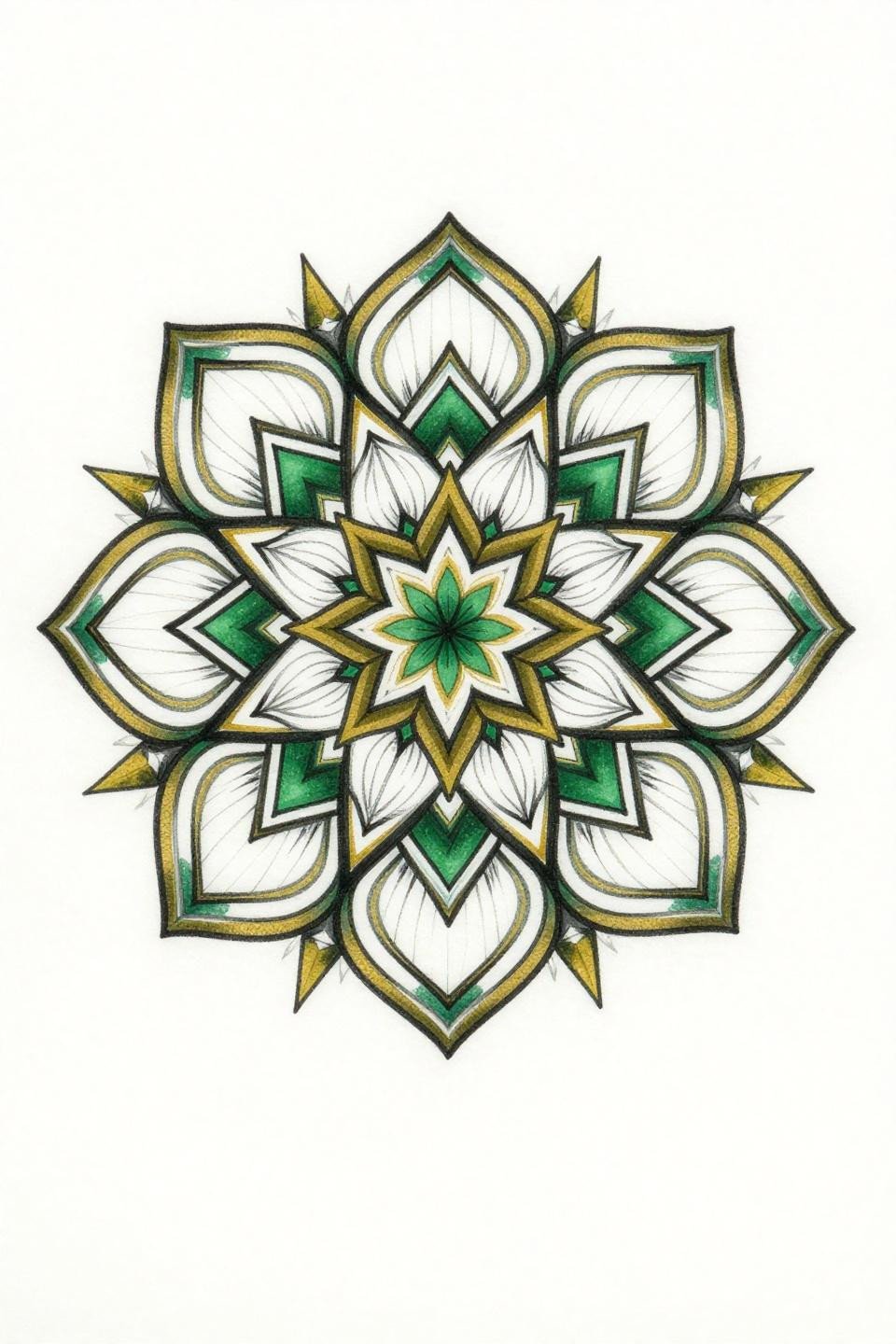
Five-fold symmetry is rarer in mandala flash because it does not divide evenly into a circle by standard geometry tools. This design resolves it through a starburst core of alternating diamond rays and concentric crescents, then layers lotus petal rings with fine vein anatomy drawn in forest green and gold.
The botanical vein detail inside each petal is the artist skill signal here. Consistent vein weight across 20-plus petals in a single sitting separates artists who work from muscle memory from those still measuring every stroke.
Icosahedron Core: Where Geometry Gets Uncomfortable
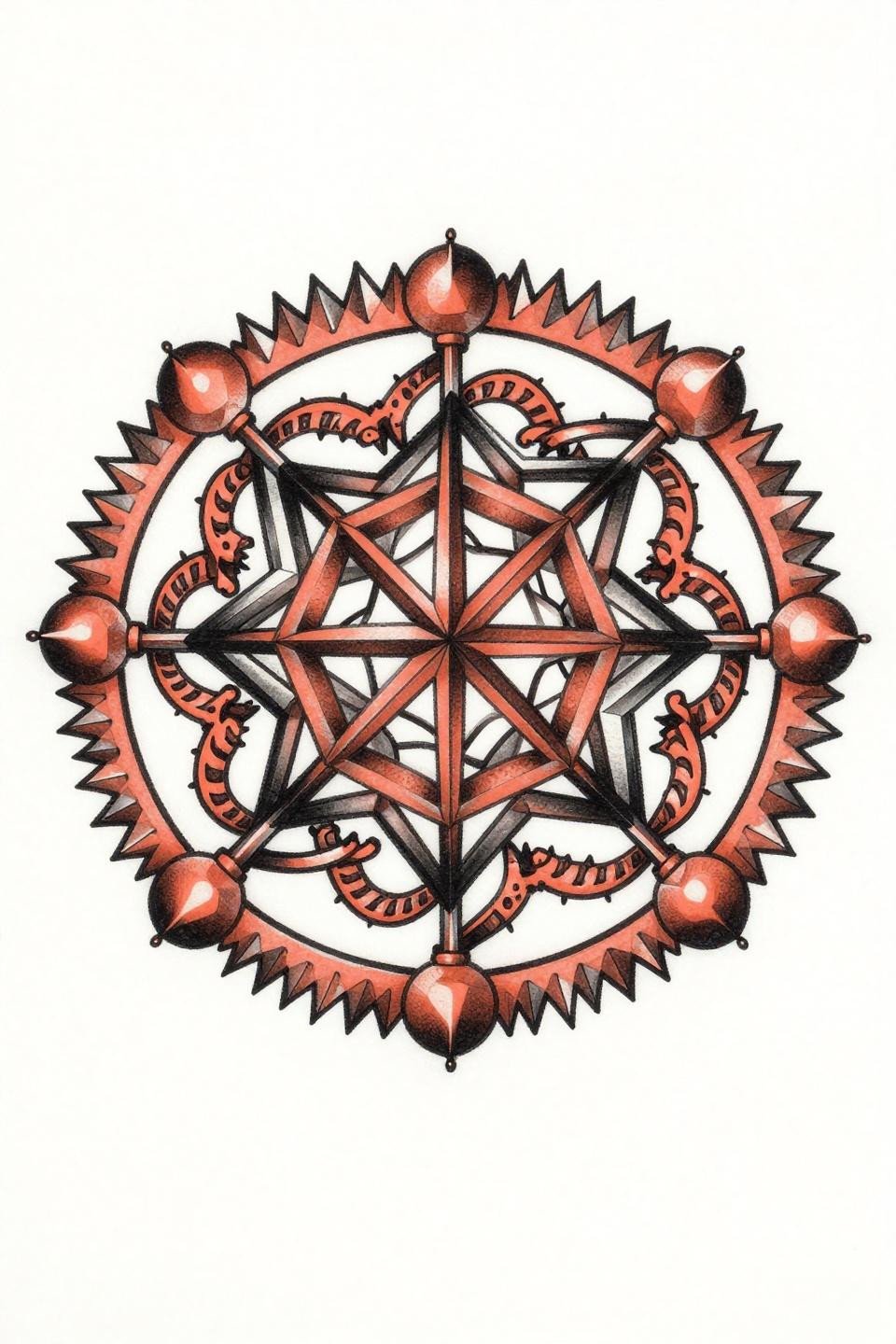
A central icosahedron surrounded by 12 concentric rings, alternating polyhedron faces with curved spiral tunnels, and finished with crystalline spike clusters at the perimeter. The coral and charcoal fill palette is an unusual call that softens what would otherwise read as purely mechanical geometry.
On olive and darker skin tones, the coral fill risks muddying without strong black outline separation. The 2-3pt outlines carry all the contrast load here, which is exactly why the line weight needed to stay bold. For more complex back placement options for larger designs, this format scales well to a shoulder blade or upper back field.
Isometric Cube Rings and the Problem of Optical Depth
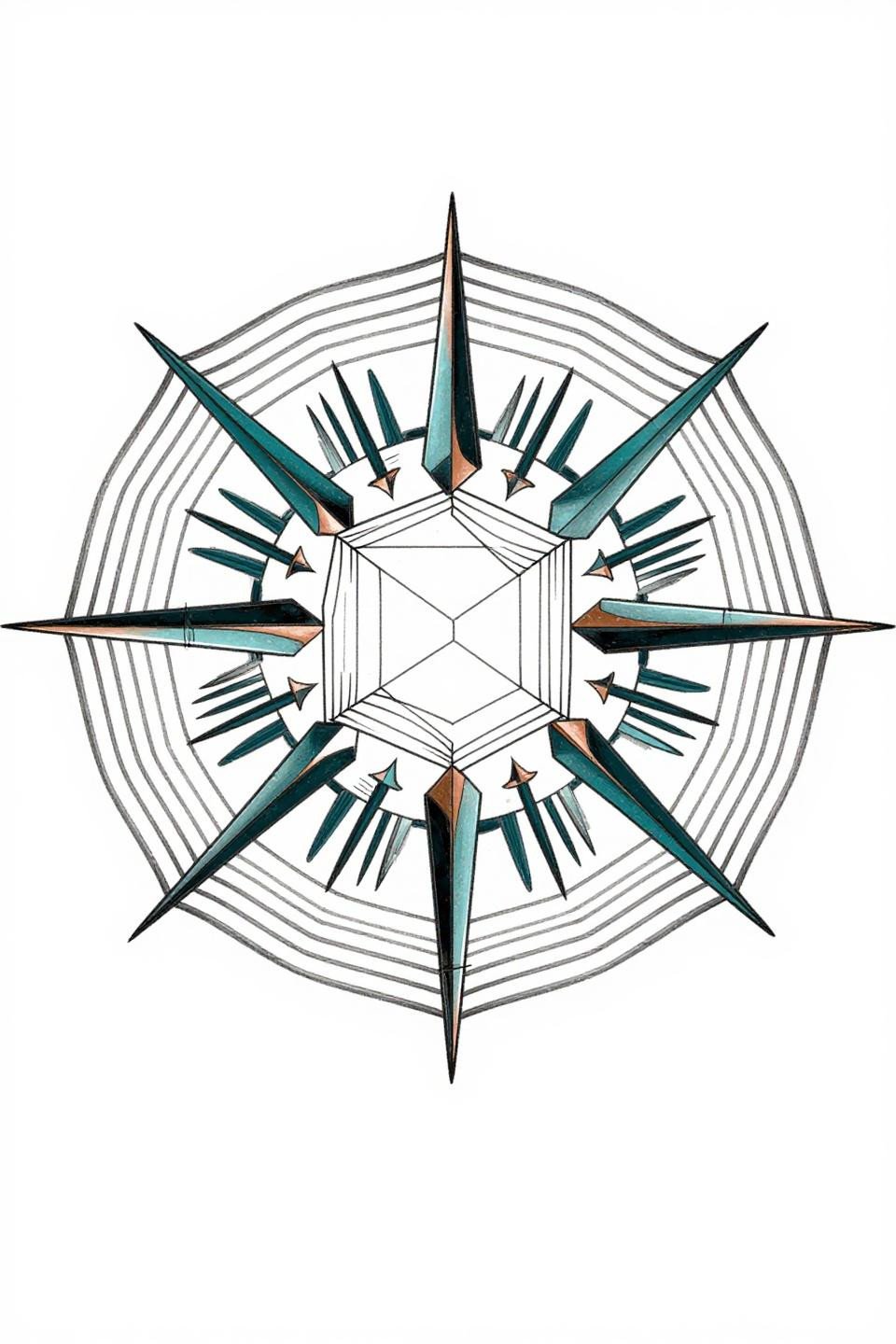
Nested concentric square rings in isometric perspective, collapsing into a hollow cube chamber at the center, with angular spike terminals at the outer edge. The deep teal and copper metallic accent on black works because the two tones sit far enough apart on the value scale to stay readable under studio lighting.
Four-fold rotational symmetry is the most forgiving count to tattoo because horizontal and vertical axis lines can both be checked against the stencil grid. This is a good entry-point format for collectors who want geometric precision without commissioning something that takes three sessions to complete.
Hexagonal Lattice and the Six-Fold Symmetry That Locks In
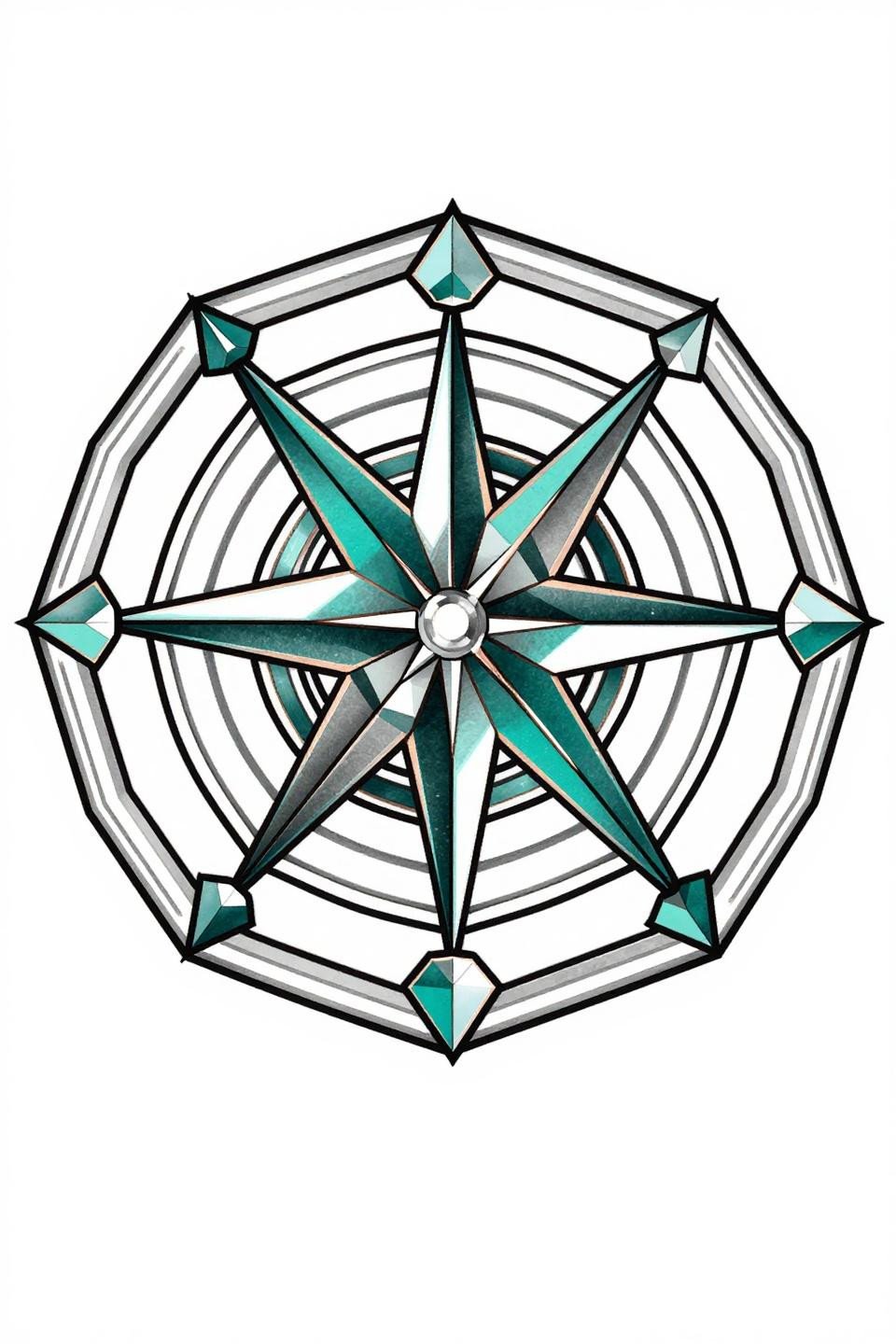
This design builds a prismatic core from an isometric cube lattice, then expands outward through nested hexagonal rings with alternating geometric starbursts and angular shield terminals. The six-fold rotational format is the structural standard for most compass-drafted mandala flash because it aligns naturally with circle geometry.
Six-fold designs age well when the outline weight stays at 2-3pt minimum. Thinner lines in this density of geometry tend to bleed into each other by year five, especially in placements with sun exposure like the outer forearm or upper arm.
Art Deco Twelve-Fold: When Stipple Fills Replace Solid Black
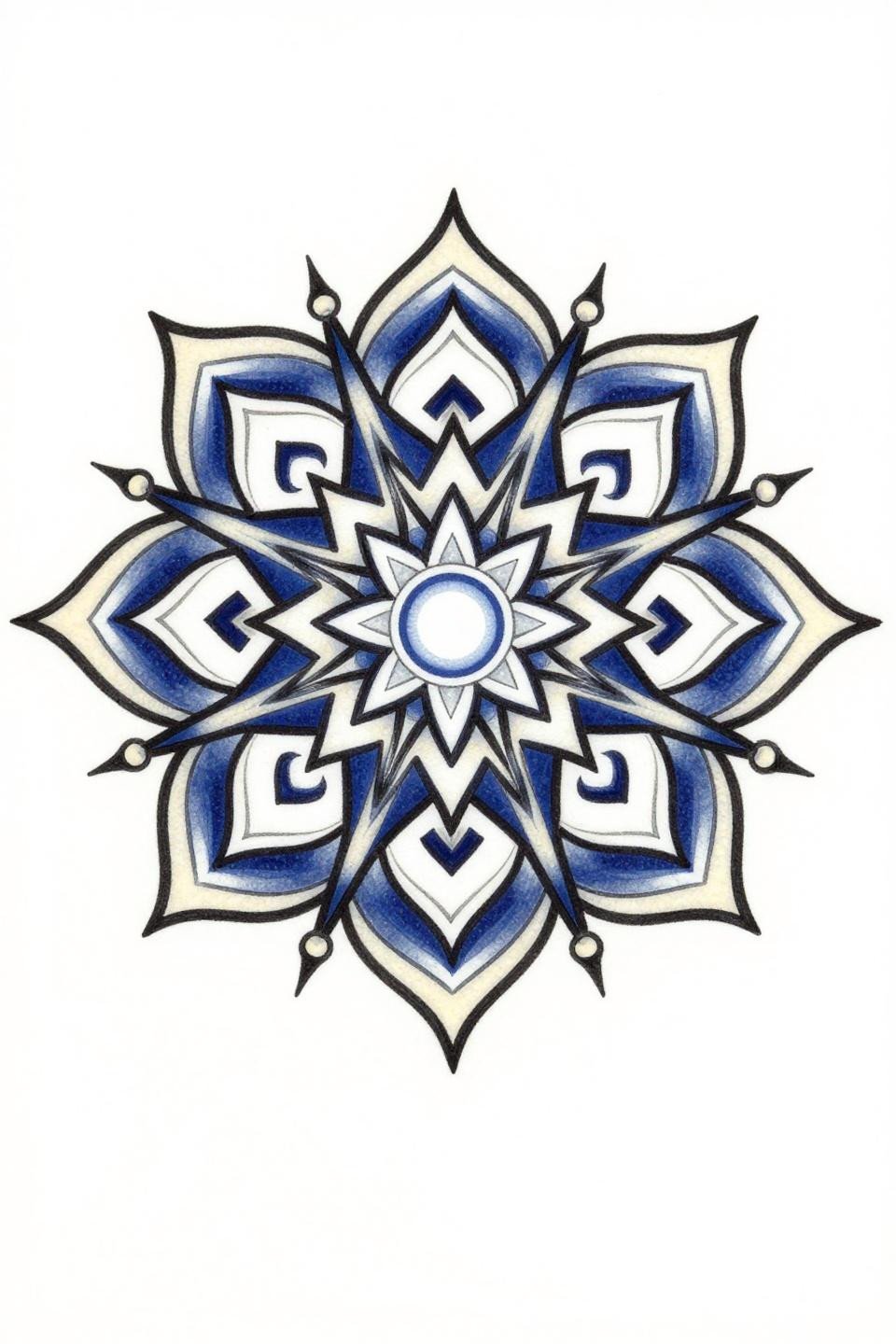
Twelve-fold rotational symmetry with a diamond ray sunburst core, interlocking geometric petals carrying stippled centers, and crescent moon terminals at the outer perimeter. The stipple-filled petal centers against flat navy and cream fills create tonal variation without relying on grey wash dilution, which is the Art Deco move.
Twelve-fold designs demand the longest flash drafting sessions because the angular spacing between each division is 30 degrees, tight enough that a half-degree drift at the core reads as a full misalignment at the outer ring. Check the artist’s healed work portfolio specifically for designs in this count.
Sak Yant Geometry Scaled for Western Skin
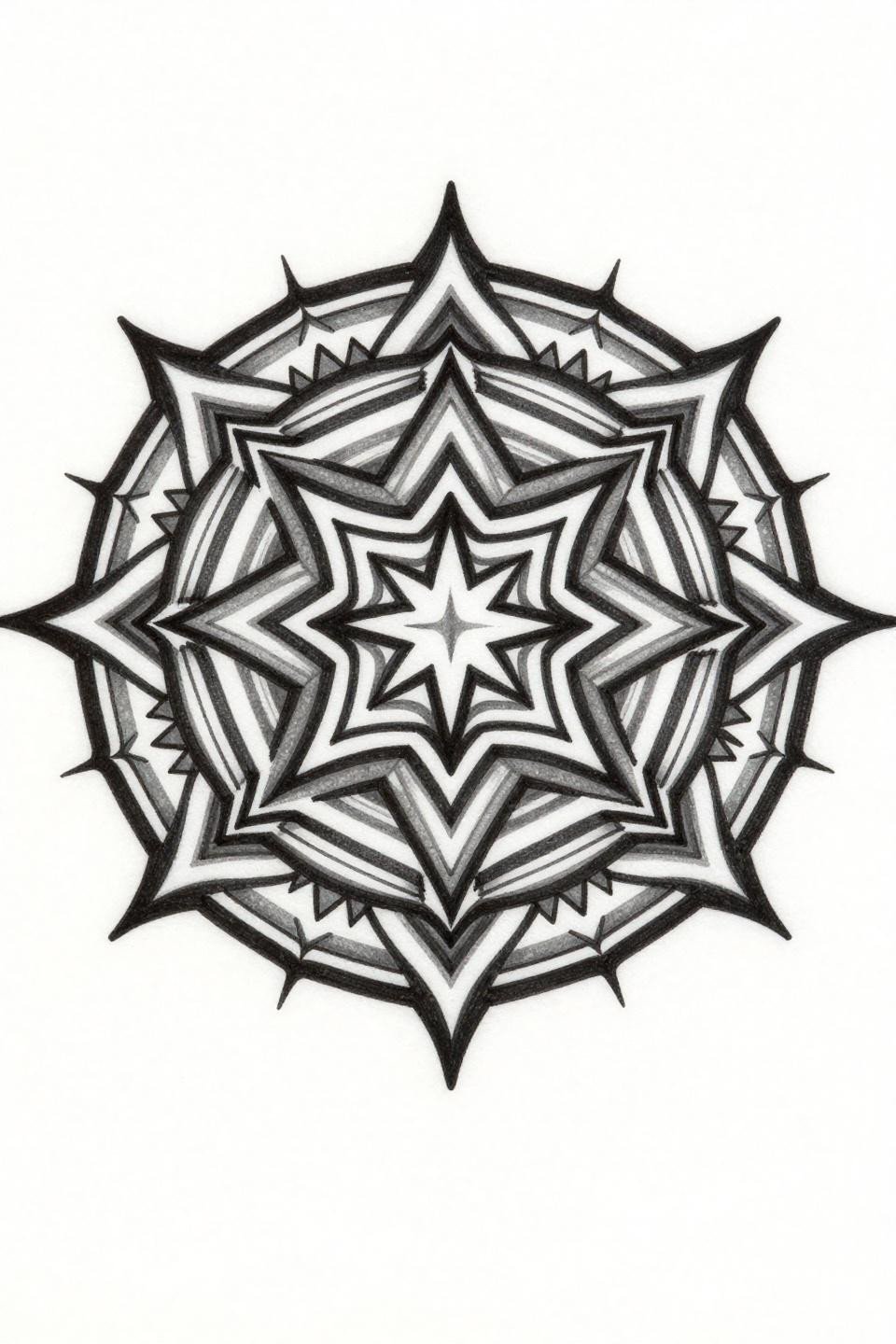
Concentric rings of interlocking geometric scales and sawtooth patterns, collapsing into a four-pointed star with nested diamond chambers, and crowned with radiating terminal spikes. The grey wash dilution for midtones against dense black ink is a departure from traditional Sak Yant execution, which typically stays in flat black, and it is what bridges this design into Western ornamental territory.
This format works as ornamental henna pattern inspiration for collectors who want the density of sacred geometry without the specific cultural weight of traditional Sak Yant placement. The scale ring patterning holds readability at sizes from 4 inches up.
Trash Polka Meets Rotational Symmetry: The Unlikely Pairing
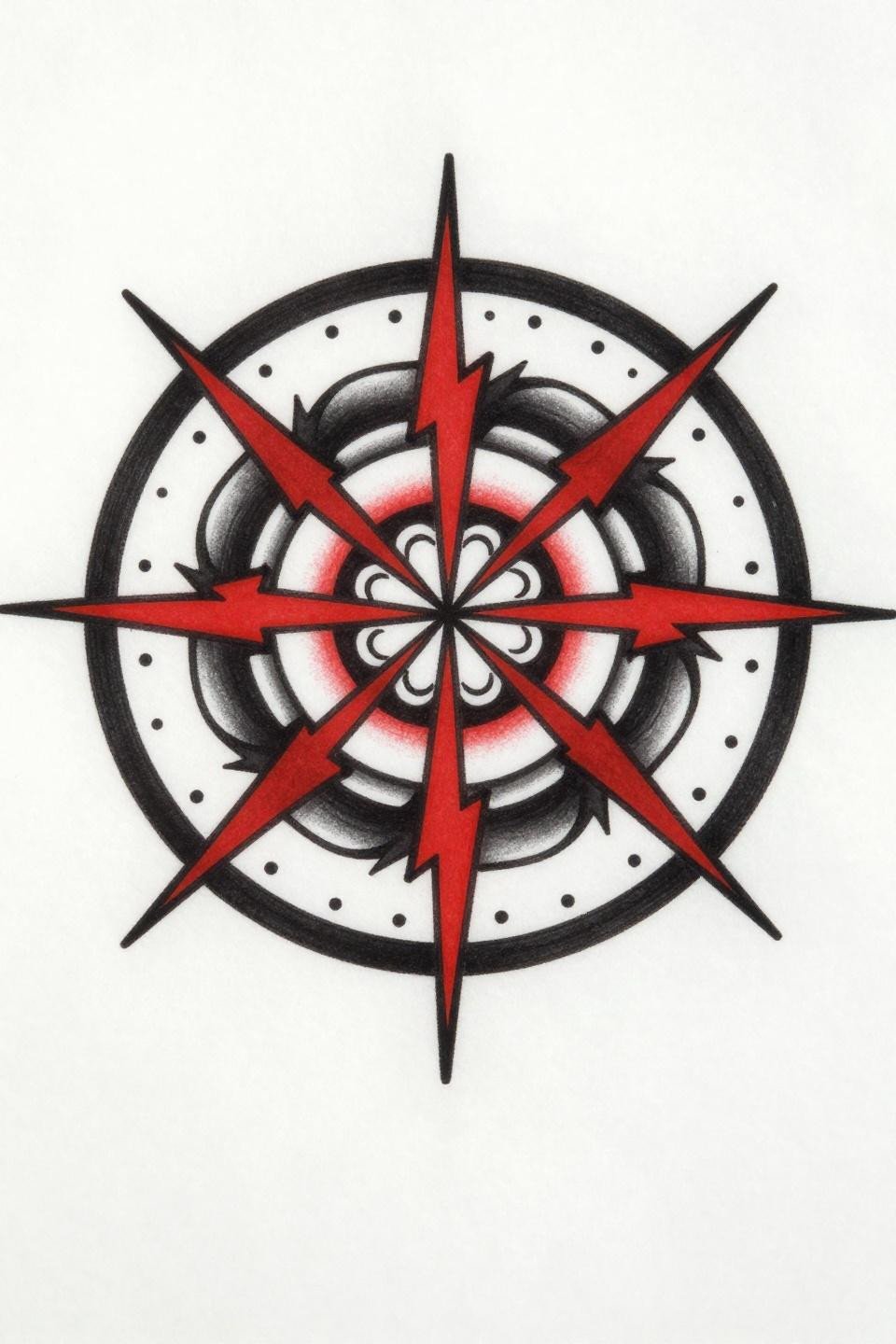
Trash polka traditionally resists symmetry, so building a four-fold rotational mandala from chevron lightning bolts and spiral vortex formations in this style is a structural tension that either reads as bold or reads as confused. Here it holds, because the crimson red accent is used only on the chevron rings and not in the spiral fills, which keeps the eye moving outward in a controlled sequence.
The two-color restriction is doing the heavy lifting compositionally. Any additional color in this density of linework would collapse the contrast and flatten the rotational illusion the design depends on.
Celtic Knotwork Converted to Mandala Format
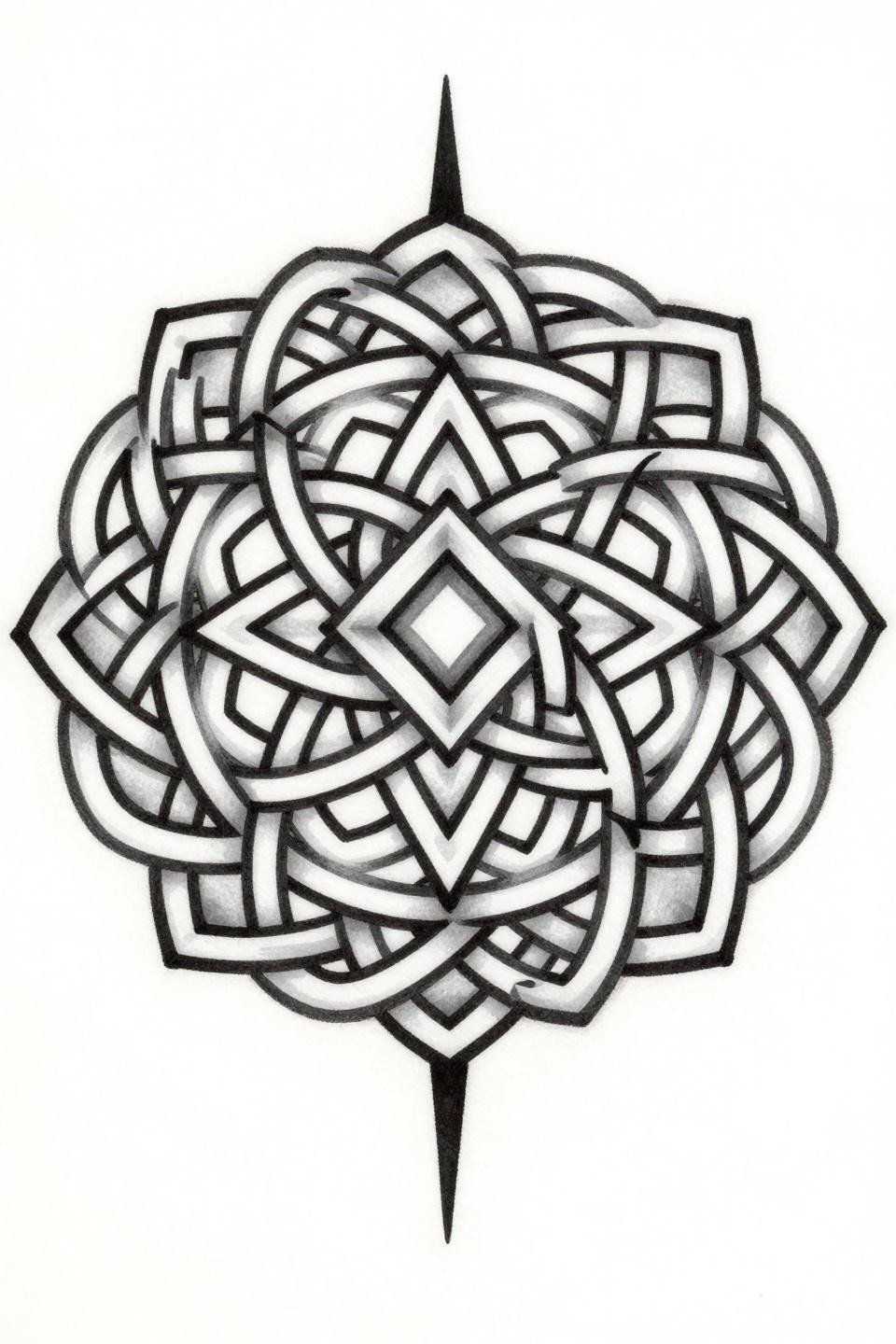
Interlocking knotted bands in concentric rings, alternating chevron teeth and teardrop forms, with a six-pointed geometric star at the center and a terminal spike ring at the outer perimeter. The grey wash midtone work between the black fills is what separates this from flat blackwork Celtic and gives the knotwork its dimensional over-under braid reading.
Celtic knotwork at this ring density is a slow tattoo. The continuous line logic of true knotwork means the artist has to resolve every crossing consistently or the illusion breaks. Request a section of healed knotwork from the portfolio before booking.
Sketch Line Energy in a Precision-Demanding Format
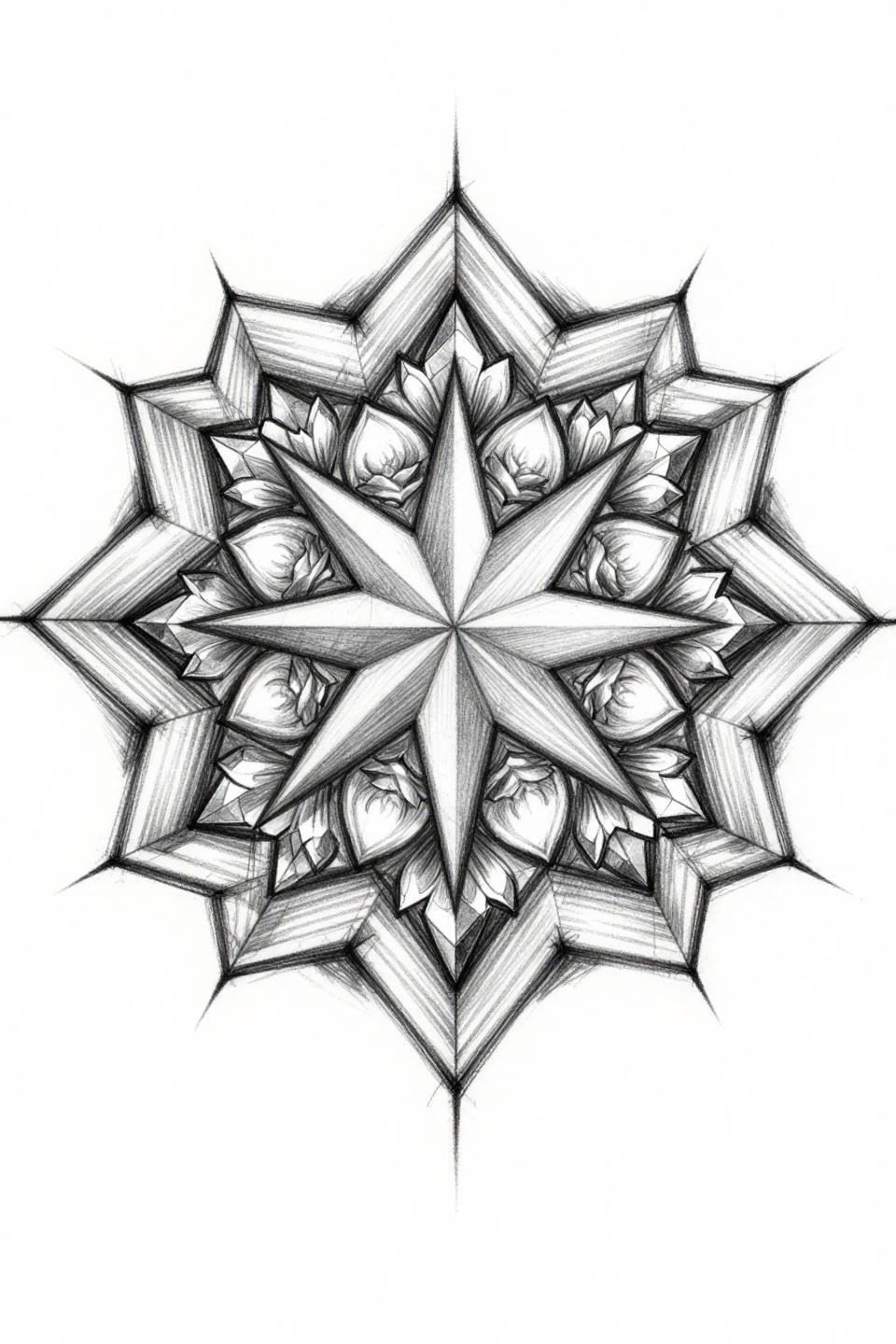
A six-pointed kaleidoscopic star expanding through crystalline fractal rings and lotus bud spirals, drawn in urgent gestural linework with visible hand-drawn imperfection at every edge. The uneven outline weight is intentional here, not a skill deficit. It is what gives the sketch style its energy against the otherwise strict six-fold rotational structure.
This is one of the few mandala styles that tolerates minor stencil imprecision and reads better for it. For collectors drawn to spiritual symbol tattoo designs with a raw, hand-rendered quality, this format bridges geometric discipline and expressive line work without forcing a choice between them.
Eight-Fold Dotwork and the Gradient That Has to Be Earned
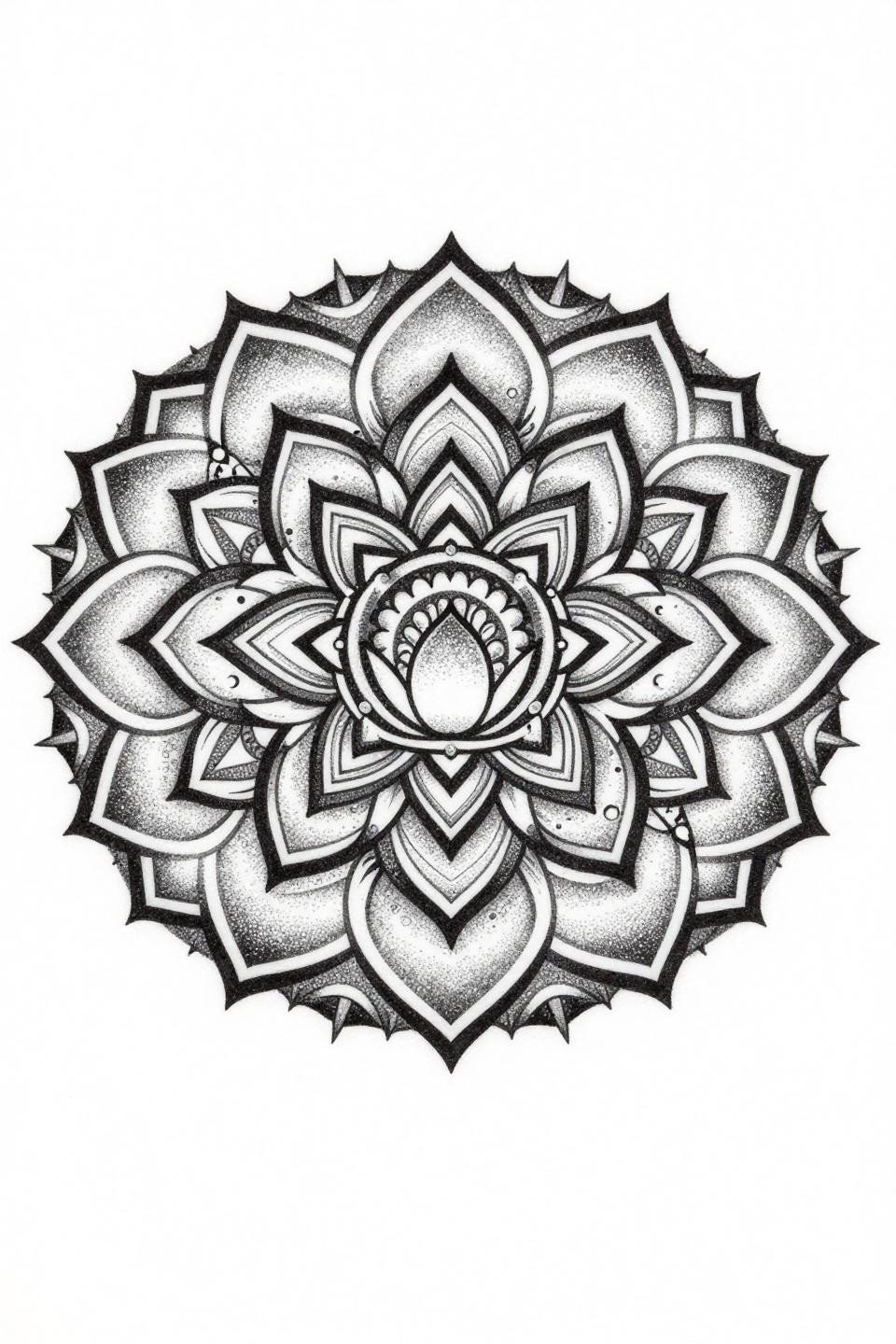
An eight-petaled lotus center expanding through nested chevron bands and concentric spheres, built entirely from stipple dot gradient with no outline structure. Contrast comes from dot density alone, packed at the center and thinning progressively to open negative space at the outer shield ring.
No-outline dotwork mandalas are the most technically demanding format to tattoo cleanly because the gradient transition has to hold across the full diameter with consistent dot spacing. Look for even dot size across the full gradient in portfolio work. Inconsistent dot size is the first sign of rushed stipple work.
Single-Needle Seven-Fold and Its Shelf Life Problem
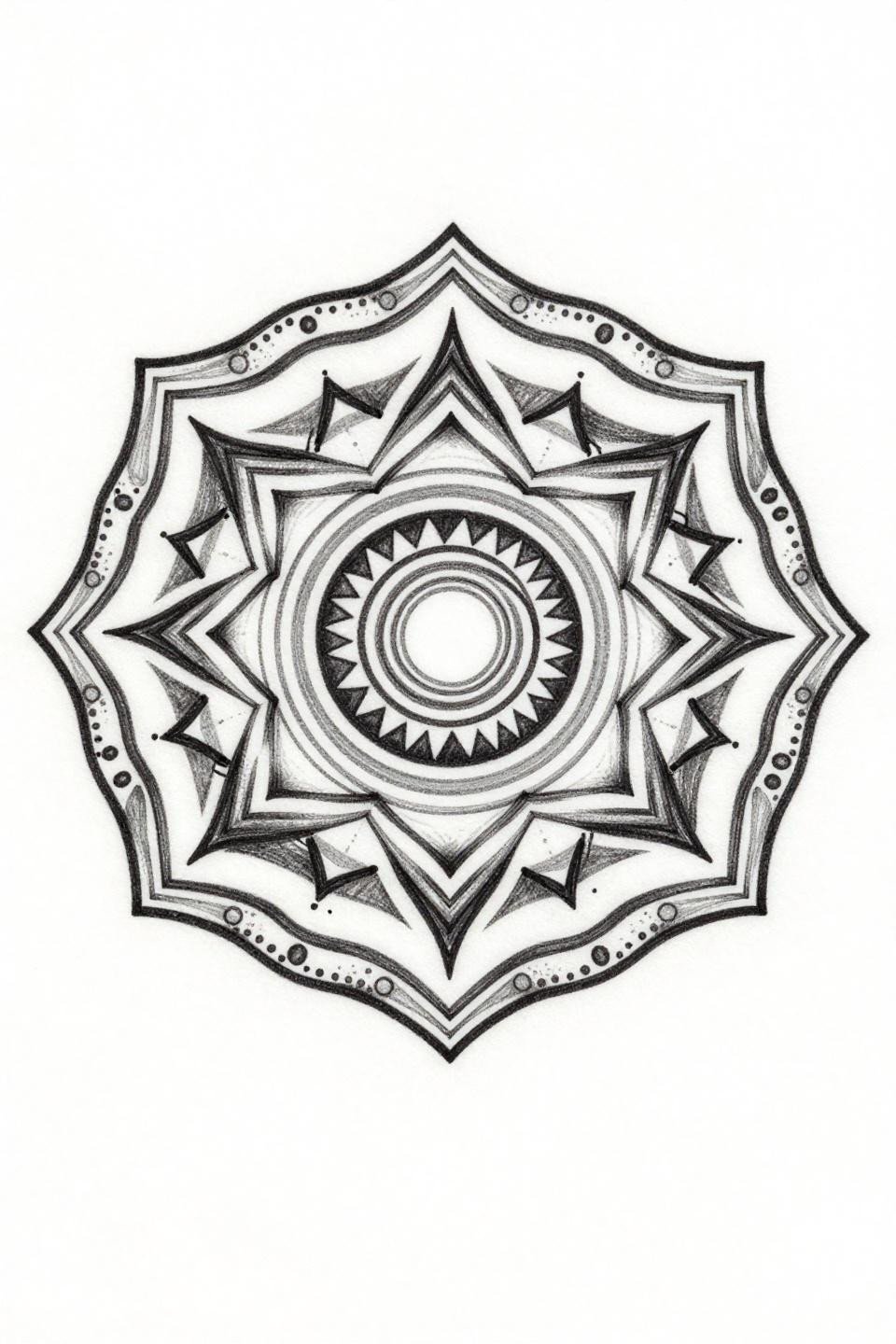
A seven-pointed star core with triangular fractal rings and concentric spirals, drawn in hairline 0.5mm single-needle strokes with generous open negative space between each ring layer. The seven-fold rotational count is the rarest in this collection and one of the hardest to draft cleanly because the 51.4-degree divisions require custom geometry that most compass sets cannot hit directly.
Single-needle work at this line weight needs a protected placement to have any real longevity. Sternum and upper back hold these lines for years. Inner arm or ribcage, where skin flexes and rubs, will need a touch-up within two to three years minimum.
Neo-Traditional Gold Fills and the Ten-Fold Problem
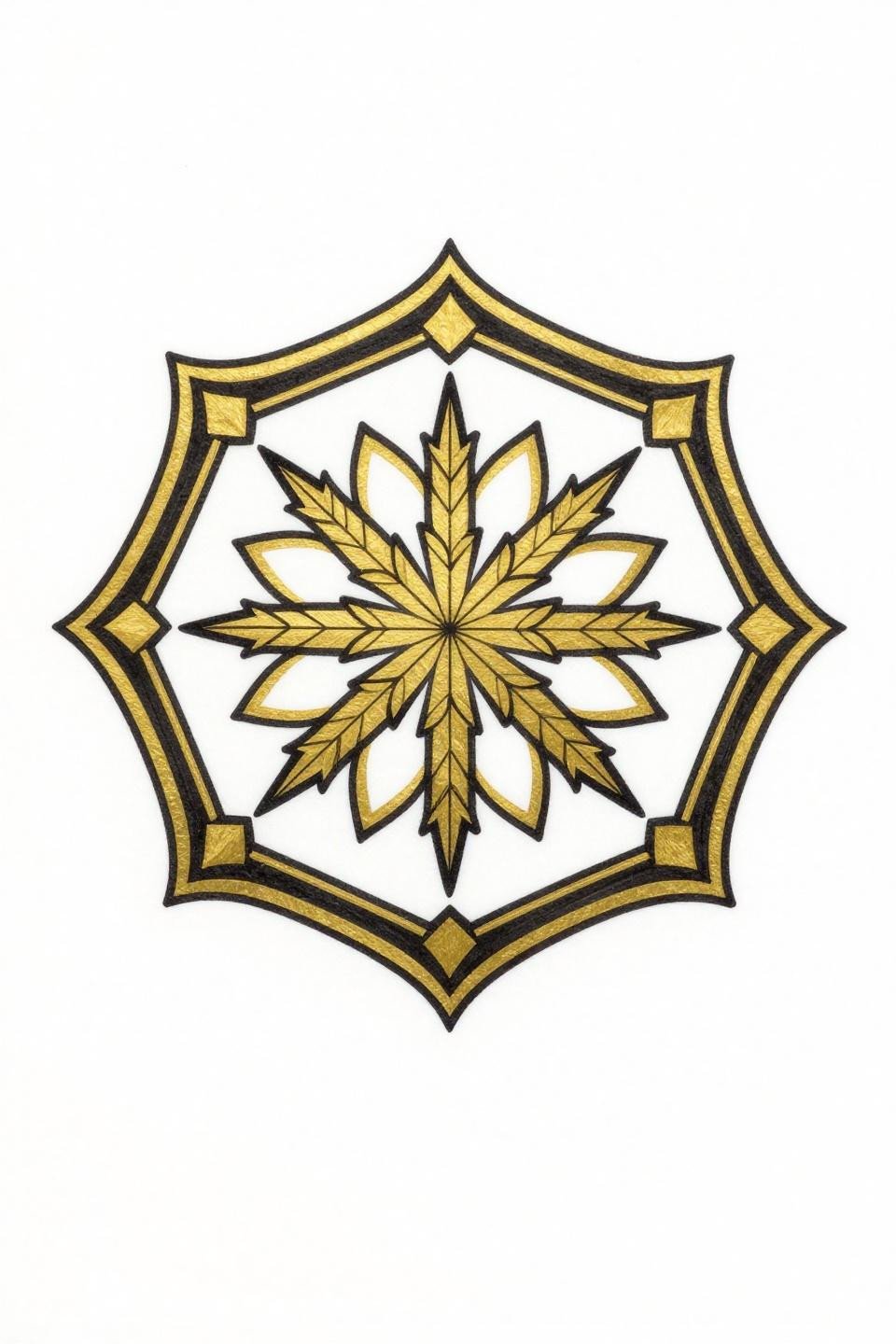
A ten-pointed star core with nested rings alternating arrow chevrons and lotus bud formations, finished with geometric shields carrying diamond inlay at the perimeter. The metallic gold and solid black two-color restriction gives this neo-traditional format a cleaner read than most color mandala flash, which tends to compete with its own palette at this ring density.
Ten-fold rotational symmetry is divisible by five, which makes it slightly easier to draft than seven-fold but still demands a careful stencil. The chevron-to-lotus alternation at each ring layer is the collector signal: it shows the artist can hold two distinct motif vocabularies in strict rotational register.
Crosshatch Etching Inside a Nine-Pointed Rotational Frame
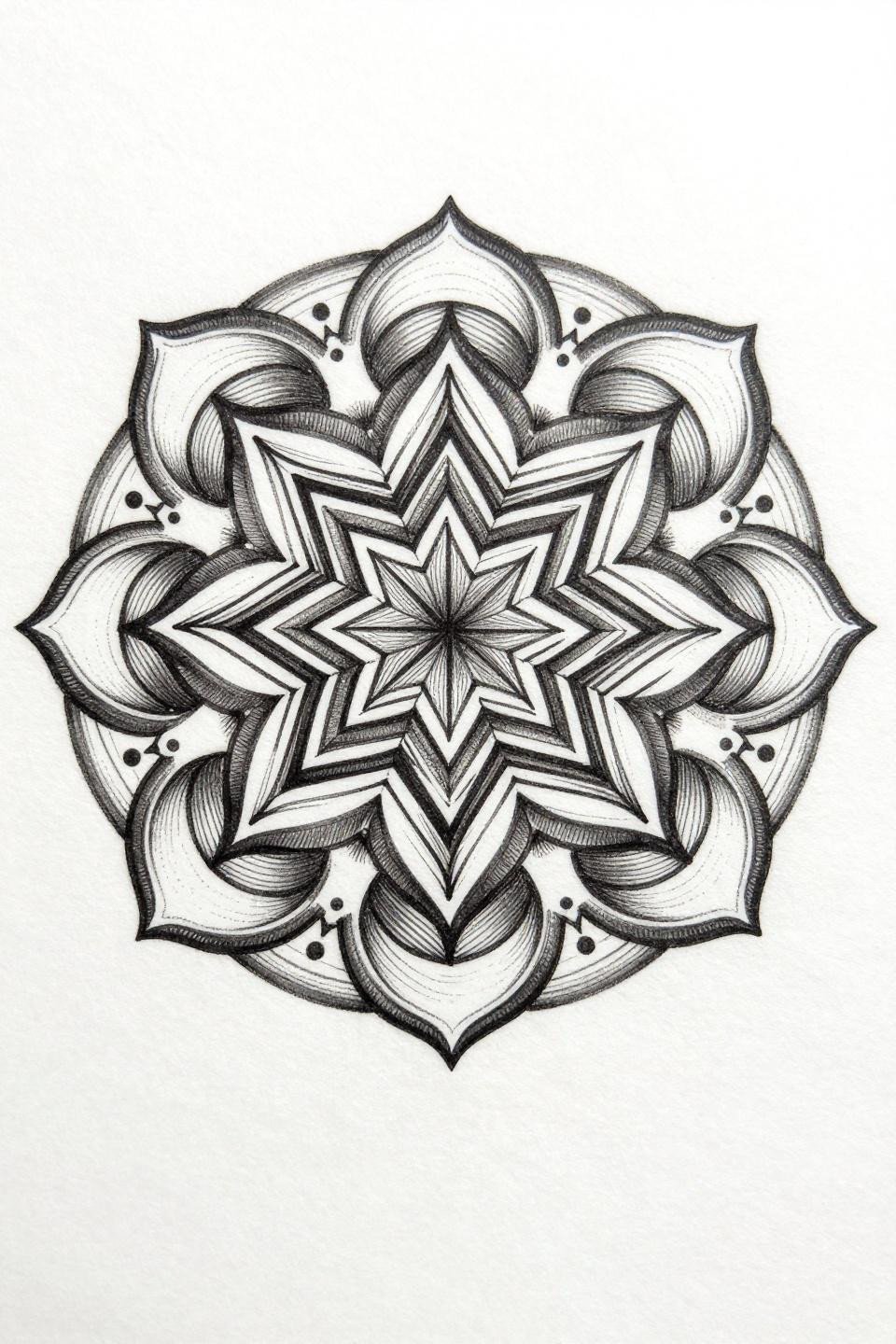
A nine-pointed star core with nested rings alternating fine parallel line hatching and negative space geometric petals, edged by interlocking crescent moons with dot terminals. The line density variation through crosshatch etching builds dimensional depth without tonal wash, a technique borrowed directly from printmaking tradition.
Parallel line hatching ages differently from stipple dot work on skin. The lines tend to maintain separation longer on lighter skin tones, but on olive and darker skin, the contrast between hatching and the negative space petals needs to be watched. This format benefits from a touch-up consultation at year seven to eight.
Watercolor Bleed Against a Twelve-Fold Ink Skeleton
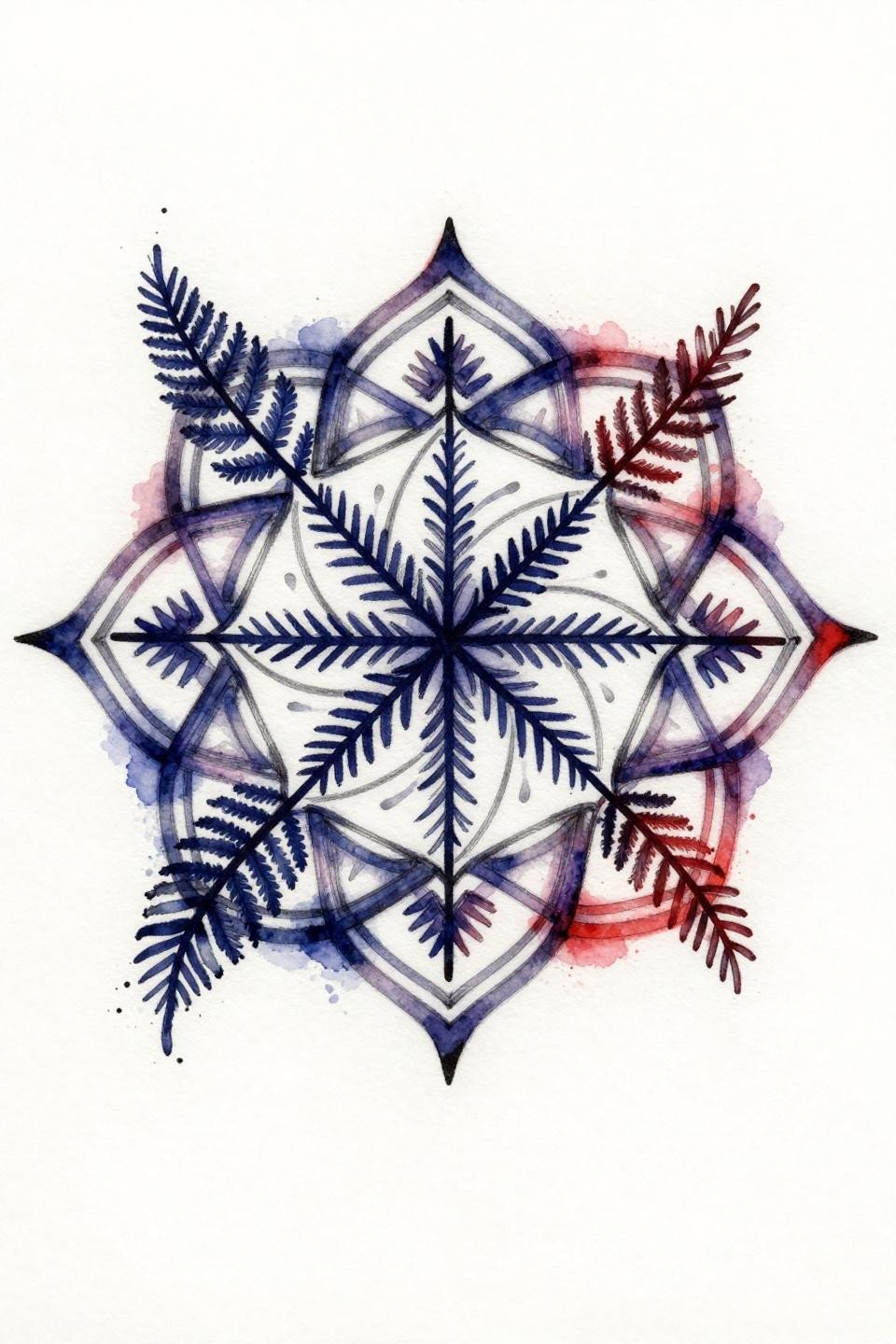
A twelve-pointed star core with nested rings alternating botanical fern fronds and sharp chevrons, built on a black ink skeleton and finished with indigo and crimson washes bleeding outward at the perimeter. The watercolor bleed diffusion works here specifically because the black ink skeleton is structurally complete on its own. The color is additive, not load-bearing.
Watercolor fills without anchoring outline support blur by year three to five. This design avoids that failure mode because every ring is outlined in solid black before color is applied. The wash reads as atmosphere, not structure, which is why it will still read cleanly as the color softens over time.
Single Continuous Line Mandala: One Stroke, No Corrections
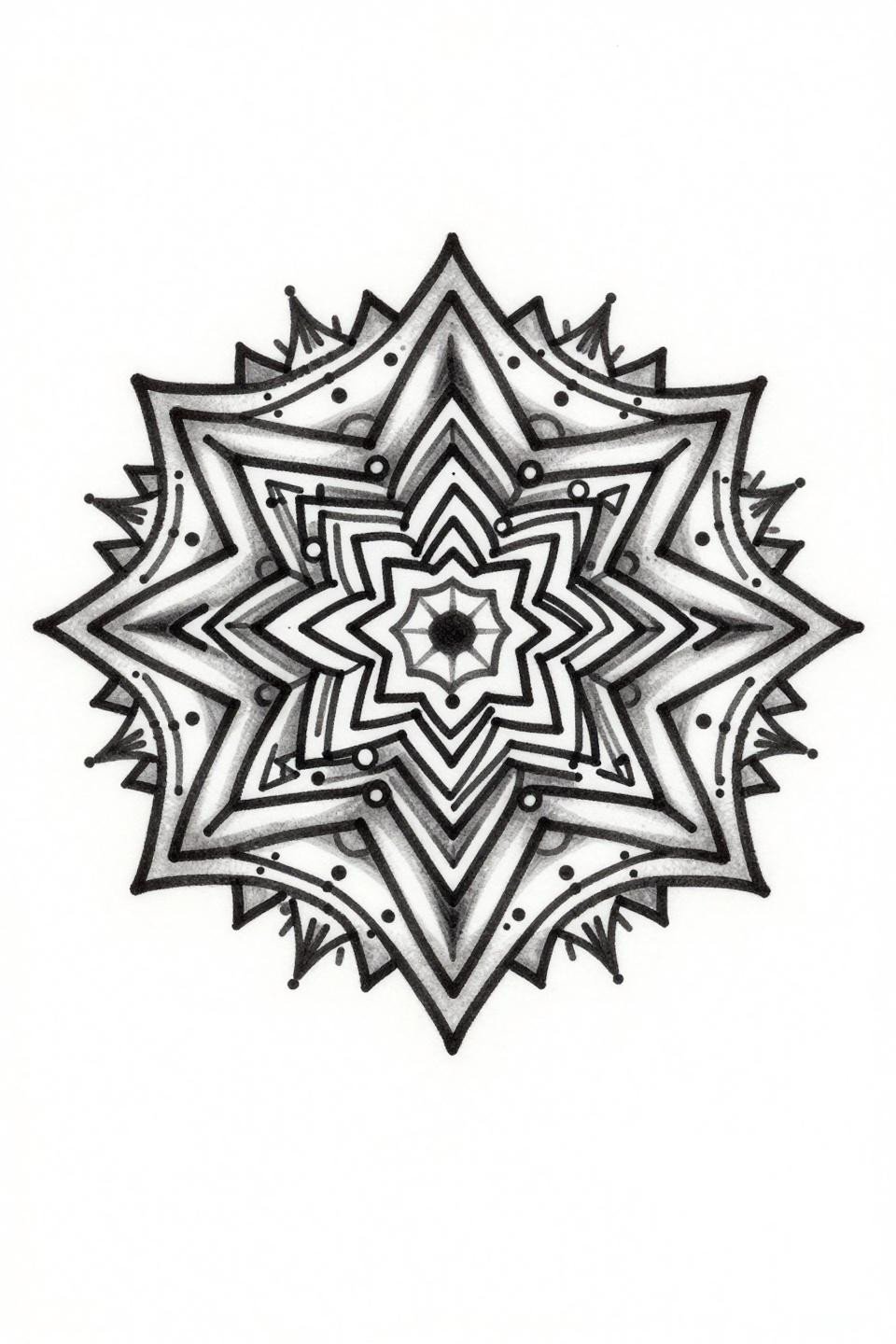
A five-pointed star core expanding through diamond clusters and concentric circles to a spike perimeter with dot-terminated endpoints, drawn in a single unbroken continuous line at bold 2-3pt weight. The no-overlap constraint of continuous line work forces compositional decisions that most mandala formats never have to make, specifically where each ring connects to the next without doubling back.
Five-fold rotational symmetry combined with a continuous line structure means the stencil has to be perfect before the needle touches skin. There is no corrective pass available in this format. It is a genuine artist skill signal, and the healed portfolio should have at least two examples of it before you book.
Japanese Irezumi Structure Applied to Octagonal Format
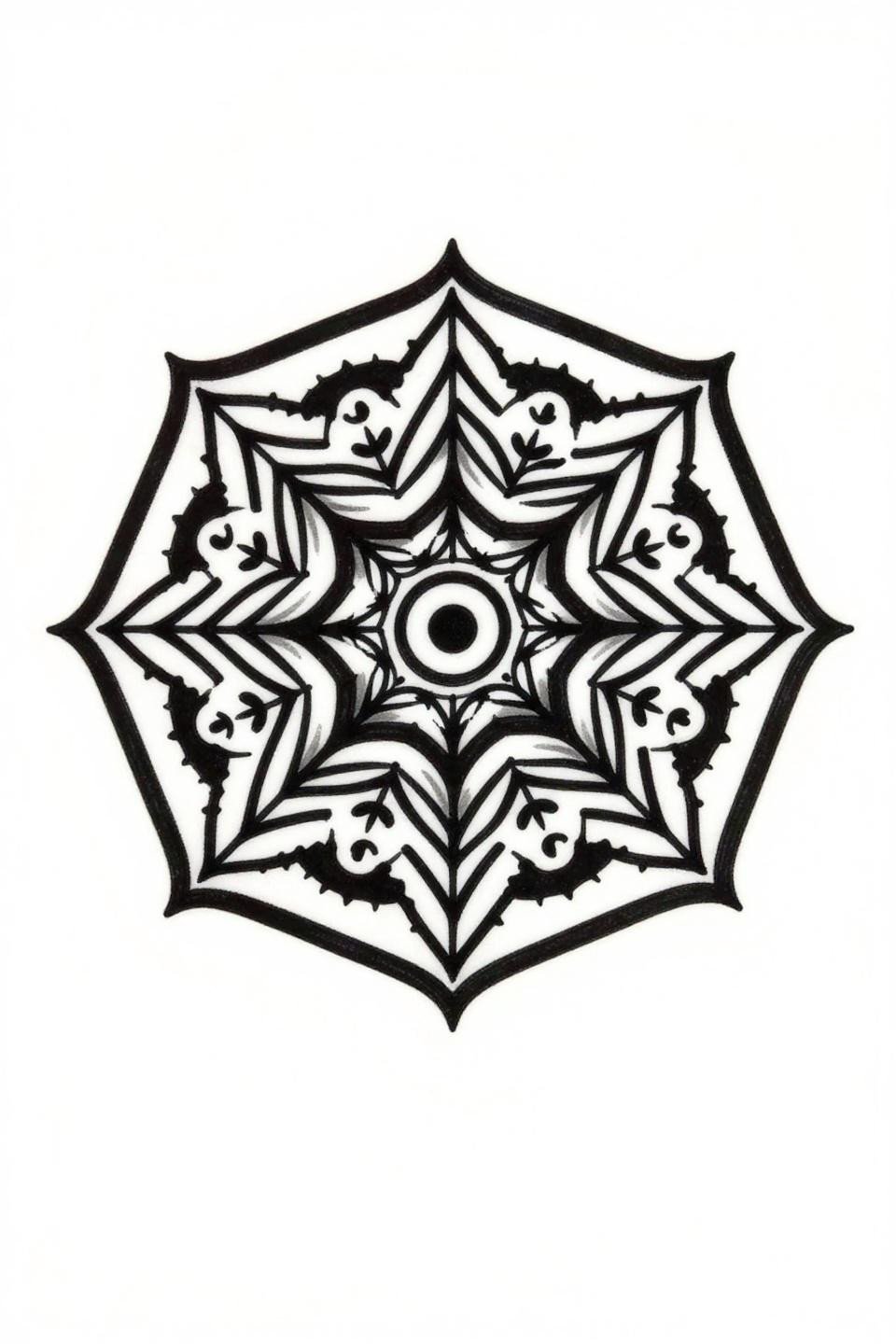
An octagonal star center with eight nested rings alternating botanical vine spirals and sharp sawtooth geometric patterns, finished with a crescent and teardrop perimeter at the outer edge. The decision to use flat black fills with no grey wash is the irezumi influence: Japanese tattooing traditionally commits to full saturation rather than tonal blending in geometric fields.
Fully saturated black in this ring density requires multiple passes to avoid patchiness, especially in the inner rings where the geometry is densest. Flat fills with no patchiness across every field are the veteran signal in this style. Uneven saturation shows up immediately in photography and on skin.
Sri Yantra Core and the Tribal Spike Perimeter
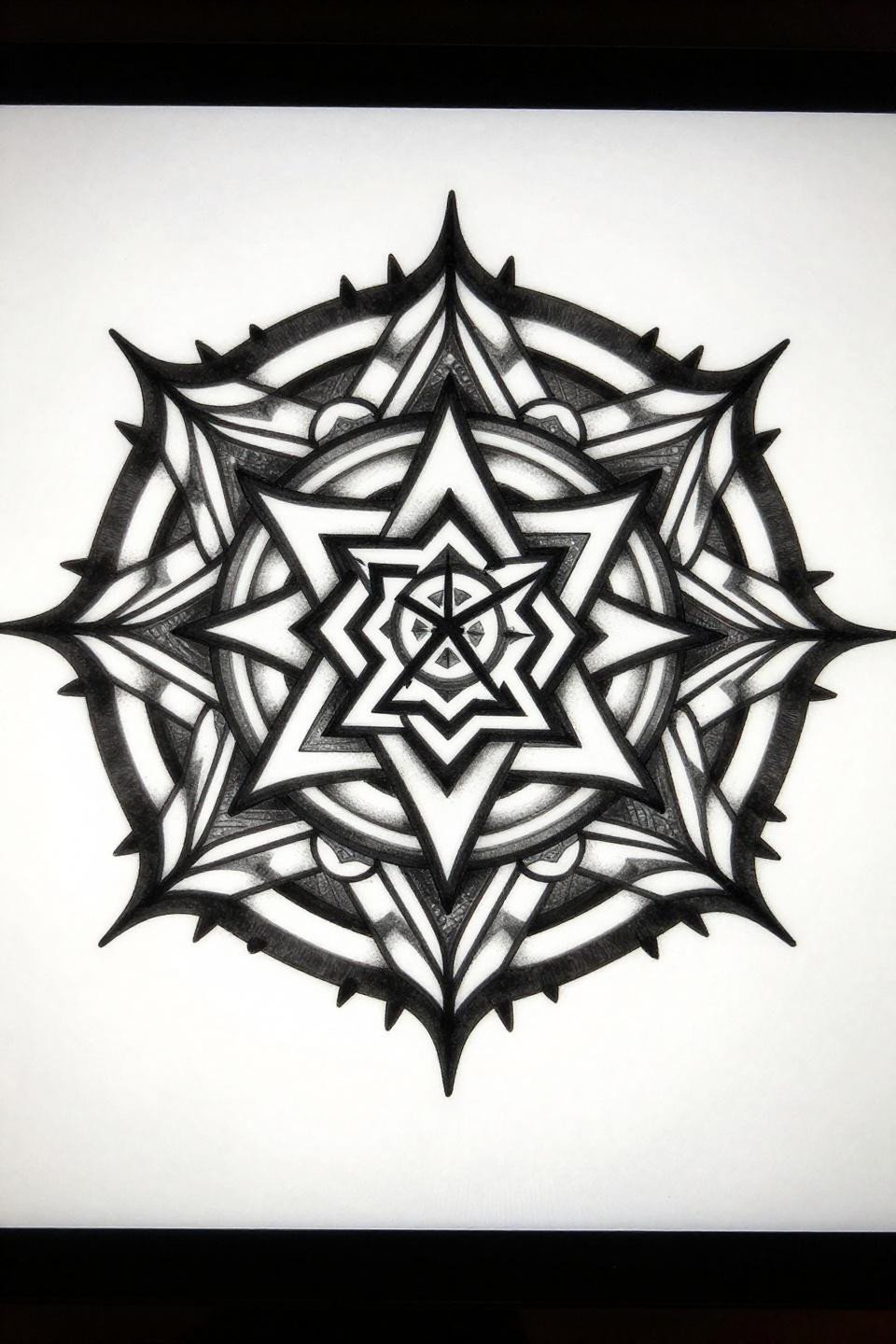
A Sri Yantra core of interlocking upward and downward triangles surrounded by nine concentric rings of angular scale formations and sharp petal geometry, with a bold protective spike ring at the outer perimeter. The zero dotwork, flat black fill decision is a tribal constraint that sharpens every edge and removes all tonal ambiguity from the design.
Nine concentric rings in flat black is a saturation commitment. At sizes below six inches, the inner rings compress enough that individual scale forms start to merge. This design needs room. A thigh or upper back placement at eight inches minimum is where this format performs correctly.
Art Nouveau Frost Lines and the Copper Detail That Holds
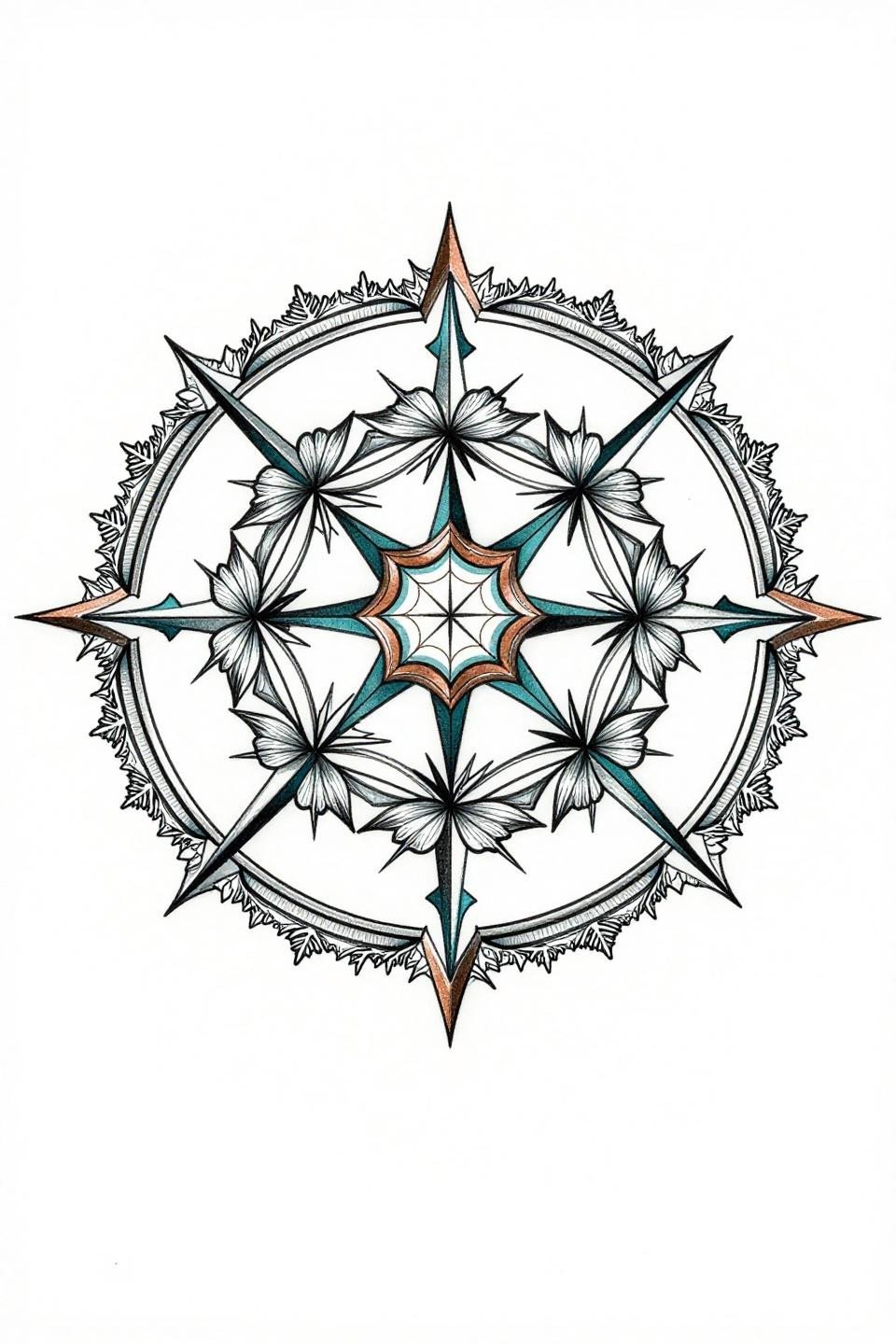
A hexagonal star center with a six-petaled flower ring, alternating triangular rays radiating outward, and a delicate branching frost-crystal line perimeter in deep teal and copper on black. The frost-crystal branching linework at the perimeter is the Art Nouveau marker: organic growth patterns interrupting the strict geometric interior without breaking the rotational structure.
Copper tones in tattoo ink behave differently from gold. They tend to warm over time on most skin tones, shifting slightly orange as the ink oxidizes. On lighter skin, this reads as a natural evolution. On deeper skin tones, the shift can muddy the contrast against the black outlines, so placement review after healing matters here.
Lotus Eye Dotwork and the Centered Motif That Demands Precision
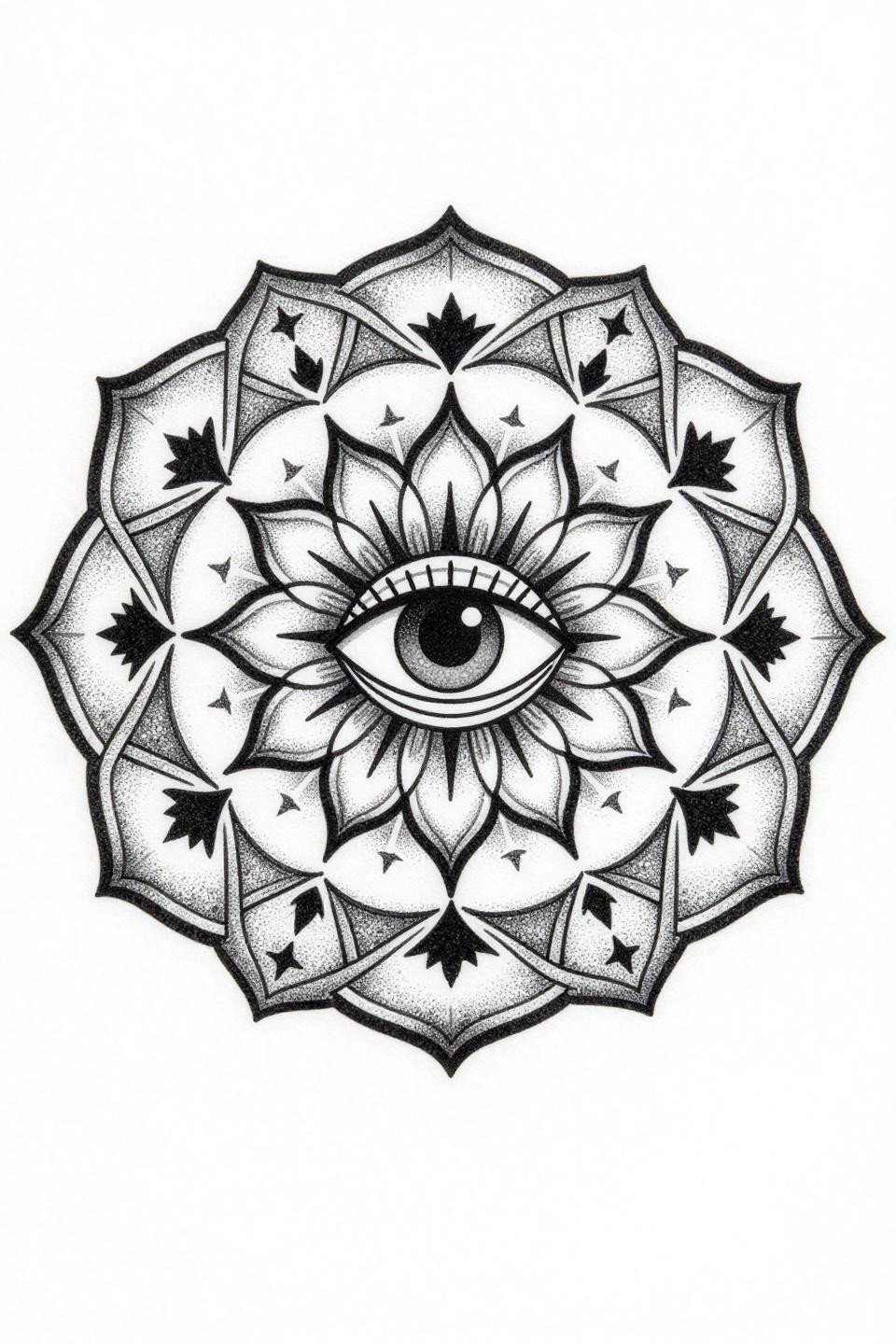
Concentric lotus petal rings surrounding a central eye motif with radiating geometric lines, finished with an interlocking crescent moon and star outer ring. The stipple dot gradient runs dense at the center eye and opens progressively outward, which is the correct execution: reversed gradients that are dense at the perimeter and open at the core tend to flatten the design’s focal hierarchy.
The eye motif at center makes this one of the strongest formats for spiritual symbol tattoo designs that carry personal meaning without requiring explicit iconographic explanation. Protected placements like the sternum or upper back give this dotwork gradient its best long-term shelf life.
Sort the references above by placement size before sending them to your artist. The flat-black tribal and irezumi formats need scale. The single-needle and fine-line designs need protected placement. Match the format to where you are putting it, and the consultation will move faster.
Save three to five of these, not all twenty. A clear direction is more useful than a complete mood board. The technical range here covers every major mandala format. Pick the ones where the line weight, color structure, and ring density match the skin real estate you actually have.