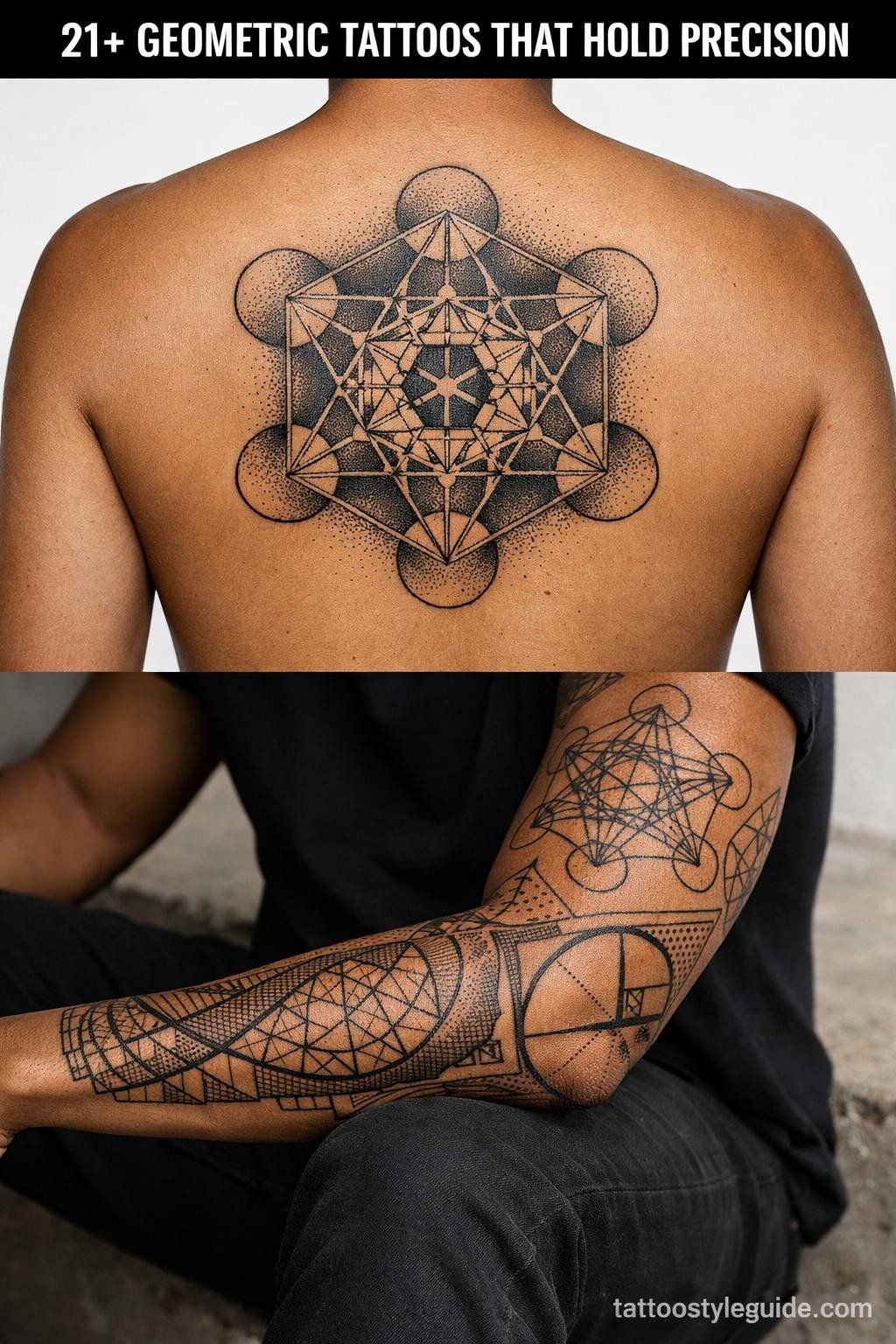
Geometric tattoos fail when the artist treats them like vector art and forgets skin moves. Hairline strokes under 0.5mm on high-friction placements blur within two years, and symmetry errors that look minor on paper read loudly on a curved body part.
The designs that hold are built with deliberate line weight, placement logic, and enough negative space to survive the natural ink migration that hits every piece by year three.
Concentric Parallelograms: When Asymmetry Outperforms Grid Symmetry
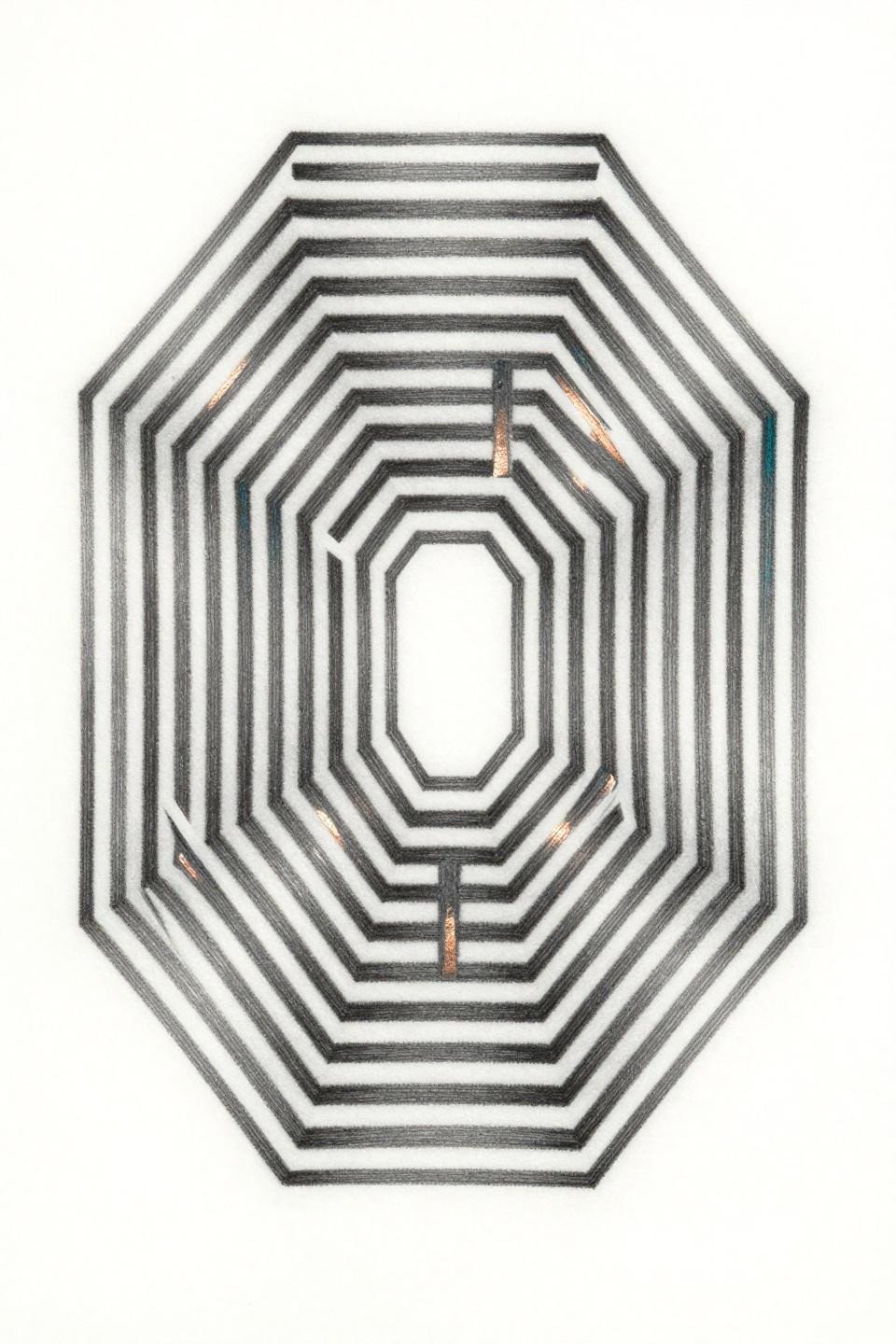
This recursive labyrinth uses staggered 45-degree rotation offsets across concentric parallelograms, with an irregular hexagonal void at center and radiating spoke lines dissolving into an octagonal frame. The grey wash dilution gradient, running dense at the outer frame and open toward center, creates dimensional depth without a single fill pass.
The teal and copper palette is a collector risk. Copper-adjacent pigments shift toward muddy brown on most skin tones within five years, so confirm your artist uses a stable metallic-adjacent black ink rather than actual metallic pigment.
Golden Ratio Petals and the Fractal Mandala That Earns Its Complexity
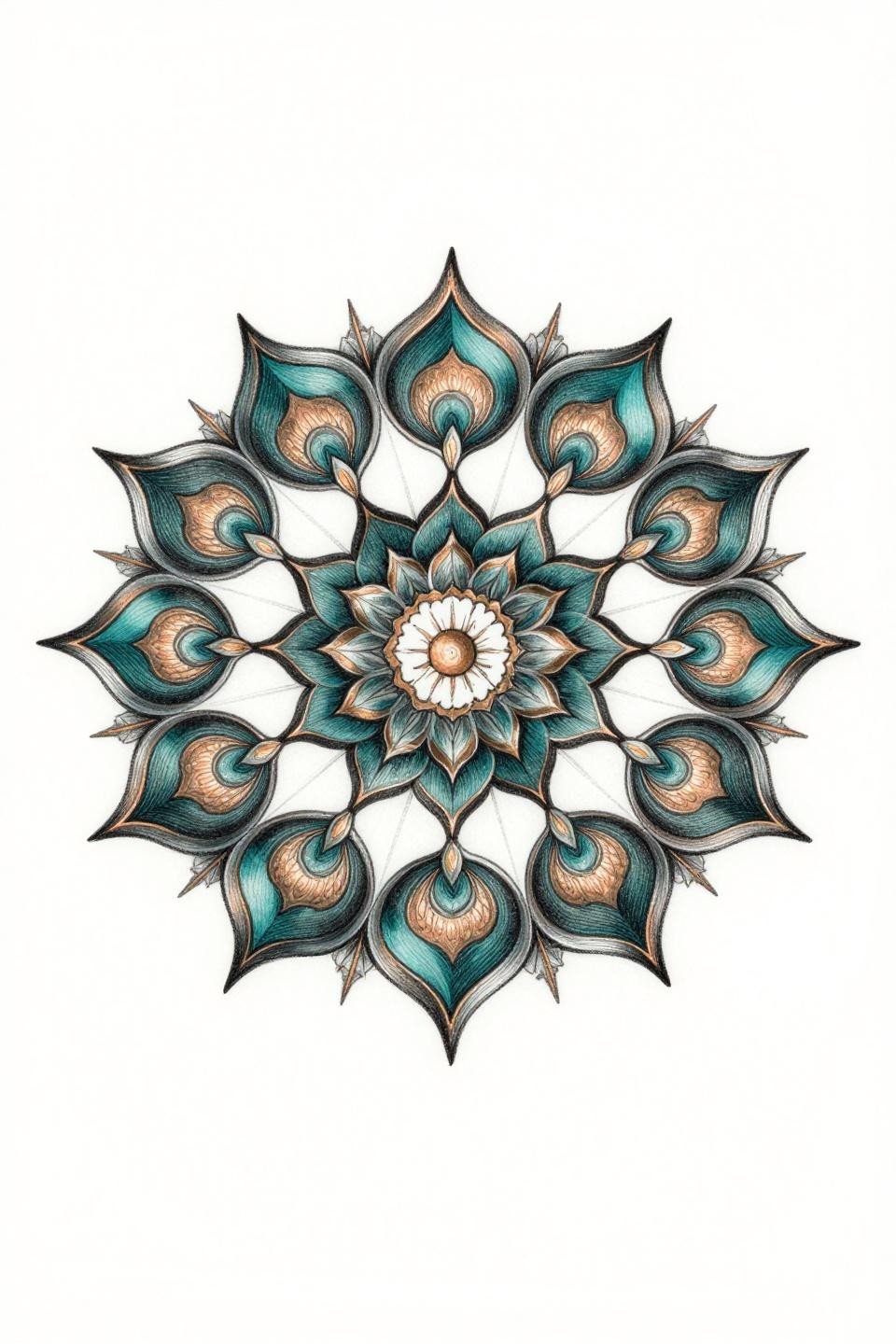
Alternating concave and convex petal chambers subdivided into golden ratio spirals, anchored by a lotus void at center and bounded by a 12-pointed star, this reads as botanical geometry. Whip shading on curved petal forms is the technique signal here, requiring consistent hand speed to avoid patchiness in the gradient strokes.
Radial mandala designs at this complexity level need a minimum 4-inch diameter to hold legibility on skin. Compress the scale and the subdivided chambers merge into grey noise by year five.
Hourglass Recursion: Crosshatch Density as Structural Shadow
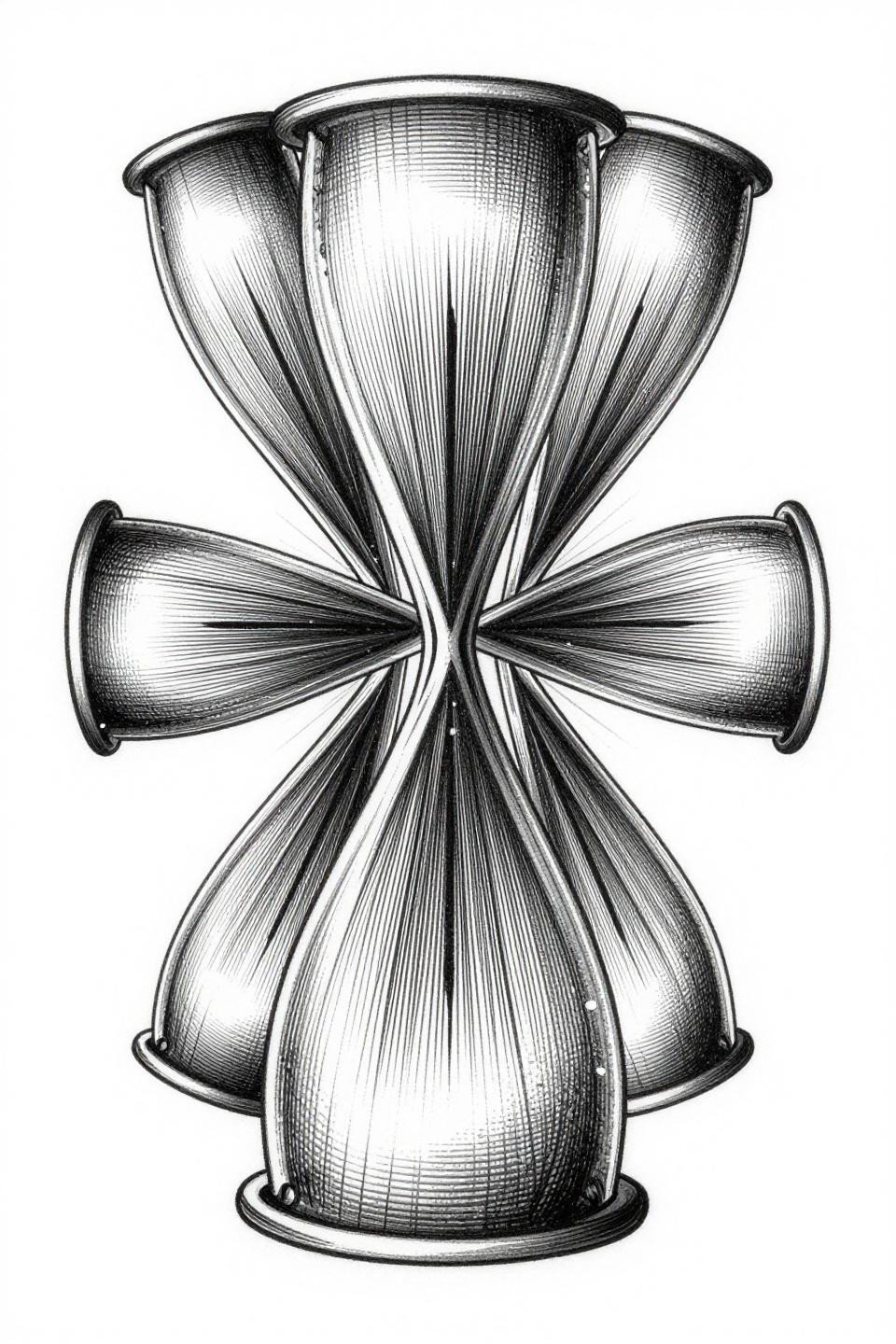
Mirrored trapezoids in 180-degree rotational symmetry form a recursive hourglass, with nested smaller versions subdividing each quadrant and an outer rectangle anchoring spoke lines to the frame corners. Parallel line hatching with crosshatch shadow zones replaces grey wash entirely, making this an engraving-style piece that holds its tonal structure through ink migration.
Hatching-based shading ages more predictably than grey wash on olive and darker skin tones because the contrast relies on line spacing rather than diluted ink density. Ask to see healed hatching work in your artist’s portfolio, not just fresh shots.
Sak Yant Geometry: Bold Outlines as a Longevity Decision
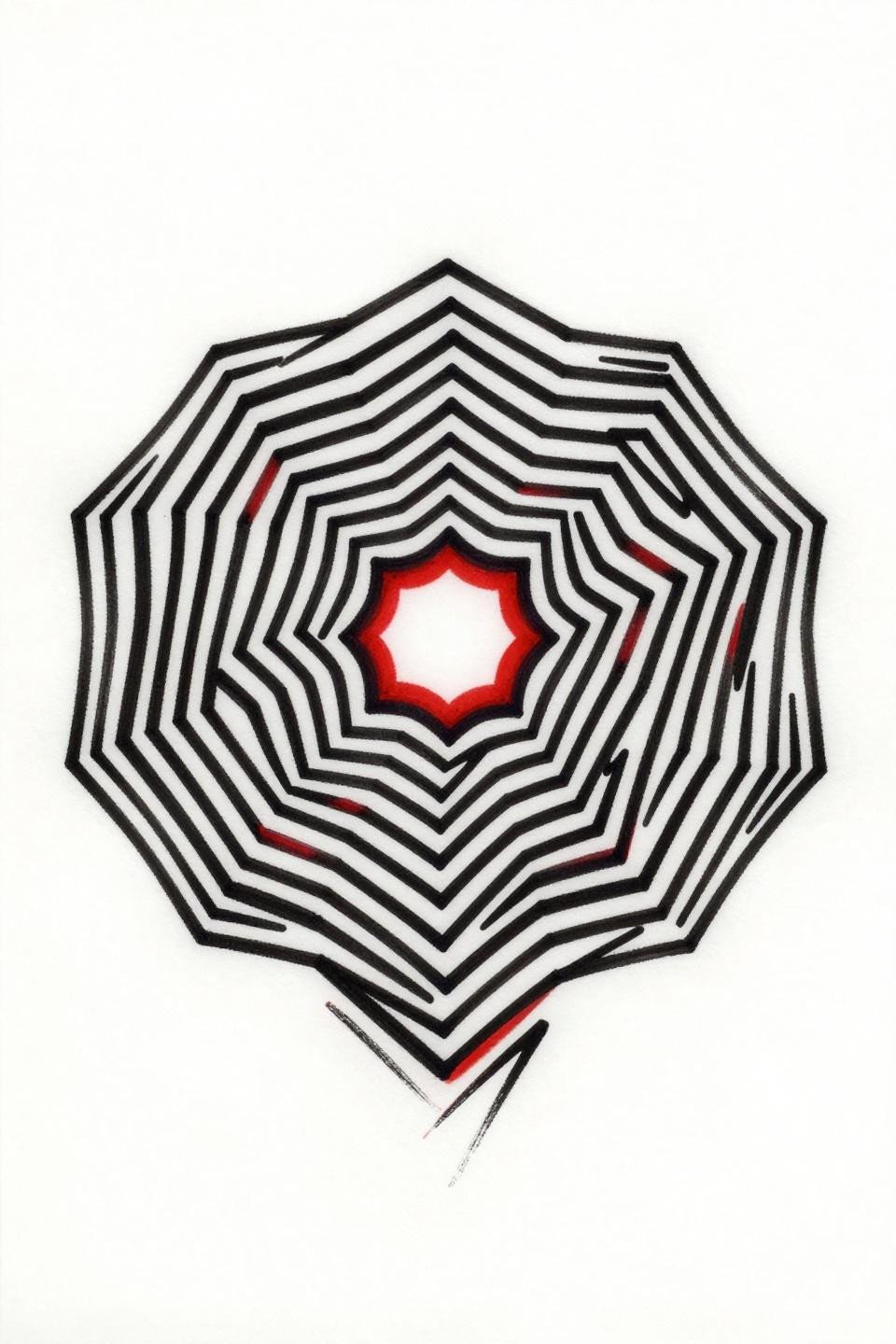
The sak yant-influenced structure uses bold 2-3pt outlines with flat indigo and crimson fills, anchoring the asymmetric parallelogram labyrinth inside an octagonal frame with even negative space. The 2-3pt outline weight is a direct longevity signal: at that stroke thickness, the outer boundary holds clean definition past the ten-year mark on most placements.
Indigo pigments behave well long-term on lighter skin but read less distinctly on medium and darker tones where the value contrast compresses. A straight-black outline version of this design works harder across a wider skin tone range.
Fibonacci Tree Flash: When Negative Space Becomes the Design
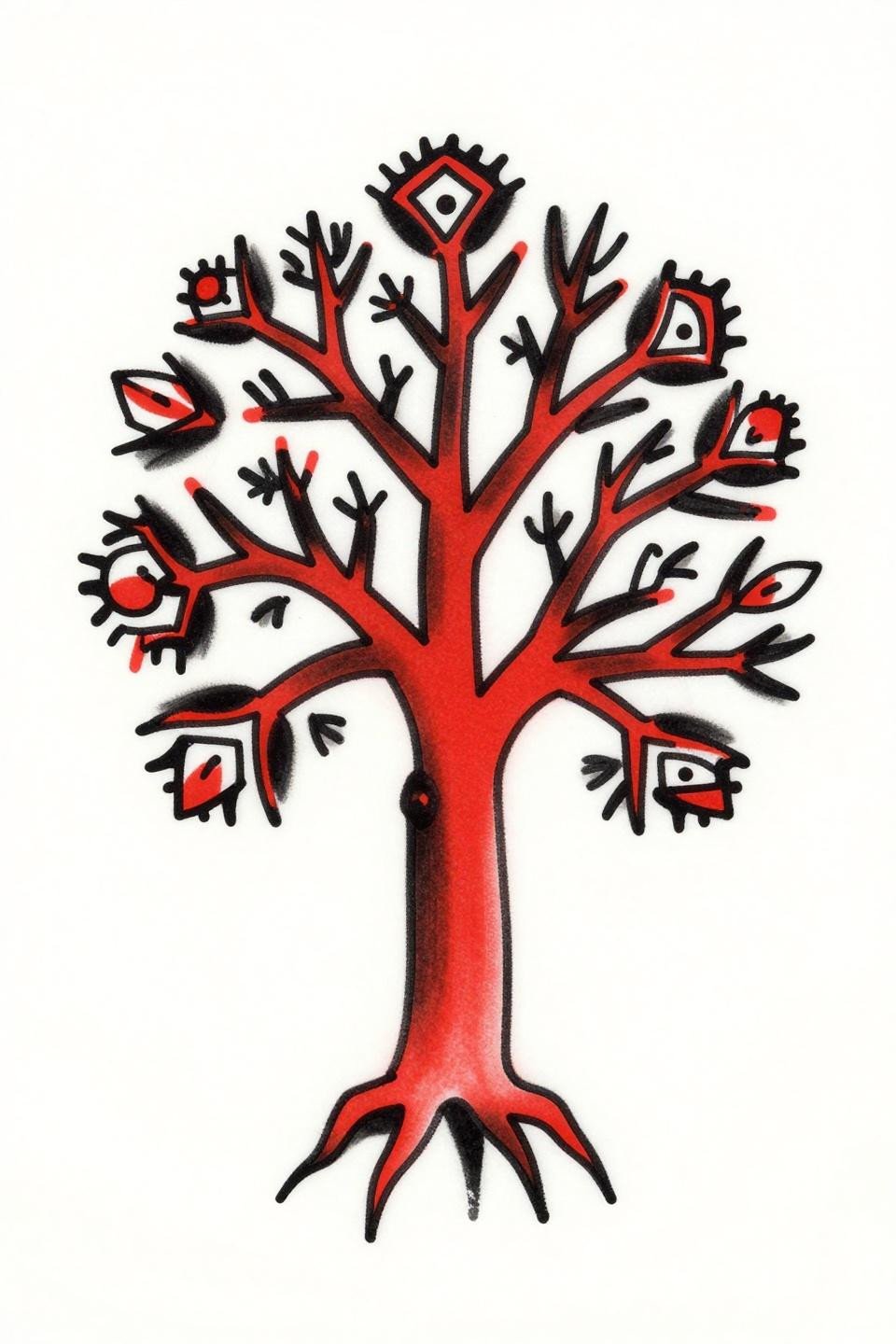
A fractal tree with Fibonacci branch progression uses the negative angular chambers between limbs as secondary geometric forms, rendered in traditional American structure with bold outlines and flat crimson and black fills. The negative space chambers are load-bearing design elements here, not gaps, so any artist who fills them is misreading the composition.
Traditional American line weight at 2-3pt is the most placement-forgiving approach in geometric work. Upper arm, forearm, and calf all sustain this structure without the warping that kills fine-line geometric pieces on curved surfaces.
Ignorant Style Starburst: Raw Edges on a Precise Foundation
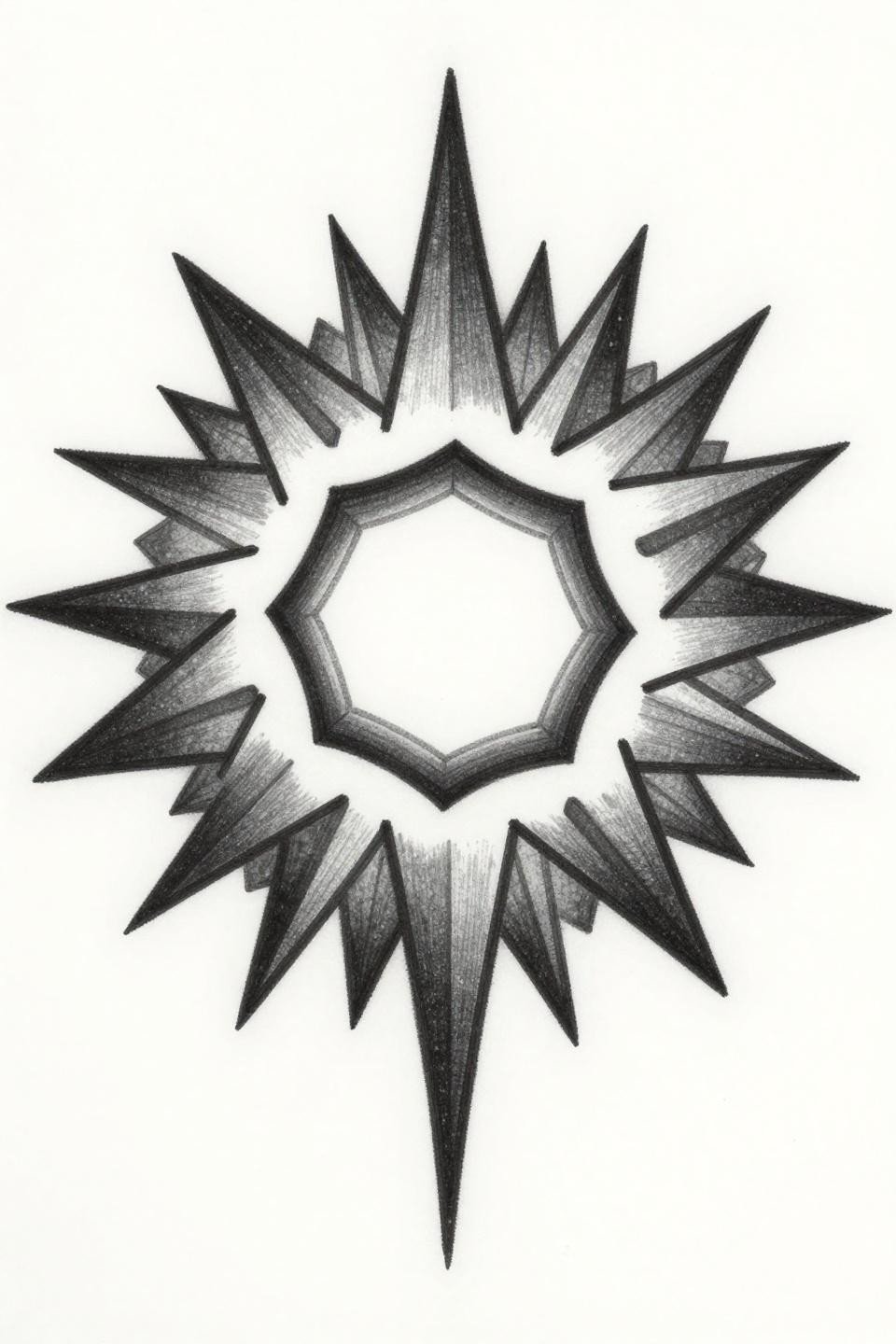
Radiating parallelograms with alternating 30-60-90 triangle subdivisions build a starburst with a hexagonal void at center, the jagged outer edges deliberately rough against a circular frame. The tension between hand-drawn raw edges and the strict underlying angular geometry is the whole point of this piece.
Ignorant-style geometry is deceptively difficult to execute well. The rough line quality has to feel intentional, not technically inconsistent. Check that the artist’s portfolio shows controlled variation in stroke weight, not just uneven linework.
Dotwork Octagon: Reading the Stipple Gradient as a Technical Audit
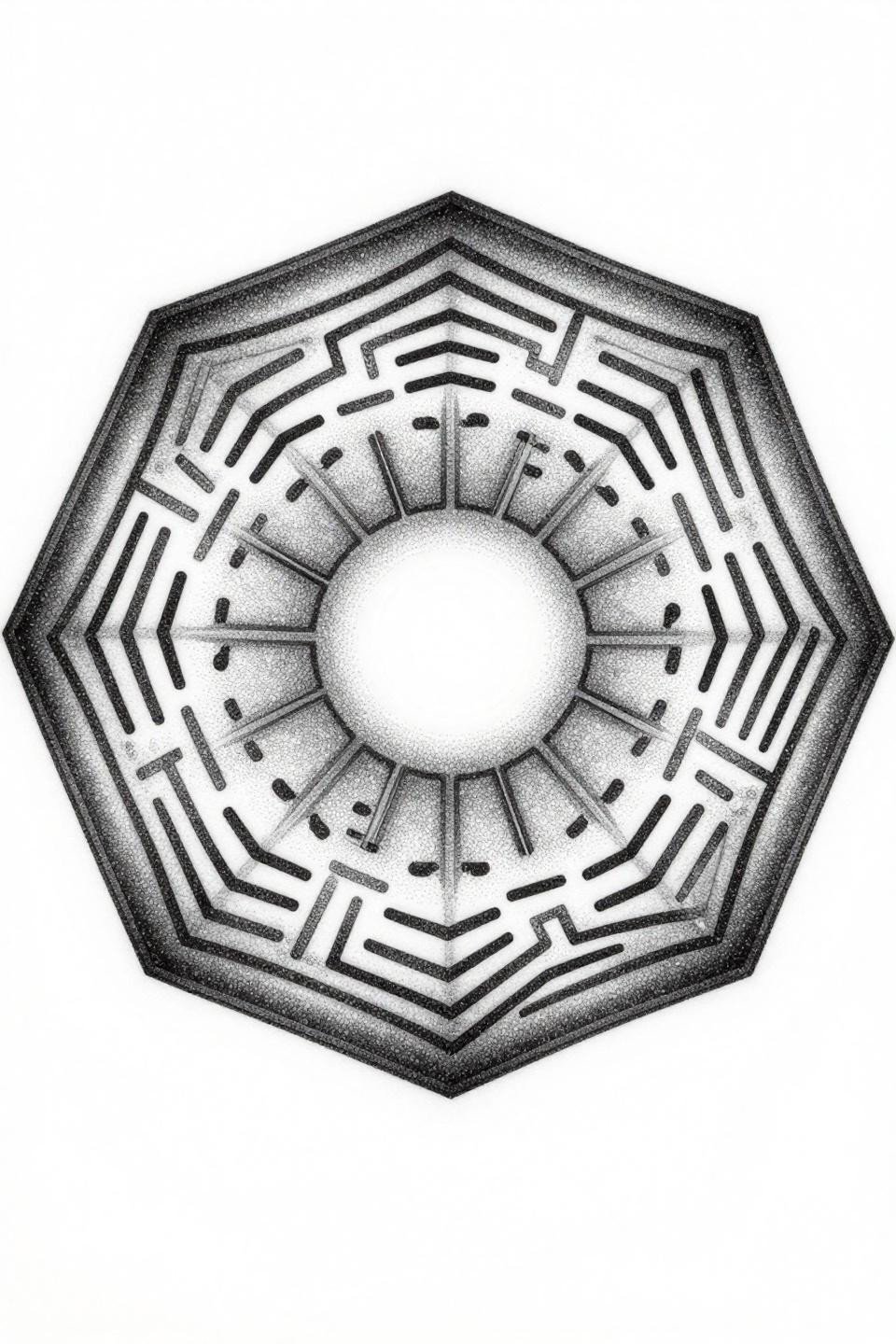
An octagonal labyrinth with strict 8-fold rotational symmetry uses stipple dot gradient running dense at the outer frame and dissolving to open void at center, creating a visual pull inward without any line shading. Consistent dot size across the full gradient is the artist quality signal here: irregular dots create muddy midtones that worsen as ink spreads with age.
Dotwork at this density needs a protected placement to read its best at year five and beyond. Sternum, upper back, and outer forearm all work. Inner bicep and ribs introduce movement distortion that breaks the radial symmetry over time.
Diamond Labyrinth Sketch: Kaleidoscopic Depth From 22.5-Degree Rotation
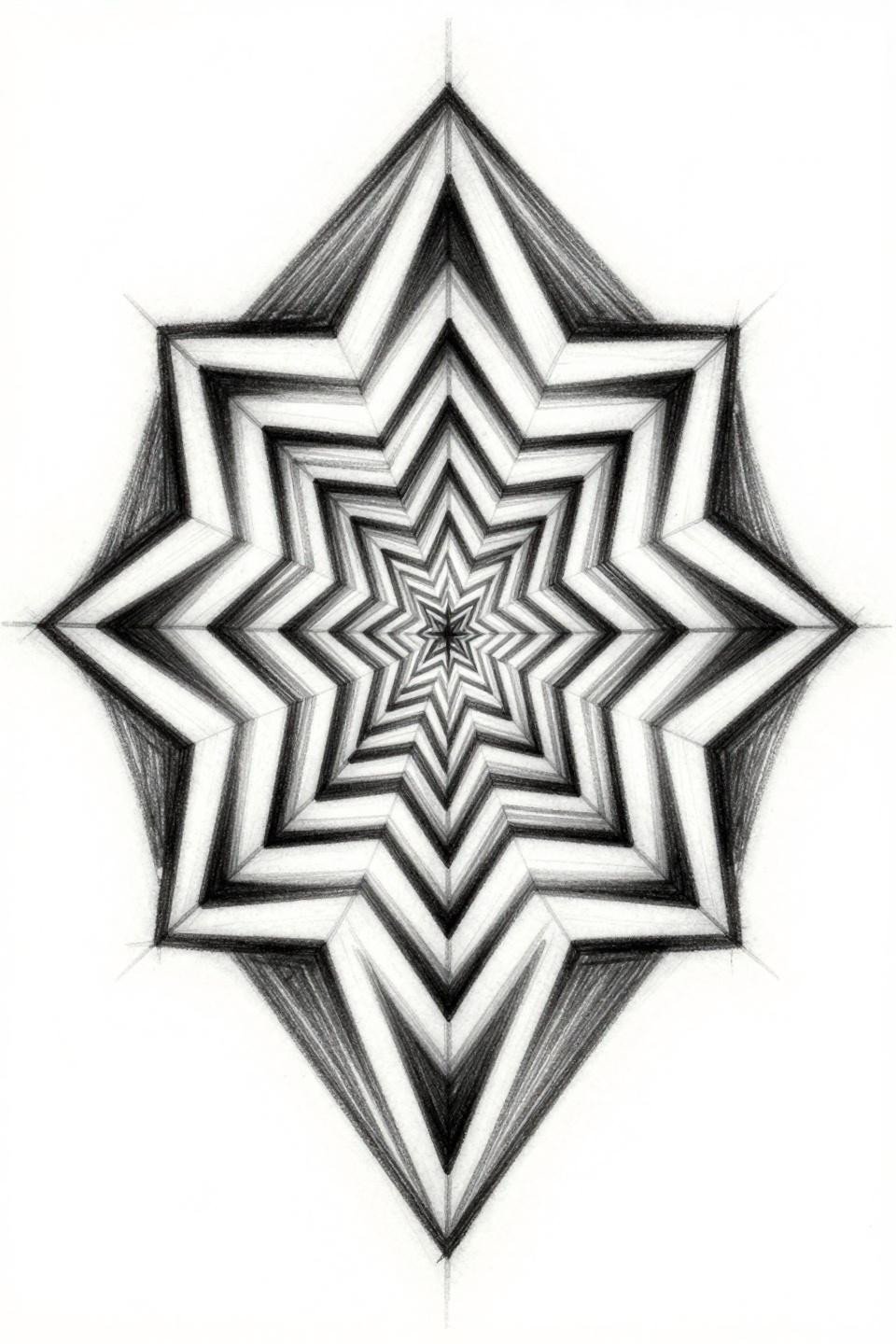
Concentric diamonds each rotated 22.5 degrees form a kaleidoscopic star aperture with a central vanishing point and spoke lines extending to an octagonal border, executed in sketch-raw style with flat black fills. The 22.5-degree incremental rotation is what separates this from a standard nested diamond pattern, producing a genuine sense of depth rather than flat repetition.
Sketch-style outlines on geometric work age into the design rather than against it. The softening of raw lines over years actually reinforces the hand-drawn quality, making this one of the lower-maintenance approaches in the geometric category.
Single-Needle Spiral: The Line Weight That Determines Shelf Life
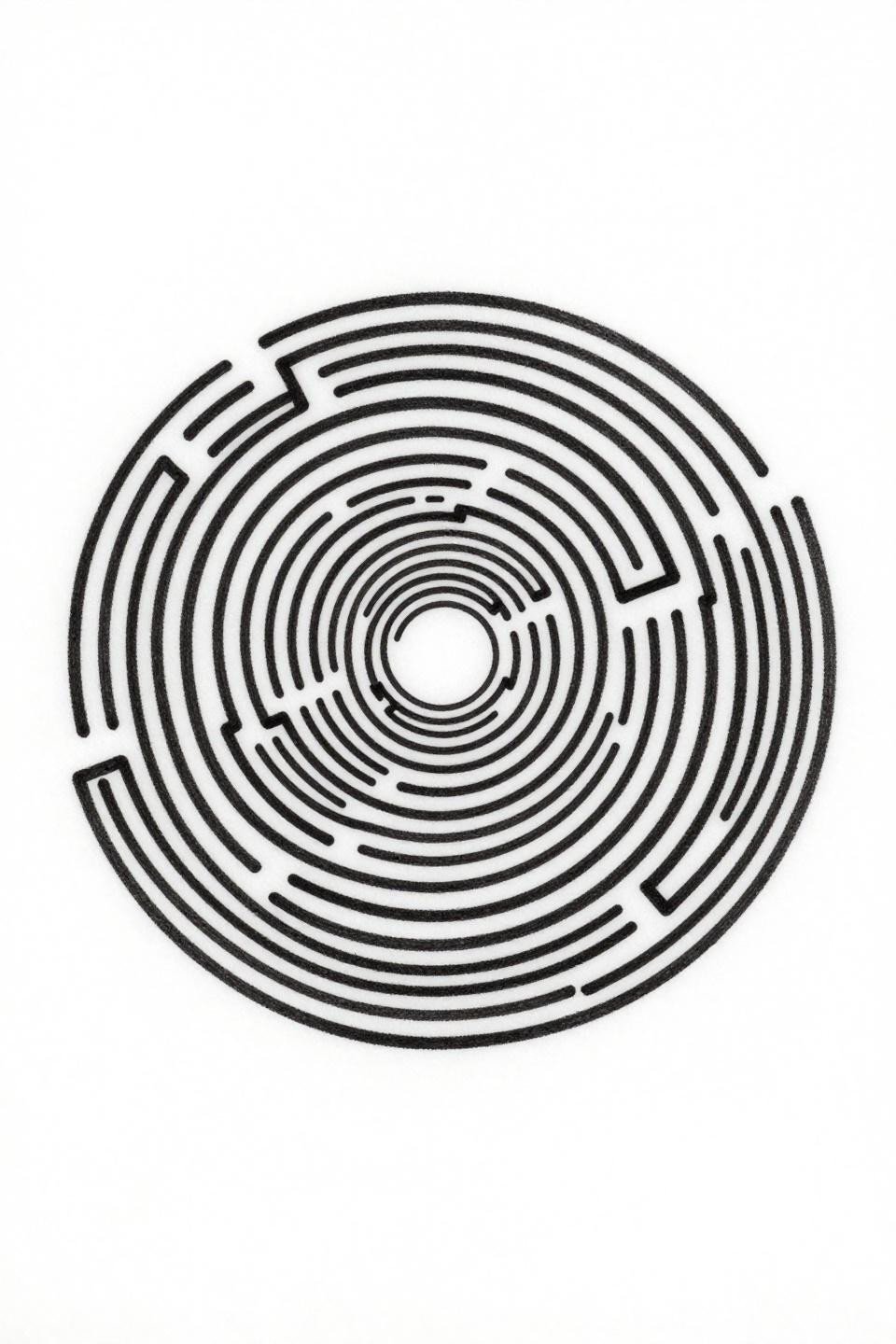
Alternating thick and thin concentric rings build a spiral labyrinth with a perfect circular void at center, executed entirely in hairline 0.5mm single-needle strokes with no grey wash and open negative space. This is a 1RL single-needle piece, and the longevity conversation starts before booking: finger, wrist, and elbow placement means visible fading in two to three years.
On lighter skin tones, this reads crisp at the right placements. On olive and darker tones, the hairline strokes need bolder weight to maintain contrast against the dermis, so discuss line weight adjustment with your artist before committing to this exact flash reference.
Celtic Knotwork Mandala: Why Vesica Chains Need Closed Paths
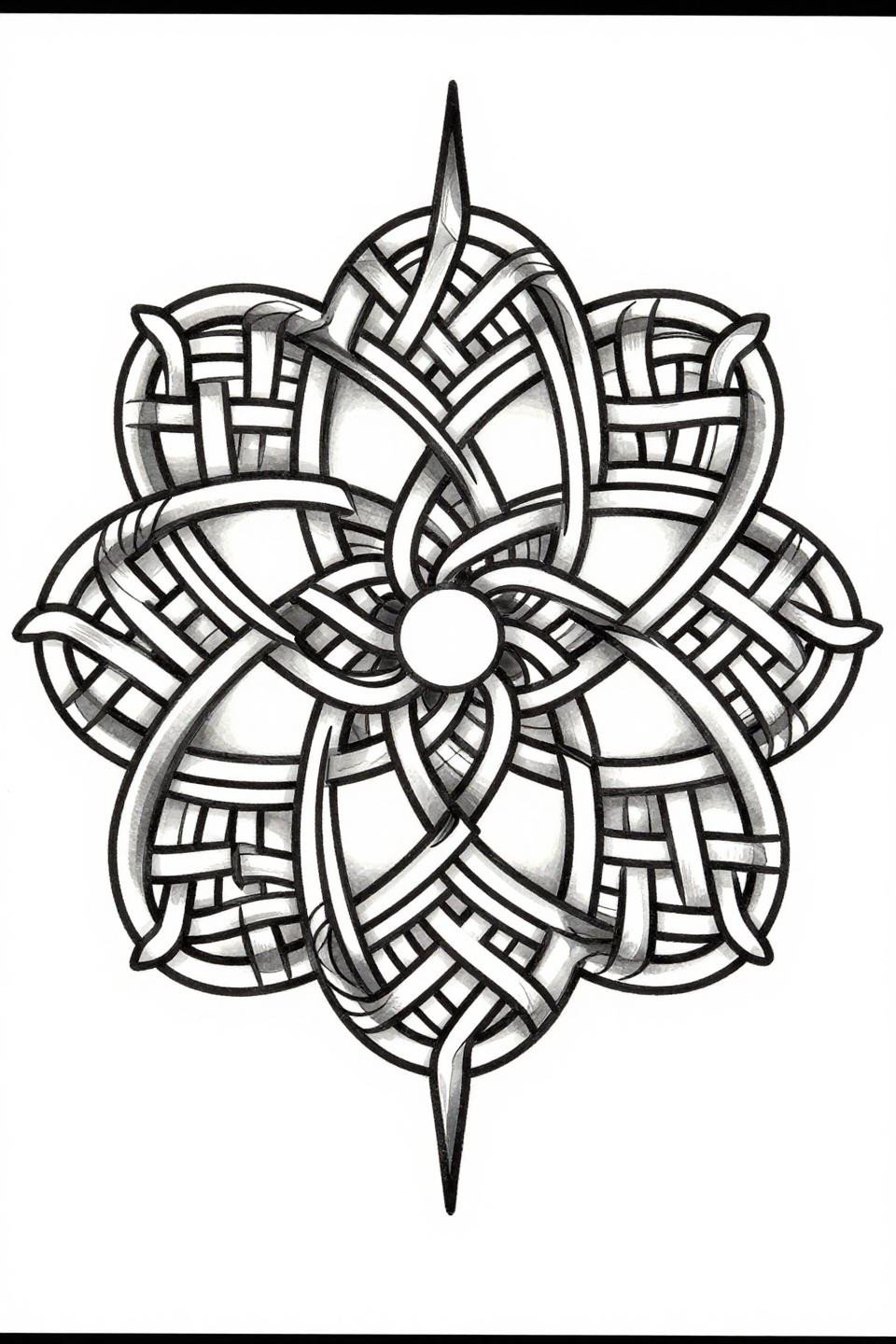
Vesica piscis chains with recursive rhombus subdivisions form a 6-fold rotationally symmetric mandala with braided rope-knot crossings, rendered in bold 2-3pt outlines with flat black fills and grey wash midtones. Closed path integrity in Celtic knotwork is non-negotiable: any break in the weave reads as an error, not stylistic choice, so verify the artist has traced the full path before stencil application.
Ornamental knotwork at this scale suits upper arm, thigh, and back placements where the circular composition can sit without distortion. Calf placement works if the artist accounts for the taper when scaling the stencil.
Triangle Tessellation: Woodcut Engraving on a Skin That Moves
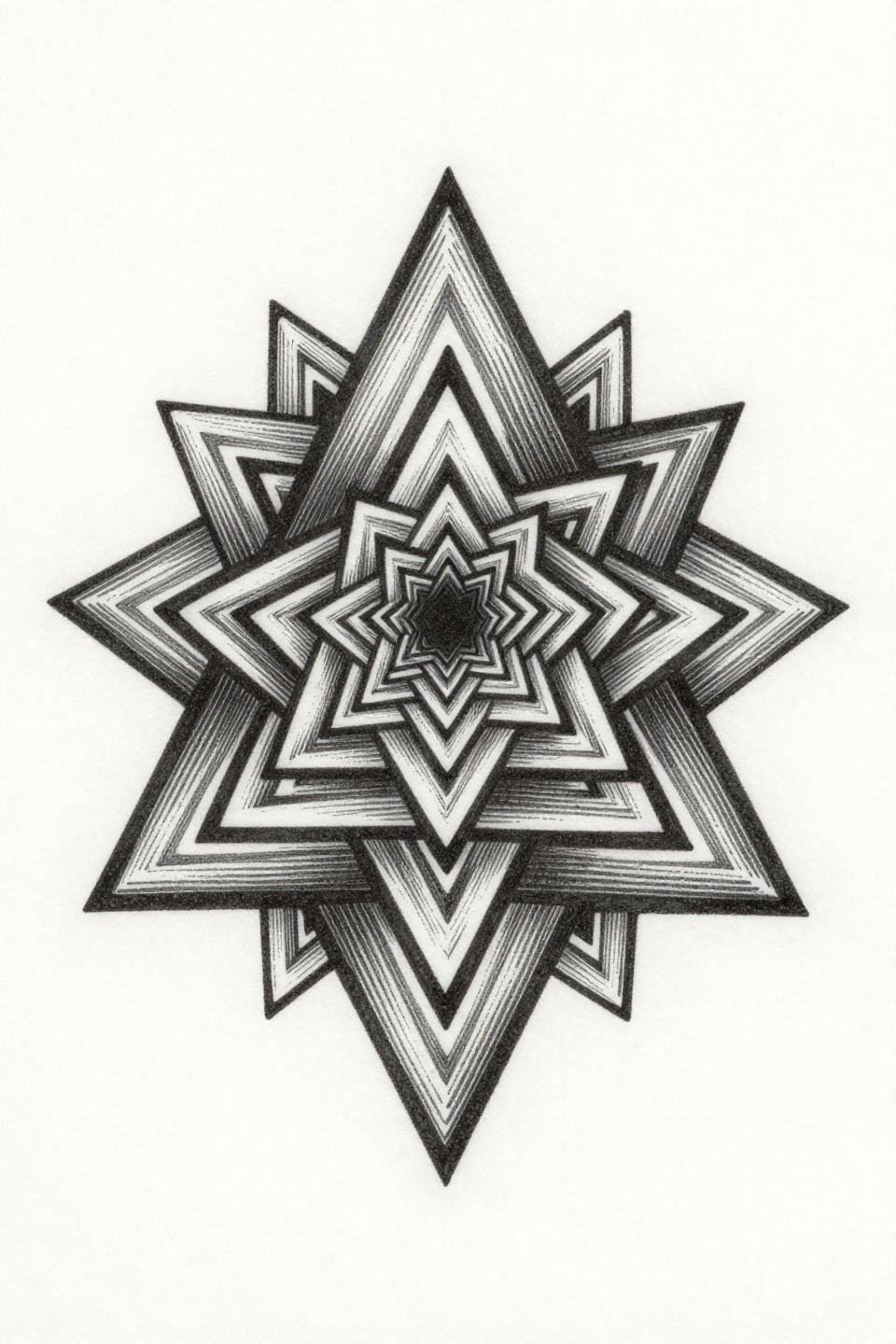
Recursive isosceles triangle tessellation radiating from a central apex uses woodcut block-print parallel line engraving with dense crosshatch shadows, producing a tonal range without any wash technique. The crosshatch shadow density does the shading work here, meaning the piece holds its visual weight even as individual lines soften slightly over the first decade.
Woodcut-engraving geometry is an underused approach in the geometric category. The parallel line structure ages like traditional American work rather than like grey wash, making it a stronger long-term investment than most clients expect.
Honeycomb Sacred Geometry: Irezumi Structure Meets Platonic Form
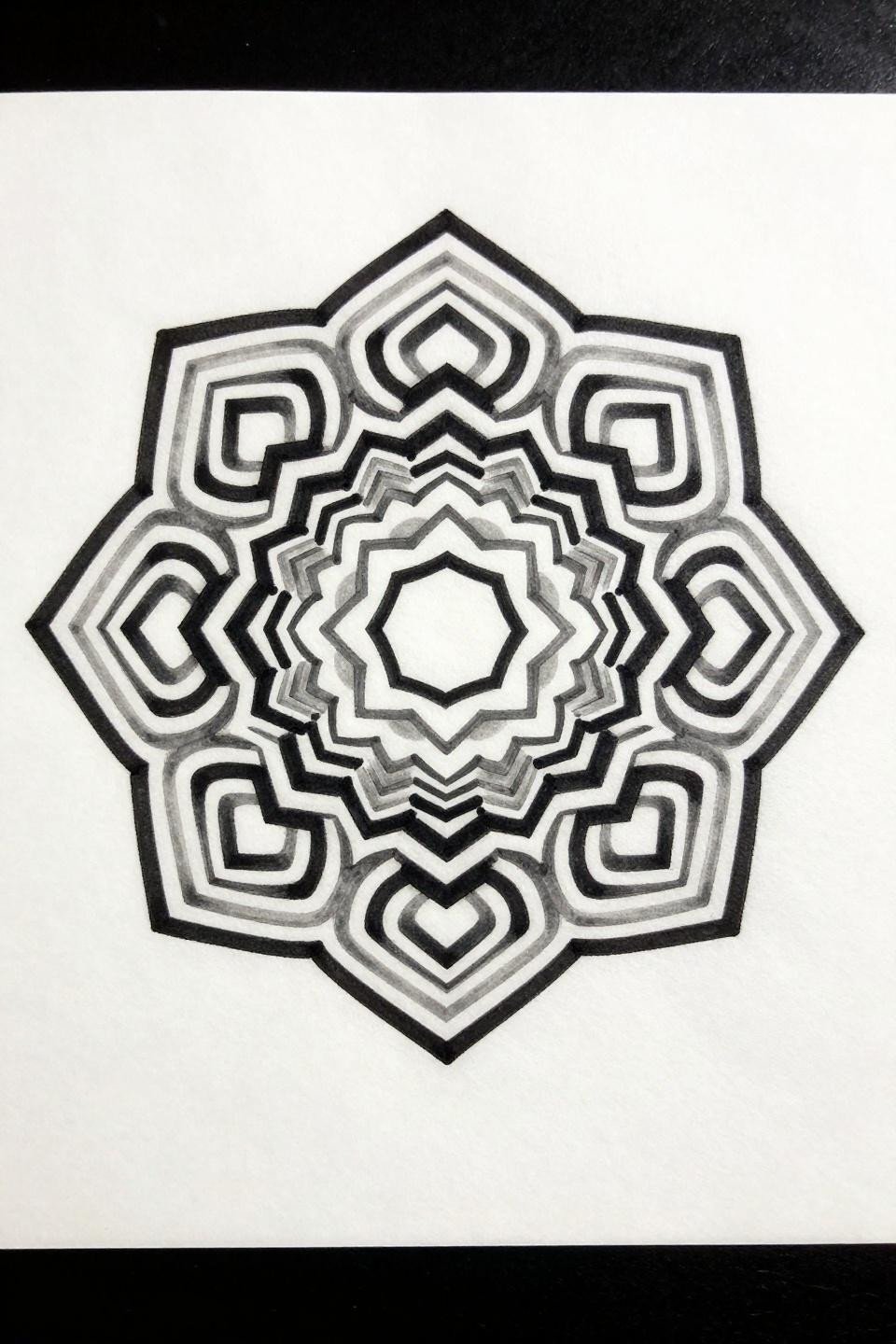
Interlocking hexagonal honeycomb lattice with recursive rotated squares inside each cell produces a four-pointed star void at center, the whole expanding outward in a circular mandala frame with irezumi-derived structural weight. Bold 2-3pt outline integrity at the cell boundaries prevents neighboring shapes from merging as ink spreads, which is the primary failure mode in dense honeycomb-scale geometry.
Japanese irezumi structure handles curved body placements better than most geometric substyles because the design logic was originally built around the body’s natural contour. Upper back and sleeve work amplify rather than distort the radial expansion.
Art Nouveau Curves Against Sharp Angles: Reading the Tension Correctly
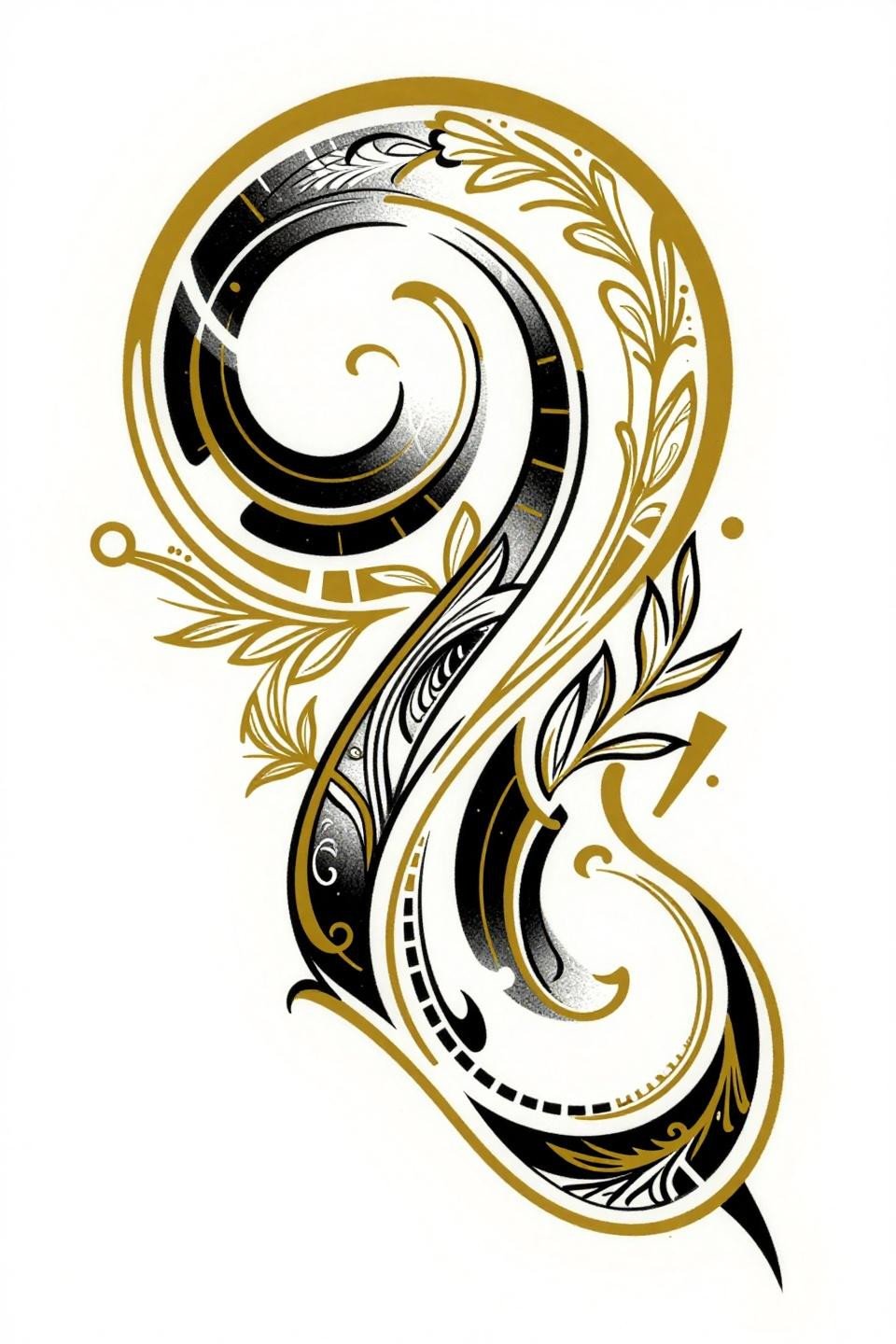
Whiplash curves through interlocking golden ratio rectangle chambers, with organic botanical tendrils set against sharp angular divisions, executed in clean 1pt outlines with gold ochre and flat black fills. The organic-to-geometric contrast ratio is the compositional engine: the botanical lines read as motion, the angular grid reads as structure, and neither can dominate without collapsing the design.
Gold ochre ink holds reasonably well on lighter skin tones but reads muted on medium to dark skin. If the warmth of that palette matters, confirm the artist tests pigment response on your specific skin tone before proceeding.
Pentagon Fractal Rings: Tribal Weight Serving Geometric Precision
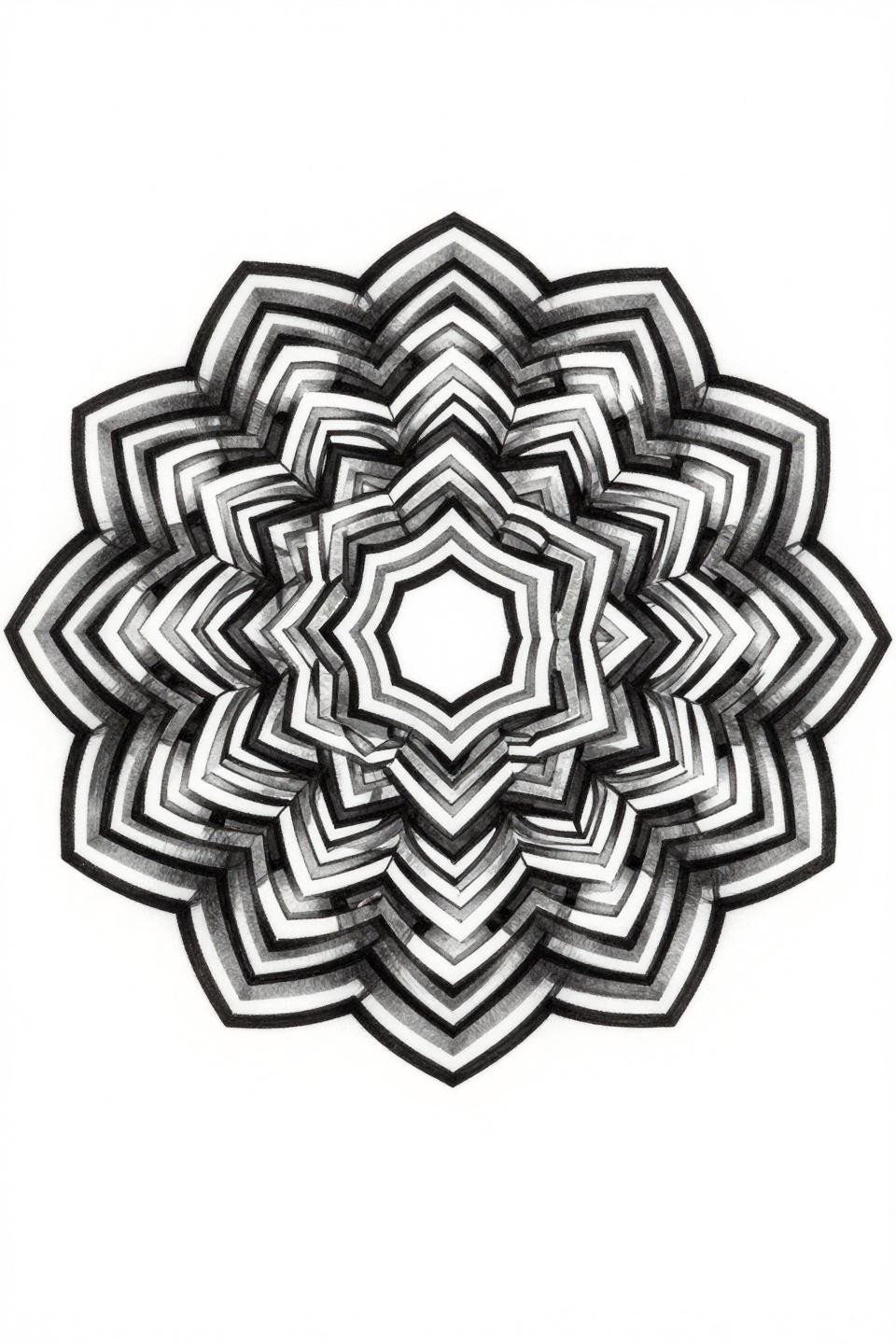
Interlocking rings built from recursive pentagon subdivisions, each segment containing nested smaller pentagons for fractal depth, form a circular mandala with a hexagonal void at center and high-contrast solid fields. Flat black fill saturation at this density requires multiple layered passes to avoid patchiness, which is the most reliable way to identify whether an artist commits to proper ink saturation.
Blackwork at full saturation holds density indefinitely when the artist completes those layered passes. Under-saturated fills look comparable on day one but thin out visibly by year two, especially on lighter skin where the contrast difference reads sharply.
Geometric Mountain Treeline: Triangular Stacking and the Negative Space Rhythm
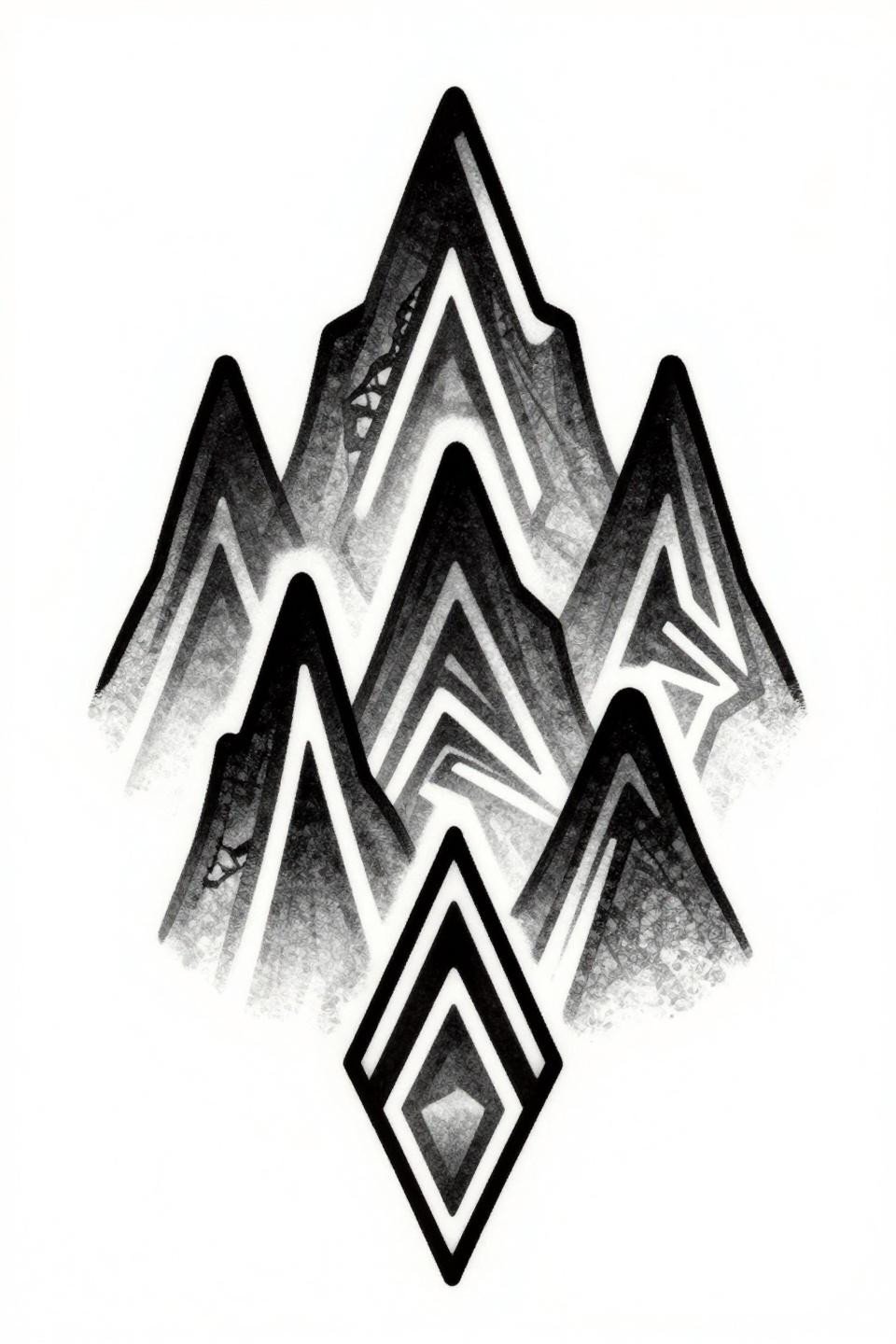
A forest treeline silhouette built from layered triangular peaks, each tier subdivided into smaller isosceles triangles with stark negative space rhythm between layers, reads as both landscape and pure geometry. The asymmetric horizontal stacking across tiers is what prevents this from reading as pattern repeat, giving the composition a genuine landscape logic.
This design scales well as a forearm band or a chest piece. The horizontal format follows the body’s natural width on either placement, and the triangular forms tolerate the slight surface curvature without distortion.
Fibonacci Spiral With Watercolor Bleed: Where the Longevity Risk Lives
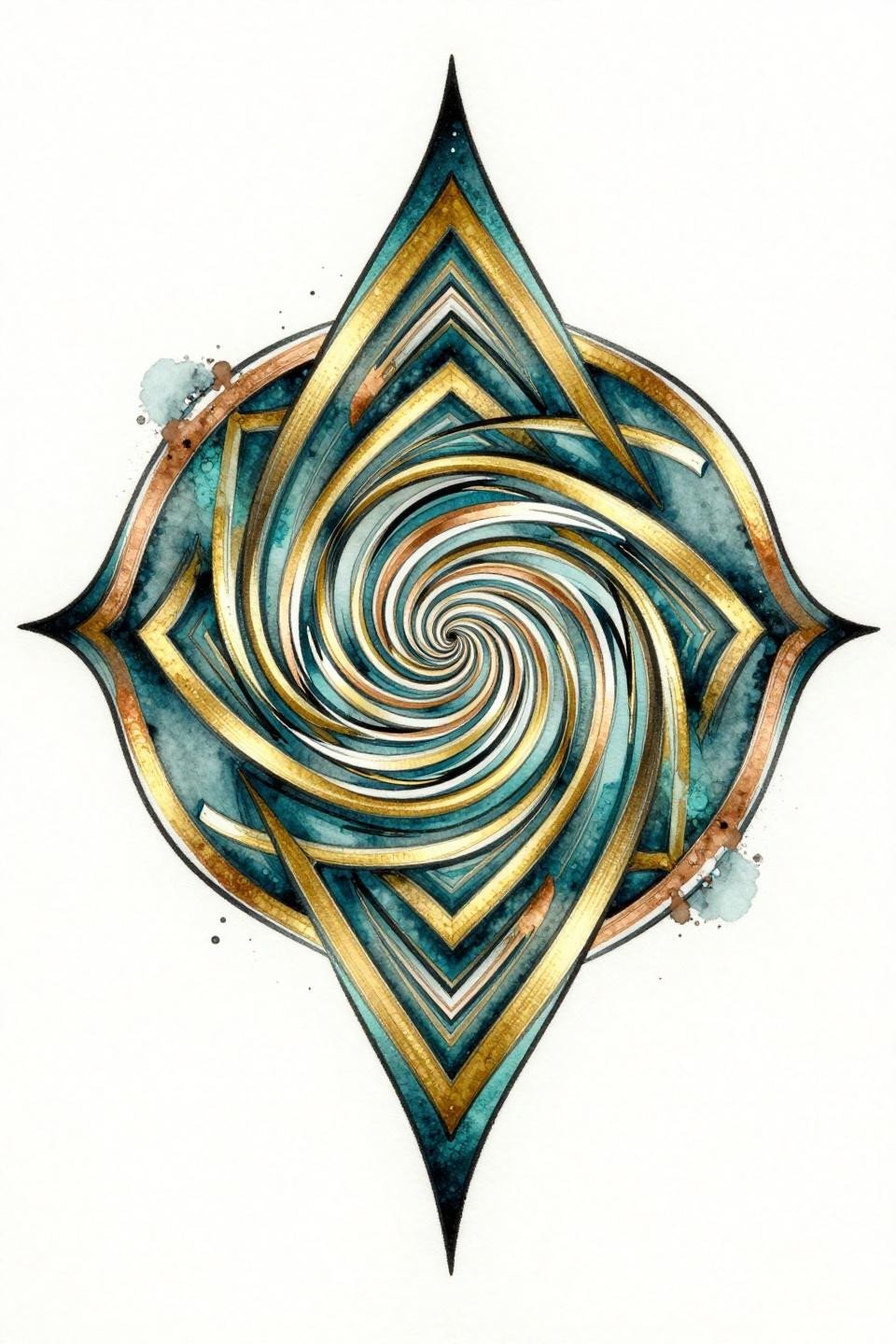
A golden ratio logarithmic spiral with recursive triangular subdivisions and fibonacci sequence chambers uses wet ink calligraphic marks and watercolor color bleeds in teal and copper accents. The watercolor wash elements are the risk factor: without an anchoring outline at the color boundaries, soft ink bleeds expand into the surrounding skin and blur within three to five years.
If this piece appeals, request a version with a defined 1pt boundary line at every color edge. The structural geometry of the spiral will hold; the watercolor effect will not unless the artist isolates it from the linework.
Isometric Cube Labyrinth: Impossible Architecture as Placement Logic
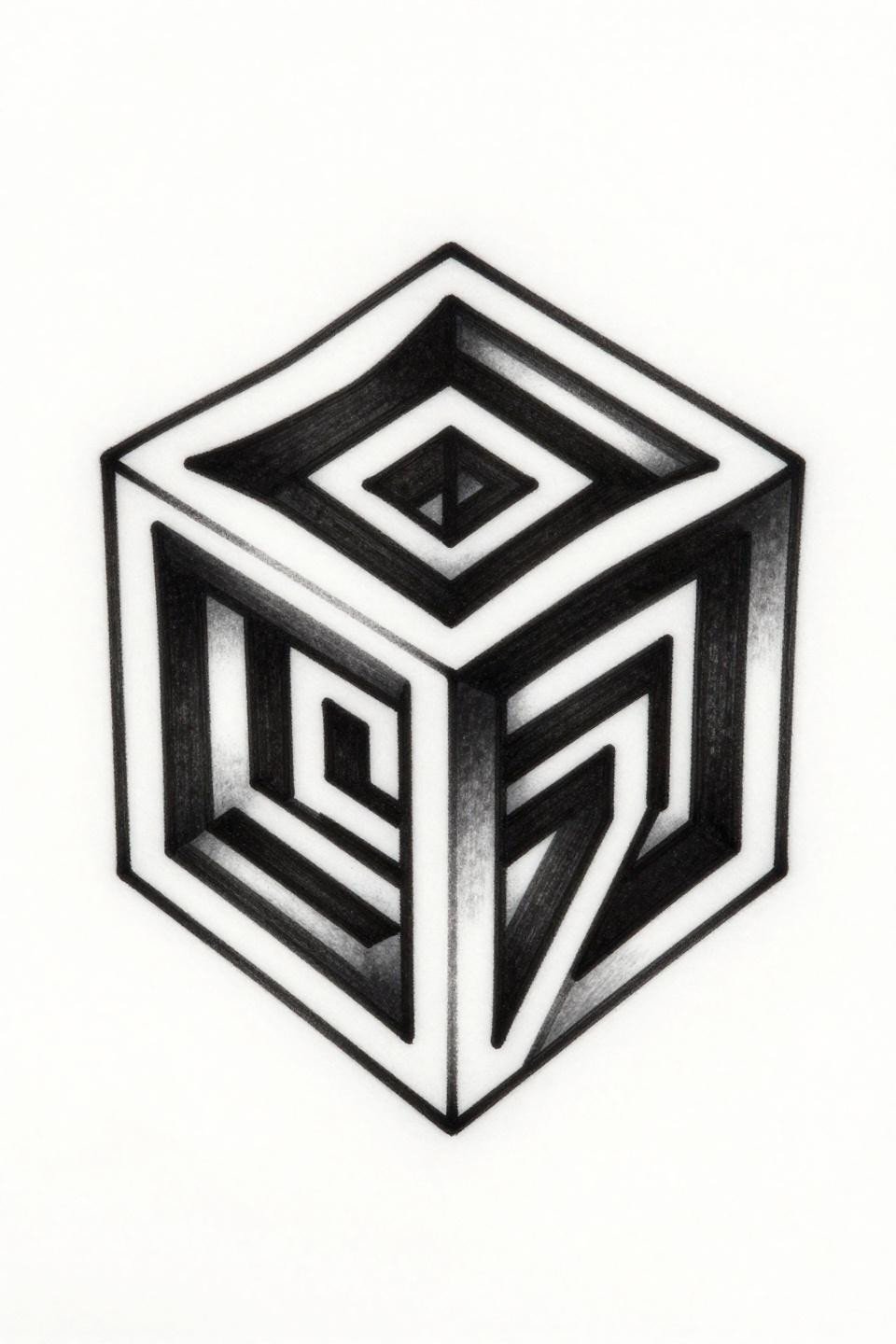
Recursive stacked isometric cubes with triangular passage corridors create an impossible architecture illusion with a vanishing point at center, executed in bold 2-3pt outlines with hard-edged perspective lines and no grey wash. Hard-edged perspective line geometry like this is placement-sensitive: any surface with pronounced curvature will visually break the isometric illusion, making flat placements like the outer forearm or sternum the correct call.
The no-grey-wash approach is a deliberate durability decision. Flat black and open negative space maintains contrast indefinitely, while grey wash versions of isometric geometry tend to flatten and lose the architectural depth within seven to ten years.
Single-Continuous-Line Diamond: Measuring Precision by Unbroken Flow
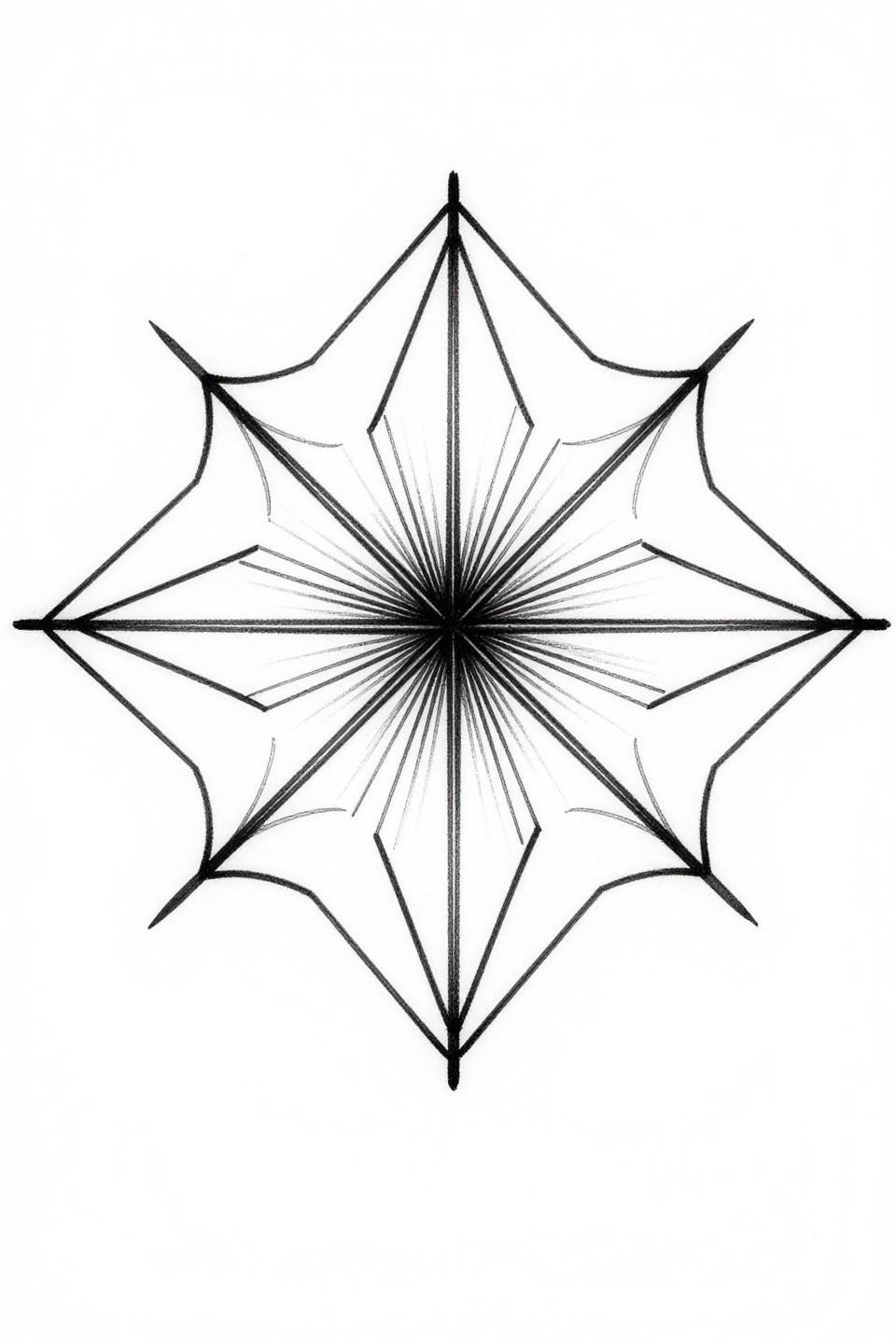
Nested polygonal diamonds with concentric squares rotated 45 degrees and radiating lines to outer vertices are constructed from one unbroken flowing line, no fills, all depth from hairline single-stroke linework and negative space. The technical proof of execution is in the corners: any wobble at the 45-degree direction changes exposes speed inconsistency, which is why this is a senior artist piece.
Single-needle continuous-line work needs an artist who controls machine speed precisely through directional changes. Fast hands produce consistent hairline weight; inconsistent speed creates visible thick-thin variation at every corner junction.
Sacred Geometry Universe Map: Platonic Solids as Compass-Drafted Structure
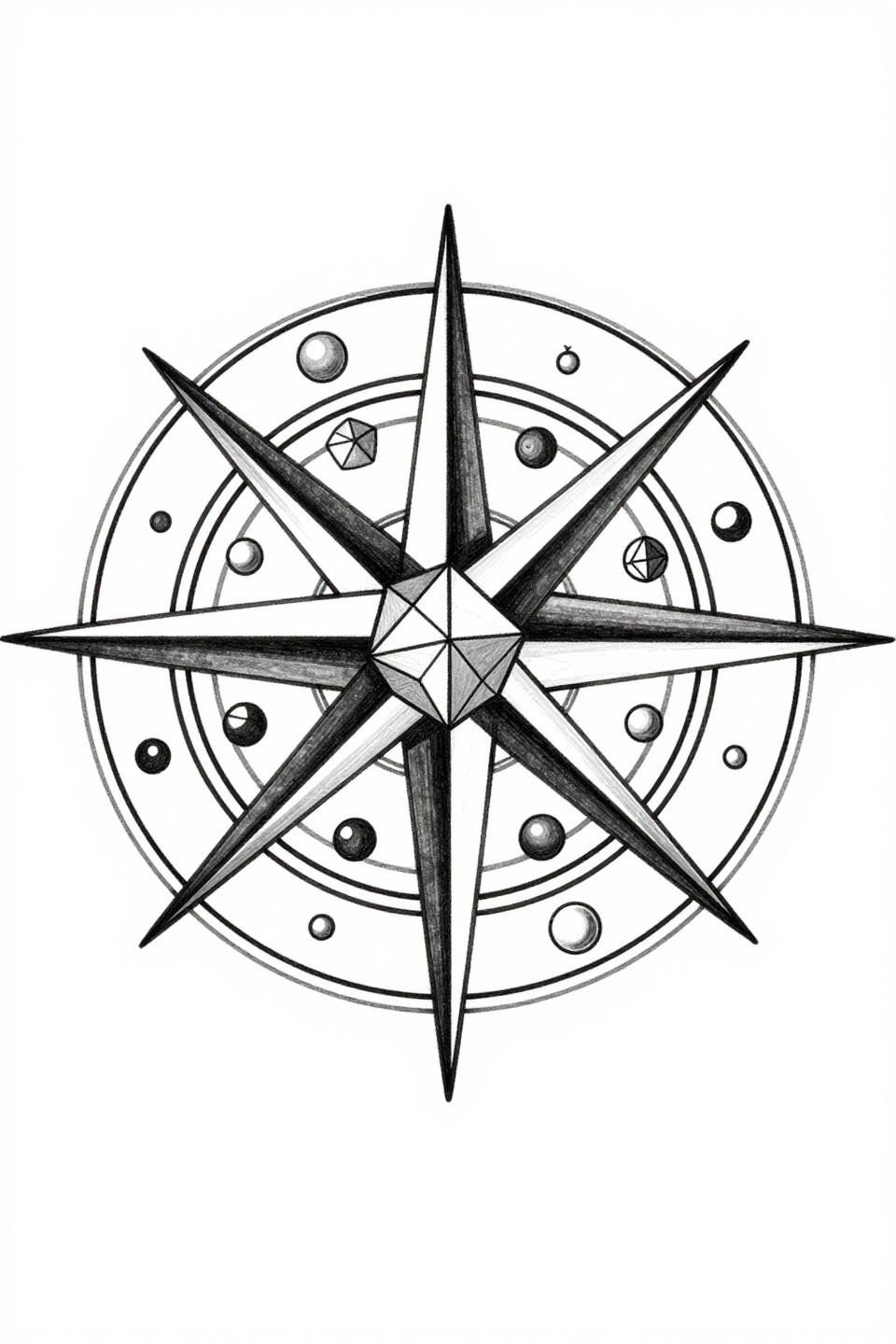
Interlocking platonic solids, tetrahedron and cube forms nested within overlapping circles with celestial bodies at cardinal points, sit inside a circular mandala frame built from compass-drafted 2pt outlines with flat fills. The compass-drafted linework standard is visible in the circle consistency: hand-drawn arcs vary in radius, compass arcs do not, and the difference reads clearly at scale.
Sacred geometry designs age best when the artist avoids fine-detail fills inside the platonic solid faces. Those small internal shapes compress into grey noise faster than the structural outlines, especially on medium and darker skin tones where contrast margin is tighter.
Flower of Life in Art Deco: High Contrast That Survives the Decades
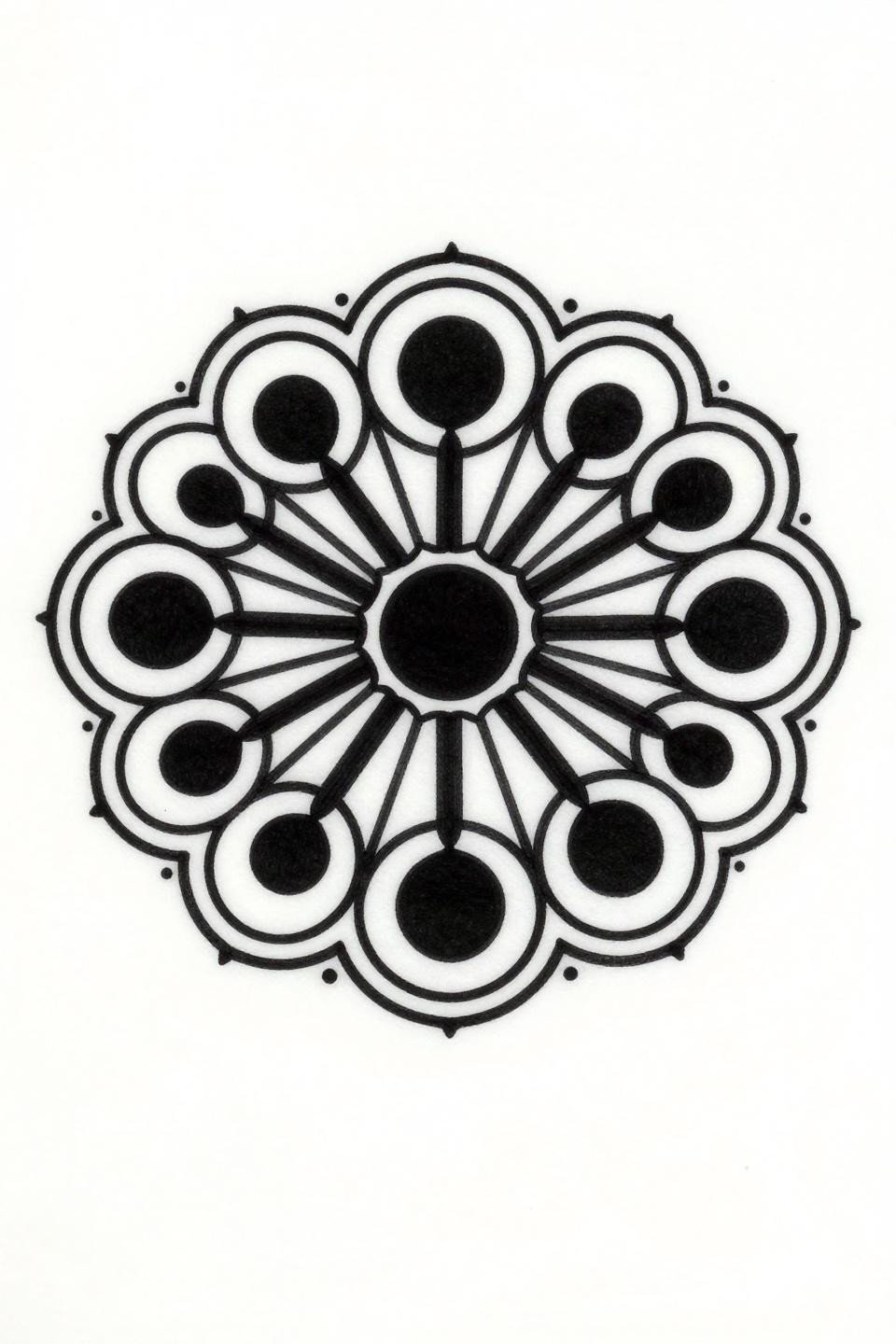
The flower of life pattern built from vesica piscis chambers uses a radial spoke grid to divide alternating solid black and void segments, executed in art deco structure with bold 2-3pt outlines and no grey wash. The positive-negative contrast ratio between solid black fields and open white voids is what makes this design function at full saturation without becoming visually heavy.
Art deco geometry with hard black fills holds its graphic weight longer than any grey wash equivalent. Check the healed portfolio for flat patchless fills. Patchiness in fresh work becomes visible contrast gaps within two years.
Hexagonal Dotwork: How Stipple Density Maps Reveal Artist Control
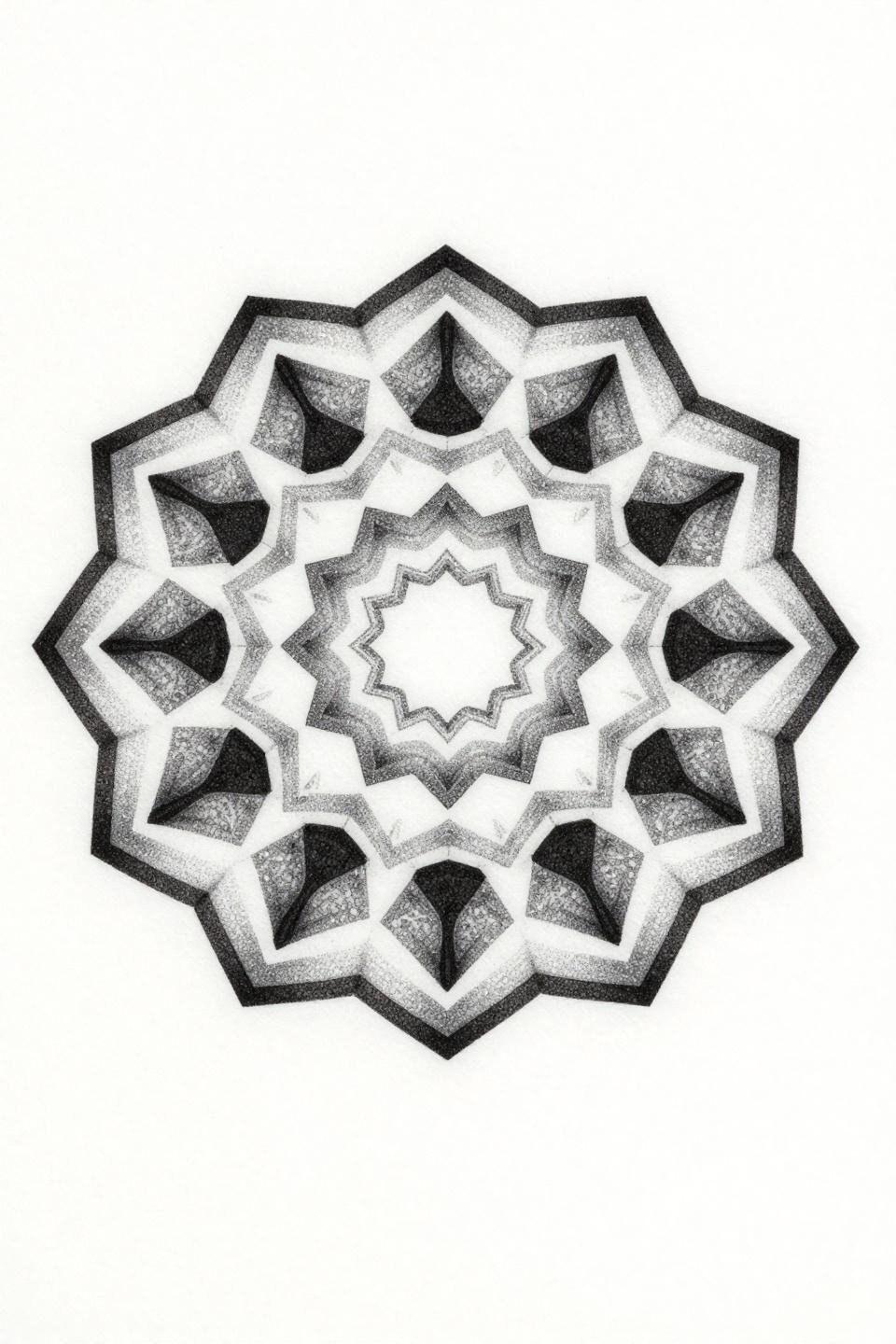
A concentric hexagonal grid with nested triangular tessellation uses stipple dot gradient running dense at the center and opening toward the outer edges, the reverse of the octagonal labyrinth earlier in this collection. Stipple density mapping in this direction, dense-to-open outward, creates an inward visual gravity that suits circular mandala placements on flat body surfaces.
Dotwork gradient control is one of the most reliable artist skill signals in geometric tattooing. Consistent dot sizing across the full tonal range confirms technical discipline. Irregular dots near the gradient transitions expose a rushed or inexperienced hand.
Pick three to five of these references that match your intended placement and scale, then filter further by line weight. Hairline work belongs on protected placements only. Bold-outline pieces go anywhere. Send references that already reflect those constraints, and the consultation becomes a conversation about refinement rather than a negotiation about what is technically possible.