
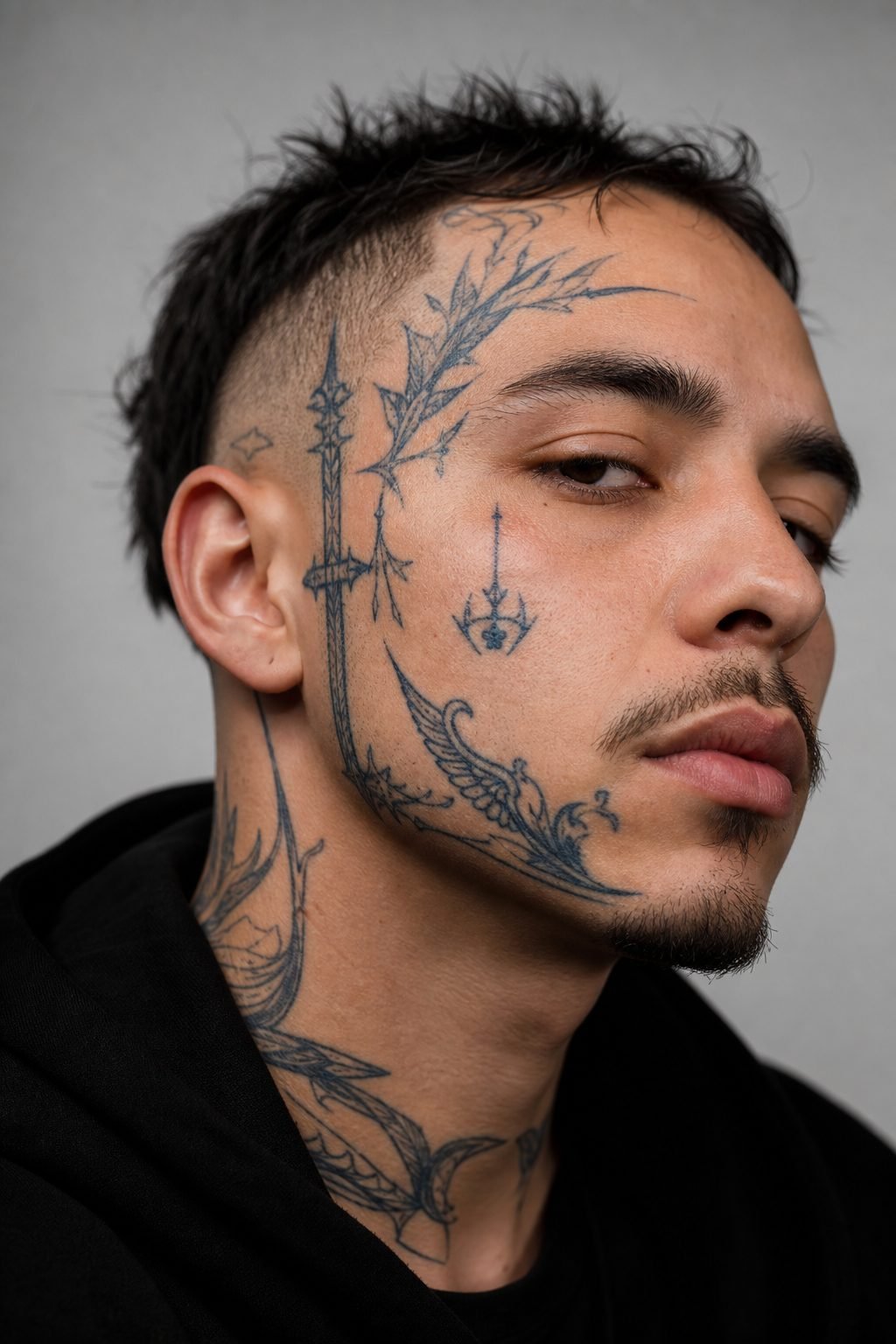
Blueface’s new face tattoos serve as a visual autobiography that merges his Los Angeles street roots with his meteoric rise in hip-hop. The rapper, born Jonathan Porter, has added several facial pieces that include script, symbols, and decorative elements representing his affiliations, personal milestones, and unapologetic embrace of controversy. These tattoos function simultaneously as permanent branding, territorial markers, and declarations of authenticity within a genre where visual identity carries significant cultural weight.
Symbolism & History
Face tattoos in hip-hop culture carry layered historical significance that predates mainstream acceptance. The practice draws from multiple traditions:
- Prison and street culture origins, where facial ink signaled commitment to a lifestyle that conventional employment could not accommodate
- Chicano tattoo traditions from Southern California, where face tattoos often represented neighborhood pride and resistance against assimilation
- Punk and alternative movements that used visible body modification as deliberate social provocation
- Contemporary rap’s evolution toward face tattoos as status symbols of success that transcends traditional employment constraints
Blueface specifically operates within the West Coast tradition, where his tattoos reference his connections to the School Yard Crips and his Compton-adjacent upbringing. The placement on the face amplifies meaning, as these tattoos cannot be concealed, representing total commitment to one’s public persona. Unlike earlier generations of entertainers who hid tattoos for commercial appeal, Blueface and peers like Lil Wayne, Post Malone, and 21 Savage transformed facial ink into expected aesthetic markers within the genre.
Common Variations & Styles
Blueface’s facial work incorporates several distinctive stylistic approaches that appear throughout contemporary hip-hop tattooing:
- Script and lettering: Names, phrases, or numbers rendered in cursive or gothic fonts, often placed on the forehead or temples
- Crystalline and decorative patterns: Diamond or money-inspired motifs referencing material success and hustle mentality
- Portrait elements: Stylized representations of figures or symbolic characters with personal significance
- Brand-adjacent logos: Visual elements that reinforce musical identity or crew affiliation
- Traditional black and grey: The predominant West Coast style emphasizing shading and depth over color saturation
His tattoo artist selection matters as much as the designs themselves. Blueface has worked with prominent Los Angeles-area tattooers who specialize in the regional black-and-grey realism that defines California prison and street tattooing. This technical choice connects his work to a specific geographic and cultural lineage rather than generic commercial tattooing.
Best Placements
Facial tattoo placement carries specific communicative functions within hip-hop culture:
- Forehead: The most visible and confrontational placement, often reserved for primary identity statements or names
- Temples: Positions that frame the eyes and create an intense, focused appearance during performance and photography
- Cheeks: Allow for larger designs while maintaining symmetry; popular for script and decorative elements
- Jawline and chin: Grounding placements that anchor facial composition and create framing effects
- Near the hairline: Strategic positions that work with hairstyle choices and can be partially concealed if desired
Blueface’s placement choices reflect understanding of how these tattoos photograph and film. As a performer whose visual presence drives social media engagement, his tattoo positioning maximizes visibility during his characteristic off-beat flow performances and meme-generating moments.
Who Chooses This Tattoo / Personal Meanings
Individuals selecting face tattoos similar to Blueface’s aesthetic typically share specific psychological and social profiles:
- Career tattoo collectors who have exhausted conventional canvas areas and seek the ultimate commitment piece
- Entertainment industry professionals whose livelihood depends on distinctive visual branding
- Individuals with strong neighborhood, crew, or family affiliations they wish to permanently externalize
- Those who have experienced significant life transitions and want irreversible markers of transformation
- People deliberately rejecting conventional professional trajectories in favor of entrepreneurial or creative paths
For Blueface specifically, the timing of his new face tattoos matters. Adding visible ink after achieving mainstream success with “Thotiana” represents consolidation of identity rather than aspirational transformation. The tattoos confirm that his controversial persona, distinctive delivery, and visual aesthetic constitute a unified artistic statement rather than calculated performance. This authenticity claim, whether genuine or strategic, resonates with audiences who value perceived realness in hip-hop culture.
Similar Symbols
Related visual elements appear across hip-hop tattooing and adjacent cultures:
- Teardrop tattoos: Historically associated with loss, violence, or incarceration; meanings vary dramatically by region and individual
- Crosses and religious imagery: Spiritual protection and remembrance, common across West Coast black-and-grey traditions
- Money symbols and currency representations: Direct material aspiration and success documentation
- Neighborhood and area codes: Geographic identity markers similar to Blueface’s regional references
- Celebrity portrait tattoos: Fan devotion or personal connection claims, increasingly common in hip-hop fan communities
These symbols operate within what scholars call “contested signification,” where identical images carry radically different meanings depending on the wearer’s context, audience, and narrative. Blueface’s tattoos participate in this fluid interpretive space, readable as authentic street documentation, calculated marketing, artistic expression, or all simultaneously.
Final Thoughts
Blueface’s new face tattoos resist simple interpretation because they function as multivalent symbols within overlapping cultural systems. They document personal history, claim territorial identity, perform authenticity for hip-hop audiences, and create memorable visual branding in an attention economy. Whether viewed as artistic statement, social provocation, or commercial strategy, these tattoos demonstrate how permanent body modification continues evolving as communication technology in contemporary culture. The meaning ultimately depends on who observes, from what perspective, and with what knowledge of the traditions Blueface both inherits and transforms.









