Corazon tattoos fail when artists treat the heart as decoration. The form carries too much loaded iconography, Catholic, anatomical, devotional, for a lazy interpretation to land. The difference between a corazon that reads for thirty years and one that looks dated in five is almost always in how the linework handles the organ’s asymmetry.
The designs that hold up lean into that tension: sacred iconography rendered with anatomical honesty, or clinical accuracy softened by symbolic detail. Both directions work. Neither forgives a weak outline.
Chicano Grey Wash and the Downward Pull of the Heart Form
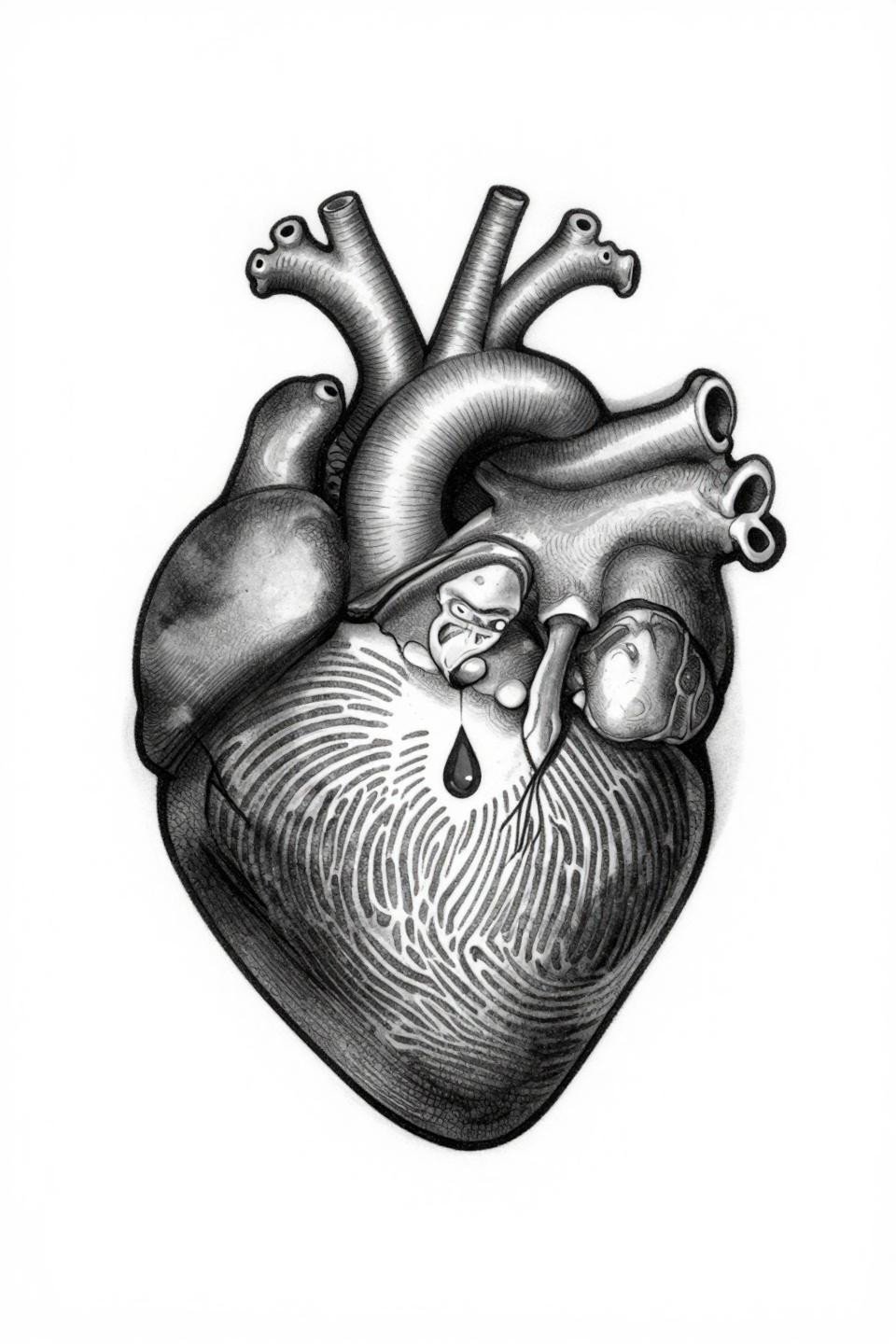
Chicano grey wash on an anatomical corazon, fingerprint ridge patterns filling both ventricles, skeletal hands cradling the base, a single vermillion teardrop suspended below apex. The triangular downward composition gives the piece visual gravity that keeps the eye anchored at the bottom of the design.
Whip shading from dense to open midtones is a technique that rewards experienced artists and punishes rushed ones. Check healed portfolio work specifically, not fresh shots, before committing to this style.
Trash Polka Red: When Chaos Still Needs a Skeleton
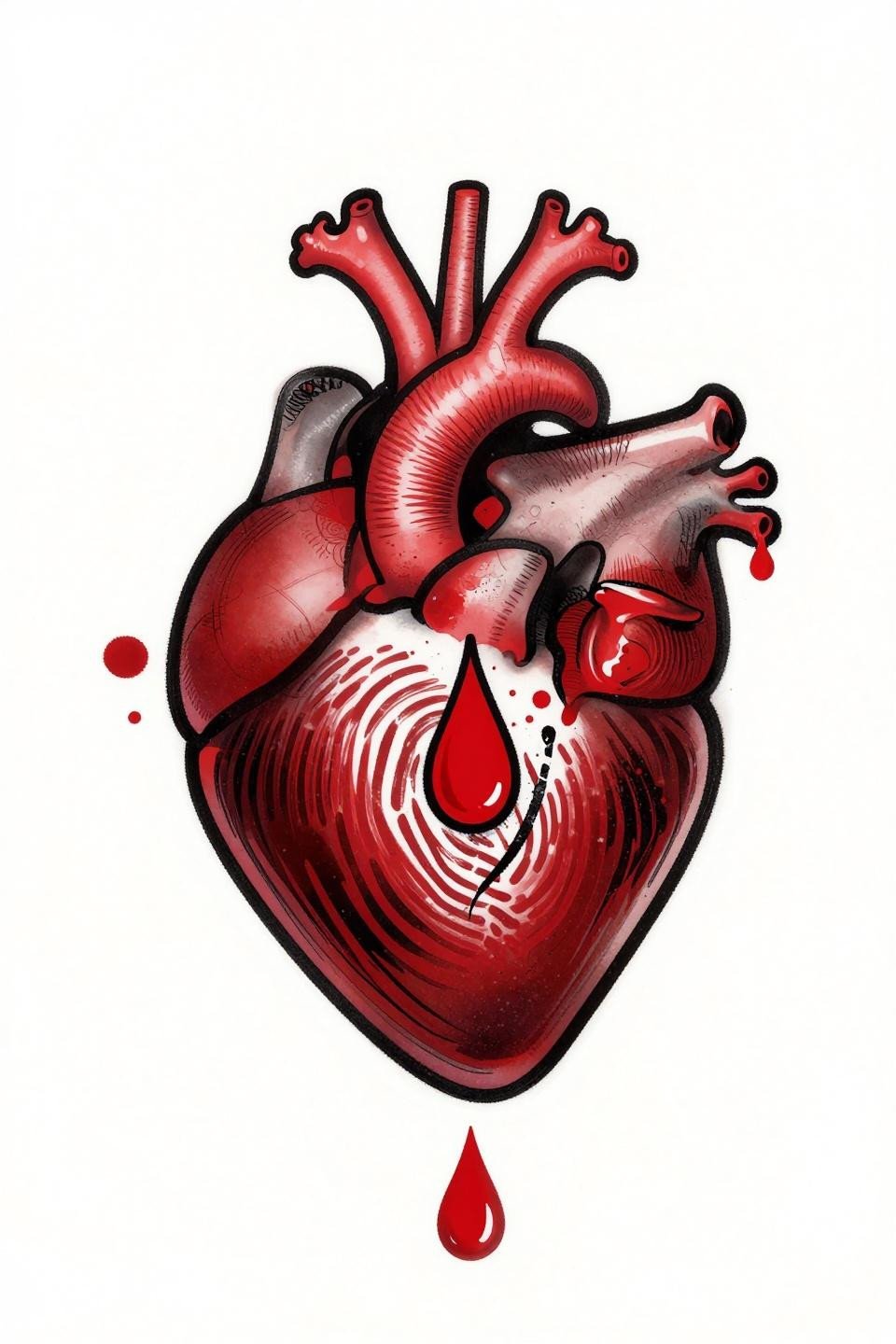
Trash polka corazon with a fingerprint whorl replacing the left ventricle chamber, a ribcage outline forming diamond negative space, bold 2-3pt black outlines holding flat crimson fills against chaotic brushstroke splatter. The controlled contrast between geometric negative space and splatter marks is what keeps this legible rather than chaotic.
On lighter skin tones this reads with high contrast immediately. On olive and darker skin, the fine splatter marks need heavier weight strokes to maintain separation from the background.
Irezumi Thorns Around a Cardiac Form That Earns the Placement
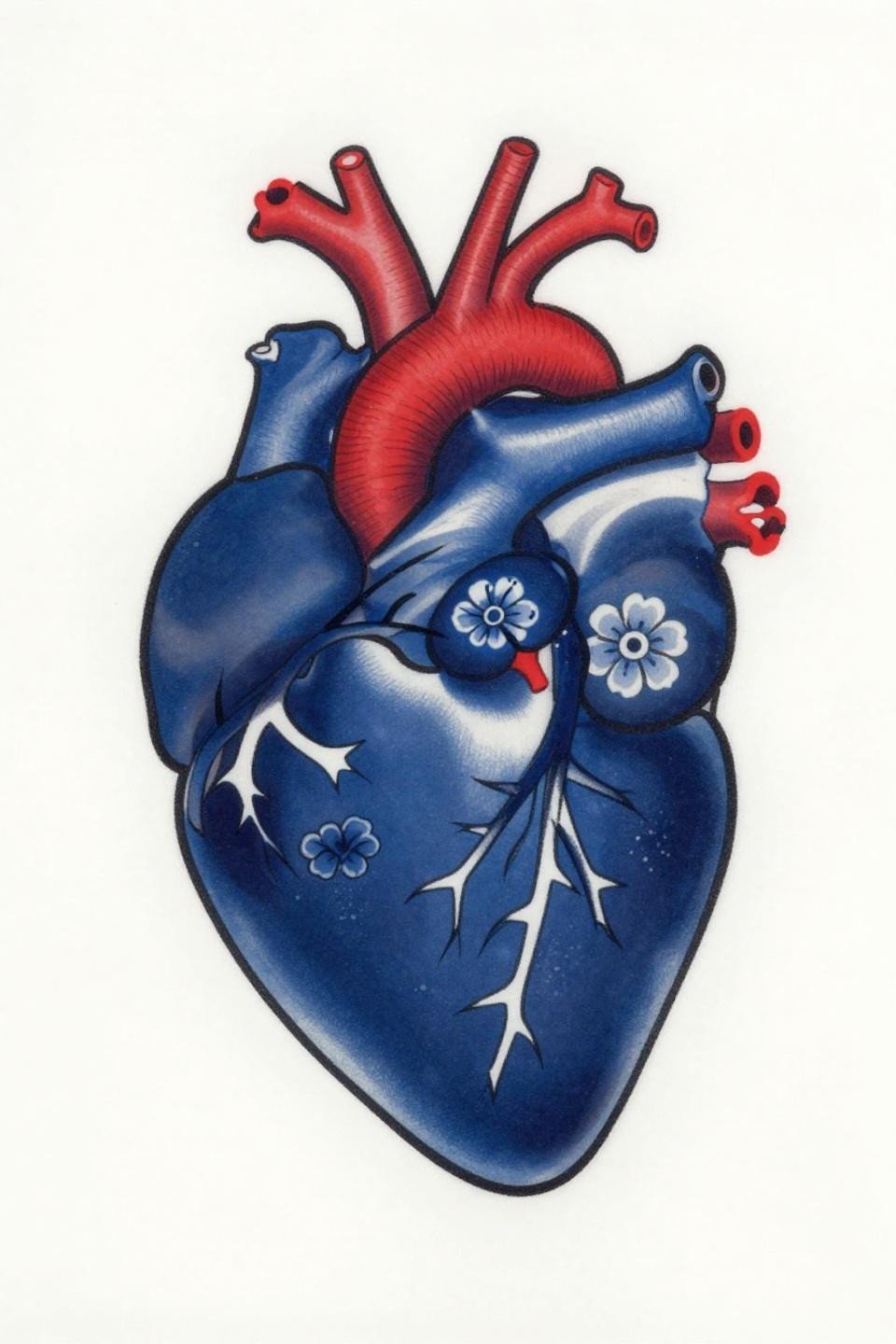
Japanese Irezumi treatment on a human heart form, thorned botanical vines weaving around cardiac chambers with small blossoms emerging from thorn clusters, deep indigo base with crimson accent fills. The organic asymmetric flow here follows Irezumi convention where the design breathes rather than sits static.
This composition scales well to chest or upper arm placement where the vines can extend naturally with the body’s own curves. Forcing it into a small format compromises the botanical movement that makes the design work.
Watercolor Wash on an Anatomical Form: The Longevity Problem
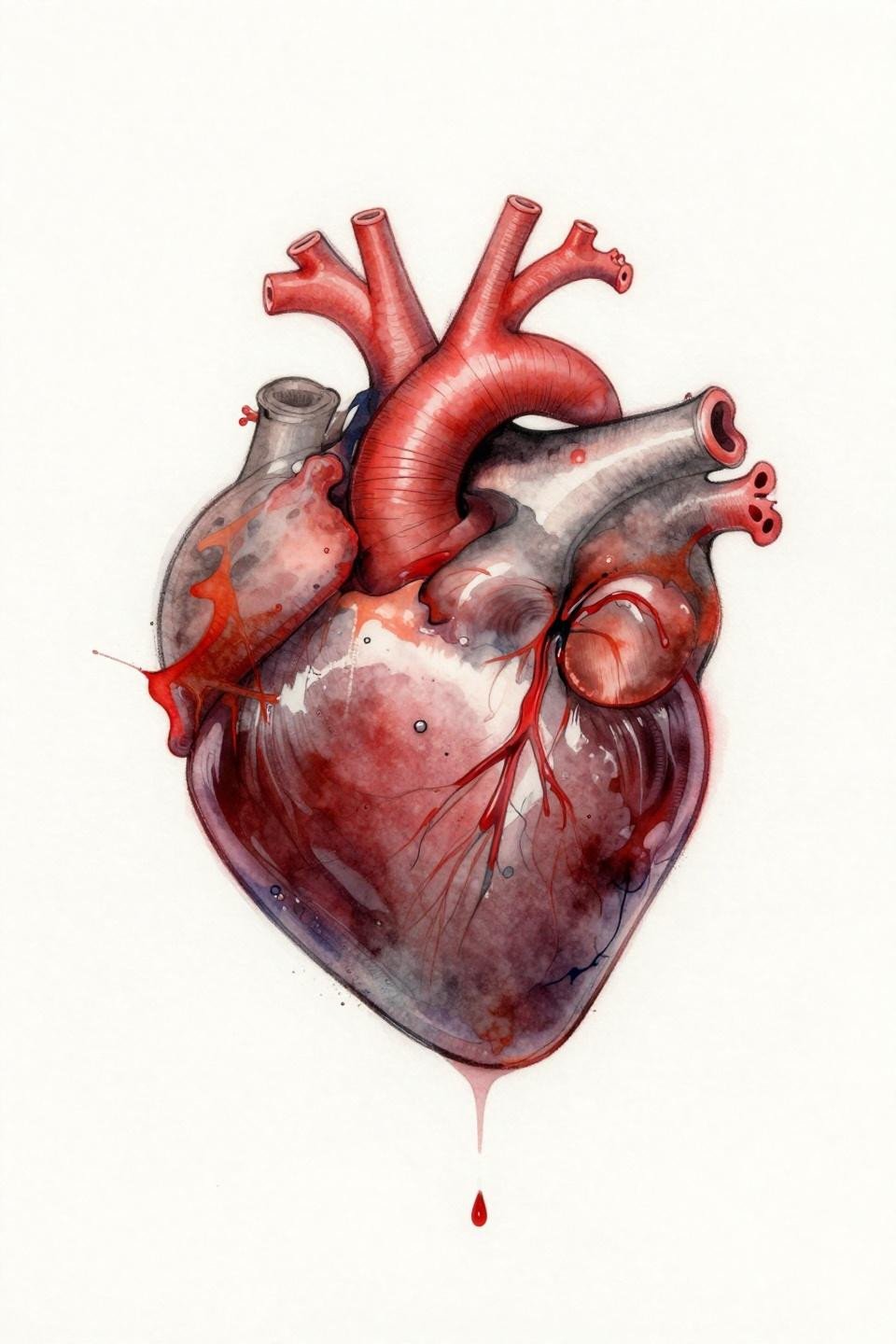
Watercolor corazon with translucent crimson bleeding into coral across the ventricle chambers, fingerprint ridge detail visible through transparent pigment layers, organic diffusion edges dissolving outward. The open pigment diffusion without anchoring outlines is the design choice that creates the most risk here.
Watercolor without a structural outline blurs by year three to five. This flash reference works best as a color direction guide for an artist who will add at least hairline linework to anchor the form.
Fingerprint Texture in Traditional Flash: How Far It Can Stretch

Traditional American sacred heart with fingerprint whorl patterns mapped across the epicardium surface, two intertwined ribbon banners crossing diagonally below, a single crimson teardrop at apex. Bold 2-3pt outlines at this weight are the longevity signal in traditional flash, holding clean definition for ten or more years across most placements.
The fingerprint texture inside a traditional outline is a harder technical ask than it looks. Consistent ridge spacing inside a flat-fill context requires an artist who moves deliberately, not fast.
Botanical Engraving Precision and the Stencil-Ready Line
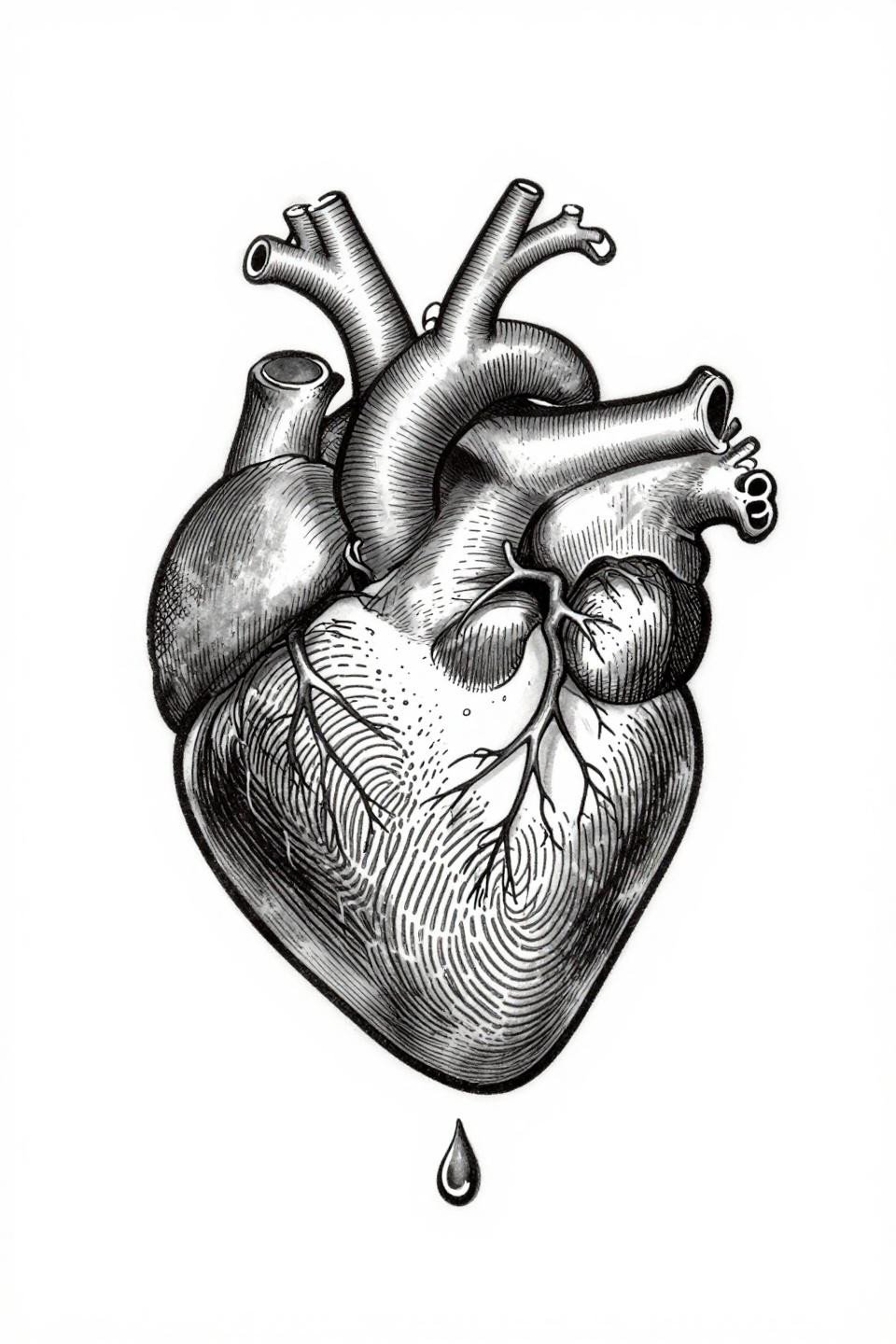
Scientific botanical engraving style corazon, arch ridge fingerprint patterns across both ventricles, hairline coronary vessel branching in clinical diagram precision, parallel line crosshatch creating directional shadow. The crosshatch hatching shadow system here reads almost like a copperplate illustration and transfers cleanly to stencil at medium-to-large scale.
Downsizing this design past three inches compresses the crosshatch until the midtones merge into grey mud. The minimum workable size for this level of linework density is palm-sized or larger.
Art Deco Sacred Geometry: When the Heart Becomes Architecture
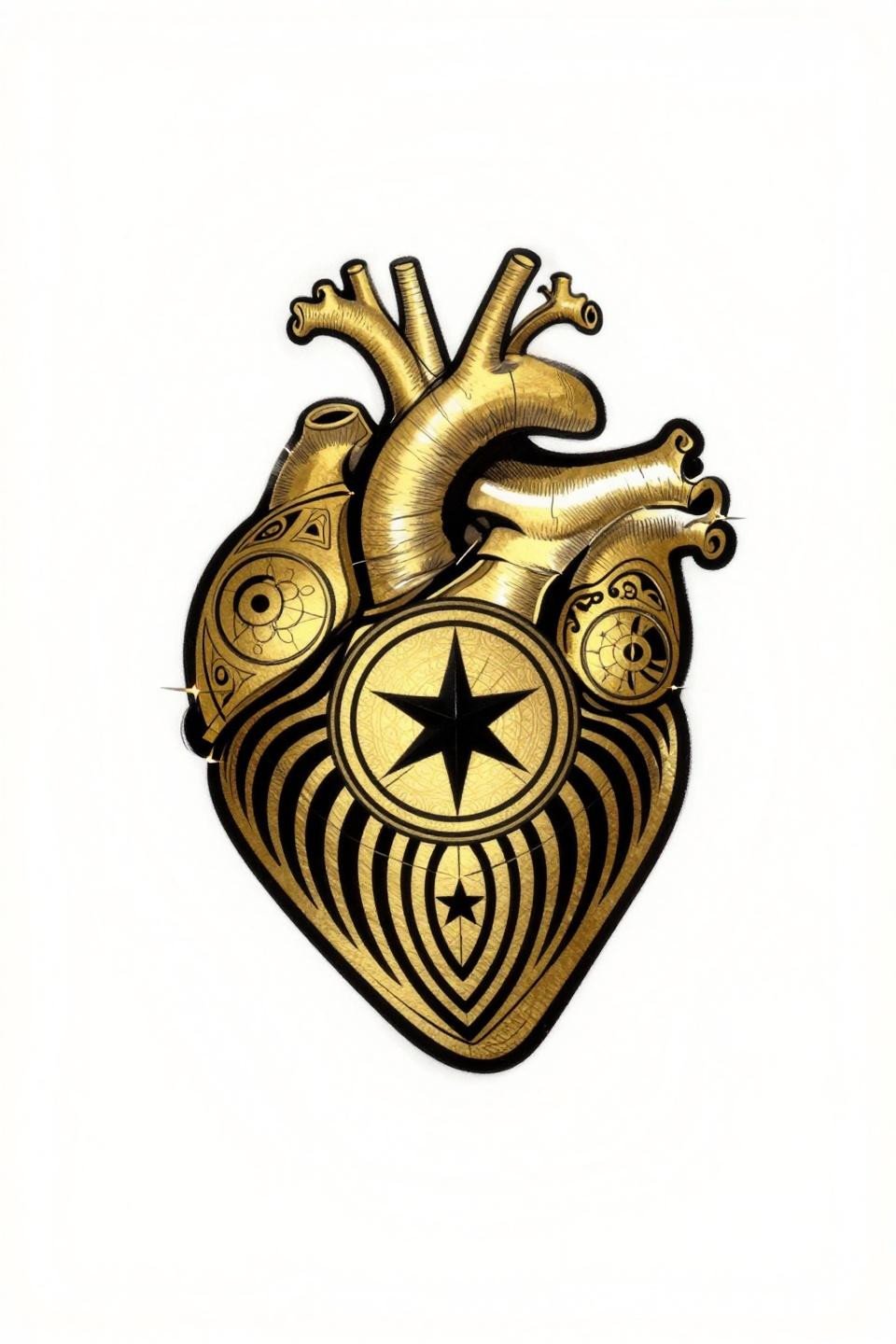
Art deco corazon with concentric circles inscribed within the ventricles, a six-pointed star at apex, arterial branches forming a radial mandala pattern, all executed in compass-drafted geometry with flat gold and black fills. Vector-precision linework at this scale demands an artist who works with rulers and compasses, not freehand.
Gold ink fades differently than black and grey. Ask specifically for a portfolio image of healed gold work before committing, because poorly saturated gold reads as yellow-brown within two years.
Fine Line Minimalism and the Risk of Going Too Small
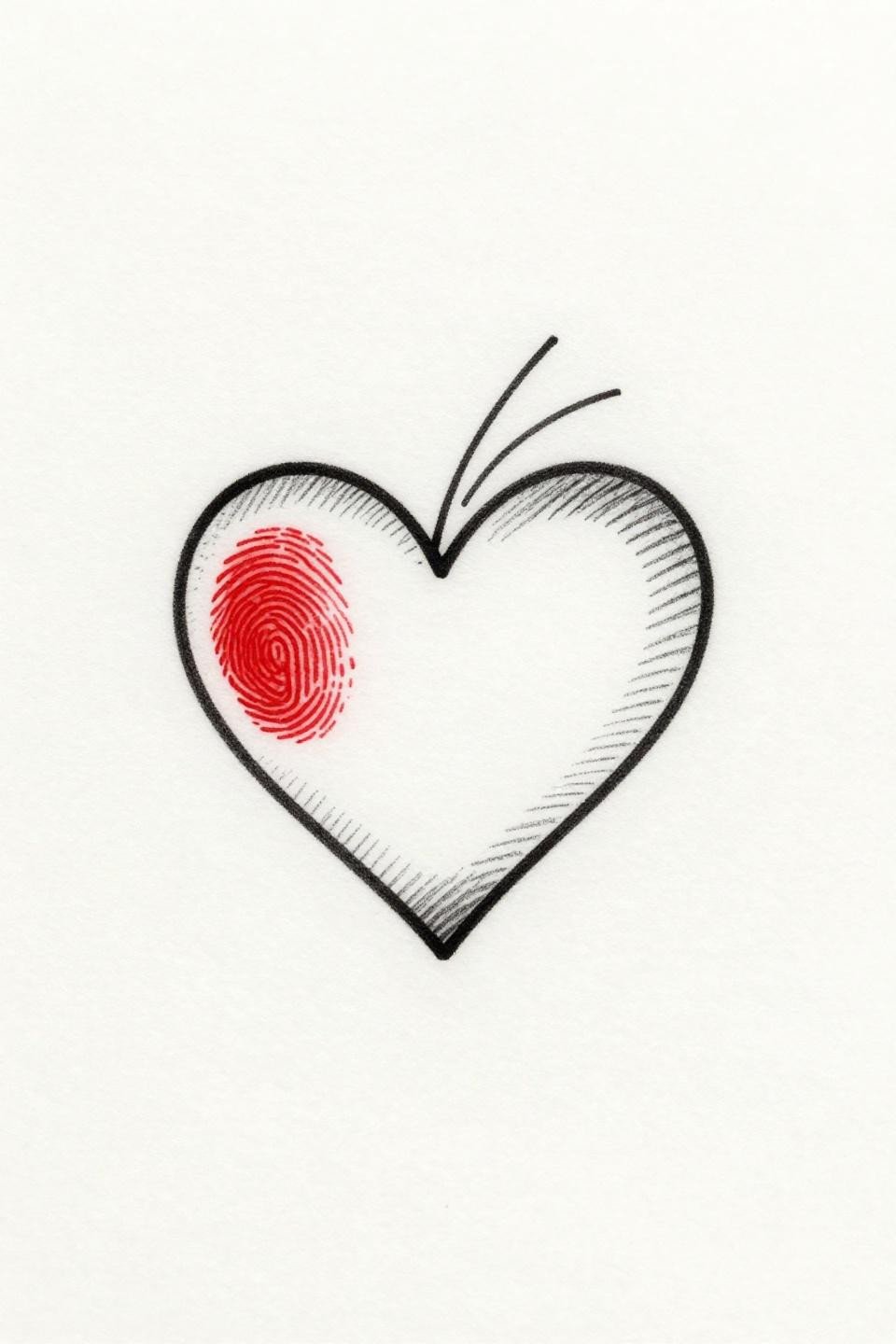
Minimalist corazon with a single fingerprint loop integrated into the left chamber, delicate crosshatch texture throughout, two slender arterial branch lines ascending from apex. Single needle 1RL hairline work like this requires an artist who controls machine speed precisely, because any inconsistency in hand speed shows immediately in stroke weight variation.
Protected placements like sternum or upper back give this style the best shelf life. On high-friction areas like wrists or inner forearms, expect migration of those hairlines within three to five years.
Dotwork at the Core: Stipple Density as a Design Language
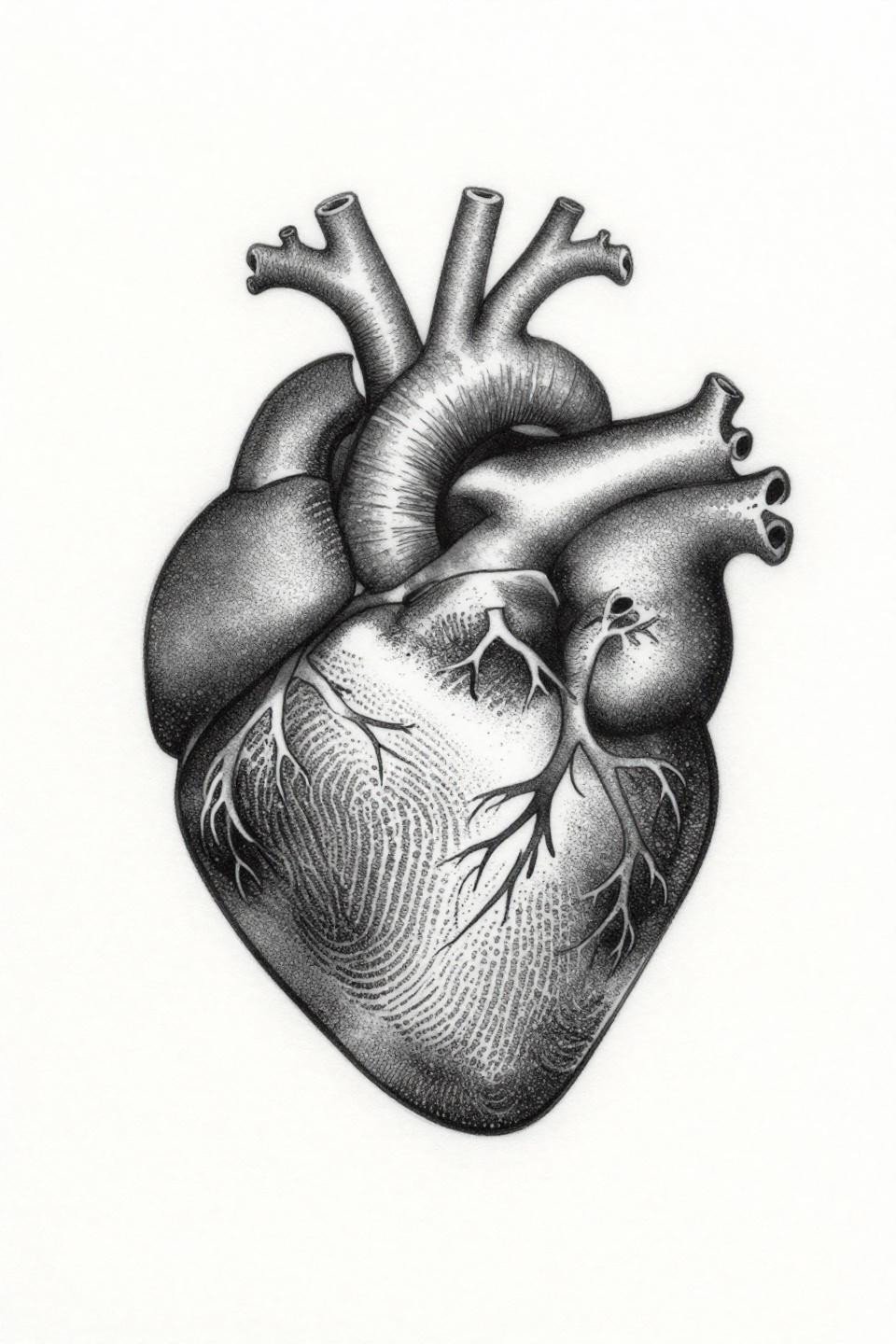
Blackwork dotwork anatomical corazon, fingerprint whorl replacing the left ventricle, coronary artery branches radiating outward, stipple dot gradient running from dense at the core to open at the edges with no solid outlines. The stipple density gradient from 90% at center to open negative space at edges is what creates dimensional form here without a single drawn contour.
Look for consistent dot size across the full gradient range in the artist’s healed work. Uneven dot size is the tell that separates artists who have built the skill from those who are still developing it.
Continuous Line Rendering on Finger Placement: The Honest Math
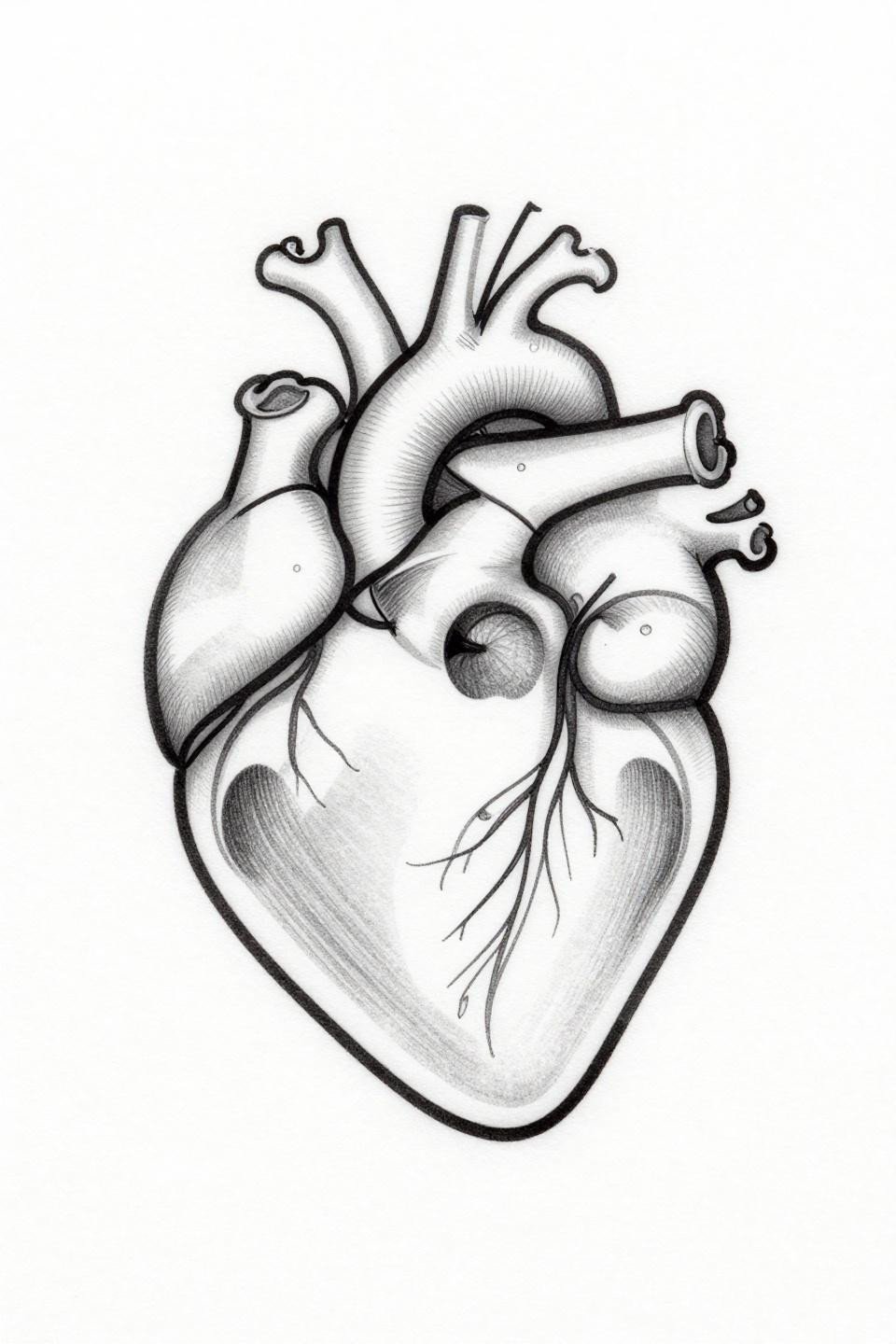
Single continuous line anatomical heart rendered in one unbroken 0.5mm hairline contour, left and right ventricles visible, aortic arch curving upward, pulmonary branches extending outward, zero shading. Continuous line work on this design format is as close to a stencil test as flash gets, showing exactly where the artist’s hand confidence lives or breaks.
Finger placement means touch-up every two to three years minimum. This level of fine line detail on a finger is a conscious maintenance commitment, not a set-it-and-forget-it choice.
Neo-Traditional Sacred Heart: Where the Red Has to Work Harder

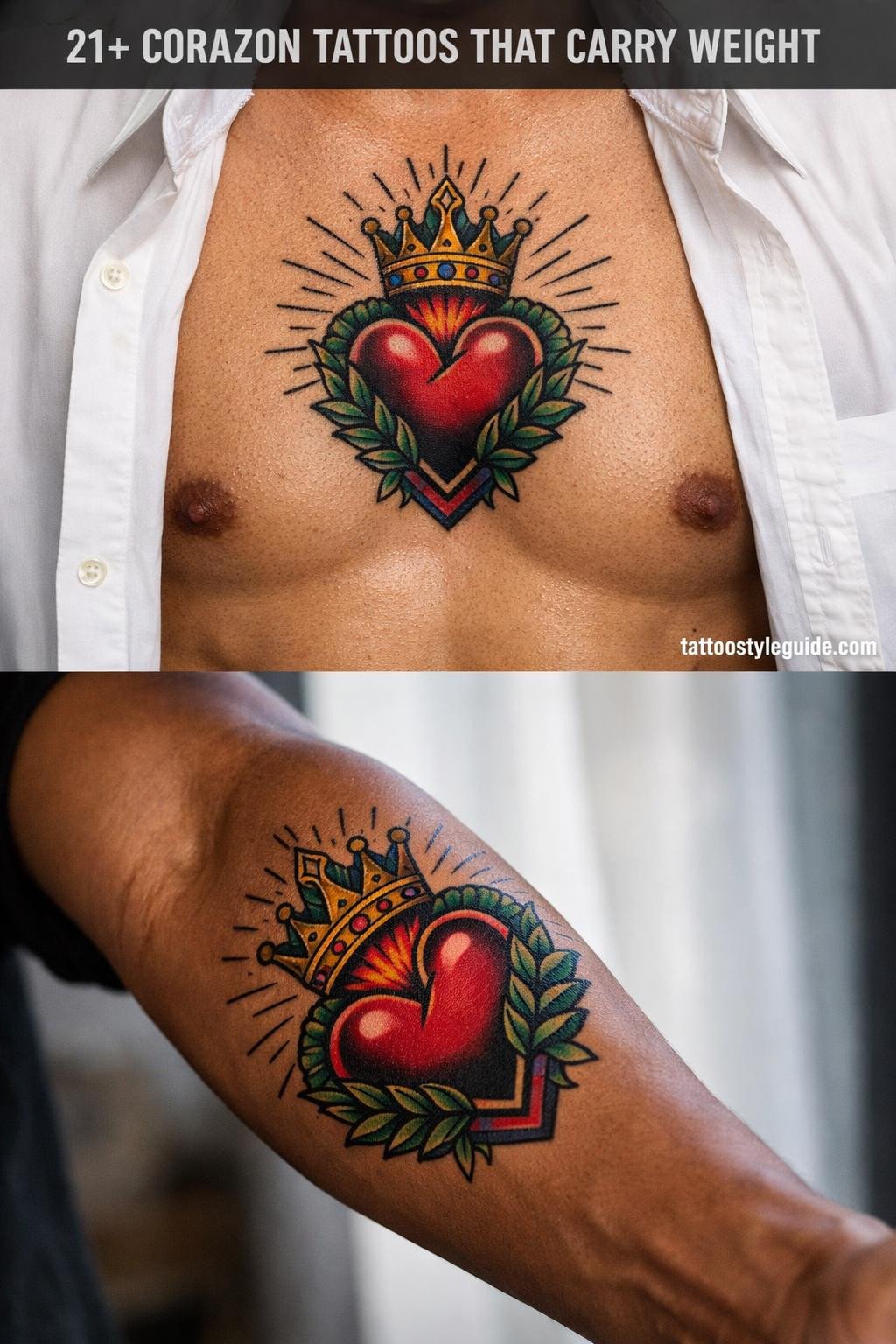
Neo-traditional sacred heart, crown of thorns, central upward flame, ornate banner ribbon below, executed in bold 2-3pt black outlines with flat crimson fills. The Catholic devotional iconography in this layout is the most loaded symbolic territory in the corazon genre and requires no additional embellishment to carry weight.
Flat crimson red holds differently than blended red across skin tones. On medium and darker skin, a single flat fill can read more saturated and legible long-term than a shaded gradient that loses contrast as it heals.
Cross-Section Anatomy With Botanical Overlay: Reading the Complexity
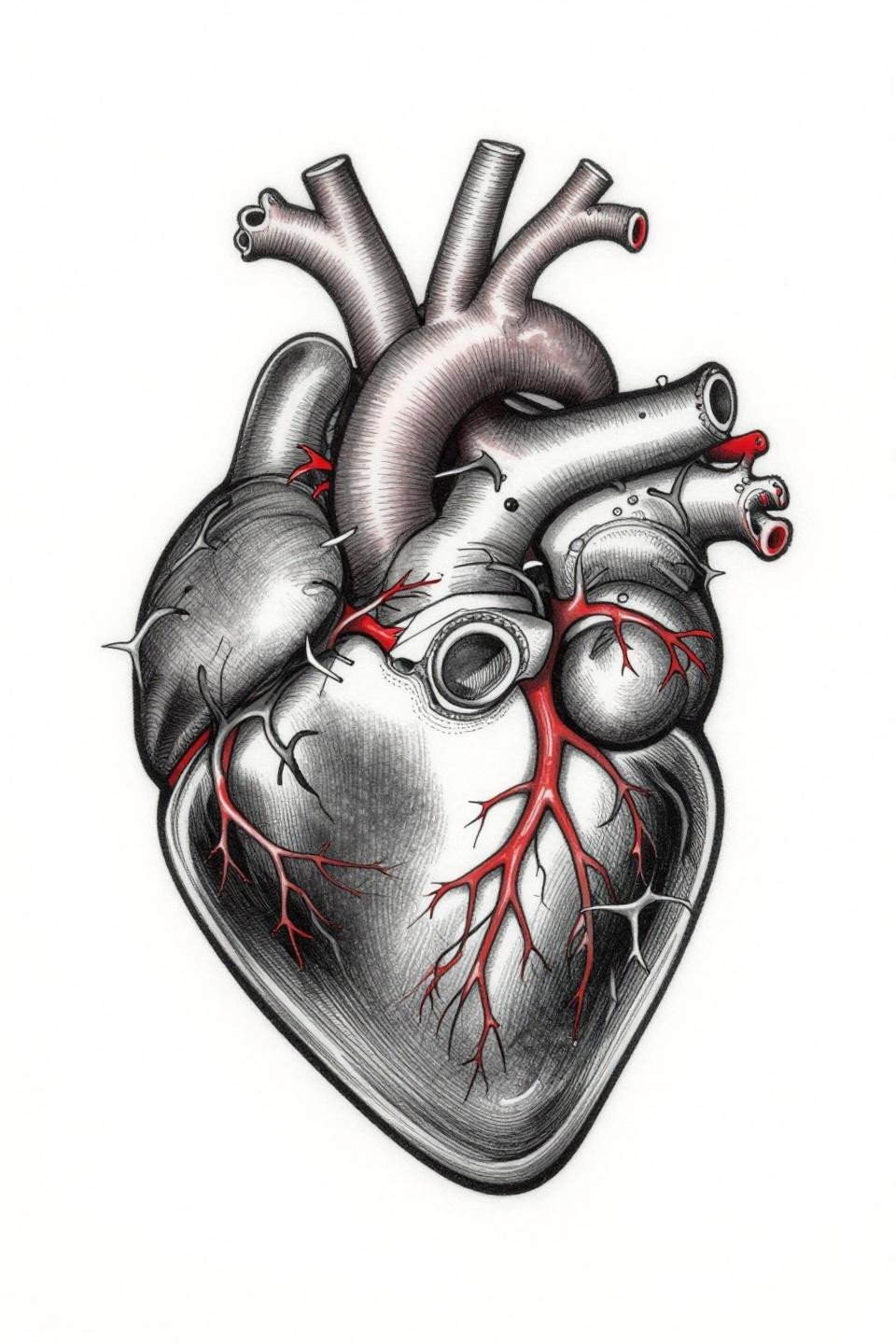
Anatomical heart in cross-section revealing all four chambers, branching arterial and venous pathways radiating outward, thorny vines wrapping the organ exterior, executed in hairline etching strokes with crimson red accent vessels. The four-chamber cross-section view is the most technically demanding layout in anatomical heart tattoo work because it requires spatial accuracy, not just visual reference.
This design reads strongest at chest or upper arm scale where the chamber detail stays legible. Below three inches, the interior crosshatch collapses into solid grey under the skin’s natural diffusion.
Micro Realism Dotwork on a Sacred Form: When Scale Becomes the Risk

Micro realism stipple dotwork sacred heart with visible chambered cross-section, fingerprint ridge mapping across the epicardium, ornate crown of thorns with blood droplets suspended mid-fall, all framed within a circular mandala. Dense-to-sparse dot gradient creating photorealistic dimensional depth without a single solid outline is the technical signature of artists working at the top tier of this format.
On olive skin, grey wash dot dilution reads cleaner than on very light skin where the open dot areas can appear muddy rather than spatial. Ask for healed work on comparable skin tones before booking this style.
Old School Fingerprint Anatomy: Bold Weight as Preservation Strategy

Old school sailor style corazon with fingerprint ridge patterns replacing the right ventricle chamber, sharp thorn crown, single blood droplet at base, executed with bold 4pt black outlines and flat crimson fills. Four-point outlines at this weight are the most aggressive longevity choice in the traditional format and will hold readable definition decades past when finer work has migrated.
The fingerprint detail inside a 4pt outline is a tight technical constraint. The ridge spacing needs to be wide enough to survive the thick border without compressing into solid black over time.
Chicano Grey Wash Diamond Frame: Filigree as a Structural Device
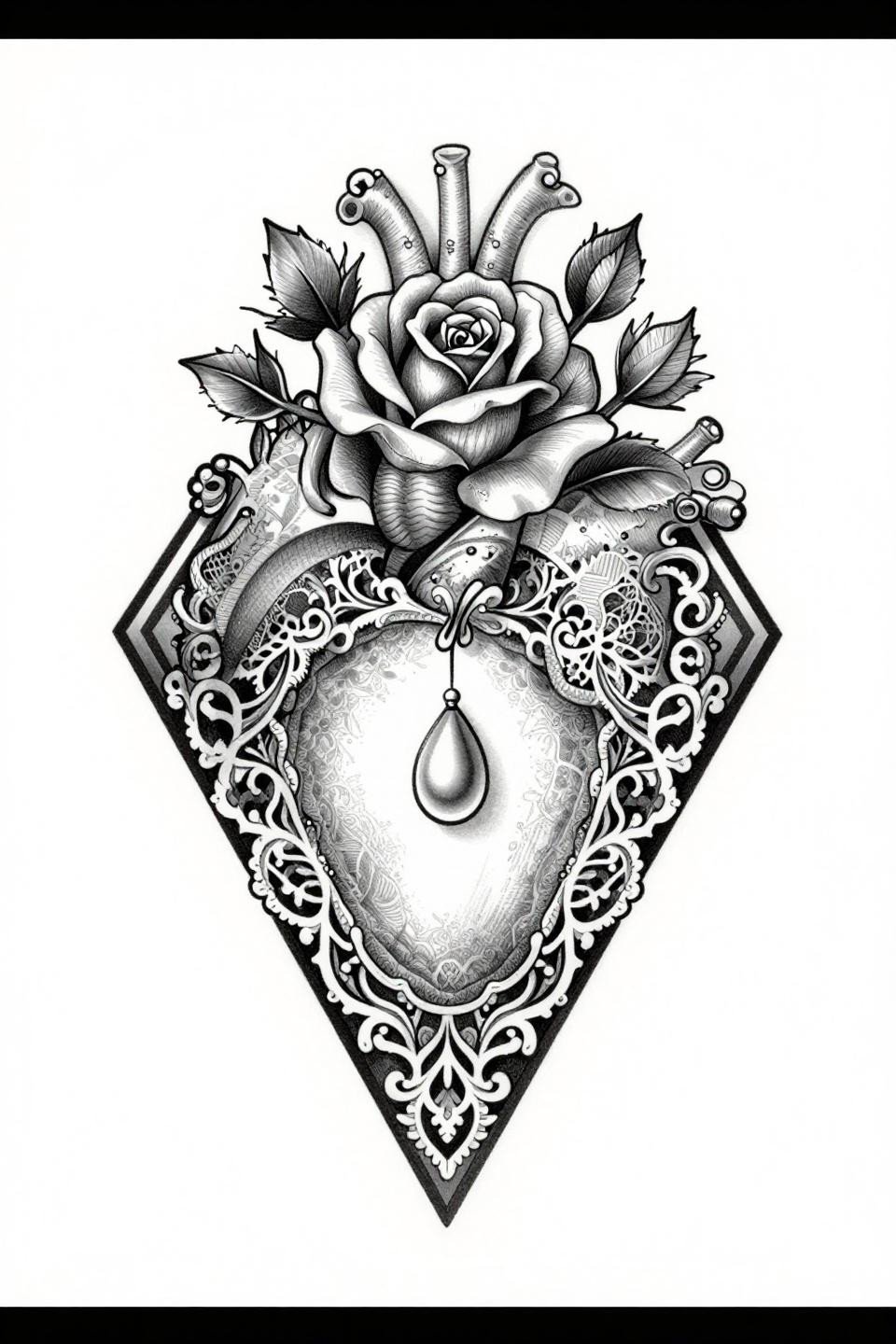
Chicano grey wash sacred heart, ornate filigree lace filling the ventricles, rose stems emerging from the apex, a pearl teardrop suspended below, all framed within a diamond composition. The filigree lace interior functions structurally here, filling the chambers with enough tonal complexity to eliminate the need for solid black fills.
Whip shading with no solid outlines is a technique that ages beautifully on the chest and upper torso, where skin movement is minimal. On joints or high-stretch areas, the open grey wash edges will spread and soften faster than outlined equivalents.
Engraving Style in Wrought Iron: Negative Space as Frame Logic
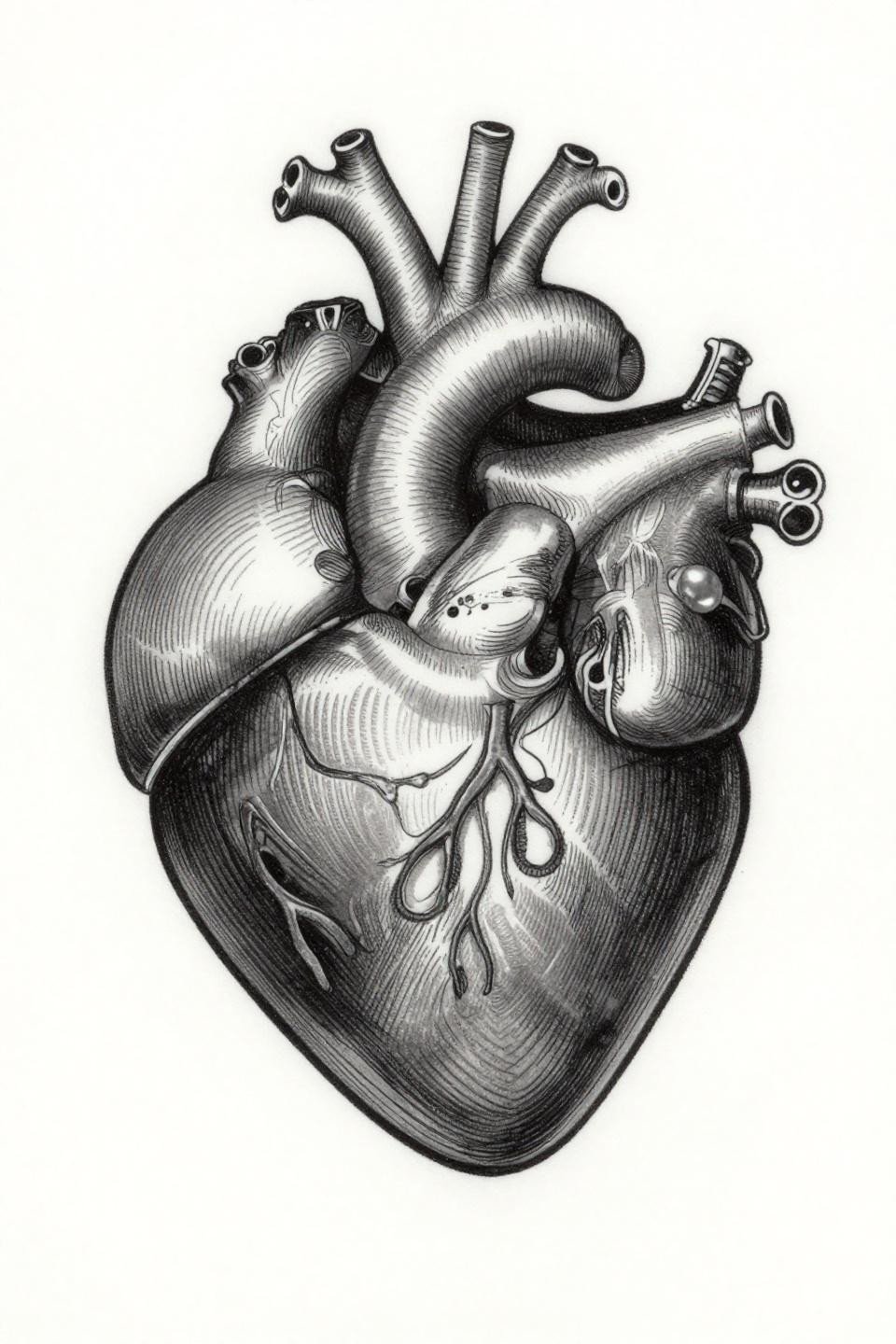
Engraving style sacred heart framed within an ornate wrought iron gate silhouette, diamond composition, bilateral symmetry, a single baroque pearl suspended from the apex, rendered entirely in crosshatch parallel-line ruled strokes. Dense ruled crosshatch creating metalwork texture and tonal depth without grey wash is a technique that reads most accurately at chest to upper back scale.
The wrought iron gate frame adds visual mass and gives this design a strong external boundary, which helps it hold up on placements where the surrounding skin tends to age unevenly.
Ignorant Style Sacred Heart: Deliberate Crude as a Commitment
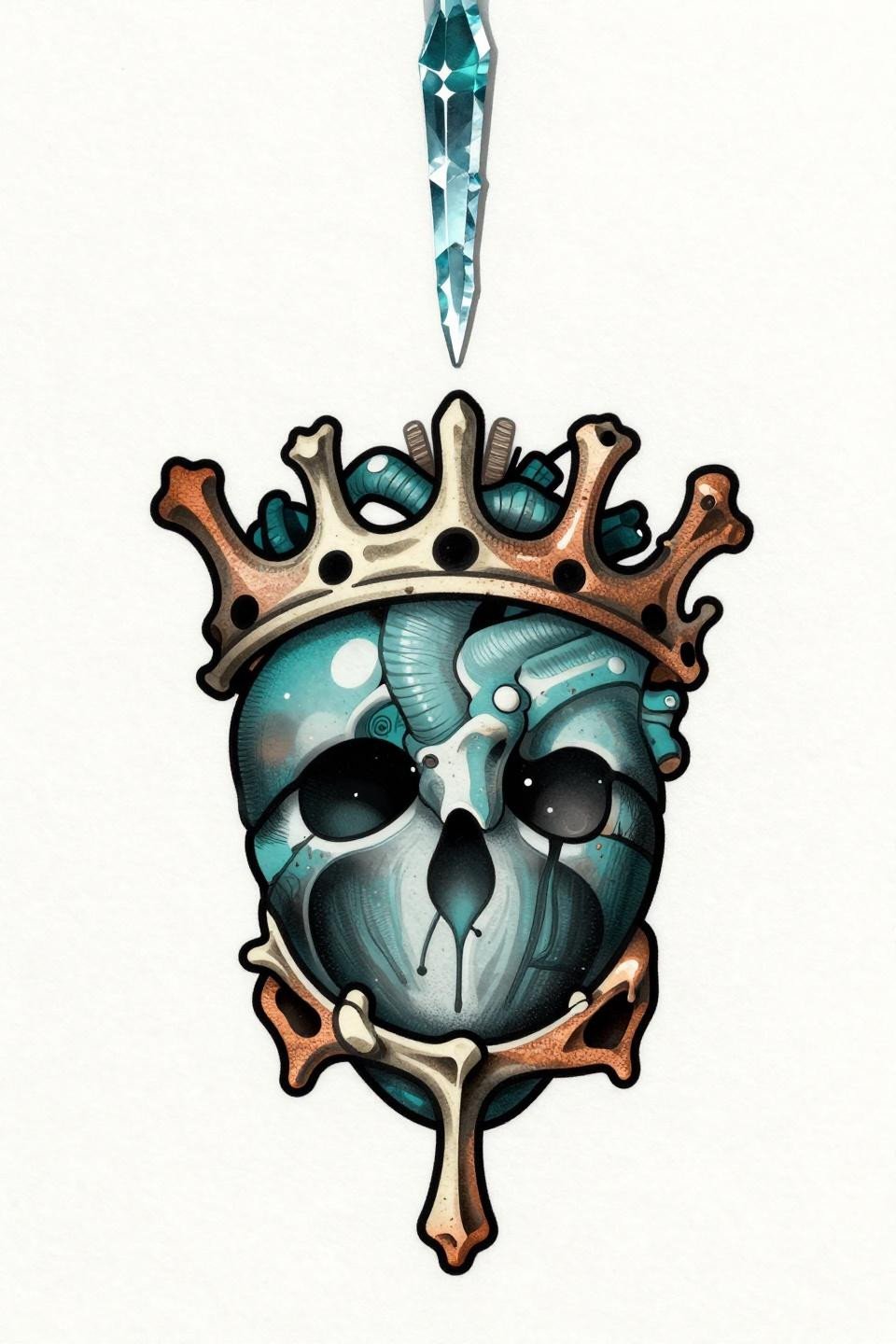
Ignorant style sacred heart with visible anatomical chambers, a skeletal bone crown, a crystalline icicle suspended from apex, bold 3pt outlines with flat deep teal and copper metallic fills. Deliberate bilateral symmetry imprecision is the signature of the ignorant style and requires an artist who can control the degree of crude intentionally, not just execute it carelessly.
The teal and copper palette is an unconventional choice for sacred heart iconography, which is exactly why it works here. The color breaks the devotional expectation and repositions the design as contemporary rather than revival.
Sak Yant Sacred Geometry: When Protective Systems Enter the Form
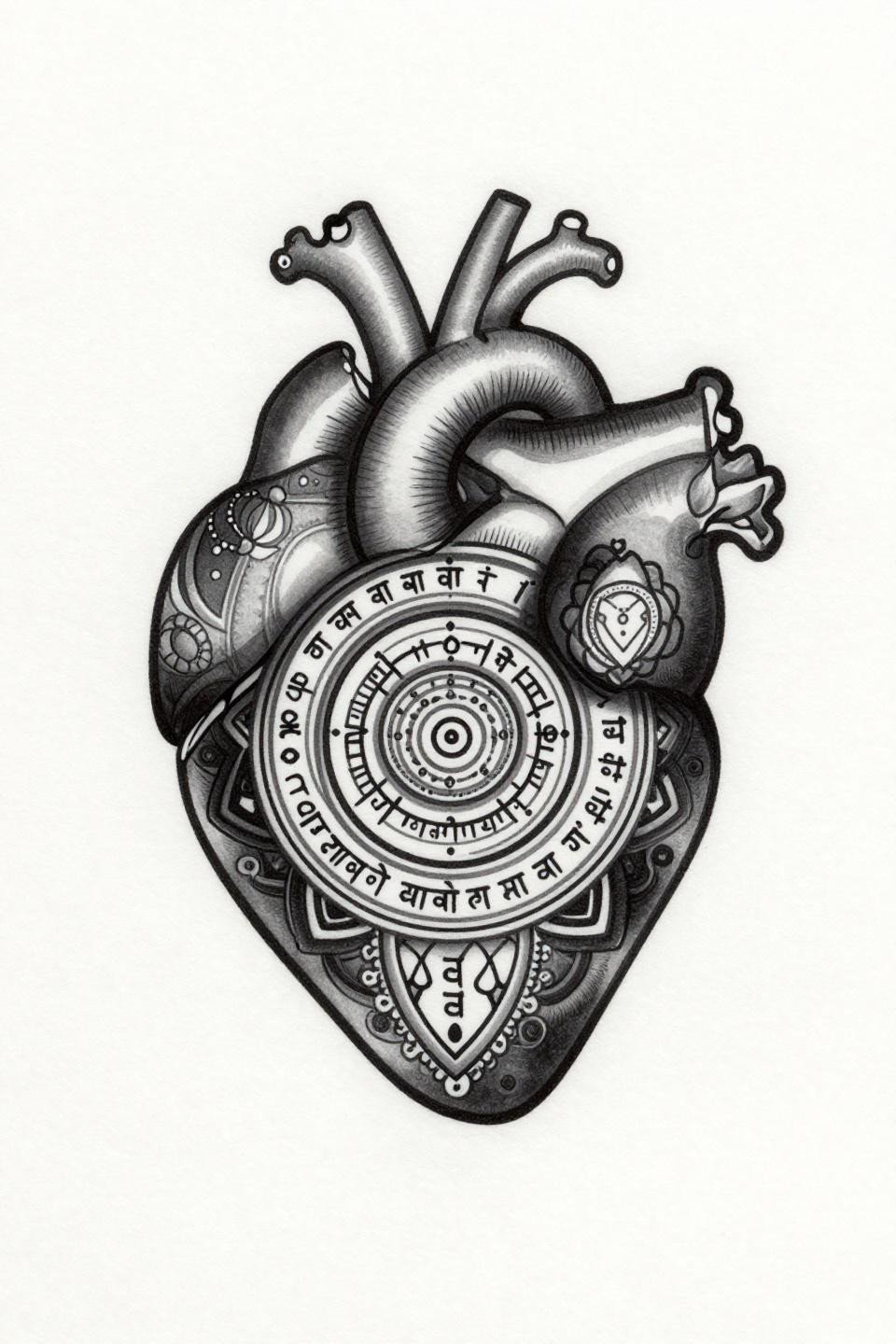
Sak Yant sacred geometry corazon with concentric protective circles inscribed within the chambers, Sanskrit blessing characters radiating from the aorta, a lotus blossom at apex, rendered in bold 2-3pt outlines with flat fills. The Sak Yant protective geometry system mapped onto a cardiac form is a collision of two distinct spiritual iconographies and carries weight that a collector should understand before wearing it.
Radial symmetry at this complexity level requires an artist who has worked with sacred geometry compositions specifically, not just artists comfortable with mandala flash. The distinction matters when the linework needs to stay true across the full radial spread.
Sketch Raw Style: Variable Line Weight as Honest Draftsmanship
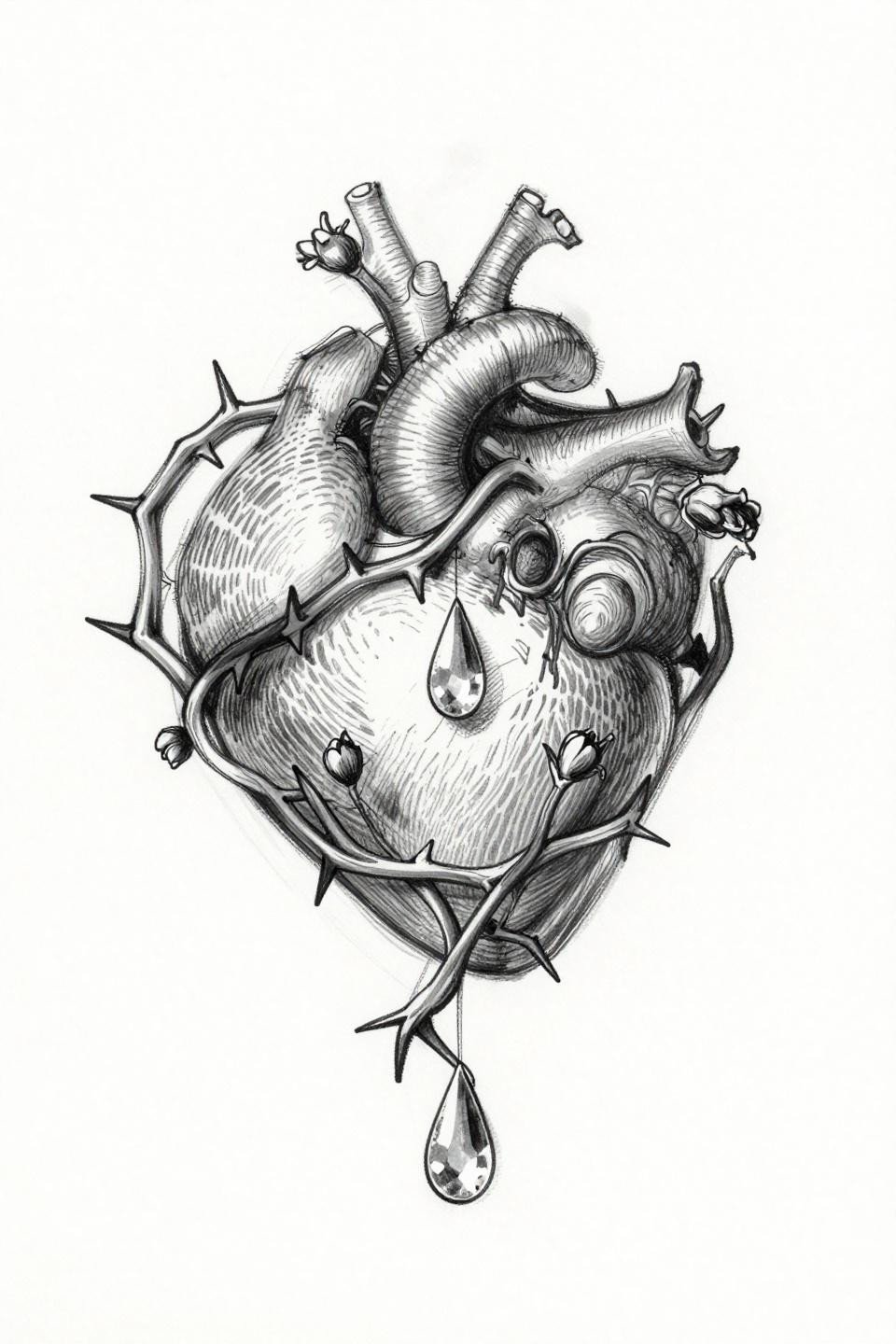
Sketch raw style anatomical sacred heart with fingerprint arch texture mapped across the epicardium, thorny vines spiraling counterclockwise, a crystalline teardrop at apex, all in loose gestural linework with variable 1-4pt scratchy outlines. Variable stroke weight from 1 to 4pt within a single design is what creates the raw sketch energy, but it demands an artist with genuine draftsmanship behind the looser execution.
The asymmetric organic flow here is intentional and technically harder to execute consistently than it reads. Ask to see multiple examples of this artist’s sketch style work, not a single reference image, before booking.
Art Nouveau Filigree Red: Symmetry With Decorative Depth
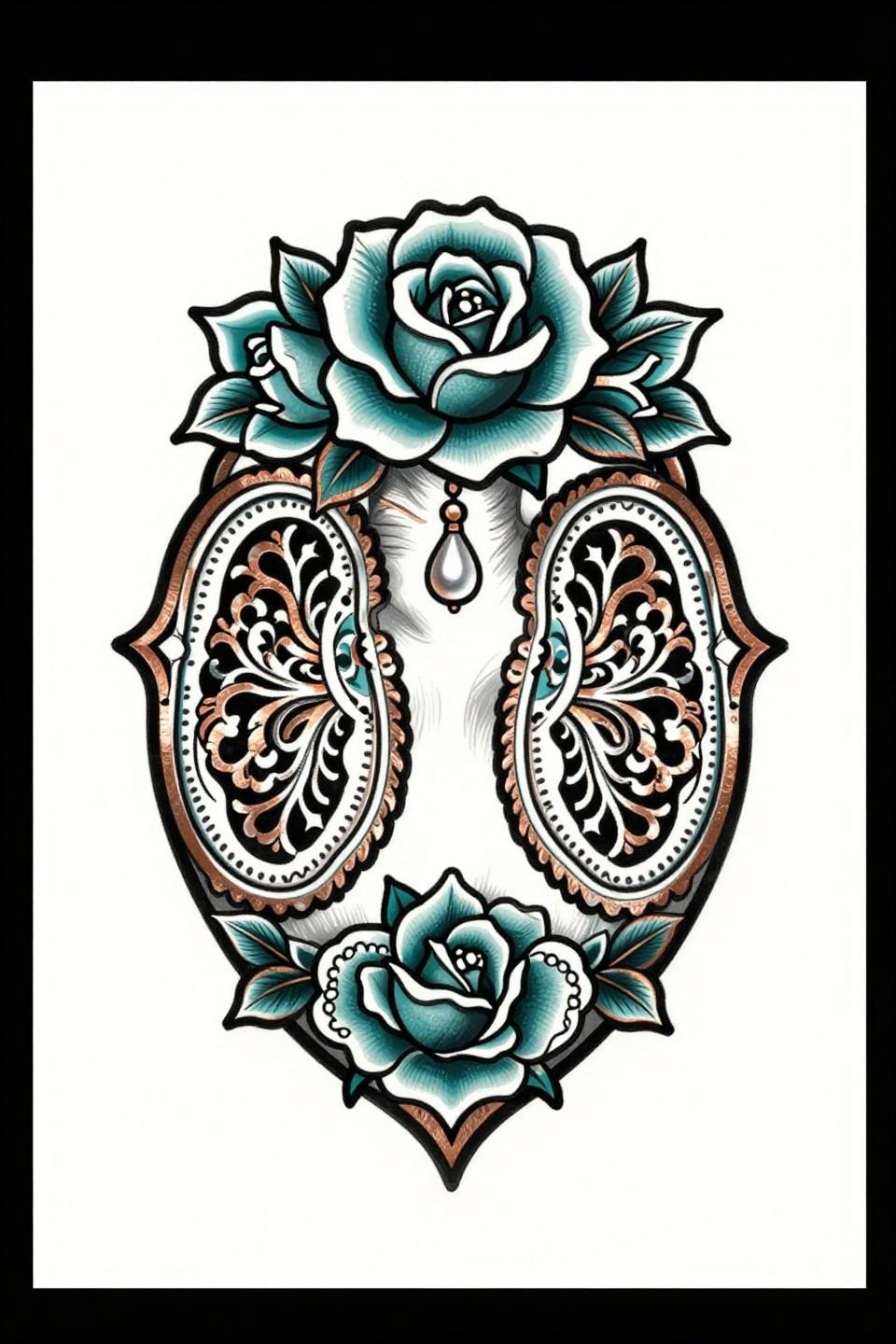
Art nouveau sacred heart with ornate copper filigree lace filling the ventricle chambers, a crown of blooming roses at apex, a pearl teardrop below, all in strict bilateral symmetry with bold 2-3pt outlines and deep teal with copper metallic fills. The copper filigree interior is doing the same structural work as the Chicano lace reference but in an entirely different decorative language.
Copper metallic ink heals with less predictability than standard pigments. Saturating metallic fills properly requires multiple passes, and an artist who rushes it will deliver a patchy result that no touch-up can fully correct.
Celtic Knotwork Frame: Where Negative Space Carries the Whole Design
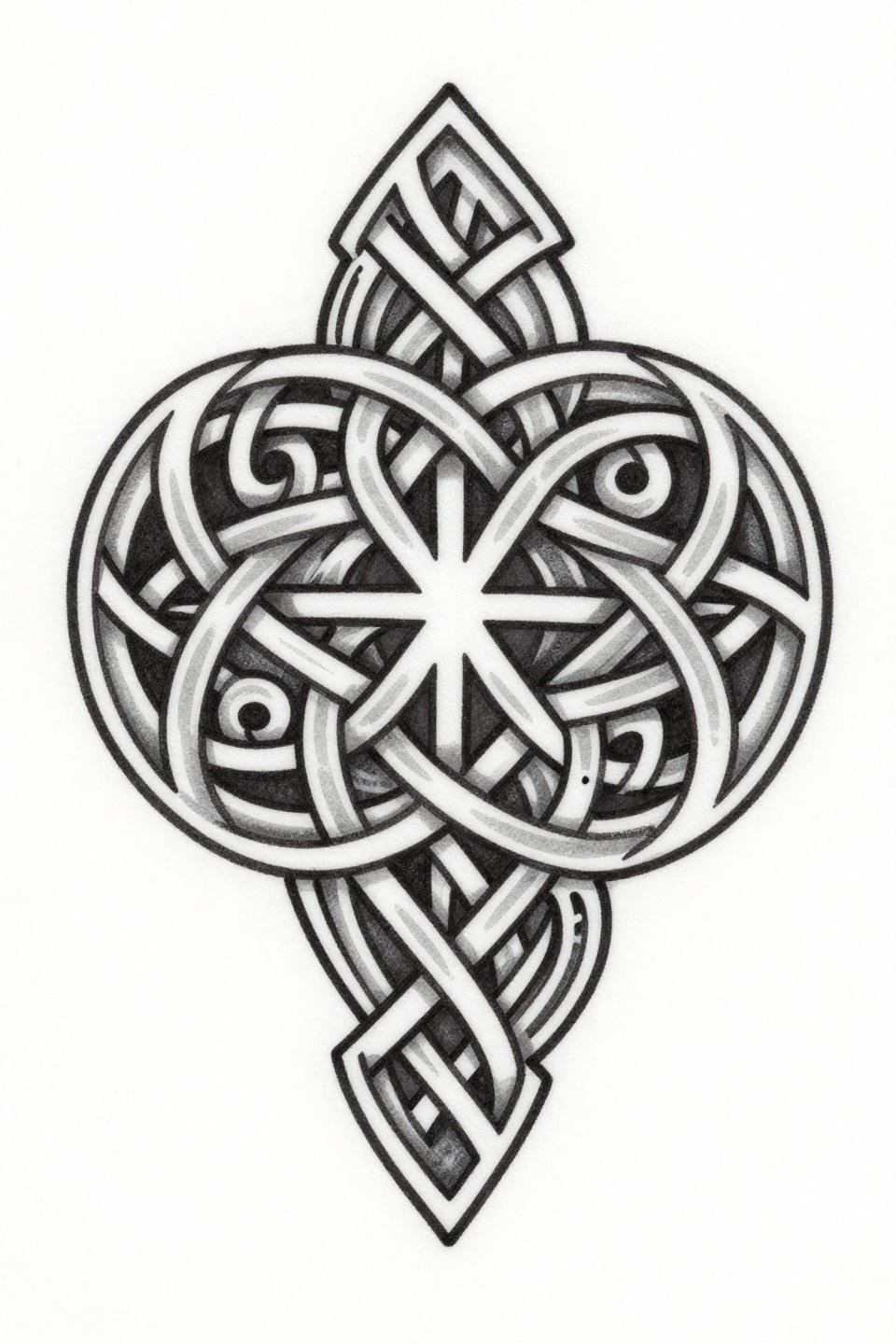
Celtic knotwork corazon with interlocking knotwork border forming a circular mandala frame, triple spiral triskelion patterns filling the ventricle chambers, a cross at apex, bold 2-3pt outlines with flat black fills and negative space cutouts creating geometric rhythm. The negative space cutout rhythm inside the knotwork is what keeps this design from reading heavy, and it is the first thing that collapses if the artist does not plan the fill-to-negative-space ratio precisely.
Blackwork at full saturation holds density indefinitely when the artist commits to layered passes. The tell for quality here is the edges of those negative space cutouts: clean, consistent borders signal an artist who knows exactly where their machine is at all times.
Narrow these 21 references down to three before sending them to your artist. Match by style first, then placement, then scale. A corazon that works as a sternum piece needs different technical handling than one going on an outer forearm, and sending both to the same artist without that context wastes the consultation.
Save the ones where the linework weight matches what your skin tone and placement can actually hold long-term. That filter alone will cut most of the shortlist.