15+ Tattoo Designs Men Actually Commit To Long Term

• CURATED BY HAZEL VOSS •

6 min read

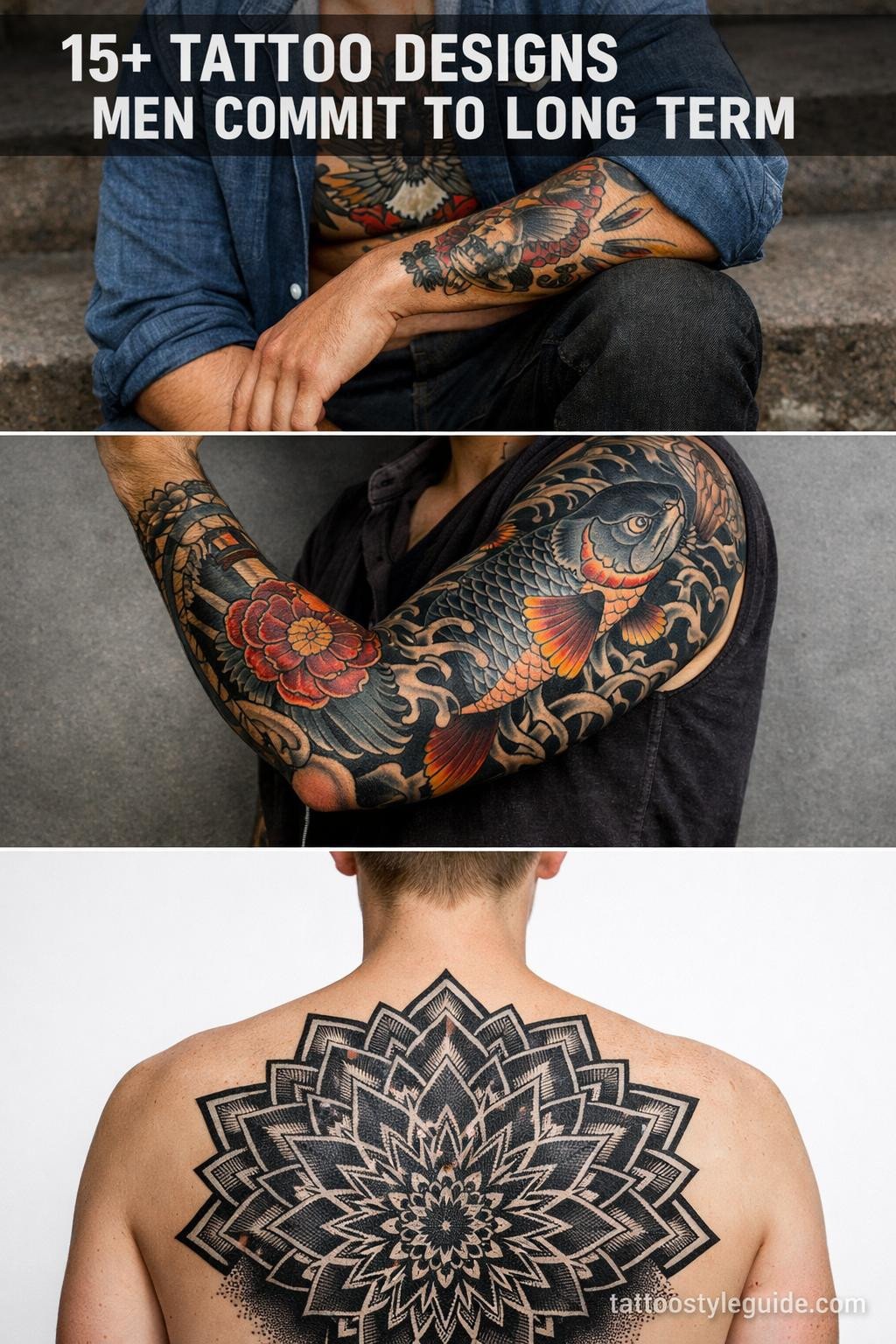
Tattoo designs men collage: traditional eagle chest, Japanese irezumi sleeve, blackwork mandala back, healed ink reference

Most tattoo designs men commit to long-term share one trait: they work at scale. A design that reads well at business-card size on flash paper will survive the distortion of muscle movement, skin aging, and placement curves. The ones that fail start too detailed, too tight, no room for the ink to breathe.

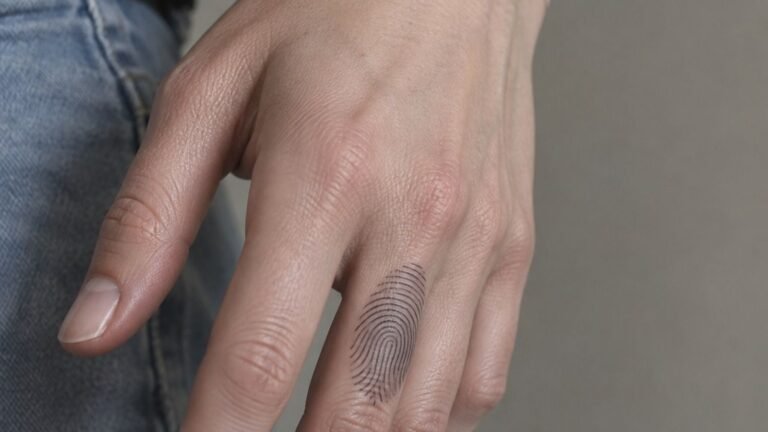
The difference between a ten-year tattoo and a five-year blur is usually the outline weight. Bold 2-3pt outlines hold the design’s edge as skin changes. Fine line work on high-friction placements like hands and fingers needs touch-ups every two to three years, minimum.

Why Dotwork Ravens Age Cleaner Than You’d Expect

blackwork dotwork raven head tattoo flash, stipple gradient dense at core open at edges, no solid outlines, grey wash midtones on white paper

This raven head uses stipple dot gradient technique, transitioning from dense black clusters at the core to open dot fields at the feather edges, with zero hard outlines holding the form together.

Without outlines, the longevity depends entirely on dot placement density. On chest or upper arm placements, this holds. On ribcage, skin movement over decades can spread the outer dots into a soft halo.

Finger Tattoos That Tell You Exactly What You’re Getting Into

fine line minimalist scorpion tattoo flash, single needle 1RL hairline strokes, open negative space, no fill or grey wash, black ink on white paper

This scorpion flash is built on single-needle 1RL linework, hairline strokes with zero fill, relying entirely on negative space to define the form.

Finger placement with this weight of line means visible fading within eighteen months. The design is strong enough to survive a touch-up cycle, but go in knowing that’s part of the commitment, not a flaw in the work.

Geometric Wolf: The Silhouette That Holds at Every Scale

tribal geometric wolf head tattoo flash, bold 3pt outlines, flat black fills, bilateral symmetry, grey wash midtones, high contrast graphic silhouette on white paper

Forward-facing wolf with bilateral symmetry, flat black fills, and bold 3pt outline weight. The triangular negative space eyes create instant visual anchoring without any detail work inside them.

This graphic silhouette approach is one of the most forgiving designs for olive and darker skin tones. The high-contrast flat fills maintain readability where fine line details would visually disappear.

The Anchor Flash That Never Actually Goes Out of Style

traditional American anchor tattoo flash, bold 2-3pt black outlines, flat crimson red fill, rope coil and barnacle texture, blank banner scroll on white paper

Traditional American anchor with barnacle texture on the stock, rope coil around the shank, and a blank banner below. The flat crimson red accent against solid black follows the classic two-color flash formula that prints and reads identically at 3 inches or 12 inches.

The open banner scroll is a collector signal, designed for personalizing without disrupting the composition. Artists who understand traditional flash leave that space intentional, not incomplete.

Mandala on the Arm: Where Geometric Precision Gets Exposed

tribal geometric mandala tattoo flash, six-fold rotational symmetry, bold 2-3pt outlines, flat black fills, zero grey wash, interlocking hexagons and lotus petals on white paper

Six-fold rotational symmetry with alternating thick ray spears and concentric lotus petals, executed in flat black fills with zero grey wash dilution. Every element locks to a grid.

Mandala placements on the arm expose any wobble in the rotational symmetry immediately. Check the artist’s healed portfolio specifically for mandala or geometric work, not just their fresh shots, before committing to this design.

Fine Line Snake: The Back Placement Makes This Design Viable

fine line ornamental snake tattoo flash, figure-eight coil, single needle 1RL hairline strokes, hexagonal scale texture, vertical slit pupil, open negative space, no fill on white paper

Figure-eight coiled snake with hexagonal tessellated scales along the full body, rendered entirely in hairline 0.5mm single-needle strokes with no fill at all. The negative space inside the coil is as active as the drawn lines.

Back placement gives this design its best longevity, protected from sun and friction compared to forearm or hand placement. The scale texture at this line weight needs an artist who controls machine speed precisely, consistent dot and line size from crown to tail.

Neo-Traditional Profile: Where Grey Wash Becomes the Structure

neo-traditional male profile tattoo flash, bold 2-3pt outlines, grey wash dilution for shadow planes, geometric faceted cheekbone and jaw, asymmetric composition weighted left on white paper

Stoic male profile with intentional line breaks at brow and chin, geometric planar facets replacing anatomical shading. The grey wash dilution does the structural work here, defining the shadow planes without continuous outlines.

Grey wash on olive skin tones can appear lighter at year three to five than it read when fresh. Artists working this style should bias the wash slightly denser than they think necessary to account for that shift.

Geometric Lion Flash Built to Scale Up or Stay Small

tribal geometric lion head tattoo flash, bold 2-3pt outlines, flat black fills, bilateral symmetry, parallel line mane, open white negative space, no grey wash on white paper

Forward-facing lion with a triangular mane built from straight parallel lines and a single bold circular eye as the focal anchor. Bilateral symmetry along the vertical axis is enforced entirely by flat fills and open white negative space, no shading used anywhere.

The parallel-line mane is an artist skill signal. Consistent spacing between those lines across the full width of the design separates clean execution from rushed work. Look for even gaps, not just even strokes.

Irezumi Dragon: Why the Coil Direction Matters for Placement

Japanese irezumi dragon tattoo flash, counterclockwise coil, crescent scale forms, bold 2-3pt outlines, flat grey wash fills, dorsal fin spine detail, diagonal asymmetric flow on white paper

Japanese irezumi dragon coiling counterclockwise, scales as overlapping crescent forms, body entering the composition from the left edge in a diagonal asymmetric flow. The flat grey wash fills sit inside bold 2-3pt outlines, classic irezumi tonal hierarchy.

The counterclockwise direction is not decorative. On the right arm or leg, this coil wraps naturally with the limb anatomy. Placing a flash design without considering directional flow relative to placement is one of the most common collector mistakes.

Skull Baroque Flash: When Symmetry Is the Entire Argument

art nouveau baroque skull tattoo flash, bilateral symmetry, bold 2-3pt outlines, filigree scrollwork crown, nested diamond eye orbits, vine tendril mandible, grey wash midtones on white paper

Ornamental skull with a baroque filigree scrollwork crown, nested geometric diamonds in the eye orbits, and a mandible built from interlocking vine tendrils. The entire design hinges on bilateral symmetry along the vertical axis, and any deviation reads instantly at this scale of detail.

This is a design that rewards larger placement. At four inches or smaller, the filigree fills in over time as the ink spreads. At six inches or more on the upper back or chest, the negative space holds for a decade.

Single-Line Profile: The Most Skill-Dependent Design in This Set

continuous single line male profile tattoo flash, unbroken hairline stroke from forehead to chin, geometric angular jaw, sharp planar cheekbone, no fill or shading, black ink on white paper

Male profile rendered as one unbroken stroke from forehead to chin, angular geometric jaw, sharp cheekbone, no line lifts and no overlapping. This is pure continuous line technique. One hesitation or speed change reads in the finished work.

Finger placement with this design is a two-year tattoo, not a permanent one. On the forearm or inside of the upper arm, protected from constant friction, this style ages into a refined graphic mark rather than a blur.

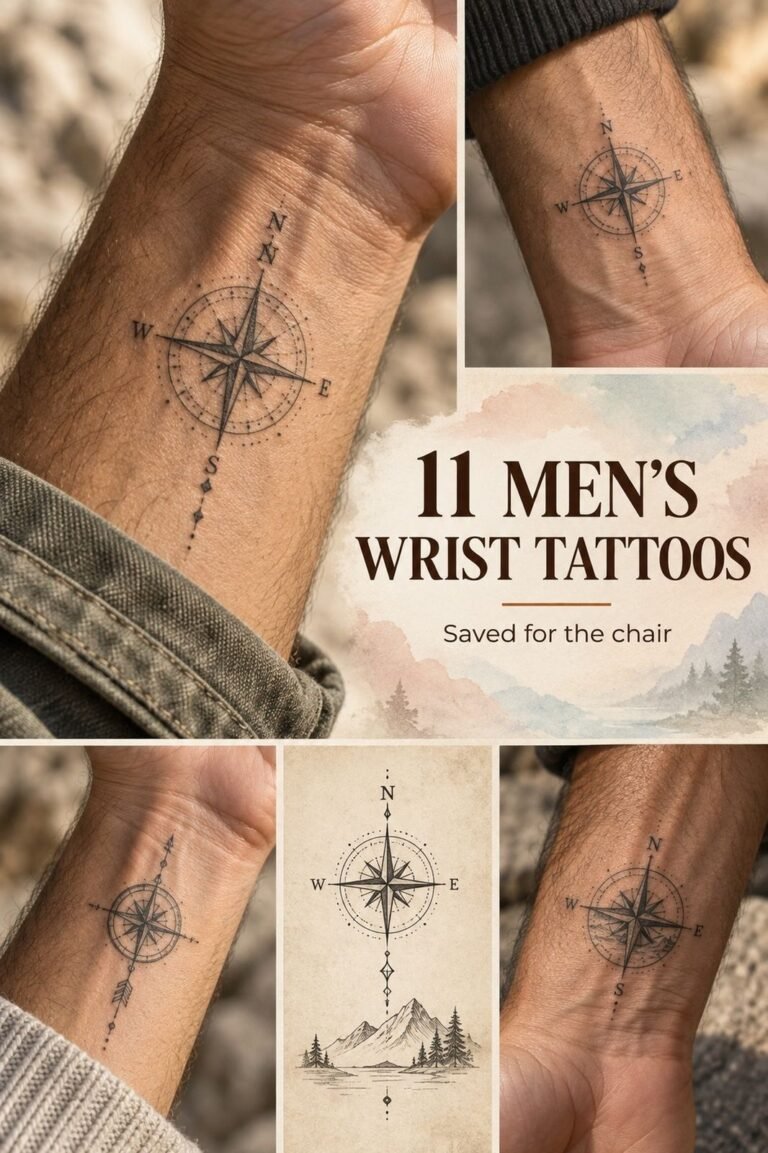
Dotwork Compass Rose: Stipple Density as the Design Language

blackwork dotwork compass rose tattoo flash, eight-point symmetry, pure stipple gradient, dense black dot clusters, zero linework, grey stipple midtones, circular mandala composition on white paper

Eight-point compass rose built entirely from stipple dots, no linework at all, with dense black dot clusters forming the visual mass and progressively open fields creating the gradient toward the edges.

Look for consistent dot size across the full gradient as the primary quality signal in this style. Dots that vary in diameter create a muddy midtone band rather than a clean gradient. Ask the artist specifically for healed dotwork reference, not fresh.

Narrow these down to three references maximum before your consultation. Pick based on placement first, design second. A reference that matches your intended body location tells your artist more than ten images that don’t account for the canvas.

Hazel Voss

About the author

Hazel Voss

Tattoo Consultant · Founder of Tattoo Style Guide


“If it doesn’t hold up over time, it doesn’t make it on the site.”

Hazel grew up around small tattoo shops in the Midwest. She spent more time watching healed tattoos than fresh ones. That’s where you learn the truth.

Some designs age beautifully. The lines hold. The composition still makes sense on real skin. Others start falling apart faster than anyone expected. That difference is what she pays attention to.

Tattoo Style Guide isn’t about trends. It’s about choosing something you won’t feel the need to explain five years from now.

Read the full story →

500,000+ Tattoo Ideas Curated Daily

Don’t Regret Your Tattoo

Most tattoo ideas look good online.
Not all of them look good on skin.
We help you choose designs that actually last.

No spam. Just real tattoo inspiration.