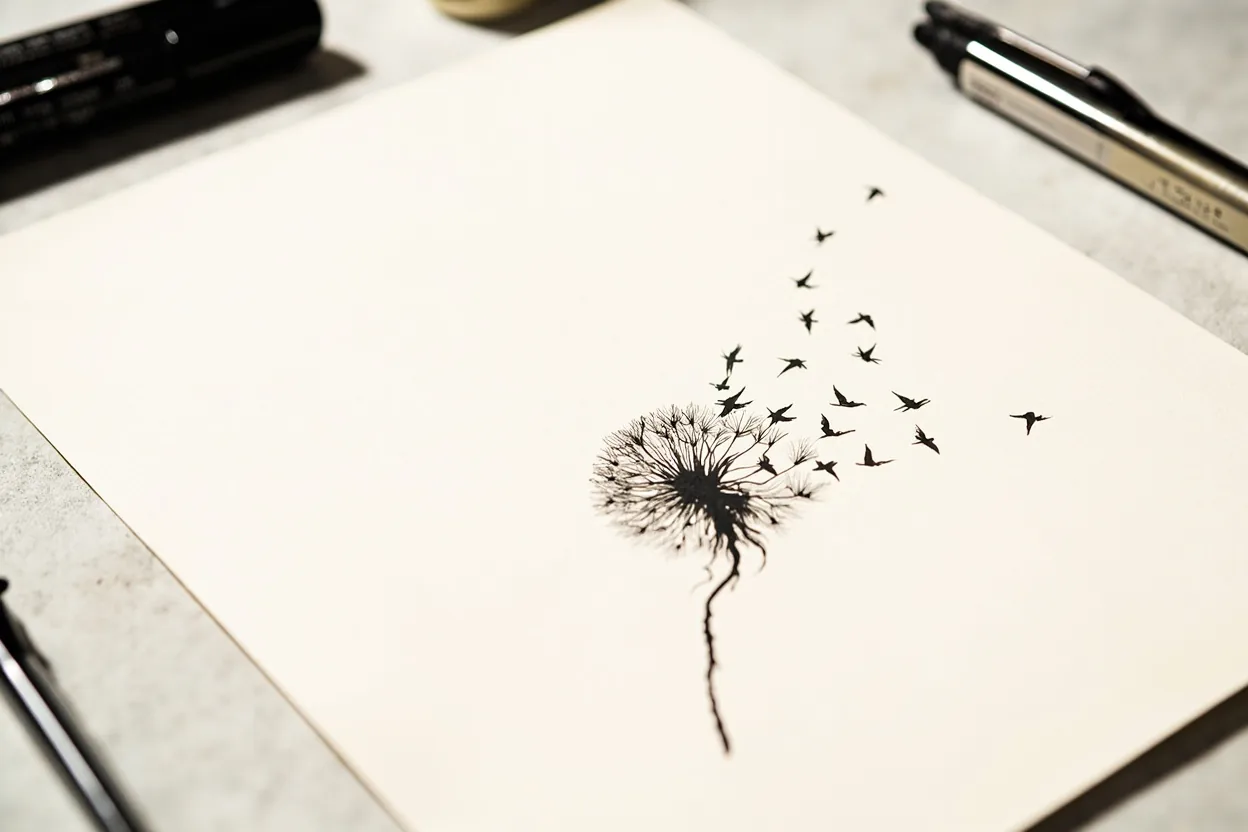
A dandelion tattoo usually means wishes, release, resilience, childhood memory, freedom, and the courage to let a life chapter move on. It can look delicate, but the meaning grows stronger when the design controls how the seeds travel across your body.
What the Dandelion Actually Means
From weed to wished-on flower
The dandelion has not always been a weed. In medieval Europe, it was cultivated for medicine and wine. Its name comes from the French dent de lion, lion’s tooth, for the jagged leaf. The shift from useful plant to lawn nuisance happened mostly in twentieth-century America, when monoculture grass became a status symbol. That reversal is part of why the dandelion works as a tattoo symbol: it carries the tension between valued and discarded, wanted and overlooked.
The wish ritual is harder to trace. Blowing seeds to carry a thought or prayer appears in European folk practice and was often linked to childhood rather than formal ceremony. No single culture owns it, which makes the symbol open enough to adapt without claiming a heritage that is not yours.
How the meaning shifts by design
A full, unblown dandelion head holds potential. It is a wish still intact, a memory kept close, a moment before change. Once the seeds release, the meaning moves toward letting go, sometimes grief, sometimes relief. The direction matters. Seeds drifting upward read as hope or aspiration. Seeds moving horizontally across the body suggest departure, a line being crossed. Seeds that fall downward carry weight, a loss acknowledged rather than escaped.
The stem matters too. A dandelion with no stem, only floating seeds, can feel too light, too resolved. A grounded stem with a few seeds escaping keeps the tension: the plant remains, it survives, it releases something anyway. That is often the stronger tattoo for resilience.
Design Choices That Hold or Lose Meaning
The seed trail
This is where most dandelion tattoos fail. The stencil comes from a detailed illustration, shrunk to skin size. Twenty seeds become twenty dots. The airy quality that made the drawing beautiful turns to visual noise once healed.
The fix is restraint. A readable flower head, a clean stem, and five to nine seeds placed with intention will age better than a cloud of tiny marks. Ask your artist to vary the opacity: darker seeds near the stem, lighter toward the edges, so the scatter reads as movement rather than pattern. If the tattoo is small, use fewer seeds. You do not need every seed to explain the idea.
Birds, script, and other additions
Seeds turning into birds is common because it reads clearly at a glance. It can also feel like a stock image. If you want birds, give them a reason. Each bird might mark a child, a year, a place lived. Or skip them: a seed trail alone, following the line of your collarbone or forearm, often says more with less.
Names and dates work for memorial pieces, but keep the script light. Heavy lettering overpowers a fine-line stem. Consider placing the text separate from the flower, linked by placement rather than overlap.
Color versus black and grey
Most dandelion tattoos stay black and grey, which suits the subject. A yellow flower head with white seeds requires technical skill to keep the yellow from muddying, and the contrast can feel cheerful in a way that clashes with themes of loss or release. If you want color, muted green in the stem or a soft wash behind the seeds can suggest environment without competing for attention.
Placement and Movement
Where the body gives the design a path
A dandelion wants direction. The forearm works because the seed trail can follow the muscle line toward the wrist or elbow. The collarbone lets seeds drift toward the shoulder or heart. The ribcage offers a longer canvas, though pain is higher here and breathing makes the stencil harder to hold steady.
The shoulder blade suits a larger piece with more seeds or a grounded stem with roots. The calf and upper arm are forgiving for simpler versions. Wrist and ankle can work but require severe simplification: a short stem, minimal seeds, and acceptance that detail will soften over time.
What to avoid in placement
Avoid trapping the design in a cramped square. A dandelion is not a badge or a seal. It needs space to scatter. Also avoid perfectly symmetrical seed placement. The organic irregularity is the point. A stencil-clean dandelion with evenly spaced seeds looks corporate, not wild. The symbol of release deserves a design that looks released.
How Dandelion Tattoos Age
Fine line work is vulnerable. The dandelion’s thin stem and tiny seeds are especially prone to blowout and fading. A line that looks crisp at two weeks can soften to a grey thread at two years. Seeds placed too close together heal into a single blur.
To protect the design, prioritize spacing over density. A seed with clear skin around it will read as a seed longer. The flower head should be simplified, not botanically exact. Exactness does not survive skin.
Sun exposure matters. Dandelion tattoos are often placed on forearms and collarbones, areas that see light. Plan for touch-ups, or choose placement with coverage in mind if you want the piece to stay quiet.
What to Ask Your Artist
Bring reference images that show the mood you want, not the exact tattoo to copy. Ask to see healed photos of their fine line work, not just fresh pieces. Fresh tattoos always look sharper.
Discuss seed count explicitly. A good artist will suggest fewer than you expected. Discuss direction: where the seeds start, where they end, whether they fade or stay solid. Discuss stem length and whether the root is shown. A rooted dandelion is a different symbol than a floating one.
If you want birds or script, ask how those elements will read at five years, not five days. Bold choices now often become regrets later.
Final Thoughts
The dandelion works because it carries contradiction. It is a weed and a wish. It survives harsh ground and still releases something light. A tattoo that captures only the prettiness misses the point. The better design keeps the tension: a stem that holds, seeds that leave, and enough space in the composition to let both actions breathe.
Choose the meaning first, then let the design follow. Potential or release. Memory or departure. The dandelion can carry either, but it carries them best when the tattoo knows which one you mean.
Frequently Asked Questions
What does a dandelion tattoo symbolize?
It usually symbolizes wishes, letting go, resilience, freedom, childhood memory, and release. The exact meaning depends on whether the design shows a full flower head (potential, a wish held) or seeds scattering (departure, change, grief).
Do dandelion tattoos age well?
They can, but only with restraint in the design. Too many tiny seeds or a crowded flower head will blur together as the lines spread. Simplified fine-line versions with clear spacing between elements age better than detailed, dense compositions.
Where should a dandelion tattoo go?
Forearm, collarbone, shoulder blade, rib, calf, and upper arm work well because they allow the seed trail to move naturally along the body. Wrist and ankle are possible but require severe simplification to remain readable over time.
How do I keep a dandelion tattoo from looking generic?
Avoid perfectly symmetrical seed placement and stock-image birds. Give additions a personal reason. Consider seed direction carefully: upward for hope, horizontal for departure, downward for loss. A grounded stem with a few escaping seeds often carries more meaning than seeds floating alone.