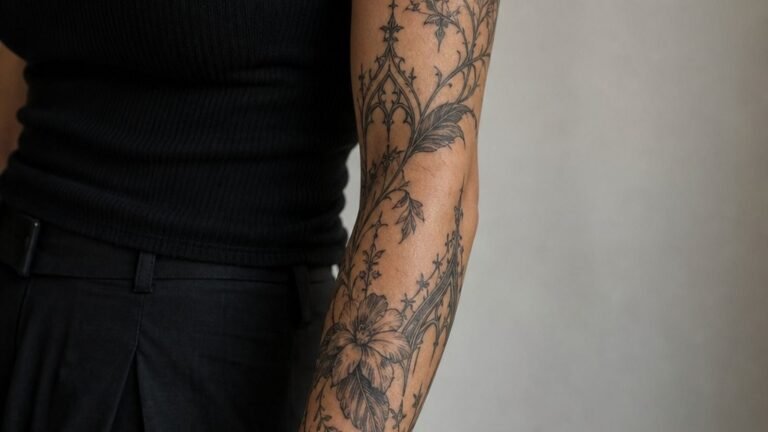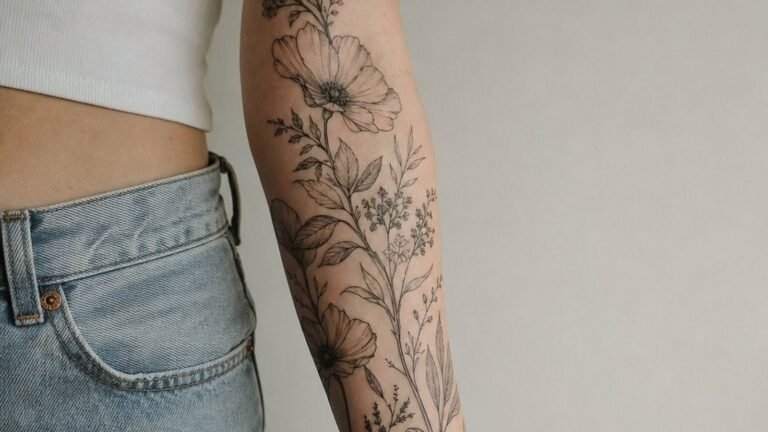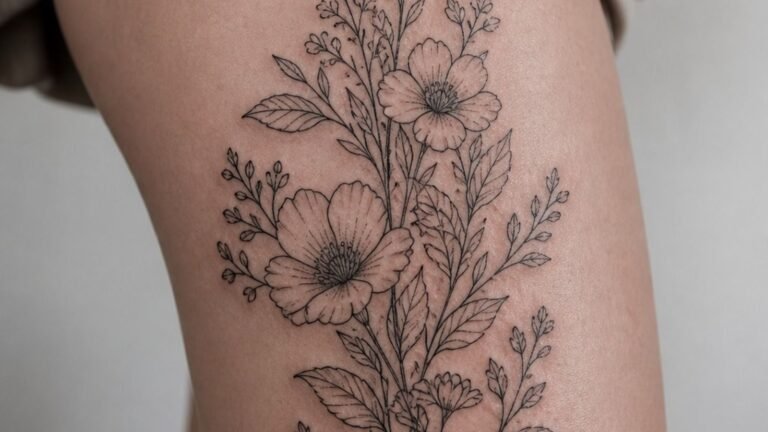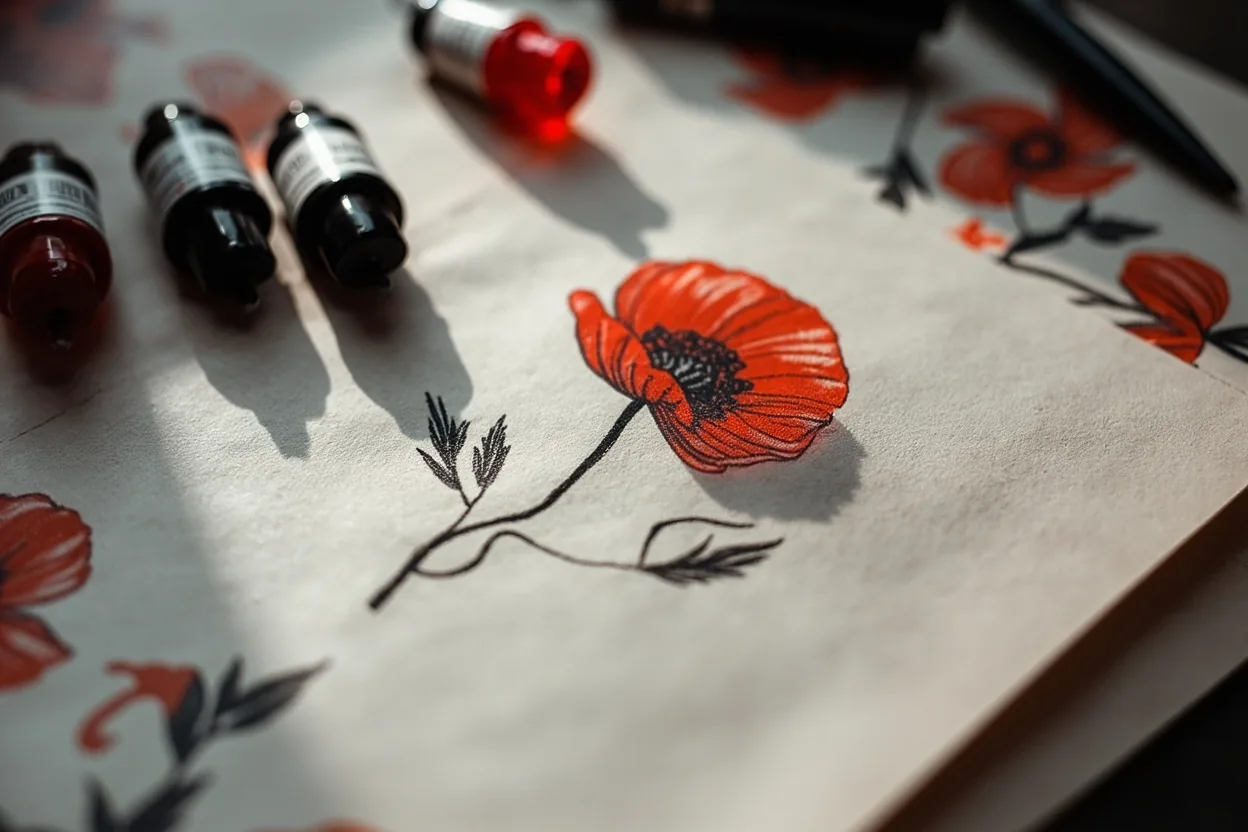
A poppy tattoo looks delicate at first, but the meaning is not light. It can stand for remembrance, loss, peace, sleep, recovery, resilience, imagination, beauty after damage, or a love of wild flowers that do not behave like roses.
Quick answer: A poppy tattoo usually means remembrance, peace, sleep, resilience, or delicate beauty. Red poppies often point toward memory and sacrifice, while blackwork and fine line poppies feel more personal and less ceremonial.
What the poppy actually symbolizes
The poppy carries layered meanings that stretch back thousands of years. Understanding them helps you choose a design that matches your intention rather than borrowing a symbol you only half recognize.
Remembrance and the red poppy
The red poppy’s link to fallen soldiers is often traced to John McCrae’s 1915 poem “In Flanders Fields,” written after the Second Battle of Ypres. The flower had already been noticed growing over disturbed ground, including battlefields, because poppy seeds lie dormant for decades and germinate when soil is churned. In the US, UK, Canada, and Australia, the red poppy became the official remembrance symbol through veterans’ organizations in the early 1920s. A tattoo in this tradition carries collective weight. If you choose it, you are connecting to a specific history of sacrifice and public mourning.
That said, not every red poppy tattoo is a military memorial. Some people simply love the color, or the flower’s form, or what it represents in a personal sense. You are free to use the symbol differently, but you should know how it reads to others. A red poppy on the forearm will often prompt questions about service or loss. If that is not your story, consider color shifts or compositional changes that steer the meaning elsewhere.
Sleep, dreams, and the underworld
The sleep association is older than the war connection. In Greek myth, poppies are often linked to Hypnos (sleep) and Thanatos (death), and to Demeter, who received the flower as a gift to help her rest after the loss of Persephone. The opium derived from Papaver somniferum made the link literal: the same plant that produced beautiful red blooms also produced the most powerful sedative known to the ancient world. A poppy tattoo can nod to this double life, beauty and danger intertwined, or to the need for rest after grief or struggle.
Resilience and wildness
Poppies grow where other flowers fail. They colonize burned fields, construction sites, war zones. They are not domesticated like roses or peonies. A poppy tattoo can mark survival, recovery from addiction, or the refusal to be tamed. The seed pod, often included in tattoo designs, holds this meaning too: it is both vessel and weapon, full of next year’s flowers and the raw material of opium. Including the pod changes the tattoo’s tone from purely decorative to something more charged.
How style changes the meaning
Color and technique shift the poppy’s emotional register more than with most flowers. The same bloom rendered in thick black lines reads as memento mori. In soft red watercolor, it suggests memory without the weight of public ceremony. Choose your style after you know what you want to say.
Traditional and neo-traditional
Traditional American poppy tattoos use bold black outlines, limited color palettes, and flat fills. They read immediately from a distance and age well because the structure is so strong. A traditional red poppy with a green stem and black center is instantly recognizable as a remembrance flower. Neo-traditional work adds dimension through smoother gradients, more detailed petal folds, and sometimes ornamental frames or jewels. The meaning stays similar but the presentation feels more personal, less institutional.
Fine line and minimalist
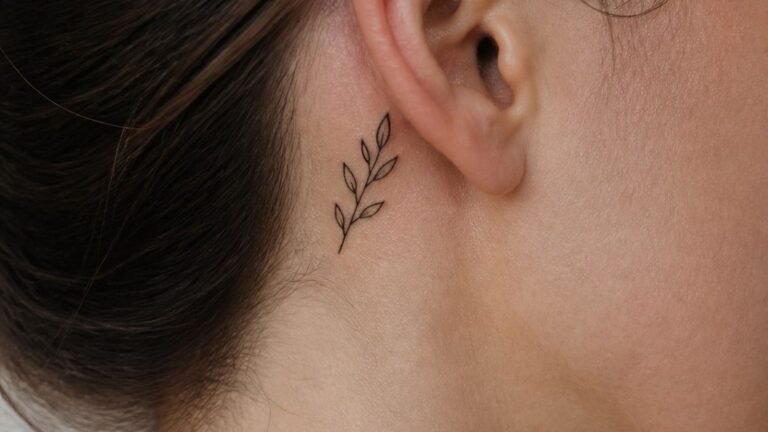
Fine line poppies are popular because the flower’s natural form suits the technique: thin stems, open petals, soft movement. The risk is making everything too small. A stem that looks elegant at drawing size can heal into a blurry thread. A minimalist poppy should still have one clearly readable petal shape. Reduce it to a few loops and you lose the flower entirely.
Placement matters enormously for fine line. Inner forearm and upper sternum heal relatively well. Hands, feet, and ribs see more movement and friction, which degrades hairline work faster. Ask your artist to show healed photos on skin similar to yours, not just fresh work. Minimalist designs that use negative space, two curved lines and a few seed pod dots, can read as poppy instantly if the composition is tight. One blown-out stroke ruins the whole thing, so this is not the place to bargain hunt.
Blackwork and black and grey
Blackwork poppies strip away color and lean into the somber side of the symbol. Whip shading on petals gives a soft, almost bruised texture that fits memorial or grief work. Without the red, the tattoo avoids the military remembrance association entirely, which may be what you want. The danger is that without color or strong shape contrast, a blackwork poppy can read as generic flower from across the room. Make sure the petal structure is distinctive, perhaps by emphasizing the crinkled edges or the bulbous seed pod.
Watercolor and color realism
Watercolor poppies look soft in photos but are technically demanding. Red pigment without structural support can fade into a warm patch. The flower needs a darker center, fine outline, or deep petal shadow to stay readable over time. If your artist pushes watercolor, ask for healed photos at six months and a year. Many watercolor tattoos look stunning fresh and muddy later.
Color realism offers more control. A true red poppy with a black center and olive green stem uses natural color contrast to stay clear. Orange and purple poppies are botanically accurate and give you more flexibility with skin tone contrast. Burnt orange with a dark center often ages better than straight red on warm or deeper skin tones. White highlights pop on fresh work but tend to disappear within a year on most skin, so do not build your design around them.
Placement and longevity
Poppies work at many sizes, but the meaning should guide the placement. A single small stem near the ribs or inner arm can hold grief quietly. A bold traditional poppy on the forearm or shoulder makes a more public statement. Consider how the tattoo will age with you, not just how it looks today.
Memorial poppies with dates, dog tags, or initials need planning for longevity. Fine line text and hairline stems blur over five to ten years, especially on high-wear spots like wrists or fingers. Bold outlines and solid fills hold intention longer. If you are honoring someone, the tattoo should still read clean in twenty years. Talk to your artist about which details can be simplified without losing the personal connection.
For fine line color work, some artists recommend packing red pigment over a healed black outline session rather than doing everything in one pass. The theory is that red settles better on already-stabilized skin. Not all artists agree with this approach, and it depends on their specific technique and pigment choice. Ask directly about their experience with red retention on your skin tone, and whether they have documentation of healed results.
Common mistakes to avoid
People sometimes choose a red poppy without knowing it reads as a WWI memorial to most viewers, then are surprised when strangers ask who they lost. Know your color’s cultural weight before you commit. If you want the flower without the military association, shift the color palette or add surrounding elements that redirect the meaning: a wild garden composition, a butterfly, a broken chain, a sunrise.
Another mistake is choosing watercolor for the aesthetic without accepting the maintenance. Watercolor tattoos often need touch-ups to keep the soft edges from becoming soft blobs. If you live far from your original artist or do not plan for future sessions, choose a more structured style.
Finally, do not let the delicacy of the flower push you toward too small a design. A poppy that looks perfect at two inches may become an indistinct red smear in a decade. Give the petals room to breathe. Three to four inches minimum for a single bloom, larger for bouquets or stems with leaves.
What to Remember
A poppy tattoo carries more history than most floral designs. The red remembrance association is powerful and specific. The sleep and dream connections run back to ancient Greece. The resilience and wildness of the flower itself, growing from scorched earth, offers a personal meaning that needs no shared cultural reference.
Choose your style after you choose your meaning. Traditional work for public commemoration. Fine line for private grief. Blackwork for the darker edges of beauty and loss. Color realism if you want the flower itself to do the talking. And always plan for how the tattoo will read not just next month, but in ten years, when the lines soften and the pigment settles and the story you are telling still needs to be clear.
Frequently Asked Questions
Does a red poppy tattoo always mean military remembrance?
Not always, but it carries that association strongly in the US, UK, Canada, and Australia due to the WWI symbol. If you want the flower without the military connection, consider orange, purple, or blackwork versions, or add surrounding elements that shift the meaning.
Why do poppies symbolize sleep?
The connection is ancient, often linked to Greek figures like Hypnos and Demeter, and made literal by the opium derived from certain poppy species. The same flower produces both beauty and powerful sedative properties.
How small can a poppy tattoo be and still look good?
Three to four inches minimum for a single bloom. Smaller than that, and the petal details blur together during healing. Fine line work especially needs enough scale to maintain its structure over time.
Do watercolor poppy tattoos age well?
They require careful planning and often need touch-ups. Without structural support like outlines or deep shadows, watercolor reds can fade into warm patches. Ask your artist for healed photos at six months before committing.
What does the poppy seed pod mean in tattoos?
The pod adds a layer of duality: it contains next year’s flowers and the raw material of opium. Including it can suggest resilience, danger, transformation, or the link between beauty and destruction.