
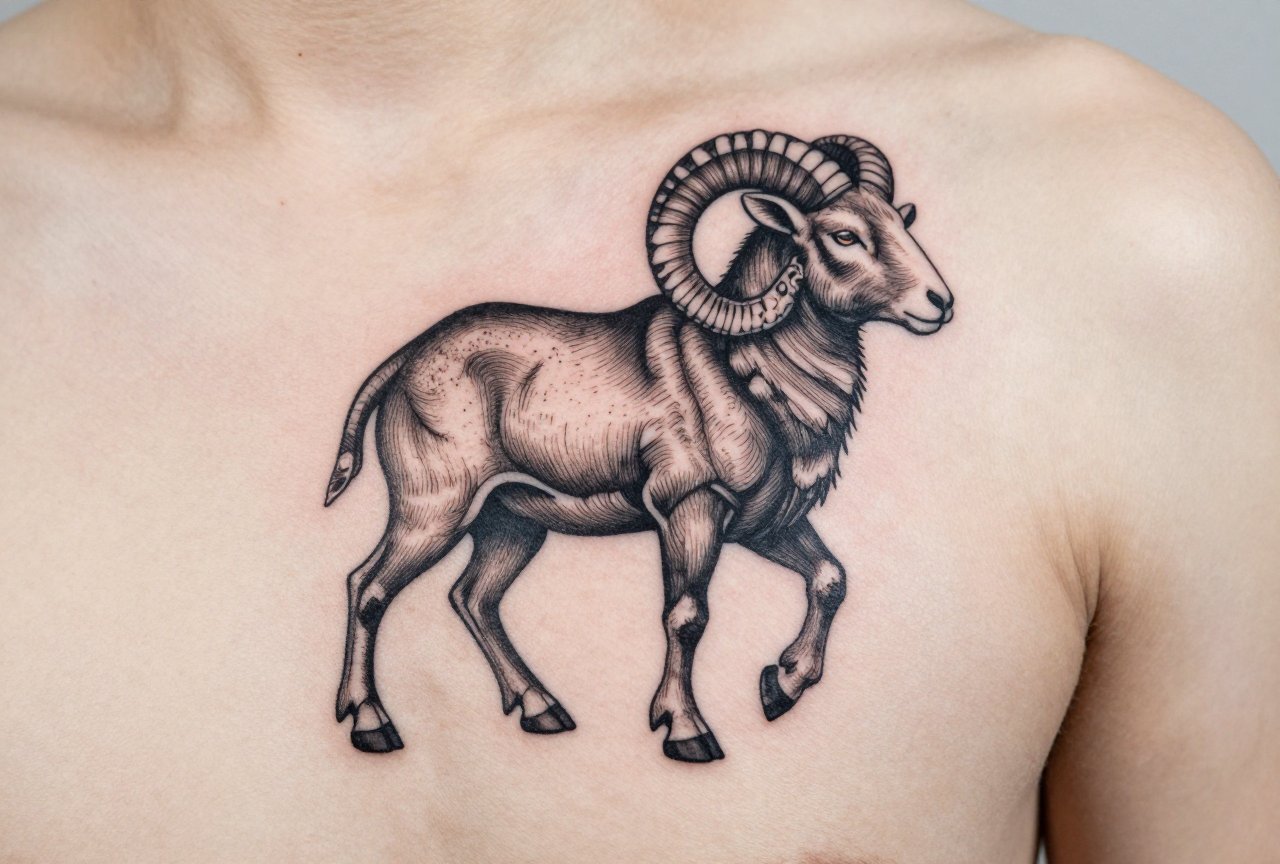
Ram Tattoo Meaning: Strength, Leadership & Aries Symbolism
A ram tattoo carries weight that extends far beyond its striking visual presence. Horns curling in defiant arcs, eyes fixed with unwavering intensity, these designs speak to something primal in human consciousness. Whether drawn to the animal’s raw physical power, its astrological significance, or its deep roots in mythological tradition, you are considering a symbol that has commanded respect across millennia.
The Ram as Ancient Power Symbol
Long before tattooing became the global art form it is today, the ram occupied sacred space in human civilization. Mesopotamian cultures often linked the animal to divine kingship and agricultural fertility. Egyptian tradition associated rams with the creator god Khnum, who fashioned humans on his potter’s wheel and was depicted with a ram’s head. These were not arbitrary choices. The ram’s ability to climb impossible terrain, to lead its flock through harsh landscapes, and to defend territory with lethal force made it a natural emblem for forces humans both revered and sought to embody.
Greek mythology amplified this significance through the Golden Fleece, sought by Jason and the Argonauts. The fleece itself came from a winged ram sent by Nephele to rescue her children, a creature of divine intervention and heroic destiny. Norse traditions often linked rams to Thor’s chariot-pulling goats, though distinct ram imagery appeared in Germanic warrior cults where the animal’s head adorned helmets and shields. Across these varied contexts, consistency emerges: the ram represents active, aggressive protection rather than passive guardianship.
Horns as Visual Architecture
The spiraling horn structure gives ram tattoos their immediate visual impact. Tattoo artists frequently emphasize this geometry through several approaches:
- Single-horn profiles that trace the logarithmic curve with precise linework
- Frontal compositions where opposing horns create natural framing around other elements
- Broken or weathered horn depictions suggesting survival through conflict
- Interwoven horn designs merging with Celtic knotwork or geometric patterns
The horn’s natural spiral also resonates with broader symbolic systems: the golden ratio, growth patterns in shells and galaxies, the labyrinth as journey rather than maze. This layered geometry rewards thoughtful placement and scale decisions.
Aries: The Astrological Dimension
As the first sign of the zodiac, Aries carries particular symbolic weight. Those born March 21 through April 19 fall under this cardinal fire sign, and ram imagery serves as their direct visual representation. Yet the tattoo’s appeal extends well beyond birthday identification.
Aries occupies the vernal equinox point, where daylight begins its dominance over darkness. This astronomical positioning historically connected the sign to initiation, sowing seasons, and the violent energy of spring’s arrival. The ram’s charging behavior mirrors this archetype: direct, unhesitating, sometimes destructive in its forward momentum. For individuals identifying with these qualities, or seeking to cultivate them, the ram becomes a personal emblem of decisive action.
Birth Chart Integration
Many choose to integrate Aries symbolism with broader astrological elements. Moon or rising sign placements can modify the core ram imagery, perhaps incorporating water motifs for a Pisces moon or earth textures for a Capricorn rising. Some designs incorporate the Aries glyph, a simplified horn structure resembling a stylized “V” with curved tips, either as standalone minimalism or integrated into larger compositions. The glyph’s angular simplicity particularly suits fine-line and single-needle techniques that have gained technical sophistication in contemporary tattooing.
Style Approaches and Technical Considerations
Ram tattoos adapt remarkably across stylistic boundaries, though certain approaches particularly suit the subject’s inherent characteristics.
Blackwork and neo-traditional techniques emphasize the horn’s dramatic silhouette and the animal’s heavy musculature. These approaches leverage high contrast and bold outlines that maintain clarity over decades. The ram’s natural darkness around eyes and muzzle provides built-in opportunities for solid black saturation that ages reliably.
Realistic portraiture demands careful attention to reference material. Domestic rams, bighorn sheep, and mouflon each present distinct horn morphology, facial structure, and wool texture. Mountain sheep species typically show more pronounced horn mass and tighter curl patterns. Your artist’s familiarity with specific reference types directly impacts anatomical accuracy.
- Dotwork and stippling excel at rendering wool texture and gradual tonal transitions
- Japanese-inspired approaches can incorporate ram imagery within broader nature or warrior compositions
- Geometric abstraction reduces the form to essential angles while preserving recognizable identity
- Negative space techniques use skin tone to suggest horn highlights against dark backgrounds
Placement and Scale Dynamics
The ram’s frontal symmetry makes it exceptionally suited for chest pieces, where the horns can frame sternum space or extend toward shoulders. Thigh placements accommodate the full head with horns spread, allowing detailed wool rendering. Forearm and calf positions work well for profile compositions that trace the horn’s curve along the limb’s natural axis. Smaller designs behind the ear or on the wrist typically isolate the horn spiral or Aries glyph for symbolic concision.
Cultural and Personal Resonance
Contemporary military traditions in several nations maintain ram mascots and insignia, continuing ancient associations between the animal and organized combat. British Army regiments including the Royal Regiment of Fusiliers and various territorial units incorporate ram imagery. These institutional connections provide meaningful context for veterans and service members, though the symbol’s power requires no uniform to activate.
Individual interpretation remains paramount. The ram’s leadership qualities attract those in positions of responsibility, entrepreneurs building from nothing, athletes cultivating competitive intensity. Its stubbornness resonates differently: as determination to some, as warning against inflexibility to others. The same horned charge that protects the flock can isolate the individual who cannot moderate impulse.
Religious contexts persist in scattered traditions. Some Christian iconography associates the ram with Christ as sacrificial substitute, deriving from the Genesis account where Abraham’s hand is stayed and a ram caught in thorns serves as offering. This redemptive reading contrasts sharply with the warrior ram, yet both threads remain available to contemporary interpretation.
Gender and the Ram Symbol
Historically coded masculine in Western symbolic systems, the ram increasingly transcends this limitation in contemporary tattooing. The qualities it represents, strength, initiative, protective aggression, are not biologically exclusive. Female and non-binary clients frequently reclaim the imagery, sometimes emphasizing maternal protection through ewe-and-lamb compositions, sometimes asserting direct identification with the ram’s unapologetic power. The symbol’s evolution reflects broader cultural shifts in how strength itself is gendered.
Final Thoughts
A ram tattoo offers uncommon density of meaning within a visually arresting form. Its ancient credentials are genuine, its astrological connections precise, its stylistic adaptability proven across decades of tattooing practice. The symbol risks overuse only through superficial deployment, the horned silhouette chosen without engagement with its layered significance.
Your specific design should emerge from genuine personal connection to some thread of this complex tradition. Whether drawn to mythological depth, astrological identity, or the animal’s sheer physical presence, commit to that motivation in your consultations. The best ram tattoos result from collaboration between your understanding of why this symbol matters and your artist’s technical capacity to render that significance visible. The horn’s spiral, after all, suggests not just power but process: growth accumulated through persistent, directed effort. That patience, applied to your tattoo’s conception and execution, yields results that endure.
Frequently Asked Questions
What does a ram tattoo symbolize?
A ram tattoo typically symbolizes strength, leadership, determination, and protective aggression. The animal’s ability to navigate difficult terrain and defend its flock translates into personal qualities of resilience and initiative. Astrologically, it represents Aries traits: cardinal fire energy, decisive action, and pioneering spirit. Ancient mythological associations add layers of divine kingship, heroic destiny, and creative power depending on which cultural tradition resonates with the wearer.
Is a ram tattoo only for Aries?
No. While ram imagery directly represents the Aries zodiac sign, its appeal extends far beyond birthdate identification. Many people choose ram tattoos for the animal’s inherent symbolic qualities, its mythological significance, or personal connections to leadership and strength. Conversely, some Aries individuals prefer other symbols to represent their astrological identity. The ram functions as a universal power symbol with particular, not exclusive, relevance to those born under its sign.
What tattoo styles work best for ram designs?
Ram tattoos succeed across multiple styles. Blackwork and neo-traditional approaches emphasize dramatic silhouette and bold contrast that ages well. Realism demands careful species reference for anatomical accuracy. Dotwork excels at wool texture rendering. Geometric abstraction reduces the form to essential angles while maintaining recognition. Japanese-inspired compositions can integrate rams into broader nature or warrior themes. The horn’s spiral structure particularly suits fine-line minimalism and single-needle techniques.
Where should I place a ram tattoo?
The ram’s frontal symmetry suits chest placement, with horns framing sternum space or extending toward shoulders. Thighs accommodate full head compositions with detailed horn spread. Forearms and calves work well for profile designs that follow the limb’s natural axis. Smaller positions like behind the ear or on the wrist suit isolated horn spirals or the Aries glyph. Consider visibility preferences, pain tolerance for specific areas, and how the design’s scale relates to your body’s proportions.









