A Greek mythology tattoo means you’re carrying a story older than most religions, one about human flaws, divine punishment, stubborn endurance, or the price of ambition. It’s not just “cool imagery from a movie.” In my chair, I’ve tattooed Medusa on survivors who want to reclaim their power, and I’ve done Icarus on guys who finally quit soul-crushing jobs. The meaning lives in what the story says about your own life, not just what it said in a textbook.
Symbolism & History
These symbols have been etched into human consciousness for roughly three thousand years. That longevity matters for tattoos. A Greek myth won’t feel dated in five years because it already survived millennia.
Power and Punishment
Zeus’s thunderbolt, Prometheus bound to the rock, Atlas holding the heavens, these aren’t heroic portraits. They’re warnings about the cost of defiance. I’ve had clients choose Prometheus specifically because they gave too much of themselves to ungrateful people. The eagle eating his liver daily? That’s the reliving of old wounds. The symbolism hits different when you’ve actually lived something similar.
Transformation and Identity
Arachne becoming a spider, Daphne turning into a laurel tree, Actaeon becoming a stag, these myths speak to moments where identity shatters and rebuilds. Medusa falls here too. She wasn’t born monstrous; she was transformed by violation. The clients who sit for Medusa pieces often have their own transformation stories. I did one on a woman’s ribs where the snake hair became actual healing scars woven into the design. The myth gave language to something she couldn’t otherwise name.
Common Variations & Styles
Not all Greek mythology tattoos look the same, and the style changes the meaning subtly.
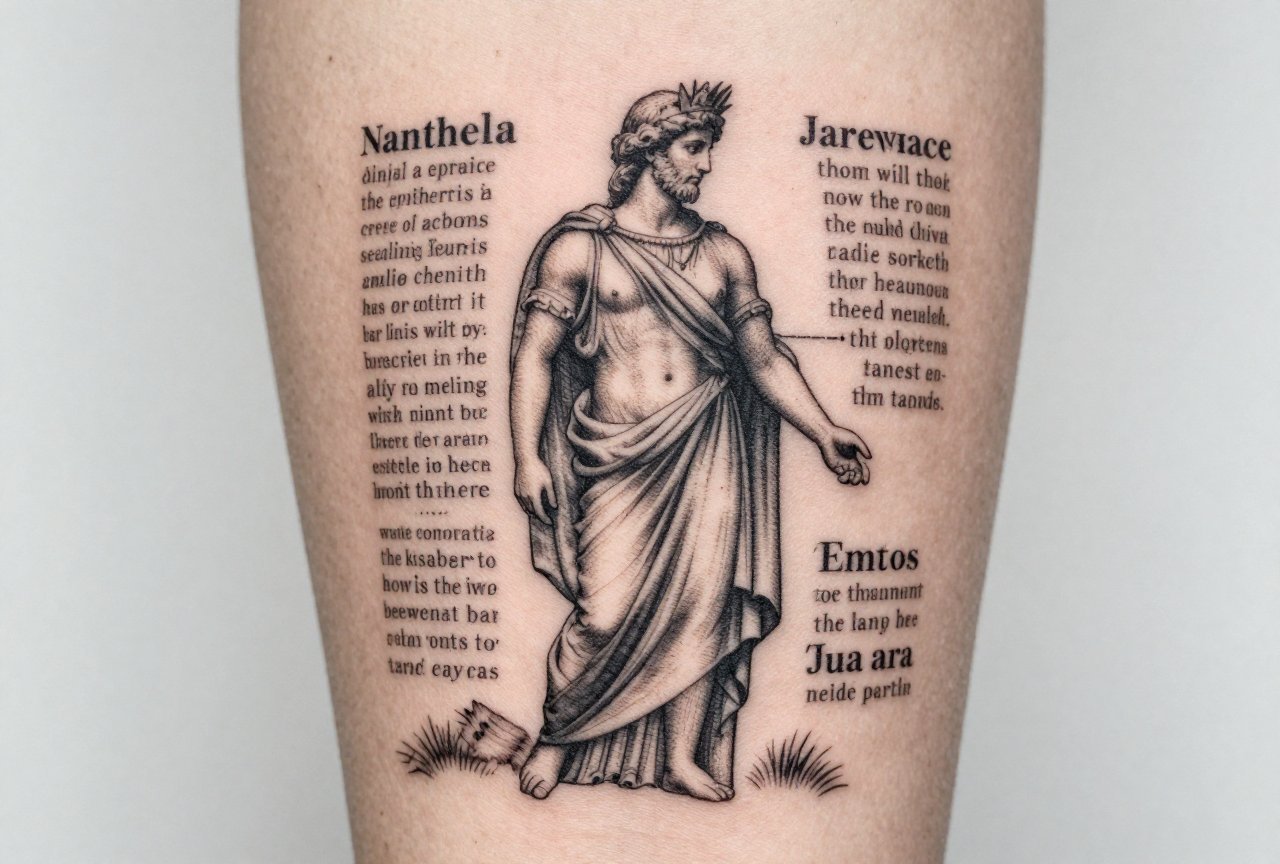
- Blackwork statues: These read as classical, timeless, almost museum-piece. The marble aesthetic suggests endurance, something carved in stone. Heavy line weight, no color. They age beautifully because there’s no fine color to fall out.
- Neo-traditional with color: Aphrodite with roses, Dionysus with grapes and wine. More celebratory, less solemn. The color adds life but needs touch-ups sooner. I warn clients: red fades to pink, purple goes muddy. Plan for that.
- Fine line celestial: Constellations named for myths, Orion, Cassiopeia, Andromeda. Delicate, often paired with small script. These age poorly if too small. I tell people: minimum two inches for constellation dots, or they’ll blur to freckles in five years.
- Graphic dark: Hades, Cerberus, the Fates. Heavy black, high contrast, sometimes horror-adjacent. These clients usually want the shadow side of myth, the underworld, not Olympus.
We see this a lot in shops: someone brings a Pinterest screenshot of a gorgeous watercolor piece, wants it tiny on their wrist, and it’s Medusa with full snake detail. I have to explain that watercolor without black line won’t hold. The snakes become green blobs. Adjust or regret.
Best Placements
Where you put it changes how the story reads to others, and how it feels to you.
Visible Power Placements
Forearms, calves, upper chest. These are for the myths you want to explain or display. Ares on a forearm says something different than Ares on a thigh. The forearm is confrontational, self-declared. I’ve tattooed Achilles heels on actual heels, small, private, but the client knows the reference to vulnerability. That’s the opposite energy.
Intimate Story Placements
Ribs, sternum, upper back, inner bicep. These are closer to the heart, literally. Persephone’s pomegranate on ribs, where breathing moves it. The underworld queen who returns each spring, that’s a comeback story, and the placement makes it personal. I did a full-back piece of Sisyphus pushing his boulder up the client’s spine. Every time he bends, the boulder rolls. He wanted that physical reminder of his own cycles.
Line versus shading matters by placement. Ribs and inner arms hurt more and swell more; heavy shading there heals rough. I often suggest line-heavy designs for first pieces in painful spots, saving the full black fill for later when they know their pain tolerance.
Who Chooses This Tattoo / Personal Meanings
In my experience, three types of people sit for Greek mythology work.
- The reader: They actually read the myths, maybe studied them. They want accuracy. They’ll correct me if Icarus’s wings have too many feathers, or if the Minotaur’s horns curve wrong. Their meaning is intellectual, layered, sometimes obscure myths like Cassandra or Tithonus.
- The survivor: Medusa dominates here, but also Phoenix (technically Egyptian origin, but culturally blended), Persephone, Chiron. The wounded healer, the stolen girl who became queen of death, the gorgon who turned men to stone. These clients need the myth to speak what they can’t yet say in therapy.
- The striver: Icarus, Sisyphus, Atlas, Hermes. The messenger, the lifter, the doomed flyer, the endless worker. Often young men, often in competitive fields. They identify with the ambition, sometimes missing that the myths punish these figures. I don’t lecture them. The tattoo outlasts the job, the relationship, the phase. The meaning will shift.
One client, a woman in her fifties, got Penelope’s loom on her shoulder. Not the waiting, but the unweaving, each night undoing the day’s work to keep suitors at bay. She’d spent thirty years in a marriage that required similar strategic patience. The tattoo was her recognition, finally, of her own cunning.
Similar Symbols
Greek mythology bleeds into other tattoo traditions. Clients sometimes mix or confuse these, and that’s fine, but the meaning changes.
- Norse mythology: Odin’s sacrifice, Loki’s chaos, Thor’s protection. Similar themes of cost and power, but colder, more fatalistic. The aesthetics differ, knotwork versus meander patterns.
- Christian iconography: Archangel Michael defeating Satan draws from the same heroic dragon-slayer tradition as Apollo and Python. But the moral framework shifts from human struggle to divine salvation.
- Japanese irezumi: Oni, dragons, the nine-tailed fox. Transformation myths again, but the visual language is entirely different. I’ve seen clients try to blend Greek figures with Japanese waves. It can work with a skilled artist, but the cultural mixing needs intention, not accident.
- Classical sculpture generally: Roman copies, Renaissance interpretations, modern neoclassical. These aren’t strictly mythological but share the visual vocabulary. A marble bust of an anonymous figure carries different weight than a named myth.
Shop culture note: artists often have strong opinions about mixing traditions. Some refuse; some specialize in it. Ask before you assume. I’ve turned down pieces where the client wanted a photorealistic Zeus with traditional Japanese background. The styles fight each other. Find an artist who actually does the fusion, not one who’ll reluctantly attempt it.
Final Thoughts
Greek mythology tattoos endure because the stories already endured. They weren’t written for tattoos; they were written to explain human cruelty, desire, stupidity, and grace. That gives them weight that trendy imagery lacks.
But the weight can become burden if you don’t genuinely connect to the story. I’ve covered up Greek pieces where the client chose based on a movie or a zodiac association they later outgrew. The cover-ups are usually bigger, darker, more expensive. The original myth becomes literal scar tissue.
So sit with the story first. Read the actual myth, not the summary. Notice which part arrests you, the punishment, the transformation, the pursuit, the failure. That’s your meaning. The tattoo just makes it visible, permanent, and finally yours.
Frequently Asked Questions
Do Greek mythology tattoos have to be large to work?
Not at all, but scale matters for detail. A tiny Medusa head becomes a blob in five years. I suggest minimum three inches for any figure with recognizable features. Simple symbols, thunderbolts, helmets, owls, can go smaller and still read clearly.
Will a Greek statue tattoo look weird as I age?
Marble aesthetic actually ages well because it’s already “weathered.” The cracks and wear you see in classical sculpture translate naturally to how skin changes. I find these hold dignity better than photorealistic pieces that fight aging.
Is it disrespectful to get a myth tattoo if I’m not Greek?
Greek mythology belongs to global culture now, not modern Greek identity specifically. But approach with respect, don’t treat it as mere decoration. The clients who sit best with these pieces have actually engaged with the stories, not just the aesthetics.
Why do artists push back on some placement ideas?
Because we’ve watched bad placements age badly. A full-color Aphrodite on top of the foot? The color falls out, the lines blow. We push back to protect the work and your money. Good artists explain why; listen even if you decide differently.
Related Tattoo Meanings
- Siren Tattoo Meaning: Danger, Desire, and Duality
- Snake Eating Itself Tattoo Meaning: Cycles, Rebirth Self-Consumption
- Calla Lily Tattoo Meaning: Beauty, Rebirth Quiet Strength
- Explore more