
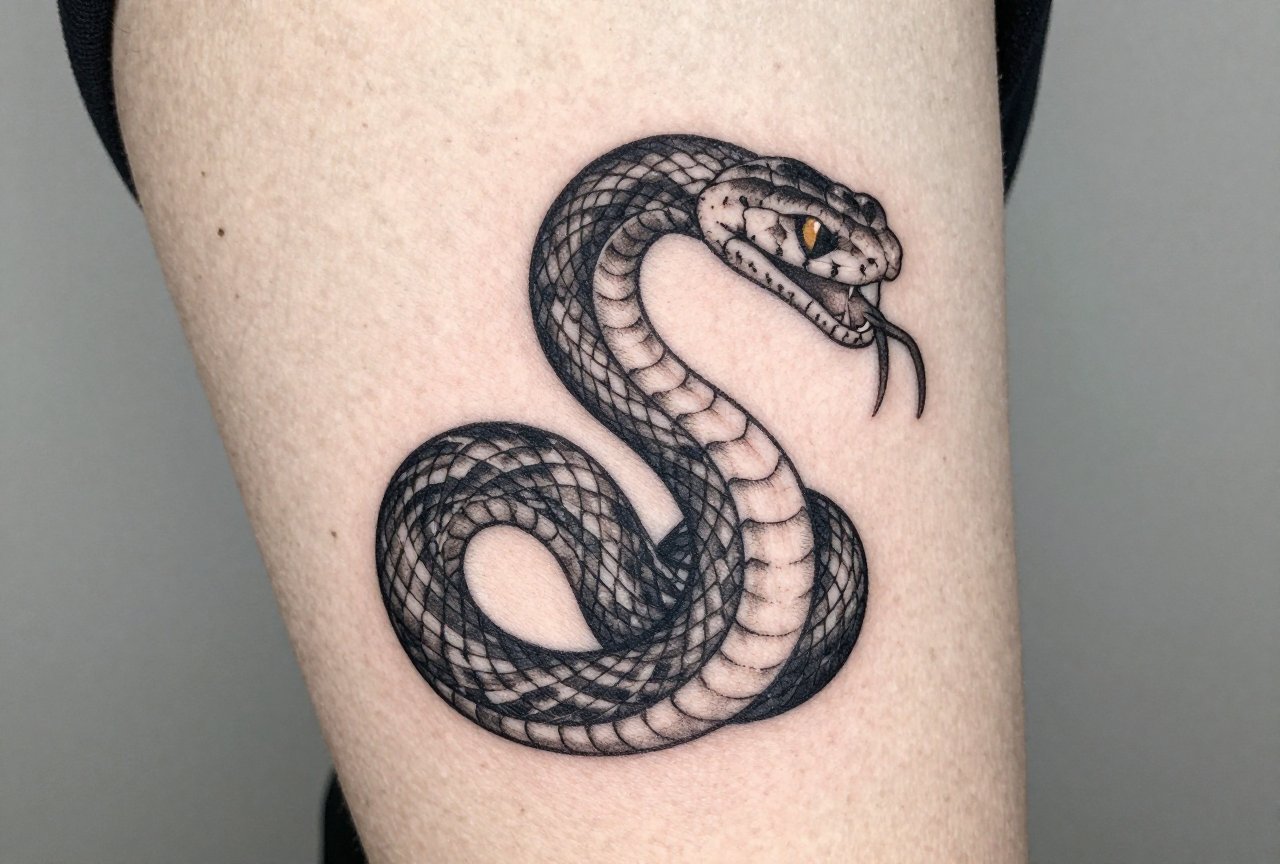
The snake eating itself, properly called the ouroboros, means cyclical renewal, the eternal return, and the paradox of life feeding on itself. In tattoo form, it becomes a personal meditation on endings that are beginnings, destruction that creates. I’ve had clients stare at this design for years before finally sitting in my chair, and almost always there’s a story of transformation they can’t quite name yet.
Symbolism & History
The ouroboros is old. Older than most symbols people wear. It shows up in ancient Egyptian funerary texts, Greek alchemical manuscripts, and Norse mythology. The serpent Jörmungandr encircles the world in Viking lore, biting its own tail to hold things together. Alchemists in the 1500s drew it in their notebooks as the “prima materia”, the unified substance that contains both the poison and the cure.
What the Circle Actually Means
A snake in a circle isn’t just decorative geometry. The closed loop rejects linear time. Birth, death, decay, rebirth, no beginning, no end. I’ve tattooed this on people who’ve lost someone and can’t find closure, on others who’ve rebuilt themselves after addiction. The symbol doesn’t promise happy endings. It promises that endings aren’t real. The tail in the mouth is consumption, sure, but it’s also sustenance. The snake feeds itself to live. That’s not pretty, but it’s honest.
The Shadow Side
Not every ouroboros client wants sunshine and renewal. Some come because they’re trapped in patterns they can’t break, toxic relationships, self-sabotage, the same mistakes on repeat. The snake eating itself can mean stagnation, the feedback loop of your own worst habits. I did one on a guy’s ribs where the snake’s eyes were hollow, the body more skeletal than alive. He called it his “reminder to stop chewing my own tail.” The symbol holds both readings simultaneously. That’s its power.
Common Variations & Styles
How you draw this changes everything. The ouroboros adapts to almost any style, but each carries different weight.
- Traditional/Americana: Thick bold lines, limited color, the snake often more cartoonish than realistic. Holds up forever. The simplicity reads immediate and iconic, not fussy.
- Blackwork/Dotwork: Dense geometric patterns filling the body, sometimes sacred geometry radiating from the center. Very popular right now. The precision appeals to people who want the symbol to feel engineered, almost mathematical.
- Realism: Scales you can almost feel, accurate anatomy, the mouth tearing actual flesh. Hits harder emotionally. I’ve seen clients tear up when they see the stencil. The visceral quality removes any mystical distance.
- Minimalist/Line: Single continuous line, sometimes no color at all. Elegant, but risky long-term. Thin lines spread and blur; I always warn clients that a hairline ouroboros on a finger or wrist will need touch-ups.
- With additional elements: The snake encircling a skull, a moon phase, a flower, a personal object. The container changes the meaning. A rose inside becomes beauty sustained by pain. A clock inside makes time explicit.
Color choices matter too. Green and gold read alchemical, ancient. Red and black read danger, blood, urgency. All black is timeless but can flatten on darker skin tones, I’ve learned to use negative space strategically so the form doesn’t disappear.
Best Placements
The ouroboros demands circular composition, which limits and liberates placement at once.
Where It Works Best
Upper arm, wrapping as a band, classic, readable, easy to show or hide. The natural curve of the bicep accepts the circle without forcing it. I’ve done dozens here. Wrists work for smaller versions, though the bone makes tattooing technically harder and the skin there ages fast. Ribs and sternum for larger, more personal pieces; the heart literally under the symbol. One of my favorite placements is the knee, the circle echoing the joint’s movement. Every time they bend, the snake consumes.
Where It Fights You
Fingers and hands: the circle distorts with tendons, ink falls out, touch-ups are constant. Ankles can work but the bone proximity makes the session rough. I’ve had clients tap out on simple ouroboros ankle pieces because the vibration rattles the whole foot. The back of the neck is popular but the circle competes with the spine’s line; off-center reads as a mistake, dead center looks like a target.
Who Chooses This Tattoo / Personal Meanings
After fifteen years, I can almost guess who’ll ask for an ouroboros before they open their mouth. Not always, but often.
The recently divorced, rebuilding identity from scratch. The sober person marking time that loops differently now. The philosophy student who discovered it in a textbook and can’t stop thinking about it. The person whose parent died, who keeps having dreams of them returning in cycles. The Burning Man veteran who wants something “ancient but trippy.”
What unites them isn’t a single life event. It’s a particular kind of thinking, people who see patterns, who can’t accept simple linear stories. I’ve had clients spend two hours explaining their interpretation while I set up. I never rush them. The meaning is the tattoo, really. The ink just makes it visible.
One woman told me her ouroboros represented her mother’s eating disorder, how the body consumes itself. Another said it was his ADHD, the same thoughts circling endlessly. A third just liked the shape. All valid. The symbol doesn’t police its own meaning.
Similar Symbols
Clients sometimes come in wanting an ouroboros but aren’t sure, or want something adjacent. I keep reference books around for these conversations.
- Phoenix: Also rebirth, but linear, burn, die, rise. The ouroboros is continuous, no death required. People who reject “before and after” narratives often prefer the snake.
- Infinity symbol: Similar endlessness, but abstract, bloodless. The ouroboros has teeth, digestion, the mess of biology.
- Mandala: Cyclical geometry without the consumption aspect. More spiritual, less visceral.
- Yin-yang: Dialectical balance, opposites in tension. The ouroboros is singular, self-referential, the same thing becoming itself again.
- Phoenix and dragon pair (Chinese tradition): Cosmic cycle but relational, two forces. The ouroboros is lonely by comparison, self-contained.
I usually ask: do you want to emphasize the cycle, or the self-consumption? The answer points to ouroboros or away from it.
Final Thoughts
The snake eating itself endures because it doesn’t resolve. Most symbols flatten into one meaning over time. The ouroboros refuses. It’s life and death, creation and destruction, sufficiency and starvation, all held in the same closed loop. When I tattoo it, I’m not just tracing a design. I’m marking someone’s recognition that nothing ends cleanly, that we feed on our own pasts to grow whatever comes next.
It’ll need touch-ups eventually. All tattoos do. There’s something fitting about that.
Frequently Asked Questions
Does the direction the snake faces change the meaning?
Clockwise and counterclockwise have different interpretations in some traditions, clockwise as evolution, counter as involution, but most tattoo artists and clients don’t distinguish. The overall composition matters more than directional nuance. If it matters to you, specify with your artist.
Is the ouroboros only for people going through hard times?
Not at all. I’ve tattooed it on people celebrating stability, marking long marriages, or honoring cyclical joys like farming or teaching. The symbol holds whatever you bring to it. Hard times are common, but not required.
How painful is an ouroboros compared to other tattoos?
Pain depends entirely on placement, not the design itself. A circular wrist band hurts more than a loose shoulder piece because the bone proximity and repeated needle passes over the same area. Ribs and sternum are rough regardless of the image. Talk placement with your artist honestly.
Can the ouroboros be combined with other symbols without losing its meaning?
Absolutely. The central circle can frame almost anything, and the snake’s body can integrate with other imagery. The meaning shifts but doesn’t erase. I’ve seen ouroboros with roses, skulls, geometric patterns, even portraits. Work with an artist who understands visual hierarchy so the symbol doesn’t get visually crowded out.
Related Tattoo Meanings
- Skull Roses Tattoo Meaning: Life, Death Everything Between
- Buddhism Symbol Wheel Tattoo Meaning: Dharma Design
- Cleopatra Tattoo Meaning: Power, Beauty Legacy
- Explore more









