
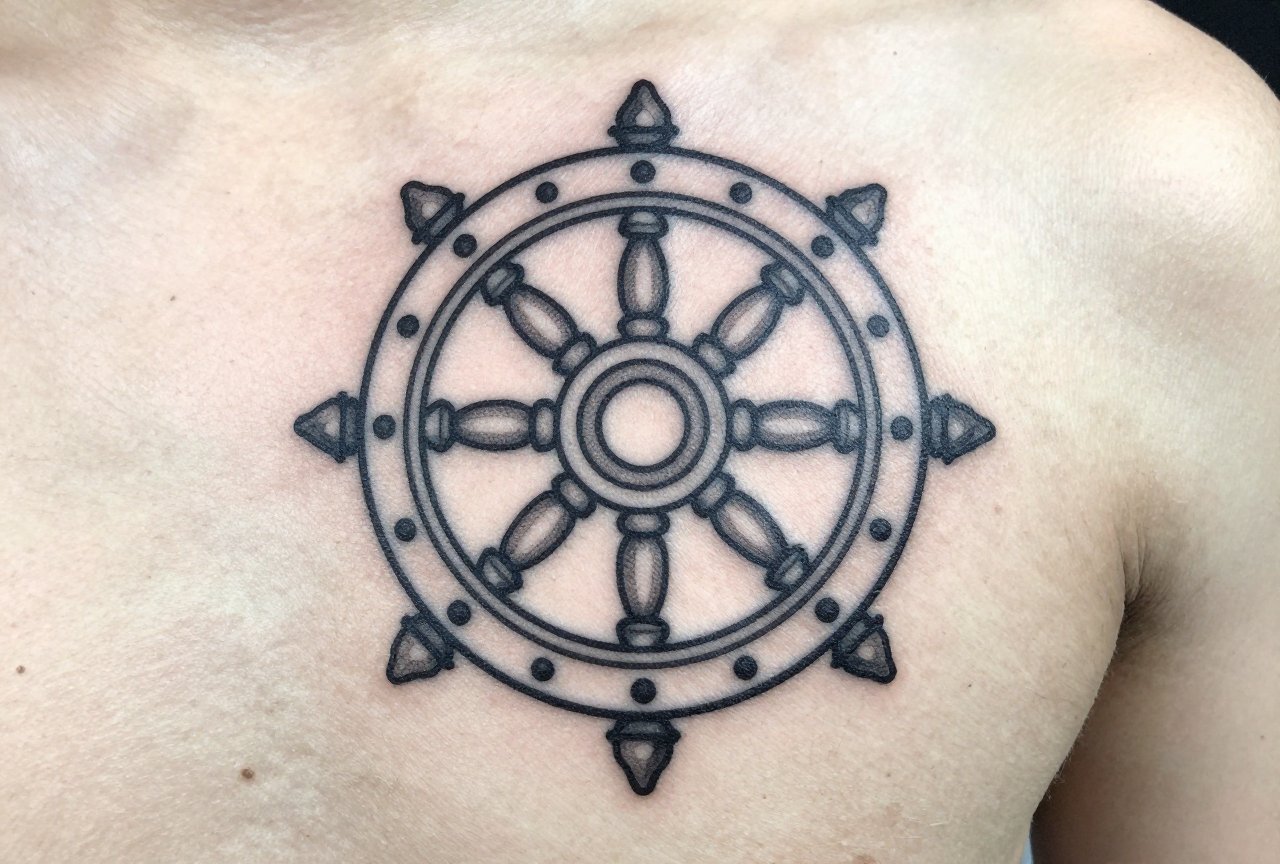
The Dharmachakra, or Dharma wheel, is one of the oldest emblems in Buddhist tradition. It represents the Buddha’s teachings, the cycle of rebirth, and the Eightfold Path to enlightenment. In tattoo form, it carries weight for practitioners, spiritual seekers, and anyone drawn to its geometry and philosophical depth.
What the Wheel Means
The eight spokes point to the Noble Eightfold Path: right view, intention, speech, action, livelihood, effort, mindfulness, and concentration. The rim represents concentration holding the practice together. The center stands for moral discipline. Some wheels include three swirling elements at the core, representing the Three Jewels: Buddha, Dharma, and Sangha.
Origins and Historical Use
The wheel’s use as sacred imagery likely predates Buddhism, with roots in ancient Indian sun and cosmic symbolism. The Buddha’s first sermon at Sarnath, often linked to the Deer Park, connected the wheel firmly to Buddhist identity. This is why deer sometimes appear flanking wheel designs. Early Buddhist art from around the 1st century BCE shows the wheel on pillars and coins. The Ashoka Chakra on India’s flag descends from this same visual lineage, though with different meaning and twenty-four spokes. Different Buddhist traditions emphasize different aspects: Tibetan wheels tend toward ornate detail, while Zen interpretations often stay minimal.
- The wheel appears on early Buddhist pillars and coinage
- The Ashoka Chakra shares visual ancestry but carries national, not religious, meaning
- Tibetan, Thai, and Zen traditions each handle the symbol differently
Style and Technical Considerations
There is no single correct way to render a Dharmachakra. The design must adapt to the body, the client’s practice, and how the image will age.
Line Work and Shading
Clean black line work ages well on this symbol because the geometry demands precision. Wobbly spokes become obvious quickly. Fine lines require planning for touch-ups over time. Shading adds depth, particularly for Tibetan-style wheels with flames, lotus bases, or intricate rim details. Dotwork can create texture at the center, but it requires an artist who understands how dots spread as skin ages.
Common approaches include:
- Traditional Buddhist: exact proportional spokes, sometimes with Pali script
- Tibetan thangka-inspired: elaborate, colorful, with gold accents
- Minimalist: simple circle with eight straight spokes, no additional elements
- Biomechanical: gears and cogs replacing organic forms
- Mandala fusion: the wheel as center point of larger geometric composition
Color carries association. Saffron and maroon connect to monastic robes. Blue and gold reference Tibetan traditions. All black reads as serious and less tied to specific lineage.
Placement and Longevity
The wheel’s circular nature suits certain locations better than others. The chest, over the heart, appeals to those who want the teaching close. The upper back accommodates larger, detailed pieces with surrounding elements. Forearms work for minimalist versions that serve as daily reminders. Ribs and sternum involve more pain; this placement often appears among people with established meditation practice who can sit with discomfort and prefer privacy.
Small wheels on fingers or hands tend to fail. The spokes blur as ink spreads. If you must use these areas, keep the design bold and simple. Behind the ear can work for small, clean designs, but expect fading.
- Forearm: daily visibility, suited to medium-sized clean work
- Upper back or shoulder blade: space for detail, deer, lotus, or script additions
- Chest: personal, protected, spiritually significant placement
- Calf or thigh: large canvas, less pain, easy to show or conceal
Who Wears This and Why
Not everyone who chooses this symbol is Buddhist. In a tattoo studio, you see a range of motivation and depth of practice.
Practitioners and Sincere Seekers
Devout practitioners often arrive with specific requirements: exact spoke count, proper directional orientation, perhaps a particular monk’s handwriting for accompanying text. They know what they want and why. Then there are those who found meditation during difficulty, who read Buddhist teachers after loss or transition, who did a retreat and something shifted. Their wheels tend toward simpler forms. The meaning remains genuine even when the practice is newer. A good artist asks questions, ensures the client understands what they carry, and does technically sound work without gatekeeping.
Common personal meanings include:
- Recovery from addiction, the wheel as turning from old patterns
- Loss of a parent who practiced Buddhism
- Marking a pilgrimage to Bodh Gaya or another significant site
- General commitment to mindfulness, not tied to formal religion
Personal layers make the tattoo specific to the wearer: a sobriety date in Roman numerals at the center, a teacher’s name in Tibetan script circling the rim. These details transform a standard symbol into something owned.
Symbols Often Confused or Combined
Clients sometimes mix the Dharmachakra with related imagery. Clarification before tattooing matters.
The Ashoka Chakra on India’s flag looks similar but has twenty-four spokes, no rim details, and carries meaning related to law and national identity rather than Buddhist practice. The ship’s wheel is entirely different, though some sailors request Buddhist wheels that subtly reference both. The ouroboros shares the cyclical concept but belongs to Western esoteric traditions.
Within Buddhism, the wheel often appears alongside:
- The lotus flower: purity emerging from muddy water
- The endless knot: interconnectedness, cause and effect
- Pair of deer: referencing the first sermon, gentle presence
- Om or mantras: sound and vibration as path
Composition matters. Crowding a small wheel with multiple additional symbols usually fails. Better to choose one or two companions and give them space to breathe.
Before You Decide
The Dharmachakra carries weight. It is not a trend piece selected because it photographs well. The best work happens when the client has sat with the meaning, sometimes literally in meditation, and arrives knowing why this image, why now, why on this particular body.
The wheel also invites. Its openness, the way it turns, suggests movement and possibility. You do not need to be enlightened to wear it. You need to respect what it represents, find an artist who understands the geometry, and commit to the sitting. The tattoo will age with you, spokes softening slightly over decades, but the intention behind it is what holds.
Frequently Asked Questions
Do you have to be Buddhist to get a Dharma wheel tattoo?
No, but respect for the symbol’s origins matters. Many non-Buddhists wear it to represent mindfulness or personal transformation. Learning the basic meaning allows you to explain it if asked.
How many spokes should a Buddhist wheel tattoo have?
Traditionally eight, for the Noble Eightfold Path. Some variations exist. If you practice formally, a teacher might offer specific guidance. For general spiritual use, eight is standard and immediately recognizable.
Does the wheel direction matter, clockwise or counterclockwise?
Clockwise typically symbolizes the forward progression of Dharma and natural order. Counterclockwise appears in some ritual contexts. Most tattoo artists default to clockwise unless you request otherwise for personal reasons.
Will fine line details at the center blur over time?
Yes. Intricate center work typically softens and can become muddy after five to ten years. For lasting clarity, keep the center simple or plan for periodic touch-ups.









