
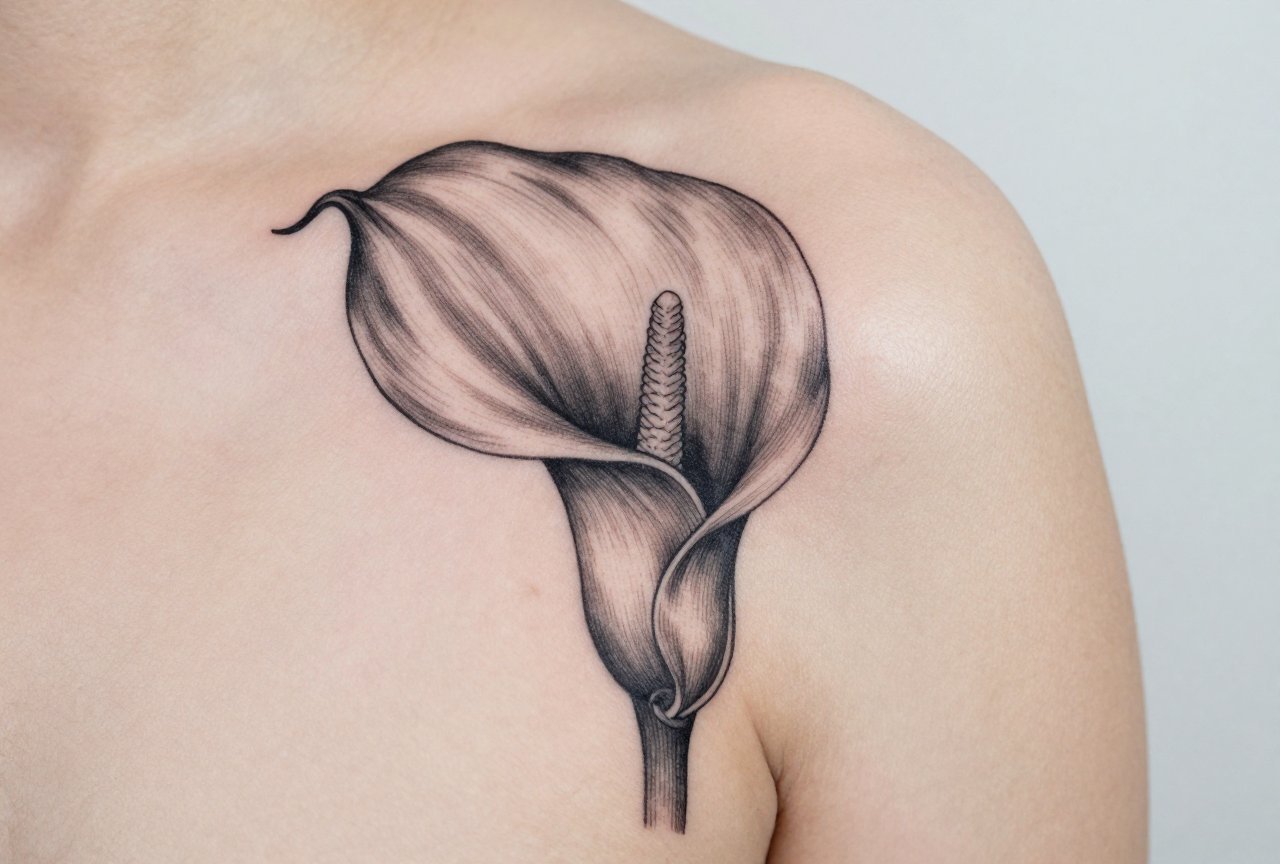
The calla lily tattoo carries layered meaning: rebirth after hardship, beauty that doesn’t need to shout, and a quiet strength that outlasts the flashy blooms around it. I’ve tattooed this flower on mourners and newlyweds, on shoulders and ribs, and the story is rarely the same twice. What ties them together is the shape itself, that elegant, unbroken curve that feels almost architectural against skin.
Symbolism & History
People assume calla lilies are lilies. They’re not. Botanically they’re arums, closer to philodendrons than to the stargazer lilies people mix them up with. That confusion actually feeds their tattoo meaning, this flower lives in the in-between spaces, refusing easy categories.
Rebirth & Transformation
In my chair, this is the story I hear most. Someone’s finished chemo, left a marriage, survived something they don’t name out loud. The calla lily’s trumpet shape reads as emergence, something pushing up from dark soil into air. I did one on a woman’s forearm last spring where the stem emerged from actual blackwork shading at the wrist, fading to nothing but clean linework at the bloom. She didn’t need to explain.
The Greek myth connection to Hera’s milk fits here too, though most clients don’t know it. The flower supposedly sprang from where her milk dropped to earth, divine origin, mortal soil. That’s the rebirth narrative in miniature.
Purity & Devotion
Wedding bouquets made white calla lilies famous, and that association stuck. But “purity” in tattoo form rarely means virginity. I tell clients it reads more like clarity, decision without doubt, commitment without performance. The single bloom has no petals to arrange, no pollen to scatter. It’s already complete.
- White ink highlights on black or grey blooms can emphasize this “clarity” reading
- Single stem vs. bouquet changes the tone dramatically, one is resolve, many is celebration
- Water drops added by some artists read as morning freshness, not tears (unless you want them to)
Common Variations & Styles
Style choice reshapes meaning as much as color does. I’ve watched the same flower communicate grief in fine-line blackwork and triumph in saturated neotraditional.
Black & Grey Realism
This is what we see a lot in memorial pieces. The smooth gradient from deep shadow to highlight mimics how actual calla lilies catch light, that waxy surface that seems to glow from within. The downside: heavy black shading in the spathe’s center can blur over time if your artist overworks it. I keep my greywash loose there, building value slowly across sessions if needed.
Minimalist Line Work
A single continuous line forming the silhouette. These age beautifully on inner arms and collarbones because there’s nothing to fall out, no tiny details, no stipple dots that spread. The meaning shifts toward essence over ornament. I did one on a guy’s ribs, just the curve, no stem, no leaves. He’d lost his mother to ALS; the shape was her handwriting, he said, though I couldn’t see it. That was the point.
- Botanical illustration style: accurate, educational, appeals to gardeners and scientists
- Japanese-influenced: bold outlines, limited color, often paired with waves or wind bars
- Abstract/geometric: the curve broken into planes or negative space, increasingly popular
Best Placements
The calla lily’s elongated form dictates placement more than most floral designs. It wants vertical space. Horizontal wrapping distorts that elegant reach.
Forearms work when the stem extends toward the wrist or elbow, creating movement with the arm’s natural geometry. Ribs and side pieces let the curve follow the body’s own architecture, I’ve placed blooms near the hip bone with stems trailing toward the waist, and the effect is almost sculptural.
Behind the ear and on the hand are placements people request but I often talk them down. The flower’s detail gets lost at small scale, and hands see so much sun and wear that fine lines blur fast. If you’re committed, go bold and simple, not delicate.
- Thigh: space for multiple blooms, color saturation holds well
- Spine: single stem following vertebrae, dramatic but requires pain tolerance
- Foot/ankle: popular but fades unevenly due to shoe friction and thin skin
Who Chooses This Tattoo / Personal Meanings
After fifteen years, I can almost guess the story by where they want it and how they describe the color. Almost. The calla lily attracts people who’ve already thought longer than they want to admit.
Memorial & Grief Work
Funeral flowers by definition. I’ve done these in purple (dignity, royalty), in white (the classic), and once in deep burgundy that matched the actual bouquet at a client’s father’s service. She brought dried petals. We matched the ink to them. The tattoo aged lighter, as tattoos do, but she knew that going in. The meaning was in the act, not the permanence.
Recovery & New Beginnings
Addiction recovery, divorce, career abandonment, gender transition. The calla lily’s emergence narrative fits these without requiring explanation. A client last year got a half-sleeve of calla lilies breaking through concrete rubble, her design, her metaphor, my job to make the greywork read as actual broken stone. The flowers were almost incidental, but they made the piece coherent.
- Anniversary markers: couples getting matching simplified stems
- Creative professionals: the “artistic” flower, less common than roses, more distinctive
- Spiritual seekers: the Madonna lily confusion leads some to Christian symbolism, though calla lilies have no biblical presence
Similar Symbols
Clients sometimes waver between the calla lily and related designs. Here’s how the conversation usually goes in my shop.
True lilies (Lilium) offer more petal detail, more fragrance association, stronger Christian iconography. They also read more traditional, less modern. The calla lily’s smooth surface feels designed, almost Art Deco, where stargazers feel organic and slightly wild.
Lotus flowers share the rebirth/mud-to-bloom narrative but carry heavier Eastern spiritual baggage that some want and some don’t. The calla lily is culturally lighter, you can assign meaning without fighting pre-existing symbolism.
Orchids read as exotic, expensive, slightly performative. Calla lilies are domestic, available at grocery stores, unpretentious. That accessibility becomes part of the tattoo’s meaning for people who reject ostentation.
- Peony: prosperity and romance, bulkier, more petals, more session time
- Chrysanthemum: death in some cultures, longevity in others, riskier cross-culturally
- Anemone: fragility, forsaken love, more delicate linework required
Final Thoughts
The calla lily tattoo works because it holds contradiction without collapsing. Funeral flower and wedding bloom. Architectural and organic. Simple enough for a first tattoo, deep enough for a twentieth. In my experience, the best ones happen when clients stop explaining and start trusting the shape itself, that curve that needs no justification, that stands for whatever you’re standing for at the moment you sit in the chair.
I’ve watched these age across decades. The bold ones hold. The timid ones blur. If you’re considering it, commit to scale or commit to minimalism, the middle ground, half-detailed and half-implied, is where tattoos go to look confused. Know your story, but don’t over-narrate the design. The flower’s already saying something. Your job is to decide if you’re listening.
Frequently Asked Questions
Does the color of a calla lily tattoo change its meaning?
White reads as purity or memorial, purple as dignity, yellow as gratitude, and black as grief or rebellion. Most clients choose based on personal association rather than fixed symbolism.
How well does fine-line calla lily tattooing hold up over years?
Single-needle work on the curve itself ages okay if kept large enough, but tiny interior details tend to blur. I recommend bold outline weight or strategic negative space for longevity.
Can a calla lily tattoo cover up older work?
The spathe’s broad shape can mask small tattoos, but the stem’s narrowness limits coverage area. Dark purples and blacks work best for concealment purposes.
Why do artists recommend against hand placement for this design?
The calla lily’s impact relies on its elegant curve, which gets distorted by finger movement and fades fast on high-wear skin. Simpler, bolder adaptations work better there.
Related Tattoo Meanings
- Chi Rho Tattoo Meaning: Faith, History, and Personal Devotion
- Cleopatra Tattoo Meaning: Power, Beauty Legacy
- Crab Tattoo Meaning: Symbolism, Styles What It Says About You
- Explore more









