
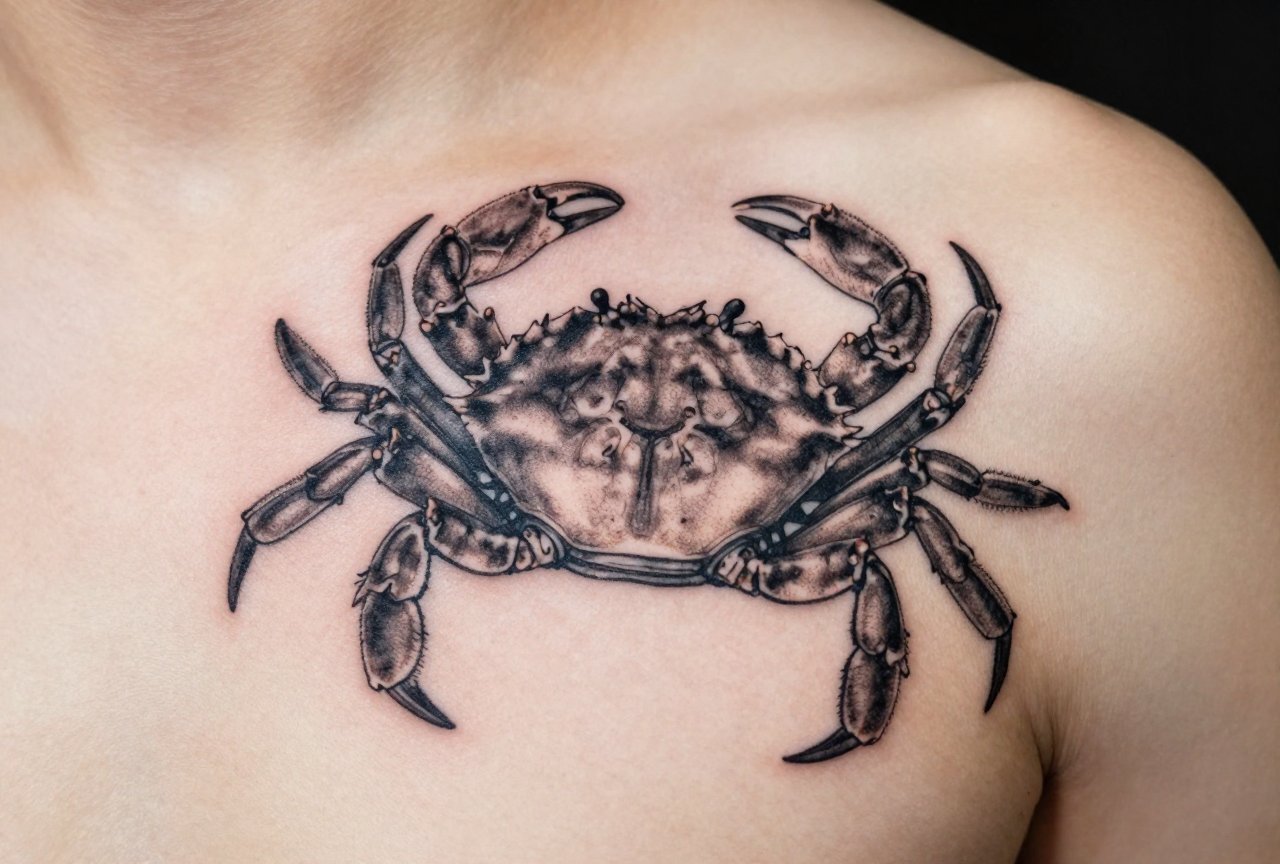
A crab tattoo usually means resilience, protection, and the ability to thrive in tough conditions. It speaks to people who guard their soft interior with a hard shell, who move sideways when direct paths fail, and who feel tied to the ocean’s rhythms. I’ve tattooed crabs on fishermen, cancer survivors, and folks who just grew up on the coast, each one carrying a slightly different weight.
Symbolism & History
The crab’s been a symbol long before tattoo shops existed. Ancient sailors carved them into ship beams for safe return. In Chinese tradition, the crab pairs with the moon and autumn, representing prosperity and regeneration. The Greeks saw the crab as tenacious, remember the myth of Karkinos, the crab that bit Hera’s enemy and earned a place in the stars as Cancer.
What draws people to this creature isn’t just mythology. It’s the physical reality of the animal. Crabs shed their entire shell to grow. They walk sideways when forward won’t work. They carry their home on their backs. These aren’t abstract ideas, they’re survival strategies that translate hard to skin.
Emotional Resonance
I tell clients who want crab tattoos that this design often marks a boundary. Not a wall, but a membrane, something that lets you choose what gets in. The shell isn’t about hiding; it’s about having a door. People who’ve rebuilt themselves after trauma, who’ve learned to say no, who’ve figured out that vulnerability requires protection first, they gravitate here. The claws add another layer: defense, but also the ability to hold on tight to what matters.
Ocean Connection
For coastal people, the crab carries place-memory. I’ve done blue crabs on Maryland natives, Dungeness on Pacific Northwesterners, spider crabs on New Englanders. It’s not just “I like the beach.” It’s “this specific water raised me.” The tide pool ecology matters too, crabs live in liminal spaces, neither fully land nor sea, surviving in the in-between.
Common Variations & Styles
Not all crab tattoos look alike, and the style choice shifts the meaning subtly.
- Traditional American: Bold lines, limited color palette, often with a dagger or banner. Reads tough, nostalgic, maritime. We see this a lot in Navy towns.
- Japanese (Irezumi): Usually part of a larger water scene, highly detailed, often with waves or lotus. Emphasizes the crab’s place in nature’s hierarchy rather than individual symbolism.
- Blackwork/dotwork: Geometric or stippled shells, modern aesthetic. Appeals to people who want the symbol without the nautical cliché. The texture of dotwork mimics the shell’s surface beautifully.
- Realism: Scientific illustration style, accurate coloration. Chosen by marine biologists, serious fishermen, people who actually know the species. I’ve done a hyper-realistic horseshoe crab that took four hours just for the carapace detail.
- Minimalist/line: Single needle, simple silhouette. Often placed small, private. The meaning stays personal, not broadcast.
Color matters too. Red crabs signal cooked food, which can be playful or dark depending on context. Blue crabs feel alive, electric. Natural brown-green tones blend into earthier, less aggressive presentations. The red of a cooked crab has become its own sub-genre, I’ve had chefs and restaurant workers request that specific shade as a nod to their trade.
Best Placements
Crab anatomy lends itself to certain spots. The spread of legs works across shoulders, upper backs, and chest pieces where the limbs can extend naturally. I’ve seen beautiful sternum crabs where the claws reach toward the collarbones, the shell centered over the heart.
Movement & Flow
The sideways walk changes how you compose the piece. A crab crawling up a forearm reads differently than one static on a bicep. Curved placements, around the calf, following the shoulder cap, wrapping the ankle, let the legs splay naturally. Straight lines fight the form. In my chair, I’ll often freehand the leg placement even when the body is stenciled, just to get that organic spread right.
Size Considerations
Small crab tattoos lose leg detail fast. Below two inches, you’re getting a symbol, not a crab. That’s fine if that’s what you want, but clients sometimes expect tiny realism and don’t understand that skin doesn’t hold micro-detail the way paper does. The shell’s texture needs room to read. For fine line work, I recommend palm-sized minimum. For bold traditional, you can push smaller because the lines carry the image, not the subtle shading.
Who Chooses This Tattoo / Personal Meanings
After fifteen years, patterns emerge. Crab people tend to fall into a few categories, though there’s always the exception that proves the rule.
- Cancer zodiac: The most obvious group. Some want the constellation, some want the creature itself. The ones who choose the animal usually feel more connected to the crab’s behavior than the astrological stereotype. They’ll tell me about their own sideways approaches to problems.
- Survivors: Physical or emotional. The shell metaphor writes itself, but it’s no less real for being obvious. I’ve had clients who’ve beaten cancer, escaped abusive situations, rebuilt after addiction. The shedding aspect resonates hard here, leaving the old self behind, growing the new armor.
- Coastal identity: Born by the water, worked on it, fed by it. These tattoos often include specific local species. A Chesapeake waterman doesn’t want a generic crab; he wants the exact blue crab his grandfather taught him to catch.
- Introverts and boundary-setters: People learning to protect their energy. The crab retreats; it’s not cowardice, it’s wisdom. This meaning has grown in my practice over the last decade as conversations about mental health have normalized.
The personal story always matters more than the universal symbol. I’ve tattooed identical crab flash on two different people with opposite meanings, one celebrating escape from a hard shell, one celebrating finally building one.
Similar Symbols
Clients sometimes compare crabs to other armored creatures. Turtles share the home-on-the-back symbolism but read slower, more passive. Scorpions bring poison and aggression that crabs typically lack. Lobsters overlap in maritime imagery but carry class connotations, fancy dinner versus working-class catch.
The hermit crab specifically deserves mention. It’s become its own tattoo category, emphasizing borrowed protection, impermanence, the willingness to change homes as you grow. I’ve had clients transition from hermit crab to full crab tattoos as they’ve settled into themselves. That’s a narrative arc you can’t get from most symbols.
Octopus and squid share the oceanic intelligence but lack the crab’s defensive architecture. They’re escape artists; crabs are fortifiers. Choose based on which strategy fits your life.
Final Thoughts
A crab tattoo works because it’s specific yet flexible. The animal is real, observable, slightly ridiculous in its sideways scuttle and yet perfectly adapted. It doesn’t romanticize survival, it demonstrates it. The shell is heavy, but it keeps you alive. The claws are awkward, but they grip. The shedding is vulnerable, but it’s the only way to grow.
In my chair, I’ve watched people choose this image for reasons they couldn’t fully articulate until we started talking. That’s the mark of a symbol that actually works, it holds more than you put into it initially. If you’re drawn to crabs, trust that pull. The meaning will clarify as you wear it. And if you’re an artist reading this, respect the form. Those legs need to splay right. The shell needs weight. Get it wrong and you’ve got a spider with a funny hat. Get it right and you’ve got someone’s whole survival strategy, inked in.
Frequently Asked Questions
Does a crab tattoo always mean you’re a Cancer zodiac sign?
Not at all. While Cancer zodiac connections are common, many people choose crab tattoos for resilience, coastal identity, or personal boundary-setting. The meaning depends on your own story, not just your birth month.
How well do detailed crab tattoos age over time?
Fine leg details and subtle shell textures tend to blur after five to ten years, especially on high-movement areas like elbows or wrists. Bold outlines and strategic negative space help crab tattoos stay readable longer than ultra-fine realism.
What’s the difference between a crab and hermit crab tattoo meaning?
A crab tattoo typically emphasizes permanent self-protection and established identity, while a hermit crab suggests transitional phases, borrowed safety, and willingness to outgrow your current situation. Some people choose hermit crabs when they’re still figuring things out.
Can a crab tattoo be feminine or is it mostly masculine?
Crab tattoos work across gender expressions beautifully. I’ve placed delicate single-needle crabs on sternums and bold traditional pieces on biceps. The style and placement shift the energy more than the subject itself, there’s nothing inherently masculine about this creature.
Related Tattoo Meanings
- Scorpion Represent Tattoo Meaning: Power, Protection Transformation
- Equal Sign Tattoo Meaning: Love, Equality Identity
- Filigree Tattoo Meaning: Elegance, History Personal Symbolism
- Explore more









