
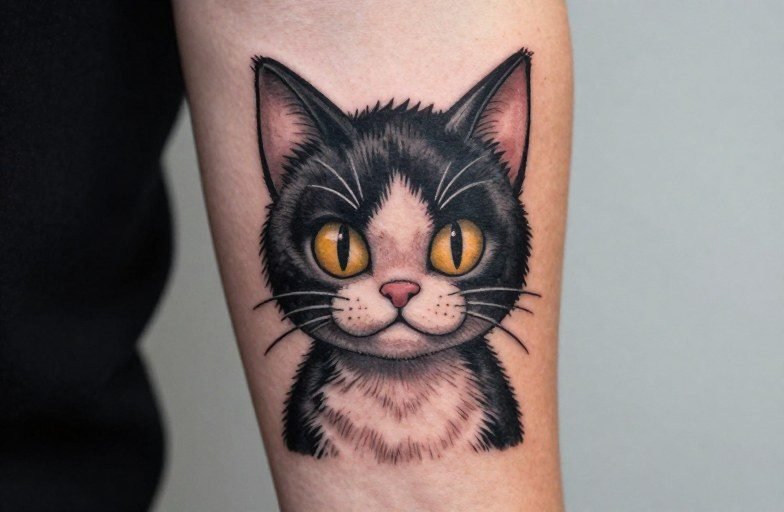
Felix the Cat tattoo meaning centers on a mix of old-school charm, good fortune, and rebellious spirit. Most people choose this design for its connection to early animation history, its association with luck and resourcefulness, or simply a personal link to childhood nostalgia. The black cat silhouette with its wide grin and oversized eyes carries decades of cultural weight that translates naturally to skin.
Who Chooses This Tattoo
Walk into any shop with solid traditional or neo-traditional artists and you’ll spot Felix flash on the wall. The people who actually sit for him tend to fall into a few distinct camps, though plenty blur the lines between them.
Animation and Film Buffs
Serious collectors of animation history gravitate toward Felix because he predates Mickey Mouse by nearly a decade. Pat Sullivan and Otto Messmer’s creation was the first true animated superstar, making this a prestige pick for people who know their Fleischer from their Disney. The design signals genuine knowledge of film history rather than casual pop-culture consumption.
Gamblers and Luck-Seekers
Felix’s “Magic Bag of Tricks” and his general black-cat association make him a natural talisman for poker players, pool sharks, and anyone who courts fortune. The imagery pairs well with cards, dice, and horseshoe motifs without descending into generic “lucky tattoo” territory. There’s specificity here that a four-leaf clover or plain black cat can’t match.
- Traditionalists drawn to 1920s-30s American tattoo iconography
- Cat owners wanting something beyond realistic pet portraits
- People with family connections to the silent film era
- Those who’ve beaten odds, health, financial, personal, and want a symbol of resourcefulness
Similar & Related Symbols
Felix doesn’t exist in isolation. Understanding where he overlaps with and diverges from related imagery helps clarify what you’re actually signing up for.
Black Cats in Tattoo Tradition
Traditional American tattooing has always featured black cats as luck symbols, particularly among sailors. Felix complicates this by adding personality, he’s not just a generic feline silhouette but a specific character with expressive eyes and that distinctive crescent-moon grin. The difference matters: a plain black cat reads as superstition or witchcraft; Felix reads as cleverness and adaptability.
Other Animation Icons
Mickey Mouse, Betty Boop, and Popeye occupy similar territory but carry different baggage. Mickey’s corporate ownership makes him complicated for counterculture types. Betty’s sexualized history appeals to a different aesthetic. Felix’s relative obscurity among general audiences actually works in his favor, he’s a shibboleth, recognizable to those who know without being obvious to those who don’t.
- Sailor Jerry-style panthers: share the black cat lineage but lean aggressive rather than playful
- Cheshire Cat: similar grin, but Alice in Wonderland associations dominate
- Maneki-neko: Asian luck cat, often paired with Felix in cross-cultural designs
- Bag of tricks/magic hat: common accompanying elements that reinforce Felix’s resourceful nature
Personal & Modern Meanings
Contemporary wearers layer their own significance onto Felix beyond the historical associations. The design’s flexibility lets it absorb personal narrative without breaking.
Resilience shows up frequently in consultations. Felix survived studio bankruptcies, character rights disputes, and multiple animation revivals across nearly a century. That staying power resonates with people who’ve endured their own reinventions, career pivots, recovery journeys, relationship rebuilds. The character’s ability to produce exactly the right tool from his magic bag translates metaphorically to making do, finding solutions, landing on your feet.
There’s also a strain of deliberate anachronism. In an era of hyper-polished digital animation, Felix’s rubber-hose limbs and pie-cut eyes represent something handmade, imperfect, enduring. People tired of algorithm-driven culture sometimes choose him as a small declaration of analog values.
Subversive and Punk Associations
Since the 1980s, Felix has appeared in street art, skate graphics, and underground comix. The 1950s TV revival’s surreal, minimalist episodes gained cult status among avant-garde animation fans. This secondary life gives the design edge for people who want vintage without quaintness. A Felix with crossed-out eyes, bandaged tail, or switchblade in paw nods to this tradition without needing explanation.
Best Placements
Where you put Felix changes how he reads. The character’s proportions, large head, small body, expressive face, favor certain locations.
Classic Placements
The upper arm and forearm remain standard for traditional-style Felix. The cylindrical shape suits his vertical posture, and the design scales cleanly from 3 to 6 inches. Thigh pieces work similarly for larger versions, giving the artist room to include the magic bag or surrounding scene elements.
Smaller and More Intimate Locations
Behind the ear, the inner bicep, and the ankle suit minimalist Felix silhouettes, just the head, or the iconic pose with tail curled into a question mark. These read as personal rather than performative. The chest over the heart carries obvious resonance for luck-talisman purposes, though the flat plane demands careful design adjustment to avoid distortion.
- Hand and fingers: possible but challenging; Felix’s fine facial details blur at small sizes
- Back of calf: excellent for full-body poses with action lines
- Ribs: painful, but the vertical space suits standing Felix well
- Neck: bold choice; the face-forward orientation works best here
One practical consideration: black ink dominates Felix designs, and black saturates heavily. On darker skin tones, artists may need to incorporate negative space or gray-wash highlights to maintain definition as the tattoo ages. This isn’t a limitation, it’s a design parameter that skilled artists navigate routinely.
Design Tips & Pairings
The classic Felix is solid black with white eyes, but contemporary interpretations offer range. Knowing your options prevents defaulting to the most common version without considering alternatives.
Style Variations
Traditional American rendering emphasizes bold outlines, limited color palette, and stylized proportions. New-school approaches exaggerate features further, massive paws, swirling tail, graffiti-influenced background elements. Single-needle blackwork can render the 1920s newspaper-comic aesthetic with fine line variation that mimics old print halftones. Each style ages differently; bold traditional holds up longest, fine detail requires more frequent touch-ups.
Common Companion Elements
The magic bag of tricks appears most frequently, often rendered with question marks or starbursts suggesting unknown contents. Moons and stars reinforce the black cat/luck connection. Dice, cards, and poker chips specify the gambling angle. Script banners with dates, names, or short phrases work but require careful font selection, too ornate and they fight the character’s graphic simplicity.
- Color accents: red tongue, yellow eyes, or green bag add pop without abandoning the black-dominant scheme
- Action lines: suggest movement, particularly for forearm placements where the limb’s motion activates the design
- Broken fourth wall: Felix reaching toward the viewer, tail escaping the frame border
- Period backgrounds: art deco patterns, film reels, or theater marquees that anchor the historical context
History & Cultural Roots
Felix emerged in 1919, often linked to Pat Sullivan’s studio though animation historians continue debating Otto Messmer’s actual creative contribution. The character’s immediate popularity spawned merchandise, comics, and eventually the iconic 1920s silent shorts where his tail became a multipurpose tool, question mark, ladder, propeller.
The 1950s television revival, with its stripped-down animation and surreal Trans-Lux episodes, introduced Felix to mid-century audiences and established visual elements still referenced today: the magic bag, the more rounded proportions, the catchphrase “Righty-o!” This version’s simplified forms actually translate better to tattoo than the detailed 1920s original.
Japanese audiences encountered Felix early; his image appeared on kamishibai cards and influenced early anime creators. Osamu Tezuka, often called the “god of manga,” cited Felix as an influence. This cross-cultural circulation means the design carries different resonances in Japanese tattoo contexts, sometimes read as vintage Americana, sometimes as proto-anime history.
Rights disputes throughout the 1960s-70s fragmented Felix’s commercial presence, which ironically preserved his underground credibility. Unlike corporate-managed characters with consistent branding, Felix accumulated contradictory versions that now coexist, silent film star, TV trickster, punk mascot, street art staple.
The Takeaway
Felix the Cat works as tattoo subject matter because he’s accumulated genuine cultural density without becoming overexposed. The meaning you build from him, luck, resilience, nostalgia, subversion, or simple aesthetic preference, rests on a foundation of actual history rather than manufactured significance. Choose him because you respond to something specific: the silhouette, the era, the attitude. Avoid him if you want instant recognition from casual observers; part of his power is that not everyone gets it. Work with an artist who understands traditional American tattoo grammar, specify your style preference clearly, and let the design’s existing visual strength do most of the communicative work.
Frequently Asked Questions
Does a Felix the Cat tattoo have to be all black?
No, though the classic design uses heavy black ink. Many artists add color accents, red tongue, yellow eyes, green magic bag, that maintain readability while personalizing the piece. Discuss options during your consultation.
How well does a Felix tattoo age over time?
Bold black lines hold up best. Fine detail in the face, particularly around the eyes and whiskers, may soften after 5-10 years depending on sun exposure and skin type. Plan for potential touch-ups to maintain crisp expression.
Can Felix be combined with other tattoo styles?
Absolutely. Neo-traditional, Japanese, and even blackwork approaches all accommodate Felix’s graphic shape. The key is maintaining his recognizable proportions, exaggerated head, expressive eyes, so the character remains identifiable regardless of stylistic treatment.
Is Felix considered a lucky tattoo like other black cats?
He carries that association, particularly with his magic bag imagery, but he’s more specific than a generic lucky cat. The luck meaning is layered with creativity, resourcefulness, and historical significance that plain black cat designs don’t automatically convey.
Related Tattoo Meanings
- Female Inuit Tattoo Meaning: Lines of Resilience and Identity
- Fishing Hook Tattoo Meaning: Symbolism, Placements Aging
- Flaming Heart Tattoo Meaning: Passion, Devotion Transformation
- Explore more









