
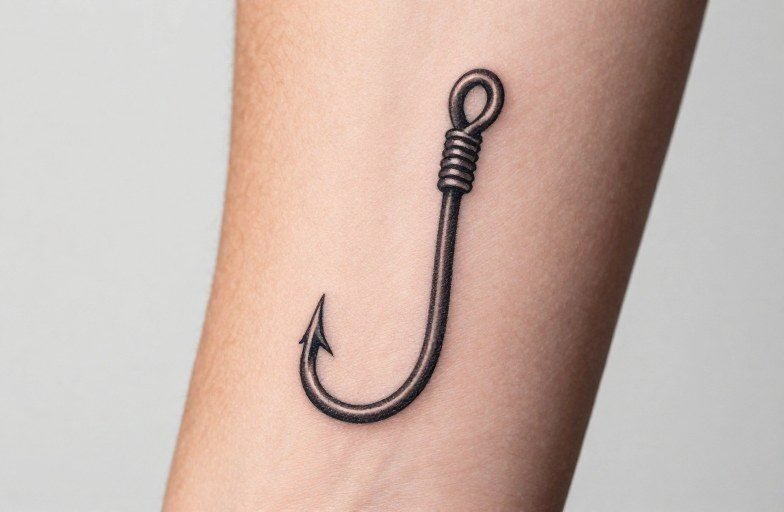
A fishing hook tattoo most commonly signals patience, resilience, and a bond with water or outdoor life. Beyond the obvious angler connection, it functions as a quiet emblem of waiting for the right moment, of holding on through struggle, and of self-reliance. The specific meaning shifts with design choices, a single bare hook reads differently than a hook wrapped in rope or paired with a fish.
Religious & Spiritual Angles
The Ichthys Connection
The fish hook intersects with early Christian symbolism through the ichthys, the Greek fish acronym for “Jesus Christ, God’s Son, Savior.” Some trace the hook specifically to the apostle Peter, a fisherman called from his nets. A hook paired with a fish or subtle cross references this lineage without spelling it out. The design works for believers who want religious ink that stays personal rather than billboard-obvious.
Water as Sacred Element
Across traditions, water carries spiritual weight, baptism, purification, the flow between worlds. A hook, as the tool that pulls sustenance from that element, can represent drawing nourishment from faith or from life’s unseen depths. This angle appeals even to non-religious wearers who connect water with meditation, memory, or family tradition.
Symbolism & Core Meaning
The hook’s physical function shapes its metaphorical weight. It catches, holds, and requires effort to retrieve. That translates to several durable meanings:
- Patience and timing: Fishing demands waiting; the hook marks someone who understands delayed reward
- Struggle and survival: The barb digs in, holds fast, useful imagery for anyone who has fought through hardship
- Connection to place: Coastal upbringing, lake summers, a specific river where someone scattered ashes
- Self-sufficiency: Catching your own food, making your own way
Unlike more aggressive symbols, the hook carries this weight quietly. It doesn’t announce suffering or triumph; it suggests both without demanding interpretation.
Who Chooses This Tattoo
Anglers and Water Workers
Commercial fishermen, charter captains, and serious recreational anglers often get hook tattoos as occupational markers. These designs tend toward realism, specific hook styles (J-hook, circle hook, treble), sometimes with line still attached, occasionally with species names or coordinates. The meaning here is straightforward: this is what I do, where I spend my hours, what I respect.
Memorial and Family Ink
Hook tattoos frequently memorialize fathers, grandfathers, or fishing partners who have died. The design might incorporate handwriting from an old fishing license, a date in the shank’s curve, or a hook rendered in the style of a lure the person actually used. These pieces often land on the forearm or chest, visible for conversation, close to the body for intimacy.
Recovery and survival narratives also surface regularly. The hook’s barb, once set, doesn’t release easily. That physical reality resonates with people who have clawed back from addiction, illness, or loss. The tattoo becomes a private marker of held ground.
How It Ages on Skin
Hook tattoos age predictably based on design choices. A simple outline, single needle or fine line, looks crisp initially but blurs faster than bolder work. The hook’s point and barb, rendered too thin, can soften into indistinct nubs within five to seven years, especially on high-movement areas like wrists or inner biceps.
Shaded or whip-shaded hooks hold definition longer. A solid black silhouette with negative-space highlights maintains readability for decades. Color adds another variable: blue water backgrounds fade unevenly, while traditional red and yellow accents in old-school designs tend to settle more gracefully.
Skin texture matters. Hooks placed over tendons or areas that flex repeatedly distort as the body moves. The shank, meant to be straight, can appear bent or twisted as skin shifts. Experienced artists account for this by slightly exaggerating proportions or placing the design where the body stays relatively stable.
Best Placements
Small and Contained
Behind the ear, along the collarbone, or on the side of a finger work for minimal hooks. These placements suit single-needle or micro designs, often under two inches. The limitation: detail disappears, so the design must read instantly as “hook” without relying on fine barb definition. A curved shank with a simple eyelet suffices.
Medium and Narrative
The forearm outer or inner, calf, and upper arm offer space for context, line coiled around the shank, a fish in motion, water droplets. These placements allow the hook to interact with other elements, building a small scene rather than an isolated symbol. Healing tends to be straightforward; these areas don’t rub constantly against clothing.
The ribcage and sternum accommodate larger hooks but hurt more and heal slower. The skin there stretches and compresses with breathing, so artists often design with that movement in mind, avoiding perfectly straight lines that would appear warped.
Personal & Modern Meanings
Contemporary hook tattoos increasingly detach from literal fishing. The design appears in mental health communities as a symbol of holding on, “hooked” on life, on recovery, on a person who kept you from sinking. Some pair hooks with semicolons or other survival iconography, though purists find this layering cluttered.
Minimalist and abstract interpretations proliferate: a hook reduced to two elegant curves, a geometric version with sharp angles, a hook dissolving into water or transforming into a bird. These designs prioritize aesthetic over narrative, letting viewers project their own meaning.
Couples and close friends occasionally get matching hooks, sometimes interlocking like links in a chain. The symbolism, caught, held, connected, translates cleanly without the sentimentality of puzzle pieces or lock-and-key clichés.
The Bottom Line
A fishing hook tattoo succeeds because its meaning stays flexible without becoming empty. It can mark profession, memory, faith, survival, or simply an aesthetic preference for curved lines and negative space. The key is specificity: a generic hook tattoo reads as generic. One that references a particular hook size, a grandfather’s favorite lure, or a specific body of water carries weight that outlasts trends.
Work with an artist who understands line weight for longevity, placement for your body’s movement patterns, and how much detail will survive at your chosen size. The best hook tattoos look like they’ve always been there, simple, sharp, and impossible to shake loose.
Frequently Asked Questions
Does a fishing hook tattoo always mean someone is religious?
No. While the hook connects to Christian fishing symbolism, most wearers choose it for personal, occupational, or memorial reasons. The religious angle is one option among many.
How big should a hook tattoo be to stay clear over time?
At minimum, two inches for a standalone hook with barb and eyelet visible. Smaller works if you simplify to a silhouette, but fine detail below one inch typically blurs within a few years.
Can a hook tattoo be covered up easily if I change my mind?
Hooks are curved and relatively compact, which helps cover-up artists. However, solid black areas and sharp points limit options. A skilled artist can usually integrate it into a larger design, but complete removal of a dark hook requires significant laser work.
What’s the difference between a circle hook and J-hook in tattoo design?
Circle hooks have a more pronounced curve with the point angled inward, creating a softer, rounder silhouette. J-hooks show a straighter shank with the point angled outward, reading sharper and more aggressive. The choice affects both visual tone and how the design fits your body’s curves.
Related Tattoo Meanings
- Jesus Fish Tattoo Meaning: Faith, History Modern Ink
- Seagull Tattoo Meaning: Freedom, Travel, and Coastal Resilience
- Suicide Awareness Symbol Tattoo Meaning: Semicolon, Butterfly Beyond
- Explore more









