
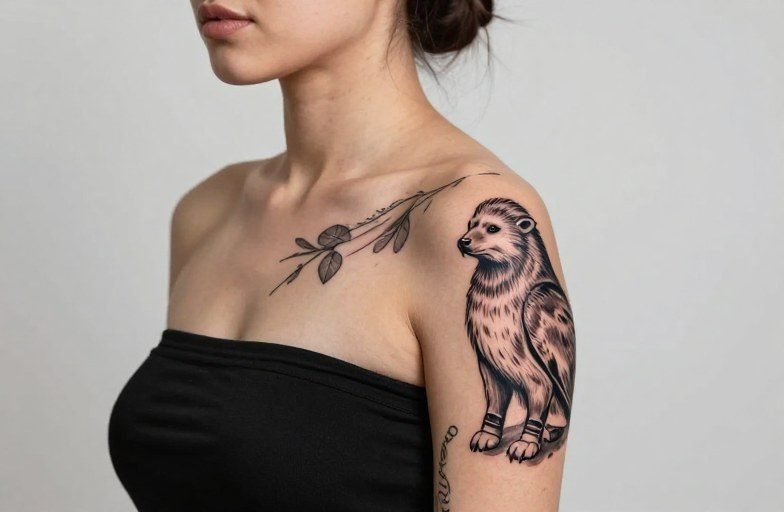
Female Inuit tattoos traditionally signified a woman’s passage through life, her endurance of pain, and her place within her community. The chin stripe, or tavlugun, marked a girl’s transition to womanhood, while hand and arm patterns recorded specific achievements and losses. These markings were never decorative alone; they functioned as visible biography, social record, and spiritual protection woven into the skin.
History & Cultural Roots
Pre-Contact Practice
Archaeological evidence places tattooing among Inuit and related Arctic peoples for at least two thousand years. The practice was widespread across Inuit Nunaat, from Greenland through Canada to Alaska. Women primarily received facial tattoos, though arm and hand markings were also common. The tattooing was typically done by elder women using bone or ivory needles, soot for ink, and a thread soaked in oil or fat to carry pigment under the skin. The process was slow, painful, and deliberate, an intentional part of its significance.
Suppression and Revival
Colonial contact, particularly Christian missionary activity in the nineteenth and early twentieth centuries, actively suppressed tattooing. Many women were shamed into removing or hiding marks that had been worn for generations. The practice nearly disappeared in many regions. Since the 1990s, and accelerating in the 2010s, Inuit women have been reclaiming these tattoos as part of broader cultural revitalization. This is not simple nostalgia; it is a deliberate act of cultural continuity and resistance.
How It Ages on Skin
Facial Placement and Longevity
The chin stripe sits on one of the most stable skin areas on the body. Unlike the neck or hands, the chin experiences minimal stretching with weight change and relatively slow collagen breakdown. A well-executed chin line will hold its density for decades, though the lower face’s constant movement, talking, chewing, does create gradual softening of edges over fifteen to twenty years. Forehead dots, placed between the eyebrows or at the hairline, similarly benefit from stable underlying bone structure.
Hand and Arm Considerations
Traditional hand tattoos present harder aging conditions. The back of the hands sees constant sun exposure, frequent washing, and thin skin with visible tendons underneath. Lines here tend to blur and fade faster than on the face, often requiring refreshment every eight to twelve years. The inner forearm offers better longevity, more protected, thicker dermis, less direct UV, making it a practical choice for those wanting traditional patterns with lower maintenance.
- Chin and forehead: excellent long-term stability, minimal fading
- Hands: high sun exposure, frequent friction, expect faster degradation
- Forearms: moderate conditions, good compromise for visibility and longevity
- Finger lines: among the fastest fading tattoos on the body, plan for regular touch-ups
Common Variations & Styles
Regional Pattern Differences
The specific configuration of lines and dots varied significantly by region and even family. Greenlandic Inuit often featured a single central chin stripe with horizontal extensions. Canadian Inuit, particularly in the eastern Arctic, frequently used multiple parallel chin stripes. Alaskan Inupiat patterns sometimes incorporated more elaborate forehead markings. These variations were not random; they signaled geographic origin and kinship connections to those who knew the code.
Contemporary Adaptation
Modern practitioners work in two modes: careful replication of documented historical patterns from specific regions, and contemporary interpretations that maintain the spirit while adapting technique. Machine tattooing has largely replaced hand-poking for practical reasons, though some revivalists practice skin-stitching or hand-poking specifically to maintain the traditional method’s embodied experience. The aesthetic difference is subtle but real: hand-poked lines have slightly more organic variation in weight and density.
Mythology & Folklore
The Chin Stripe and the Afterlife
Several Inuit oral traditions link facial tattoos to passage into the afterlife. One belief held that a woman without chin markings would be turned away at the entrance to the land of the dead, or that the tattoo functioned as identification for reunion with ancestors. The chin stripe specifically was often linked to the goddess Sedna, who controlled the sea mammals that sustained life. Marking the chin, closest to the mouth that ate and spoke, created a visible contract with this powerful figure.
Protective Function
Beyond social marking, tattoos carried protective intent. Patterns on joints, wrists, elbows, knees, were thought to prevent rheumatism and joint pain in a life of hard physical labor. Lines on the hands could protect against the cold or ensure skill in sewing and hunting preparation. Whether these functions were literally believed or ritually performed is less clear than the social functions; the distinction between practical, spiritual, and symbolic was not drawn as sharply in traditional Inuit thought as in contemporary Western frameworks.
Similar & Related Symbols
Other Indigenous Arctic and Subarctic marking practices share DNA with Inuit tattooing. The Yupik of Alaska and Siberia practiced similar facial tattooing, though with distinct patterns. The Sámi of northern Europe have their own tradition of facial marking, though the historical relationship, if any, remains unclear. More directly, the practice of kakiniit among Inuit also included amulets and clothing marks that carried similar protective and identificatory functions. The tattoo was part of a broader system of embodied symbolism rather than an isolated practice.
Within contemporary tattooing, geometric line work and dot patterns have become broadly popular, but these carry no inherent connection to Inuit tradition. The resemblance is superficial. What distinguishes Inuit tattooing is not the visual language alone but the specific configurations, their placement rules, and their embedded social meaning. A random pattern of chin lines without regional accuracy or cultural understanding is simply geometric decoration.
Personal & Modern Meanings
For Inuit Women
For Inuit women choosing these marks today, the meaning operates on multiple registers simultaneously. It is reclamation of a practice interrupted by colonial violence. It is connection to grandmothers and great-grandmothers whose marks were erased. It is also simply personal choice, the same skin, the same pain, the same permanent commitment that women made for generations before. The meaning is not fixed; it layers historical, familial, and individual significance.
For Non-Inuit Considerations
The question of whether non-Inuit should wear these marks is contested within Inuit communities. Some elders and practitioners actively welcome sincere interest and learning. Others restrict the practice to Inuit women specifically, particularly the chin stripe as a marker of lived Inuit female experience. The forehead and hand patterns sometimes carry more flexibility. The critical factor is relationship: whether the person receiving the mark has done the work of learning, listening, and establishing genuine connection to a community and practitioner, rather than treating the pattern as aesthetic extraction.
- Seek out Inuit tattoo practitioners specifically, not general tattoo shops offering “tribal” designs
- Expect to demonstrate genuine relationship and learning, not just interest
- Be prepared to accept a practitioner’s refusal; this is part of respecting the tradition
- Consider whether your motivation centers the living tradition or your own aesthetic desire
The Takeaway
Female Inuit tattoos carry weight that extends far beyond their visual simplicity. A few lines on the chin or dots on the hand encode survival, cultural continuity, and the specific endurance of Inuit women through colonial disruption and into present reclamation. For those within the tradition, the choice to be marked is increasingly available again after generations of suppression. For those outside, the appropriate response is education and respect for boundaries rather than appropriation. The lines look simple. Their history is not.
Frequently Asked Questions
What does the chin stripe specifically mean in Inuit tattooing?
The chin stripe, or tavlugun, traditionally marked a woman’s transition to womanhood and was often linked to spiritual protection and afterlife passage. Specific configurations varied by region and family, carrying identificatory as well as symbolic meaning.
Is hand-poking or machine tattooing more appropriate for Inuit designs?
Both are used in contemporary practice. Some revivalists specifically choose hand-poking or skin-stitching to maintain the traditional embodied experience, while others use machines for practical precision. The choice depends on the practitioner and the wearer’s priorities.
How painful is getting a traditional Inuit facial tattoo?
Facial skin is sensitive and the traditional areas, chin, forehead, hands, have dense nerve endings. The pain is significant and was historically understood as part of the mark’s meaning, demonstrating endurance and commitment. Modern numbing options exist but are not universally used.
Can men get traditional Inuit tattoos, or were they only for women?
Historically, the specific chin stripe and certain facial patterns were restricted to women. Men in some regions received other marks, often related to hunting achievements. Contemporary practice varies; some patterns remain specifically gendered while others have been adapted.
Related Tattoo Meanings
- Fudog Tattoo Meaning: Guardian Lions, Protection Power
- Gypsy Symbols Tattoo Meaning: Cards, Moons Traveler Lore
- Igy6 Tattoo Meaning: Semicolon, Anchor, and Veteran Solidarity
- Explore more









