A robin tattoo most commonly signals hope, renewal, and the arrival of better times after hardship. Many people choose it as a memorial for someone lost, drawn by the bird’s association with spring’s return and the idea that those gone before us remain close. Beyond the sentimental, the robin’s bold red breast and compact form make for striking, readable tattoo work that ages well across many styles and placements.
Symbolism & History
Seasonal and Emotional Resonance
Robins arrive with thawing ground and lengthening days, so the link to new beginnings feels almost automatic. In European folklore, the bird’s red breast often links to fire, sacrifice, or Christ’s blood, though these connections are commonly associated with medieval legend rather than hard historical record. Some trace the robin’s “friendly” human association to Victorian Britain, where the bird became a Christmas card staple, solidifying its role as a comforting domestic symbol.
American robins carry their own weight: they’re hardy, adaptable, and among the first songbirds to return north. That persistence matters. Someone rebuilding after addiction, divorce, or career collapse often gravitates toward this specific bird rather than a generic “hope” image because it feels grounded in real behavior, surviving winter, finding worms in frozen dirt, singing at dawn regardless.
Memorial and Spiritual Dimensions
The “robin as messenger from the dead” belief circulates widely in English-speaking cultures, particularly in working-class communities in the UK and Ireland. A robin tapping at a window or appearing during grief often gets interpreted as visitation. This isn’t universal folklore, it’s regional, recent, and emotionally driven, but it genuinely shapes why people choose the design. The tattoo becomes a private signal: you’re still here, I’m still listening.
Common Variations & Styles
Realistic and Neo-Traditional Approaches
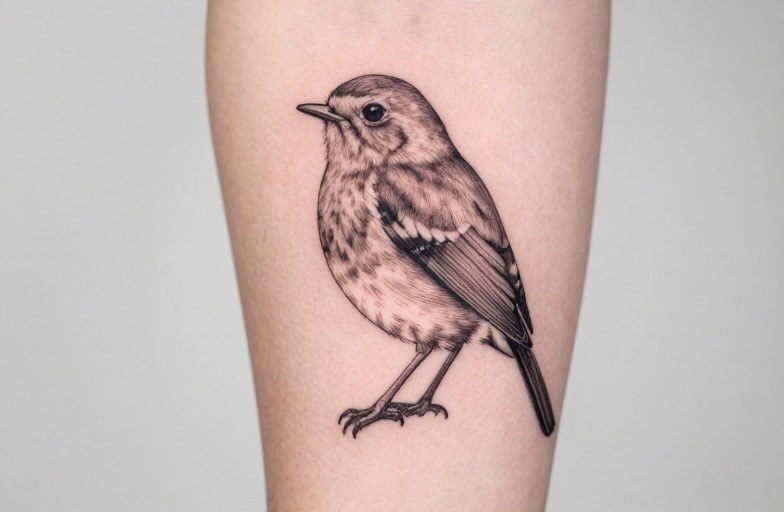
Realistic robins demand attention to the orange-red breast gradient, the gray-brown back plumage, and the dark eye with its subtle pale ring. Done well, this style works beautifully on the upper arm, calf, or ribs where the bird’s natural posture, head cocked, breast puffed, reads clearly at a distance. The downside: color realism fades. That bold breast orange softens toward brown within five to eight years without touch-ups, and fine feather detail blurs into texture.
Neo-traditional robin designs solve the aging problem through bold outlines, limited but saturated color blocks, and simplified forms. The breast becomes a clean red shape; the eye, a stark black dot with white highlight. These hold their readability for decades. Common additions include cherry blossoms, hawthorn branches, or snowdrops, plants that share the spring-return timing.
Minimalist and Silhouette Options
Single-needle or fine-line robins suit wrists, collarbones, and behind-the-ear placements. The challenge is the red breast: without it, the bird becomes generic. Some artists solve this with a small red wash or a single dot of color. Others lean into the silhouette entirely, just the profile, branch included, letting the shape itself carry recognition. These age faster than bold work; expect softening within three to five years on high-movement areas.
- Watercolor background: splashes of blue or green behind a structured robin. The bird stays readable; the background bleeds and fades attractively.
- Geometric framing: the robin inside a circle, triangle, or diamond. Adds structure but can date quickly if the trend shifts.
- Pair or nest: two robins for partnership, a nest with eggs for family or fertility. Increases composition complexity significantly.
Best Placements
The robin’s compact body, roughly five to seven inches in nature, translates well to human scale. A palm-sized design fits most locations without losing detail.
- Forearm: ideal for visibility and moderate pain. The bird’s horizontal posture matches the arm’s natural line. Inner forearm offers more privacy; outer, more display.
- Ribcage: follows the curve of the floating ribs. Pain is significant here, but the placement feels intimate and can be easily concealed. A robin in flight works especially well, the wings spreading across multiple ribs.
- Shoulder/cap: the rounded surface suits a robin perched on a branch, using the muscle’s curve as the perch itself. Good for larger designs with environmental elements.
- Ankle and foot: smaller scale, higher pain, faster fading due to friction and sun exposure. The robin’s recognizable shape helps it remain readable even as detail softens.
- Behind the ear: minimal space, so silhouette or tiny profile only. Often chosen for its secrecy; the wearer knows, others rarely notice.
Color placement matters for longevity. The red breast on a frequently sun-exposed forearm will fade faster than on a ribcage or upper thigh. Black-and-gray robins avoid this entirely but sacrifice the species’ most distinctive feature.
Who Chooses This Tattoo / Personal Meanings
Memorial robins dominate the request list, especially among people in their thirties and forties marking parental loss. The bird’s association with “checking in” from beyond resonates with those who want comfort without overt religious imagery. Often paired with dates, handwriting, or small objects, a teacup, a garden tool, that belonged to the person memorialized.
Recovery and survival narratives show up frequently too. The robin’s literal emergence from frozen ground mirrors the slow, unglamorous work of rebuilding a life. These designs tend simpler: single bird, no extras, sometimes just the profile. The restraint itself communicates the seriousness of the meaning.
Regional pride appears in the American Northeast and Midwest, where the robin is state bird in Connecticut, Michigan, and Wisconsin. These choices lean more aesthetic than symbolic, often incorporating state flowers or local landscapes.
Less commonly, couples choose matching or complementary robins, one with a branch, one without; one in flight, one perched, playing on the species’ monogamous pairing behavior during breeding season. This risks sentimentality if overworked; the best versions keep the birds small and the composition clean.
Similar Symbols
People considering robins often cross-shop related imagery. Understanding the distinctions helps clarify choice.
- Swallows: traditional sailor tattoos, distance traveled, safe return. More masculine-coded historically, more stylized, less color-dependent.
- Bluebirds: happiness, the “bluebird of happiness” trope. Brighter, more overtly cheerful, less associated with grief or endurance.
- Cardinals: American memorial bird, especially for mothers and grandmothers. More vivid red, more geographically specific to the eastern US. The cardinal’s spiritual messenger role overlaps heavily with the robin’s.
- Phoenix: dramatic rebirth, fire, destruction. The robin offers a quieter, more seasonal version of return, no flames, no myth, just persistence.
- Swans: grace, love, transformation. Larger scale, more formal, less suited to small placements or casual styles.
The robin occupies a middle space: common enough to avoid exoticism, specific enough to carry real personal weight, visually distinctive without demanding huge scale or complex color.
Final Thoughts
A robin tattoo works best when the wearer knows exactly which layer of meaning they’re activating, memorial, survival, seasonal joy, or something private and untranslatable. The design’s strength is its flexibility within a clear symbolic range. Choose bold line work for longevity, realistic color for immediate impact, or minimal form for discretion. Place it where the body’s movement complements the bird’s posture: perched on a shoulder, flying along a rib, singing from a wrist. However you wear it, the robin’s real power is its ordinariness. It’s not a rare bird or a mythic creature. It survives, it returns, it keeps going. That groundedness is what makes the tattoo matter.
Frequently Asked Questions
Does a robin tattoo always mean someone died?
Not at all. While memorial meaning is common, many people choose robins for recovery, new beginnings, or simple regional pride. The symbolism is layered, not fixed.
How well does the red breast color hold up over time?
Red and orange inks fade faster than black, especially with sun exposure. On frequently exposed skin like forearms, expect softening within five to eight years. Touch-ups restore vibrancy easily.
What’s the difference between a robin and cardinal tattoo for memorials?
Cardinals are more strongly associated with maternal figures in American tradition and are geographically limited to the eastern US. Robins carry broader spring-return symbolism and are more common in British and Irish memorial contexts.
Can a robin tattoo work in all-black ink?
Yes, though you lose the species’ most recognizable feature. Some artists add a single red dot or small wash to suggest the breast without full color commitment. Silhouette versions rely on shape recognition alone.
Related Tattoo Meanings
- Carpe Diem Tattoo Meaning: Seize the Day Ink
- Bluebird Tattoo Meaning: Hope, Happiness Home
- Machine Tattoo Meaning: Power, Craft Rebellion
- Explore more