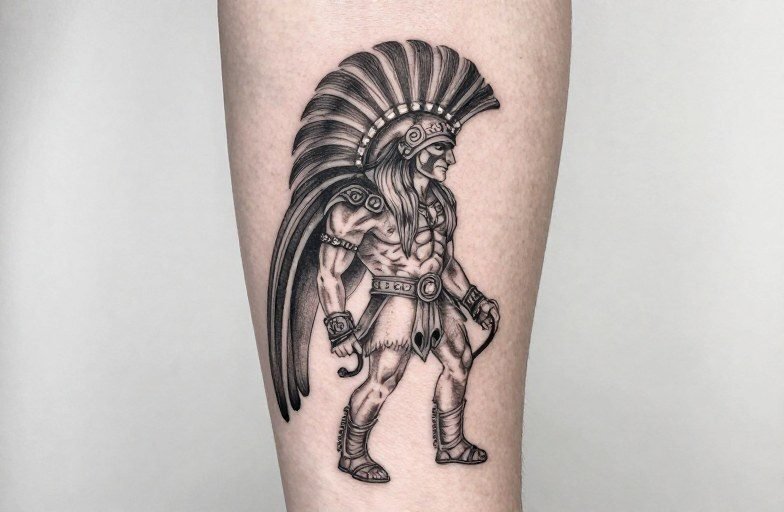
An Ares tattoo carries the weight of unbridled combat, ferocity, and the refusal to back down. Unlike Athena’s strategic warfare, Ares represents the bloody, chaotic reality of battle, making this design a choice for those who identify with raw resilience rather than polished heroism. The symbol works for fighters, survivors, and anyone who respects the darker, more honest side of strength.
Symbolism & History
The Greek God Behind the Ink
Ares occupied a complicated space in the Greek pantheon. The Olympians largely despised him, Homer’s *Iliad* shows Zeus calling him the most hated of gods, yet warriors invoked him before battle anyway. This tension gives Ares tattoos their edge: they embrace being unlikable, difficult, necessary. The god never promised glory. He promised blood, and that unflinching honesty resonates with people who’ve fought through real hardship without romanticizing it.
Common symbolic threads include:
- Untamed aggression, the force that kicks in when survival demands it
- Personal battles, addiction recovery, mental health fights, physical rehabilitation
- Rejection of performative virtue, choosing honest violence over hypocritical peace
- Military service, particularly for veterans who saw combat’s ugly reality
Visual Language Through the Ages
Ancient Greek pottery often depicted Ares in full armor, spear and shield ready, sometimes wounded or retreating. Unlike Athena’s composed helmet, Ares’ imagery allowed for vulnerability, he bleeds, he rages, he loses. This visual tradition gives modern tattoo artists a foundation that goes beyond generic “warrior” tropes. The wounded Ares, particularly from the Ludovisi Ares sculpture, offers a more nuanced take: strength that acknowledges cost.
Common Variations & Styles
Classical and Neoclassical Approaches
Marble-textured Ares portraits translate exceptionally well to black-and-grey realism. The Ludovisi Ares, seated, sword resting, fatigue visible, provides reference material that separates sophisticated work from clip-art warriors. These pieces demand technical skill: the sculptor’s treatment of draped fabric, the weight of muscle under tired skin, the particular hollow of a battle-worn face. Line weight variation becomes crucial; heavy outlines kill the stone-softness that makes these pieces breathe.
Single-needle and fine-line interpretations can work for smaller scales, but the subject’s inherent heaviness often fights against delicate execution. When fine-line succeeds, it’s usually through selective detail, rendering the helmet’s crest with precision while letting the face dissolve into suggestion.
Stylized and Modern Interpretations
- American traditional, bold outlines, limited color palette, dagger-through-heart compositions with Ares’ helmet replacing the heart
- Blackwork / woodcut, angular interpretations of the Corinthian helmet, geometric spear patterns, high contrast without greywash
- Neo-traditional, saturated reds and golds, decorative elements like laurel or blood drops, more emotional expression in the face
- Biomechanical / dark surrealism, Ares fused with machinery, the god as war itself made manifest in pistons and blade
Color choices carry weight. Blood-red dominates for obvious reasons, but oxidized bronze tones reference actual Greek armor and age with interesting dignity, unlike saturated reds that can shift unpredictably toward pink or orange depending on skin undertone and ink quality.
Best Placements
The body’s topography should serve the design’s emotional register. Ares’ full figure needs vertical space; seated or standing compositions work best on thighs, ribs, or full back pieces. The ribcage specifically suits the wounded Ares motif, the body’s vulnerable core protected by violent imagery creates meaningful tension.
For helmet-focused or portrait designs:
- Upper arm / outer bicep, classic warrior placement, visible in sleeveless contexts, accommodates circular compositions well
- Chest, center or offset over the heart; the armor-over-organ symbolism writes itself
- Forearm, daily visibility, but limited space means simplified compositions; best for helmet-only or spear-and-shield emblems
- Calf, substantial flat canvas, less painful than ribs, accommodates vertical compositions with ground lines
Hand and neck placements generally fight against Ares’ classical gravity. The imagery wants mass, historical weight; small scale or socially confrontational placement can tip into edginess without substance. Exceptions exist for committed collectors with established coverage, but as a first or second piece, these locations undermine the symbol’s intended resonance.
Who Chooses This Tattoo / Personal Meanings
The Ares client tends toward specific psychological profiles rather than broad demographic categories. Combat veterans frequently gravitate here over more sanitized military imagery, they’ve seen that Ares’ unpopularity mirrors their own complicated reception. The tattoo acknowledges service without demanding celebration.
Fighters, boxers, MMA practitioners, martial artists, sometimes choose Ares as patron rather than victory symbol. The distinction matters: Athena grants tactical triumph, Ares grants the willingness to absorb damage and continue. This appeals to athletes who’ve built identity around durability rather than dominance.
Survivors of violence, whether domestic, criminal, or systemic, occasionally reclaim Ares as self-protection made visible. The god’s monstrous aspects become feature, not bug, the capacity for proportional ferocity that kept them alive. These pieces often incorporate specific dates, coordinates, or paired imagery that contextualizes the myth without explaining to strangers.
Less commonly, the Ares tattoo functions as shadow integration, the Jungian acceptance of aggression as necessary human capacity rather than moral failing. These collectors often pair with other archetypal figures across their body, building personal pantheons rather than isolated statements.
Similar Symbols
Understanding Ares’ neighboring symbols helps clarify whether this specific god serves your intention, or if another figure carries it better.
- Athena, strategic warfare, wisdom, defensive combat; choose her for justified conflict, Ares for acknowledged brutality
- Tyr (Norse), oath-bound sacrifice, lawful war, lost hand; more morally upright, less chaotic
- Kratos (Greek personification), raw strength without Ares’ specific military domain; broader, less culturally loaded
- Mars (Roman), agricultural protector turned military patron; more respectable, state-sanctioned, less personally transgressive
- Spartan lambda / Molon Labe, historical rather than mythological, more politically freighted in contemporary America
The Ares-specific distinction remains his essential *unpopularity*. Athena tattoos signal respected wisdom; Ares tattoos signal willingness to be feared, to occupy necessary but despised roles. That social positioning matters more than any specific visual element.
Final Thoughts
An Ares tattoo succeeds when it embraces contradiction rather than resolving it. The god was hated yet invoked, wounded yet terrifying, divine yet debased. The best pieces capture this friction, strength that doesn’t pretend to be clean, violence that doesn’t claim to be noble. Technical execution should serve this emotional complexity: avoid the temptation toward heroic idealization that flattens the symbol into generic warrior posturing. The collectors who live with these pieces longest are those who understood from the start that Ares offers no redemption, only honest acknowledgment of what survival sometimes costs.
Frequently Asked Questions
Does an Ares tattoo mean I’m promoting violence?
Not necessarily. Most people choose Ares for personal struggle, resilience, or military experience rather than aggression toward others. The symbol’s power lies in acknowledging conflict’s reality, not glorifying it.
How well does an Ares portrait age compared to simpler warrior tattoos?
Detailed classical portraits require more maintenance. Fine facial features and subtle shading blur faster than bold helmet silhouettes. Plan for touch-ups every 5-8 years, and protect from sun exposure to preserve detail.
Can Ares be combined with other Greek gods in a single piece?
Absolutely, though consider the narrative tension. Ares paired with Aphrodite references their mythological affair; with Athena, you create deliberate opposition between chaos and strategy. These combinations work best with clear compositional separation.
Is the Corinthian helmet enough to represent Ares, or do I need the full figure?
The helmet functions as recognizable shorthand, especially in smaller placements. However, it risks reading as generic Spartan imagery without additional context, spear, shield, or symbolic wounds help specify Ares over broader warrior symbolism.
Related Tattoo Meanings
- Asce Tattoo Meaning: Symbolism, Styles Placement Guide
- Axolotl Tattoo Meaning: Regeneration, Resilience Rarity
- Bamboo Tattoo Meaning: Resilience, Growth Quiet Strength
- Explore more