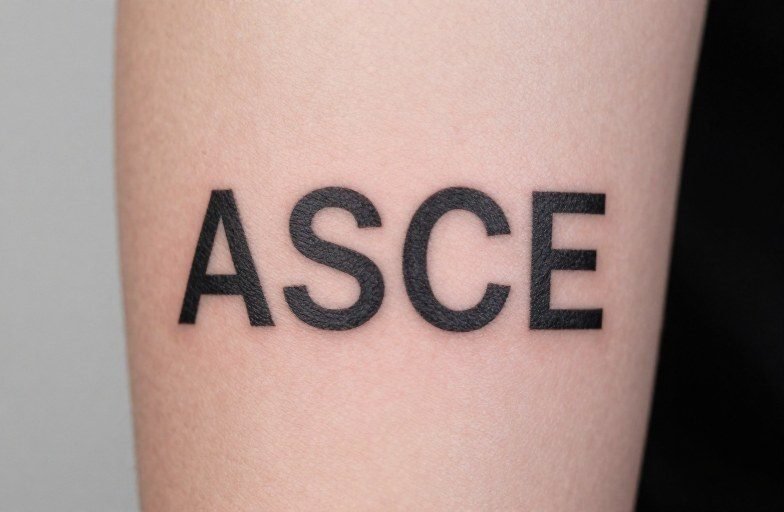
ASCE usually stands for the initials of a name, most commonly, the American Society of Civil Engineers, but in tattoo culture, it’s almost always personal: a partner, child, parent, or even the wearer’s own initials arranged as a monogram. The meaning hinges entirely on whose letters they are and how they’re rendered, making this one of the more intimate, customizable designs in contemporary tattooing.
Symbolism & History
Initial Tattoos as a Broader Tradition
Monograms and letter-based tattoos have been part of Western tattooing since at least the early 1900s, when sailors and soldiers inked sweetheart initials as tokens of connection across distance. The style evolved from simple block letters to elaborate interwoven designs during the 1970s and 80s, as custom lettering became a specialized skill in its own right. Today’s ASCE tattoos draw from that lineage but tend toward cleaner, more graphic treatments, less sailor-script romance, more architectural precision.
What the Specific Letters Convey
When someone chooses ASCE, the symbolism lives in the relationships those letters represent. A parent might tattoo a child’s initials; couples sometimes split the set, each wearing two letters. Some wearers use their own initials as a self-anchoring symbol, a declaration of identity that doesn’t rely on imagery. The acronym format, four capital letters, also carries a formal, almost institutional weight that appeals to people who want permanence without sentimentality.
- Family bonds: Children’s initials arranged in birth order
- Romantic commitment: Partner initials, sometimes with a shared date
- Professional identity: Civil engineers who reclaim the acronym personally
- Self-reference: The wearer’s own initials as a signature mark
Common Variations & Styles
Typography & Letterform Choices
The visual impact of an ASCE tattoo depends heavily on type selection. Serif fonts, think Garamond, Bodoni, or custom-drawn variations, age better than ultra-thin sans-serifs because the thicker stems hold ink density over decades. All-caps treatments read as more monumental; mixing upper and lower case introduces rhythm but requires careful spacing to avoid the letters collapsing into each other as skin shifts.
Interlocking designs, where the crossbar of the E locks into the C or the S curves through the A’s counter, create a single unified symbol rather than four separate characters. This approach works best at medium sizes, too small and the connections blur; too large and the design loses its compact, emblem-like quality.
Added Visual Elements
- Geometric frames: Diamonds, circles, or hexagons containing the letters
- Architectural lines: Blueprint-style borders or dimension marks, often linked to the engineering association
- Floral integration: Vines or stems threading through serif terminals
- Negative space: Letters cut out of a black fill, revealing skin tone
Color remains relatively rare for ASCE pieces. Black and gray predominate because the design relies on legibility and crisp edges. When color does appear, it’s typically a single accent, red for a partner’s initial, blue for a child, sometimes metallic gold in commemorative pieces.
Best Placements
Four capital letters need horizontal real estate. The most successful placements account for both the linear arrangement and how the body area ages.
- Forearm (inner or outer): Flat surface, easy to read, moderate sun exposure. Outer forearm fades faster but offers more visibility; inner stays darker longer.
- Upper chest/pectoral: Centered or offset, often scaled to 4-6 inches. Skin here stays relatively stable compared to stomach or ribs.
- Across the upper back, below neckline: Horizontal span matches shoulder width. Avoids the stretch zone of the lower back.
- Side of the ribcage: Vertical stacking if horizontal won’t fit. Painful, but the privacy appeals to some wearers.
- Along the collarbone: Trendy placement, but thin skin here blurs faster; requires touch-ups within 5-8 years typically.
Small placements, wrists, fingers, behind ears, struggle with ASCE because four letters at tiny scale merge into illegible dark blobs within a few years. If you must go small, consider just two letters or a single stylized monogram combining multiple initials.
Who Chooses This Tattoo / Personal Meanings
Demographics & Motivation
ASCE tattoos attract a specific profile: people who value understatement, who want meaning without broadcasting it to strangers. Parents of young children represent a large segment, particularly fathers who might not otherwise choose floral or figurative family tattoos. Engineers and architects, sometimes literally members of the American Society of Civil Engineers, appreciate the double meaning, the professional reference worn as personal code.
There’s also a subset who choose initials after loss: memorial pieces where the letters represent someone gone, the permanence of ink matching the permanence of grief. These tend toward simpler, more austere designs, no decorative elements, just the letters and perhaps a date.
The Commitment Question
Initial tattoos carry risk that imagery doesn’t. Relationships change. Children grow into adults with complex feelings about being permanently inscribed on a parent’s body. The people who choose ASCE despite this usually have a specific reasoning: they want to mark a moment, not a guarantee. The tattoo documents who mattered at the time of needling, not a contract for the future.
Similar Symbols
If ASCE doesn’t quite fit, several related approaches offer alternatives with different emotional registers.
- Single-letter monograms: More abstract, less tied to specific individuals. A lone A or S can stand for multiple names simultaneously.
- Morse code or binary: The same initials rendered as dots and dashes or 0s and 1s. Hides the meaning in plain sight.
- Coordinates: Latitude and longitude of a meaningful place, birth location, wedding site, home. Shares the personal-code quality without names.
- Signature reproductions: A loved one’s actual handwriting, traced and inked. More visually varied than typed letters but harder to execute well.
- Chemical structure tattoos: For the engineering-minded, molecular diagrams of serotonin, dopamine, or oxytocin offer a different kind of personal symbolism.
ASCE sits in the middle ground between explicit portraiture and pure abstraction. It names without picturing, identifies without explaining. That balance is precisely why it persists.
Final Thoughts
An ASCE tattoo succeeds or fails on execution details that aren’t immediately obvious: letter spacing adjusted for how skin stretches, line weight calibrated for aging, placement chosen with sun exposure and future touch-ups in mind. The meaning is simple, someone’s initials, someone’s importance, but the craft required to make that meaning last is anything but. Work with a letterform specialist, not just a generalist, and plan for a refresh in ten to fifteen years. The best initial tattoos are the ones that stay readable long enough to become part of how you recognize yourself in the mirror.
Frequently Asked Questions
Does ASCE always refer to the engineering society in tattoos?
No. While ASCE is the official acronym for the American Society of Civil Engineers, most people who get this tattoo use it for personal initials, family members, partners, or themselves. The engineering connection is sometimes intentional, but usually secondary.
How small can an ASCE tattoo be before it becomes illegible?
Four capital letters need at least 2-3 inches of width to stay sharp over time. Smaller than that, and the inner spaces of letters like A and E fill in as the ink spreads slightly. Finger or wrist sizes almost always blur within a few years.
What’s the best font style for an ASCE tattoo that will age well?
Medium-weight serif fonts or clean geometric sans-serifs with adequate stroke thickness hold up best. Avoid ultra-thin lines, elaborate scripts, or letters with very fine details that will disappear as skin texture changes.
Is it risky to get initials of a partner or spouse?
Any name or initial tattoo carries relationship risk, but many people choose them anyway as a marker of a specific time and commitment. Some mitigate risk by incorporating the initials into a larger design that can stand alone if context changes.
Related Tattoo Meanings
- Chevron Tattoo Meaning: Symbolism, Styles Placement Guide
- Heraldic Symbols Tattoo Meaning: Lions, Eagles, Coats of Arms
- Hot Air Balloon Tattoo Meaning: Freedom, Adventure Letting Go
- Explore more