
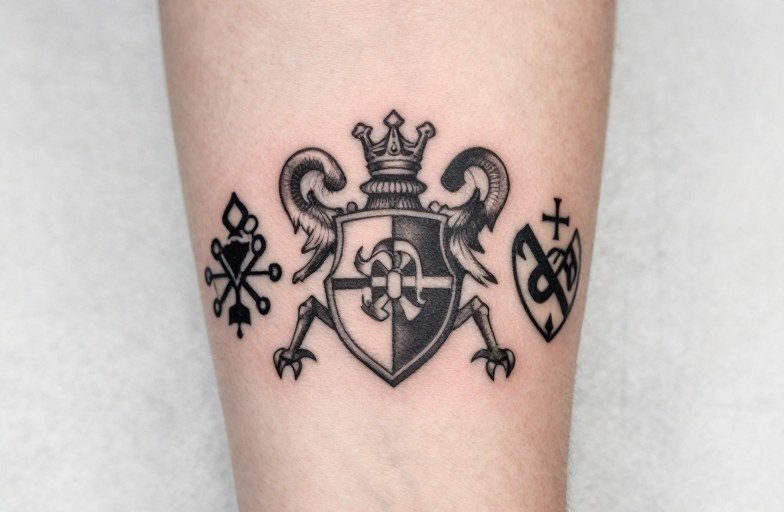
Heraldic symbols in tattooing represent lineage, personal virtue, and protective identity drawn from medieval European tradition. A lion rampant signals courage; an eagle displayed speaks to vision and sovereignty; a full coat of arms claims belonging to something larger than oneself. These designs translate centuries-old visual language onto skin, often stripped of literal family connection and reimagined as personal emblem.
Symbolism & History
European heraldry developed as a battlefield identification system around the 12th century, with knights painting shields and surcoats to distinguish friend from foe. The symbols carried specific virtues: the lion for bravery, the stag for peace and harmony, the boar for ferocity in defense. Over centuries, these images migrated from armor to architecture, documents, and eventually skin.
Tattoo collectors today rarely claim authentic noble descent. Instead, they adopt heraldic grammar for its immediate visual authority. A shield shape frames whatever values the wearer wants to foreground. Supporters, those animal figures flanking a central crest, become personal totems rather than family servants. The helmet and mantling (the decorative cloth) provide opportunities for stylistic flourish without diluting meaning.
Core Symbols and Their Traditional Readings
- Lion rampant (standing on hind legs): Traditionally denotes a warrior, someone who acts rather than waits. In tattooing, it remains the most requested heraldic beast, usually placed where muscle movement animates the pose, thigh, calf, upper arm.
- Eagle displayed (wings spread, facing forward): Associated with imperial power and spiritual ascent. Works powerfully across the chest or as a back piece where wingspan can fully open.
- Stag passant (walking): Less aggressive than the lion, often chosen by those emphasizing wisdom or peaceful strength over domination.
- Shield shapes: The heater shield (pointed bottom) reads more martial; the cartouche (oval) softer, more decorative. Choice of shield shapes the entire tone.
- Crowns and coronets: Not necessarily claims of royalty. In tattoo contexts, they often mark personal achievement or self-mastery.
Charges and Their Subtle Variations
Charges, the smaller symbols placed on shields, carry layered meaning. A sword indicates justice; an anchor, hope or naval connection; a fleur-de-lis, often linked to French heritage or feminine energy. Color matters too: gold (or yellow) for generosity, silver (white) for peace, red for warrior spirit, black for constancy. Most tattoo artists translate these into black-and-grey or limited color palettes, since full heraldic color rules (tinctures) rarely suit modern skin tones or aesthetic preferences.
Common Variations & Styles
Heraldic tattoos split into two broad approaches: historical reproduction and symbolic recombination. The first attempts accuracy, researching actual family arms, respecting heraldic conventions, sometimes consulting heraldic societies. The second treats the visual vocabulary as raw material, mixing beasts, charges, and mottoes without concern for historical validity.
Stylistic Approaches
- Traditional/American: Bold outlines, limited shading, saturated color. Lions become more graphic, less anatomically precise. Eagles reference Sailor Jerry’s patriotic iconography. Heals hard and ages well due to thick lines.
- Black-and-grey realism: Fur texture, metal reflections on armor, dimensional shading. Requires larger scale to resolve detail; small realistic heraldry muddies within years. Best at palm-sized minimum.
- Neo-traditional: Expanded color palettes, decorative backgrounds, stylized anatomy. Allows for jeweled tones in crowns, ornamental flourishes in mantling.
- Woodcut/etching style: Crosshatching and line weight variation mimic old engravings. Excellent for armorial bearings in books. Ages better than fine realism because line-based structure holds.
- Minimalist/line: Stripped to essential silhouette. Risky for complex heraldry, too much detail loss, but effective for single beasts or simple shield outlines.
Lettering integration demands particular care. Mottoes in Latin, Old French, or English require space to breathe. Script too small, or too ornamental, blurs within a decade. Most artists recommend separating text from image if the motto exceeds a few words, or placing it on a banner with sufficient negative space around each letter.
Best Placements
Heraldic designs favor flat or gently curved surfaces where the shield or central figure reads frontally. The upper arm (outer bicep, deltoid) remains classic, visible, muscular, historically where armor bore markings. Thighs offer large, stable canvas for full achievements with supporters and mantling. Chest pieces work when the design centers and the pectorals provide natural framing.
Forearms and calves suit single beasts or simplified shields. The natural taper of these limbs means centered compositions read best; off-center heraldry feels unbalanced. Hands, feet, and necks generally fail for detailed heraldic work, the scale collapses detail, and these areas experience disproportionate fading and blowout.
Back pieces accommodate the most elaborate compositions: full heraldic achievements with helm, crest, mantling, supporters, and compartment (the base). A back eagle with displayed wings can span shoulder to shoulder. This placement also hides or reveals easily, which matters for those whose professional environments restrict visible tattooing.
Who Chooses This Tattoo / Personal Meanings
Collectors drawn to heraldic symbols typically share certain traits: attraction to structure, comfort with symbolic language, often some connection to history or genealogy (though not always verified). Military personnel frequently adapt regimental insignia into heraldic formats. Firefighters and police sometimes use badge-shield compositions that borrow heraldic grammar without formal arms.
Women collecting heraldic tattoos have increased notably, challenging the form’s masculine historical association. Female collectors often emphasize different beasts, swans, falcons, or reinterpreted lions, and frequently integrate botanical elements into mantling or compartment areas. The shield itself becomes less central; the symbolic ecosystem matters more.
Some choose heraldry to mark recovery or transformation, a new “house” founded after divorce, addiction, or family rupture. The formality of heraldic language suits these moments: public declaration of private rebuilding. Others simply respond to the aesthetic weight, the sense that these images have already lasted centuries and will continue to signify.
Similar Symbols
Japanese kamon (family crests) offer parallel territory, stylized natural forms in circular or shield-like enclosures, carrying lineage meaning. The chrysanthemum kamon and the European fleur-de-lis share decorative DNA. Collectors sometimes fuse traditions, though this requires sensitive handling to avoid appropriation or visual incoherence.
Masonic and fraternal insignia borrow heavily from heraldic structure: shields, supporters, mottoes, symbolic beasts. The difference lies in organizational specificity versus personal or familial claim. Military unit crests function similarly, with institutional rather than individual identity.
Coat of arms tattoos sometimes blur into general medieval imagery, crossed swords, castles, crowns without formal heraldic structure. These share aesthetic territory but lack the systematic symbolic language. Tribal tattooing from various cultures also uses animal totems in structured compositions, though the visual grammar differs entirely.
Contemporary “family crest” tattoos found online often reproduce mass-market illustrations with no heraldic validity. The symbols may look correct but combine elements violating heraldic rules (metal on metal, color on color) or invent arms entirely. For some collectors, this matters not at all, the image serves personal meaning regardless of historical accuracy. For others, particularly from cultures with living heraldic traditions (UK, Ireland, parts of Continental Europe), accuracy carries cultural weight.
Final Thoughts
Heraldic tattooing offers something rare: a visual tradition with centuries of accumulated meaning, yet flexible enough for personal reinterpretation. The best pieces respect the form’s structural logic, clear silhouettes, readable at distance, symbolic coherence, while serving individual intention. Poor heraldic tattoos suffer from overcrowding, illegible detail, or symbolic confusion where too many charges compete for attention.
Healing and aging deserve practical consideration. Fine line work in mantling or fur texture spreads and softens over years. Bold traditional work holds longer but sacrifices nuance. Color in heraldic tattoos, especially gold and silver approximations, fades toward yellow and grey regardless of initial vibrancy. Planning for this aging, choosing scale and placement that accommodates future softening, separates enduring heraldic tattoos from those that looked sharp for only a season.
The form persists because it answers a persistent human need: to mark belonging, to claim virtue, to wear identity visibly. Heraldic grammar, developed for medieval warfare, translates surprisingly well to contemporary skin.
Frequently Asked Questions
Can I legally tattoo my family’s actual coat of arms?
In most countries, yes, tattooing existing arms on your own body isn’t legally restricted. However, falsely claiming heraldic authority in jurisdictions with active heraldic authorities (like the UK) can carry social or in some contexts legal consequences. Most tattoo artists won’t verify heraldic legitimacy; that’s your research to do.
Why do heraldic tattoos often look blurry after a few years?
Fine detail in mantling, small lettering, and intricate fur texture naturally spreads as skin ages. Bold outlines and larger scale preserve readability. If you want fine realism, commit to significant size and expect touch-ups.
What’s the difference between a family crest and a coat of arms?
Technically, the ‘crest’ is only the element above the helmet (often a beast or symbol on a wreath). The full ‘coat of arms’ includes the shield, supporters, motto, and other elements. Many people say ‘crest’ to mean the whole thing, but heraldic purists distinguish carefully.
Can I create my own heraldic symbols without historical connection?
Absolutely, personal heraldry is well-established practice. Many countries have heraldic societies that can guide formal assumption of arms, or you can simply work with a tattoo artist to develop symbolic imagery using heraldic visual grammar without official registration.
Related Tattoo Meanings
- Ilia Topuria Back Tattoo Meaning: Symbolism Style Guide
- Iris Tattoo Meaning: Symbolism, Styles Placement Guide
- Shooting Star Tattoo Meaning: Wishes, Change Fleeting Beauty
- Explore more









