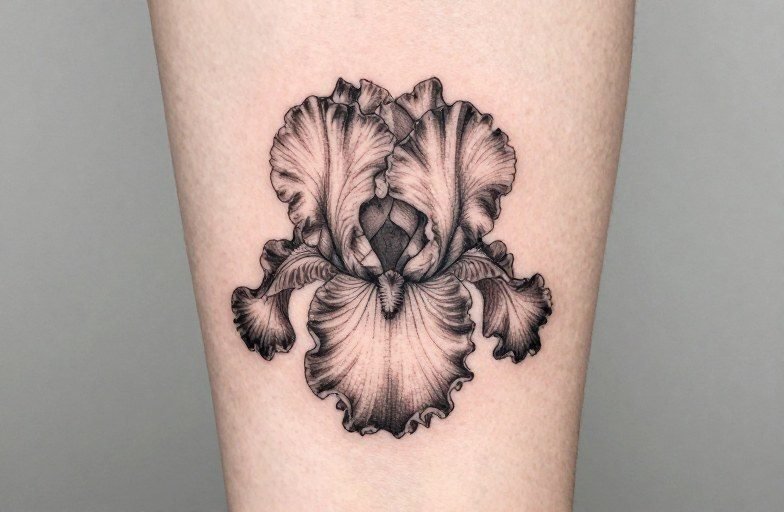
An iris tattoo most commonly represents wisdom, hope, and cherished friendship. The flower’s three upright petals and three drooping sepals have carried symbolic weight across centuries, from ancient Greek associations with the messenger goddess to modern expressions of personal transformation. What makes this design endure is its visual flexibility, it reads as delicate or bold, realistic or stylized, depending on how you approach it.
Symbolism & History
The iris’s layered meanings stack up differently depending on which tradition you trace.
Mythological Roots
In Greek tradition, the flower is often linked to Iris, the goddess who bridged heaven and earth via rainbow pathways. That connection to communication and transition still resonates, people choose the iris to mark crossroads, new chapters, or messages they couldn’t send otherwise. The purple variety specifically carried associations with royalty and power in European courts, while blue irises became tied to faith and hope in Victorian flower language.
Regional Variations
The fleur-de-lis, a stylized iris, sits at the center of French heraldry and appears across Quebec, Louisiana, and Catholic iconography. Some trace it to the baptismal lily of Clovis; others see it as a simplified iris bloom. Either way, that three-petal structure carries connotations of sovereignty, purity, and regional identity. A fleur-de-lis tattoo reads differently in New Orleans than in Paris, context shapes meaning more than the image itself.
Common Variations & Styles
The iris adapts to almost any tattoo approach, but certain styles handle its architecture better than others.
- Botanical realism: Captures the velvety texture of falls and standards, the fuzzy beard, the way light catches curved petals. Works best at palm-size or larger; tiny realism muddies into gray blobs as ink settles.
- Japanese irezumi: The iris appears in traditional scrollwork, often paired with water or koi. Bold outlines, flat color fields, and asymmetrical composition suit the flower’s natural lean.
- Blackwork/linework: Strips the iris to its essential geometry, three up, three down, central signal. Ages cleanly, especially on areas that see sun or friction.
- Watercolor: The iris’s color gradients tempt this approach, but be cautious. Watercolor tattoos without anchored line work tend to blur and require aggressive touch-ups within five years.
- Fleur-de-lis: The heraldic reduction. Reads immediately, works small, carries civic or ancestral weight depending on placement and context.
Color choice shifts meaning subtly. Purple maintains the royal/mystical association. Yellow irises symbolize passion in some flower dictionaries, though this is less commonly known. White suggests purity or memorial. Black and gray abandons the color-coded language entirely, letting form and placement carry the weight.
Best Placements
The iris’s vertical orientation and moderate complexity make it forgiving across body locations, but certain spots leverage its strengths.
Vertical Spaces
Forearms, ribs, and the side of the calf suit the iris’s natural growth direction. A single stem with two or three blooms reads as a column, drawing the eye upward. Rib placement allows for larger scale and softer detail work, skin there holds fine lines better than, say, the top of the foot.
Compact Areas
Behind the ear, the wrist bone, or the ankle bone work for simplified fleur-de-lis or single-bloom designs. The iris’s silhouette is distinctive enough to read even at two inches. Finger placement is possible but expect significant fading; the flower’s thin lines don’t survive the constant abrasion well.
Flow and Composition
As part of a larger garden piece, irises provide vertical punctuation among rounder roses or peonies. Their sword-like leaves add structural contrast. In sleeve work, they transition well between floral clusters and empty skin, preventing the dense-packed look that ages poorly.
Who Chooses This Tattoo / Personal Meanings
There’s no single demographic for iris tattoos, but patterns emerge in what people reference.
- February birthdays: The iris is the birth flower, alongside violet. This accounts for a steady stream of requests, often first tattoos.
- Connections to France or French Canada: The fleur-de-lis functions as regional pride, sometimes paired with dates or coordinates.
- Transitional periods: The rainbow-bridge mythology resonates with people leaving relationships, careers, or locations.
- Memorial work: Less common than lilies or roses, but chosen specifically when the deceased loved the flower or its associated qualities.
- Visual preference: Some people simply respond to the shape, architectural, asymmetrical, neither aggressively feminine nor masculine in default form.
The personal meaning typically attaches to one of these threads rather than inventing something entirely disconnected. That’s healthy. A symbol with existing resonance carries more weight over decades than something fabricated for uniqueness.
Similar Symbols
People considering irises often cross-shop related imagery. Understanding the distinctions helps clarify choice.
- Lily: Similar structure, stronger Christian and funeral associations. The lily tends toward symmetry; the iris embraces asymmetry.
- Orchid: More exotic, more sexual or luxurious in connotation. Harder to render simply without losing recognizability.
- Lotus: Eastern spiritual weight, rising-from-mud narrative. More universal but less personally specific.
- Rose: Overdetermined meaning, love, pain, beauty, politics. The iris offers more open interpretation.
- Fleur-de-lis alone: Strips the botanical specificity for heraldic or regional signaling. Less personal, more public.
If you’re drawn to the iris but want something less common, consider the bearded iris specifically, the fuzzy strip on the fall petals adds textural interest and distinguishes it from generic floral tattoos. Japanese varieties with their flatter, more graphic profile also separate from the standard garden iris look.
Final Thoughts
An iris tattoo succeeds when its specific qualities, vertical growth, asymmetrical bloom, layered historical resonance, are used rather than ignored. The worst iris tattoos treat it as generic flower filler, indistinguishable from any other petal cluster. The best leverage its architecture: the confident stance of standards and falls, the color range that shifts meaning, the quiet association with messages passed between worlds.
Healing follows standard floral tattoo care. The fine lines in realistic petal work need protection from sun and friction during the first month. Blackwork versions are more forgiving. After five years, expect some softening in color gradients; the structural lines of a well-designed iris should hold their shape regardless. Choose an artist who shows you healed photos, not just fresh work, irises reveal their true quality only after the skin settles.
Frequently Asked Questions
Does the color of my iris tattoo change its meaning?
Traditional flower language assigns purple to royalty and wisdom, yellow to passion, and blue to faith. Most people today choose based on personal preference rather than strict dictionary codes, but color still signals intent to viewers familiar with the symbolism.
How well does an iris tattoo age on the hand or finger?
Poorly. The fine lines and delicate petal edges that define an iris blur quickly on high-abrasion areas. If you want visible hand ink, consider the simplified fleur-de-lis with bold lines, or plan for regular touch-ups every few years.
What’s the difference between a fleur-de-lis and an iris tattoo?
The fleur-de-lis is a stylized, symmetrical heraldic design derived from the iris. It carries civic, regional, and institutional associations. An iris tattoo depicts the actual flower, with natural asymmetry and botanical detail, leaving more room for personal interpretation.
Can an iris work in a cover-up tattoo?
The dense central structure and dark bearded varieties can hide older ink underneath, but the outer petals need clean skin to read as translucent. Your artist must design specifically for the existing tattoo’s shape and darkness, don’t force a standard iris stencil over unrelated cover-up work.
Related Tattoo Meanings
- Robin Tattoo Meaning: Hope, Renewal Personal Memory
- Triskele Tattoo Meaning: Triple Spiral Symbolism History
- Flail Tattoo Meaning: Power, Justice Ancient Authority
- Explore more