
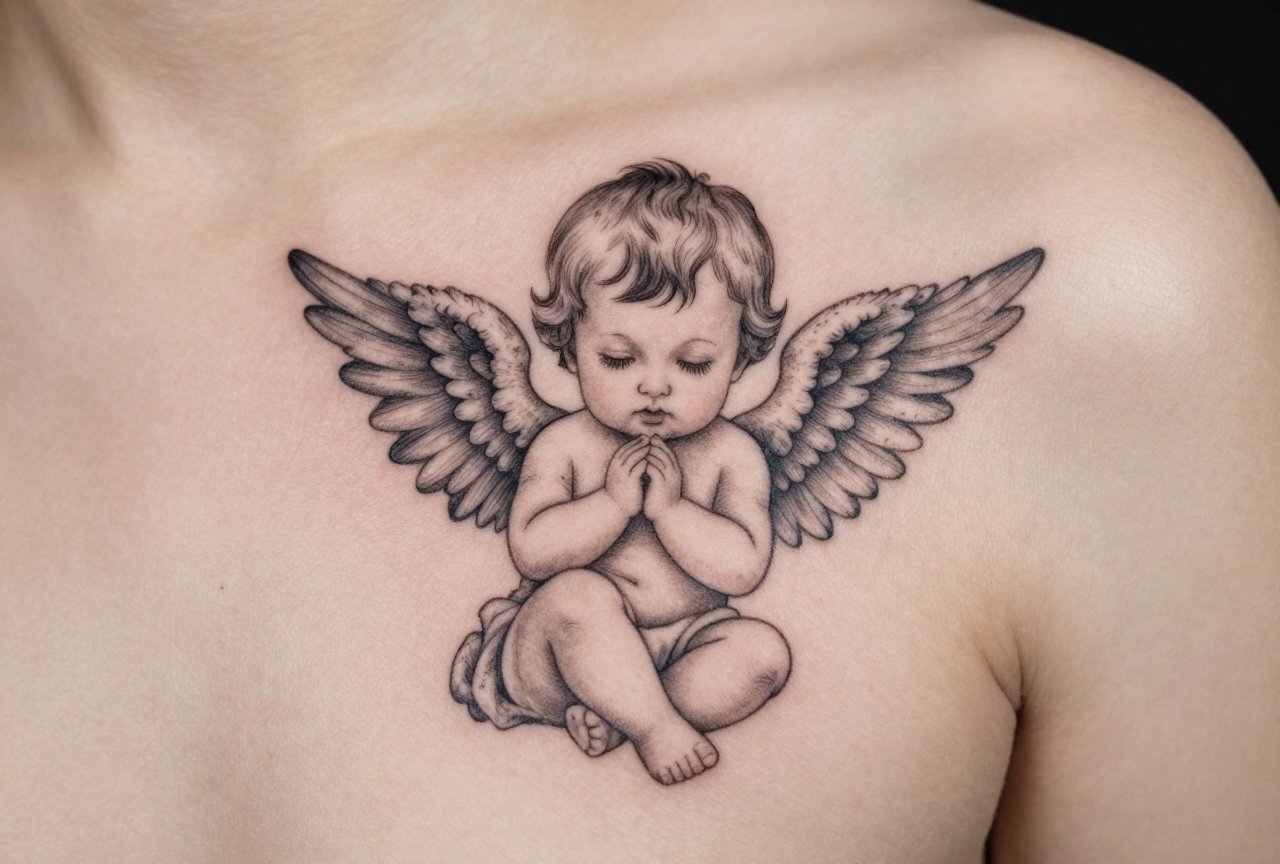
A baby angel tattoo almost always means one of three things: the loss of a child or pregnancy, a guardian watching over someone living, or the wearer’s own lost innocence. I’ve done dozens of these over fifteen years, and I can usually tell which story it is before they finish explaining. The image is simple, soft wings, round face, sometimes sleeping, but the weight behind it is never light.
Symbolism & History
Putti, those chubby winged babies from Renaissance art, got their start as symbols of Cupid and pagan spirits. The church eventually co-opted them into cherubim, though real biblical cherubs are bizarre multi-eyed creatures, not diapered toddlers. What we tattoo today is mostly Victorian sentimentalism filtered through Hallmark, but that doesn’t diminish what people feel when they ask for one.
In my chair, the meaning splits cleanly down the middle. Half are memorials. Half are protection talismans for living children or the wearer themselves. The visual language is nearly identical, so I always ask gentle questions before I start drawing. You don’t want to assume someone’s grieving parent when they’re actually celebrating a new baby.
Religious vs. Secular Meanings
Religious clients want halos, clouds, maybe a scroll with a name or date. They’ll reference a specific guardian angel tradition, sometimes a named saint. Secular versions drop the halo, add more realistic baby features, incorporate personal objects, favorite toys, footprints, ultrasound hearts. I’ve tattooed a baby angel holding a tiny pair of knitted booties that the client’s grandmother made. The wings were almost an afterthought to the real subject.
The Grief Connection
This is the heaviest reason people sit for this tattoo. Miscarriage, stillbirth, SIDS, childhood illness. I’ve had clients shake so hard I had to stop the machine. Others are eerily calm, like they’ve already cried everything out and this is just the final step. The baby angel becomes a permanent acknowledgment of someone who existed briefly or not at all in the visible world. I always schedule these appointments with extra time. Rushing a memorial piece is bad karma and bad business.
Common Variations & Styles
Style choices dramatically change how the tattoo reads and how it ages. Here’s what actually works long-term versus what looks good on Instagram for three months.
- Black and grey realism: Most popular for memorials. Soft shading mimics old memorial portraits. Holds up well if you keep contrast strong, I’ve seen ten-year-old pieces that still read clearly because the artist didn’t go too light in the wings.
- Traditional/Americana: Bold lines, limited color, graphic wings. Good for smaller sizes, ages the best of any style. The face stays readable even when details blur slightly.
- Fine line/single needle: Trendy, delicate, looks incredible fresh. I warn clients: those wispy wing lines and subtle eyelashes will disappear into a grey smudge in five to eight years. I still do them, but I make sure people understand the trade-off.
- Neo-traditional: Best of both worlds, bold enough to last, stylized enough to feel personal. I push clients toward this if they want color but need longevity.
- Silhouette or shadow: Just the outline of wings cradling a shape, or a sleeping form. Abstract, less literally baby-faced. Good for people who want the meaning without the explicit image.
Added Elements & Composition
Clients bring me reference photos of clouds, rays of light, doves, names in script, dates in Roman numerals, roses, lilies, stars. The most successful compositions integrate these elements rather than stacking them. A baby angel floating in a void with fifteen separate symbols around it looks like a scrapbook page, not a tattoo. I usually suggest one or two supporting elements maximum, worked into the negative space around the figure.
Best Placements
Placement follows the story. Memorial pieces for children tend toward the heart, left chest, over the actual heart, ribs on that side. I’ve done them on forearms where the parent can see it while holding a living child’s hand. That’s a specific kind of bittersweet that hits different.
- Upper arm/shoulder: Classic, easy to show or hide, enough real estate for detail without going huge. Most of my baby angel work lands here.
- Ribs: Painful, private, intimate. The people who choose ribs usually aren’t showing this piece to strangers. It hurts more than most spots, and I respect that choice.
- Back, between shoulder blades: Like wings on wings. Visually logical, but the skin there moves and stretches unpredictably. I’ve seen these distort with weight change more than other placements.
- Wrist or inner forearm: Small, visible, constant reminder. Fine line works here because the size demands it, but expect touch-ups.
- Ankle or foot: Less common for this subject, but I’ve done them, usually for younger clients who want something they can conceal professionally.
Skin quality matters for baby faces. Younger skin with more collagen holds fine detail better. Older skin, sun-damaged skin, skin that’s been through significant weight fluctuation, all of it will blur those delicate features faster. I adjust my approach accordingly, sometimes suggesting slightly bolder lines or more contrast than the reference photo shows.
Who Chooses This Tattoo / Personal Meanings
After all these years, I can sketch a rough demographic, but the truth is I’ve tattooed baby angels on bikers, teenage girls, grandmothers, soldiers, priests, people who’ve never set foot in a church. The unifying thread is transformation through loss or love, not any particular background.
Parents & Bereaved Families
This is the largest group by far. Mothers who lost pregnancies at eight weeks or eight months. Fathers who never got to hold their child. Siblings tattooing matching pieces for a brother or sister who died young. The baby angel becomes a way to say “this person was real, this grief is real” without carrying paperwork or explaining at parties. I’ve had clients tell me it’s the first time they felt seen in their loss.
Survivors & Protective Symbols
Some people come in after surviving something, abuse, addiction, violence, and want the baby angel as their own preserved innocence, or as a guardian for the vulnerable part they protected. Others get them for living children, a permanent prayer for safety. The visual is identical but the emotional direction reverses: looking forward instead of backward.
Similar Symbols
Clients sometimes waver between a baby angel and related imagery. I help them sort through the distinctions.
- Adult angel or archangel: More power, less vulnerability. Michael with a sword is protection; a baby angel is grief or gentleness. Different energy entirely.
- Infant Jesus or Madonna and child: Explicitly religious, specific narrative. Baby angel keeps it more universal or personal.
- Butterfly with a name: Common memorial alternative, especially for pregnancy loss. Lighter, more hopeful, less explicitly spiritual. Some clients choose both eventually.
- Paw prints with wings: The pet memorial equivalent. Same visual language, different subject. I’ve had clients get baby angels for children and winged paws for pets in the same session.
- Simple name and dates: Direct, no symbolism. Some people need the image; others find it too sentimental. There’s no wrong choice, only honest ones.
Final Thoughts
I’ve watched baby angel tattoos fade, blur, get covered up, get expanded into larger pieces, get touched up after ten years when the client finally feels ready to sit with the memory again. They’re rarely anyone’s only tattoo, but they’re often the most emotionally loaded one. The meaning isn’t in the wings or the chubby cheeks, it’s in the decision to make something permanent out of love or pain that already feels permanent.
If you’re considering this piece, spend time with the why before the what. Bring reference, but don’t get too attached to a specific image. A good artist will adapt it to your skin, your story, your body’s movement. And if you cry in the chair, that’s fine. We see this a lot. The machine keeps buzzing, and we keep going, and when it’s done you have something that stays when everything else changes.
Frequently Asked Questions
Do baby angel tattoos always mean someone died?
Not always, though that’s the most common reason. Some people get them as protection for living children, or to represent their own lost innocence. I always ask, because the meaning shapes how I design the piece.
How big should a baby angel tattoo be to keep the details?
For readable facial features that last, I recommend at least palm-sized. Going smaller forces either bolder, less realistic lines or fine detail that will blur within a few years. Your artist can advise based on your specific skin.
Is it weird to get a baby angel tattoo if I’m not religious?
Not at all. Most of my clients with this piece aren’t religious in any formal sense. The image has become cultural shorthand for innocence, protection, and grief that transcends specific belief systems.
How do I find an artist who won’t mess up something this meaningful?
Look for portfolios with strong portrait or figurative work, not just flash art. Schedule a consultation, not a walk-in. A good artist will ask about the story, suggest adaptations, and never rush you through the decision. Trust your gut on whether they feel respectful.
Related Tattoo Meanings
- Teddy Bear Tattoo Meaning: Comfort, Memory, and Childhood Inked
- Cherubim Tattoo Meaning: Angels, Symbolism Style
- Scorpio Tattoo Meaning: Power, Mystery Transformation
- Explore more









