Ocean themed tattoos can stay clean for years if you give the design enough skin and contrast. I almost made my first wave too tiny, then bumped it up before the stencil went on. Good call. These are ocean tattoos that breathe, heal nice, and still read from across the room.
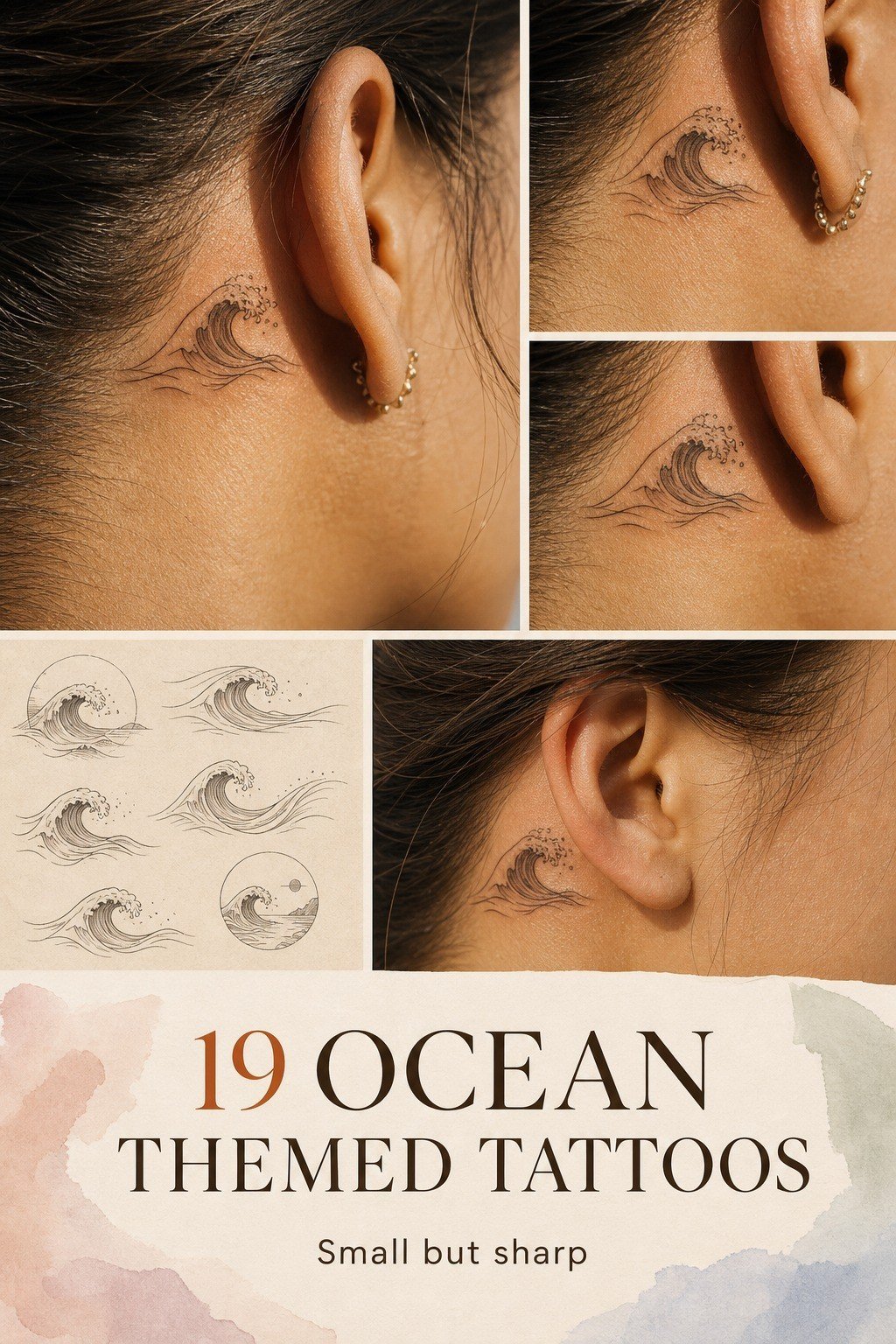
- Keep a Minimalist Wave Linework Tattoo Behind the Ear
- Let a Watercolor Ocean Horizon Tattoo Stay Anchored
- Give the Sea Turtle Fine Line Tattoo a Bigger Shell
- Use Rib Flow for a Whale Tail Tattoo
- Choose Japanese Koi Fish Sleeve Tattoo Flow Over Random Flash
- Push Contrast in a Blackwork Shark Silhouette Tattoo
- Skip Tiny Details in a Seashell Ankle Tattoo
- Build a Tiny Lighthouse Forearm Tattoo With Negative Space
- Keep a Minimalist Wave Linework Tattoo Behind the Ear
- Let a Watercolor Ocean Horizon Tattoo Stay Anchored
- Give the Sea Turtle Fine Line Tattoo a Bigger Shell
- Use Rib Flow for a Whale Tail Tattoo
- Choose Japanese Koi Fish Sleeve Tattoo Flow Over Random Flash
- Push Contrast in a Blackwork Shark Silhouette Tattoo
- Skip Tiny Details in a Seashell Ankle Tattoo
- Build a Tiny Lighthouse Forearm Tattoo With Negative Space
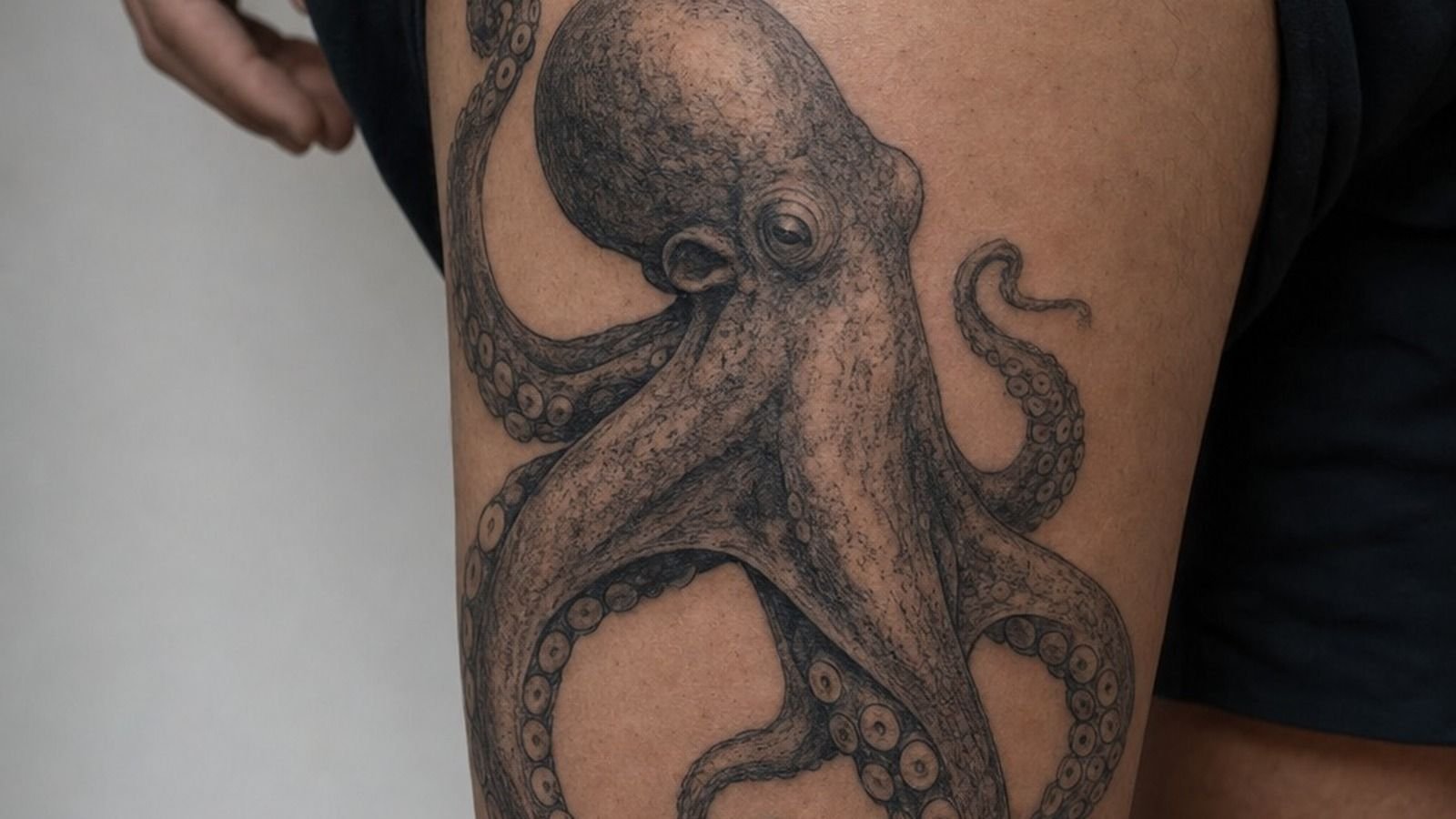
- Let Realistic Octopus Thigh Tattoo Tentacles Breathe
- Make Ocean Coordinates Wrist Tattoo Numbers Legible
- Frame an Underwater Coral Reef Tattoo Along the Collarbone
- Use the Moon-Tide Method for a Moonlit Sea Back Tattoo
- Match Dolphin Wave Tattoos Without Making Them Identical
- Wrap Mermaid Scale Hip Tattoo With the Flow, Not a Grid
- Try the Botanical Current Rule With a Seahorse Tattoo
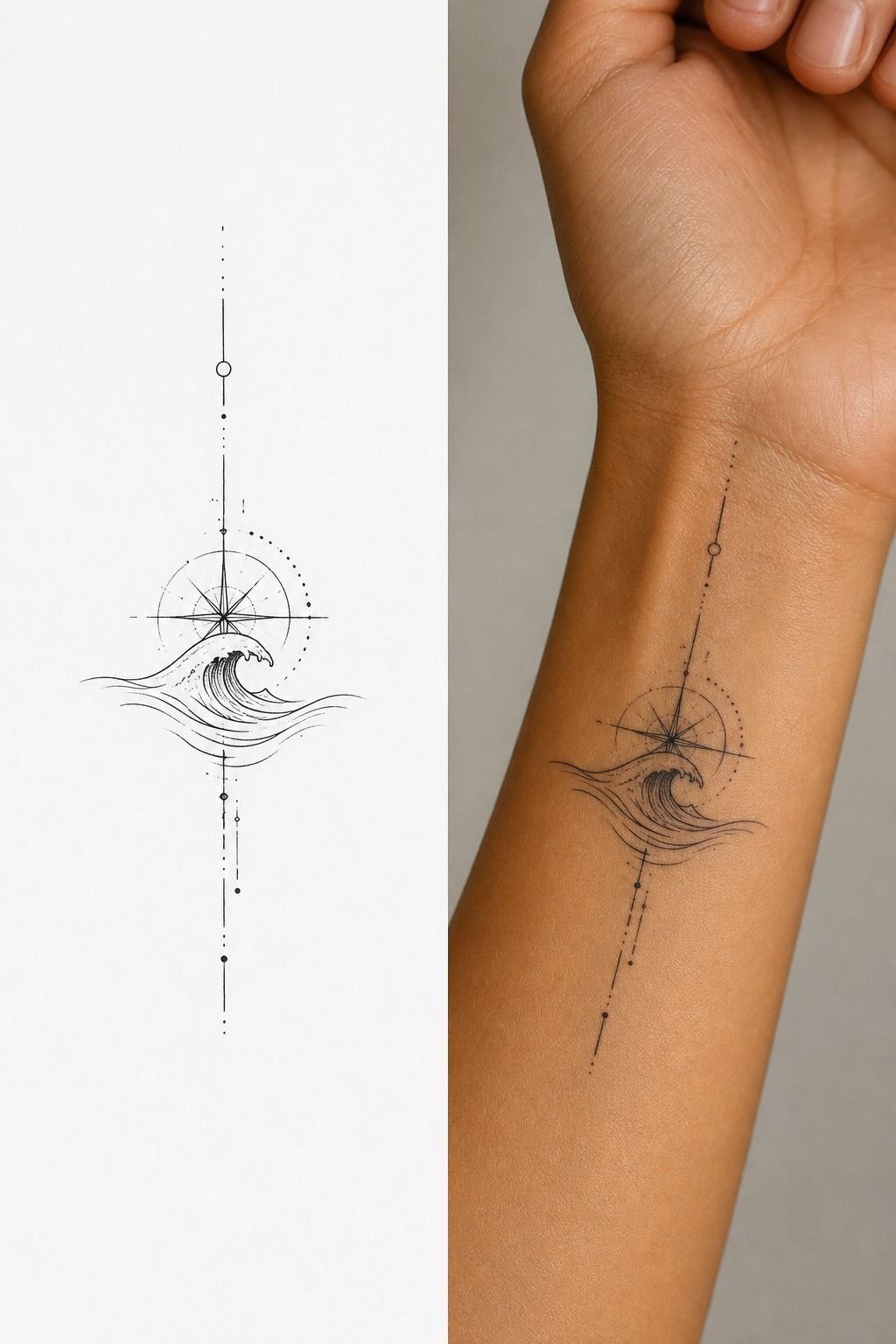
- Anchor a Compass Overlapping Ocean Waves Tattoo
- Choose Beach Sunset Shoulder Tattoo Color Over Extra Detail
- Float a Jellyfish Fine Line Tattoo Along the Collarbone
- Build an Ocean Lover Sleeve in Connected Chapters
1Keep a Minimalist Wave Linework Tattoo Behind the Ear
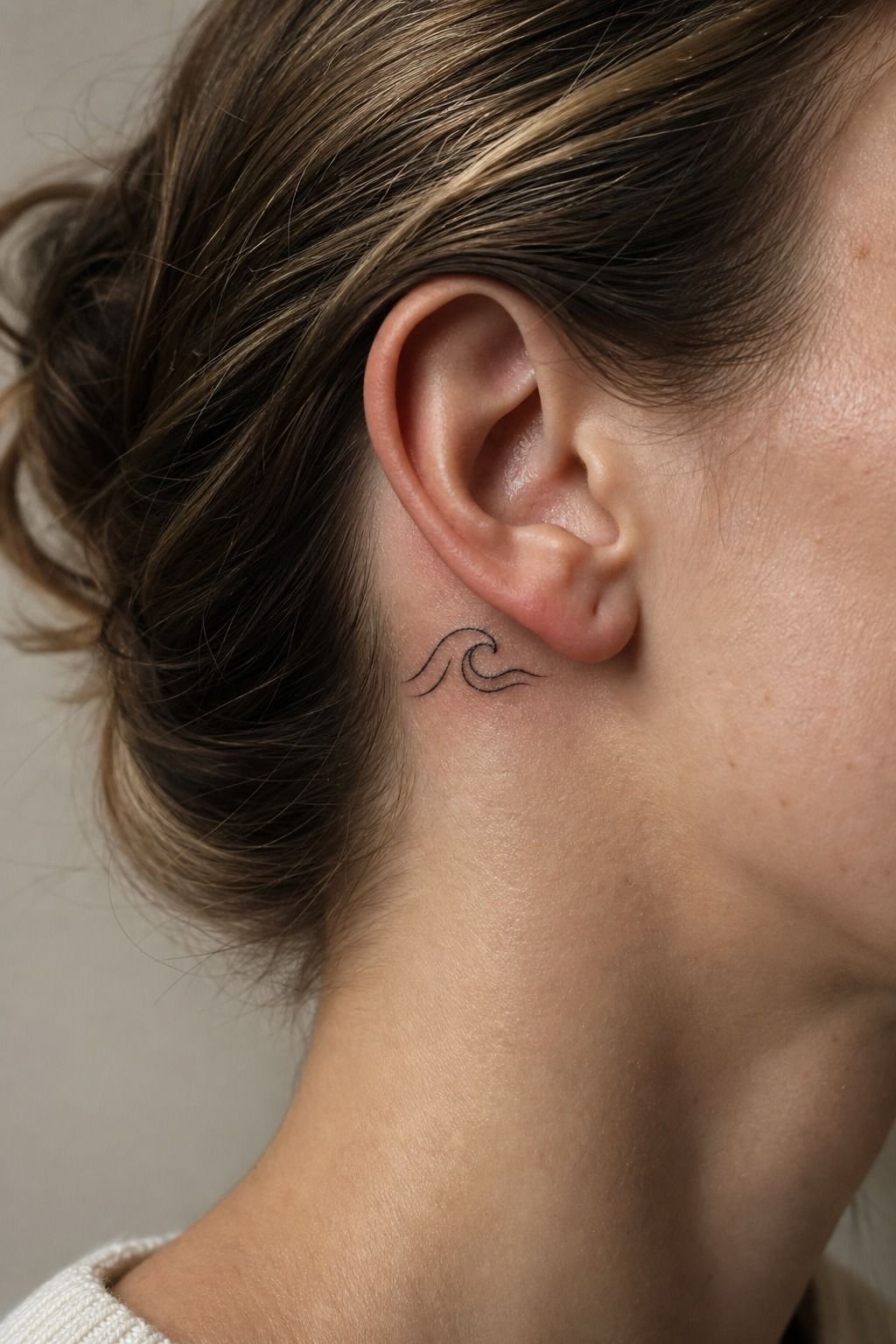
A single flowing wave behind your ear is small, subtle, and way better than cramming in foam, birds, and a sunset. You want one confident curve, not ten fuzzy ones fighting for space.
Ask for single-needle black linework with a little open skin around the crest. Your artist should follow the ear’s curve instead of dropping a flat symbol behind it. I’d skip white ink here because it can disappear fast on this high-exposure spot.
Keep it around 1 to 1.5 inches. That size gives your tattoo room to age cute without turning into a grey comma. And yes, it’s spicy right behind the ear, but it’s quick.
2Let a Watercolor Ocean Horizon Tattoo Stay Anchored
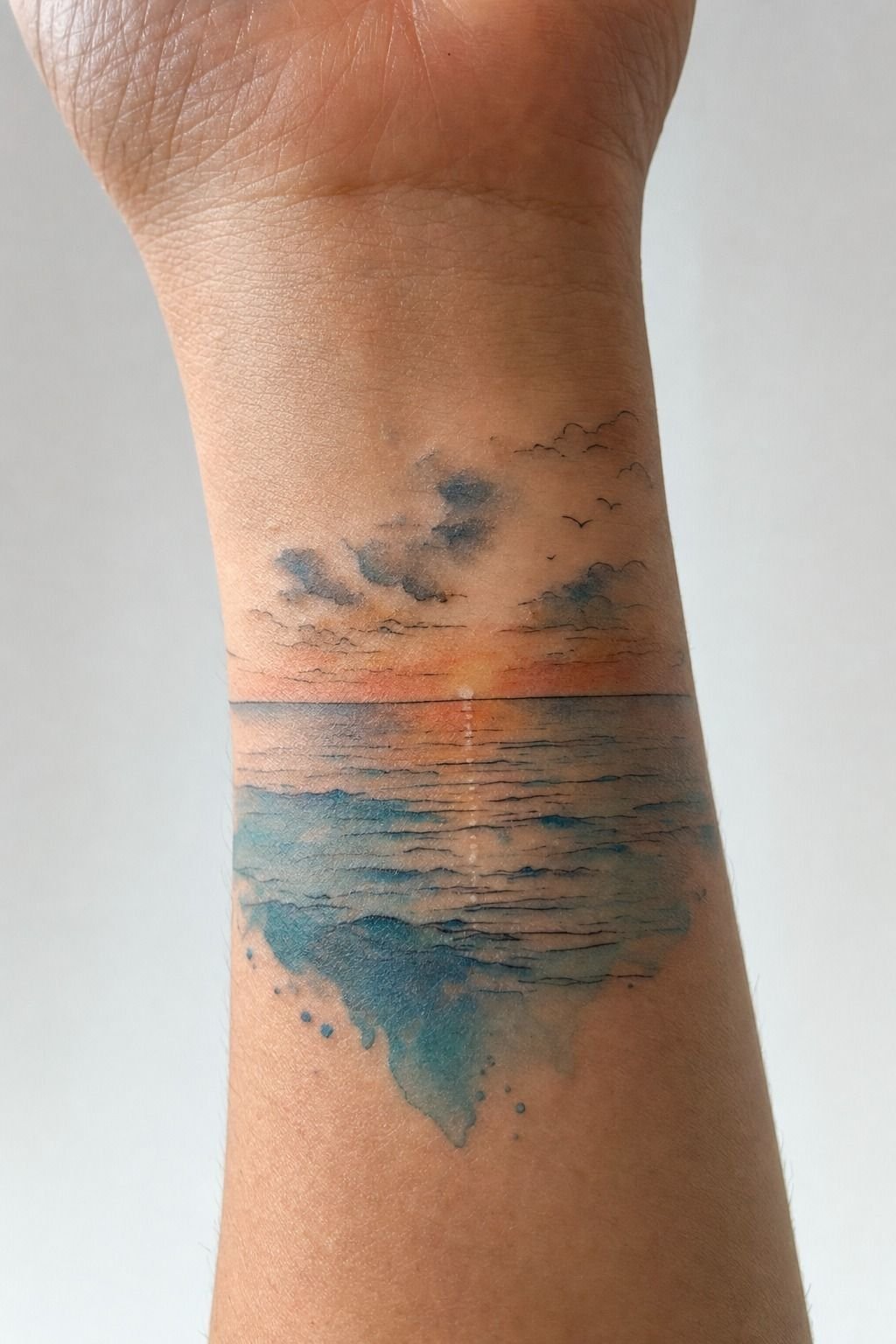
A watercolor horizon on your wrist needs a backbone. Otherwise, those soft blue washes can heal flat and muddy, especially if you want a tiny beach themed tattoo.
Use black fine-line horizon work underneath the blue and teal wash. The line gives the piece a readable edge while the color supplies the dreamy, calming movement. I like a thin sun circle, two loose wave bands, and negative skin between them.
Your wrist gets sun, handwashing, and friction all day. Wear SPF once it’s healed, because UV is brutal on soft color. A watercolor tattoo anchored with line has a much better shot at staying bright.
3Give the Sea Turtle Fine Line Tattoo a Bigger Shell
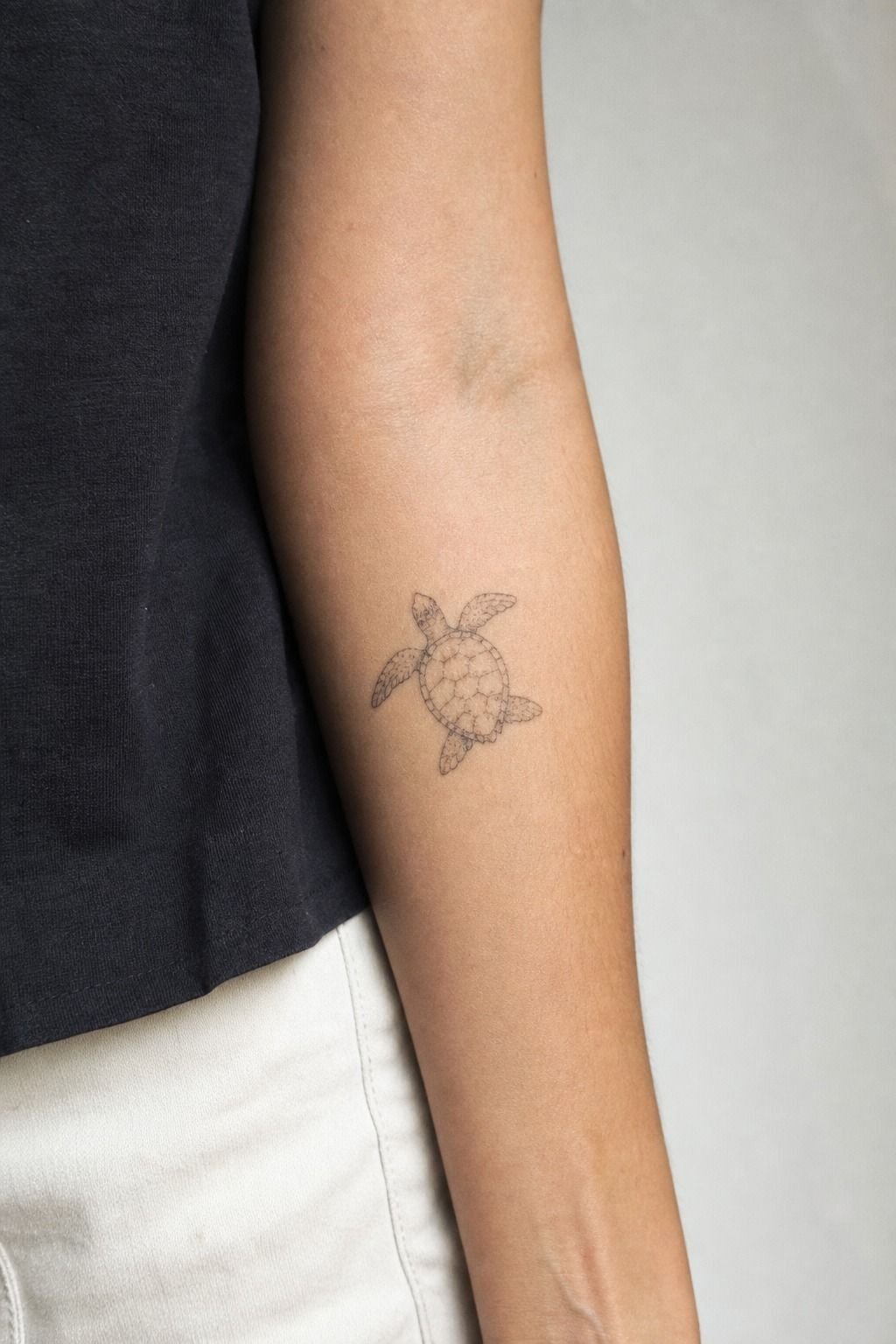
A sea turtle on the inner forearm is a solid first tattoo choice because you can see it, care for it, and keep it out of the worst high-wear zones. But don’t make every shell plate microscopic.
I’d ask for fine-line shell geometry with a few larger scutes and soft pepper shading under the flippers. Your turtle needs contrast around the head and front flippers or it’ll look like a floating pebble later. Small details are where tattoos become soup.
Three to four inches is the sweet spot for most forearms. You’ll get a gentle, organic silhouette that heals velvety instead of patchy. For more placement help, see where tattoos hurt less.
4Use Rib Flow for a Whale Tail Tattoo
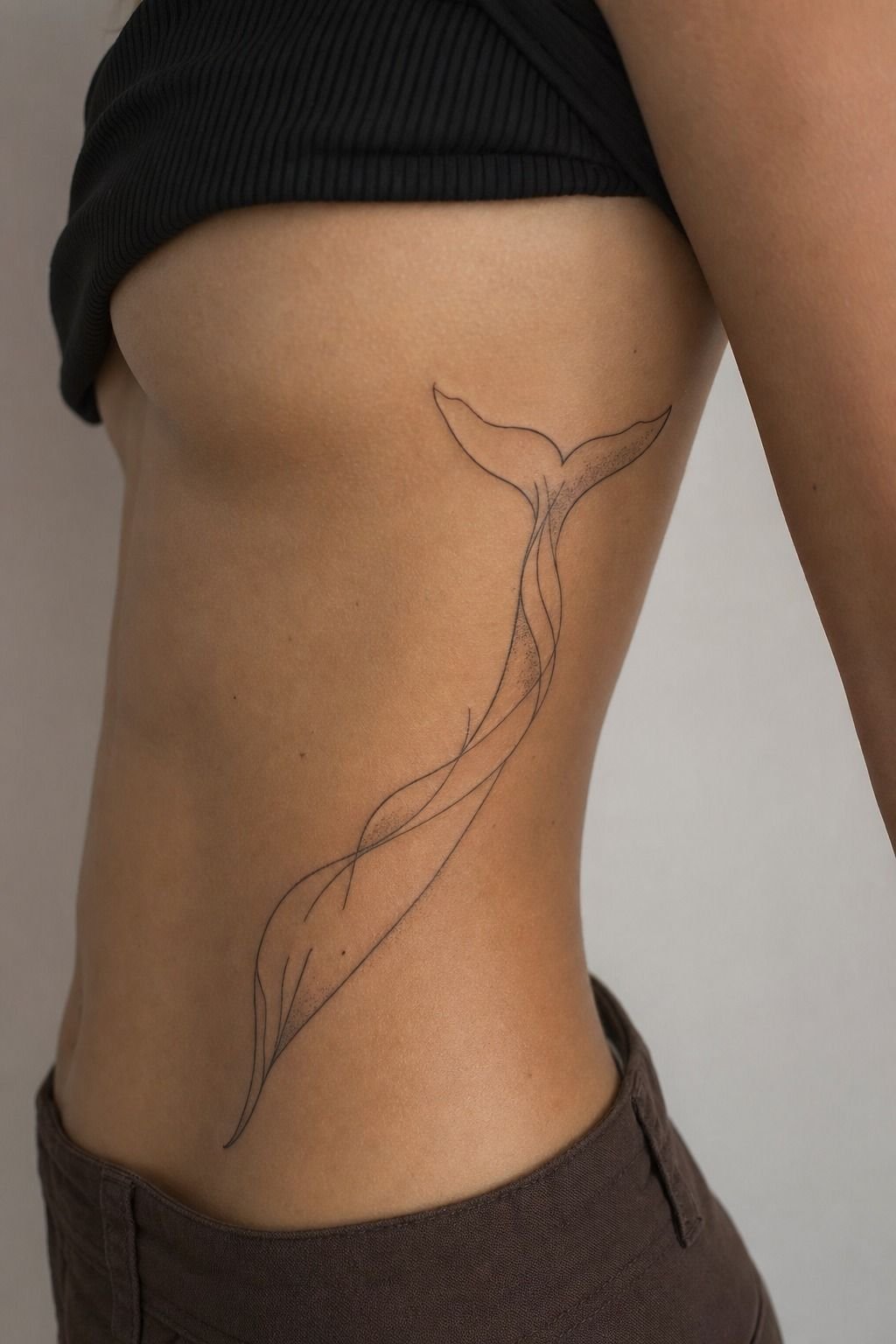
A whale tail rib tattoo should move with your body, not sit like a logo stamped onto your side.
5Choose Japanese Koi Fish Sleeve Tattoo Flow Over Random Flash
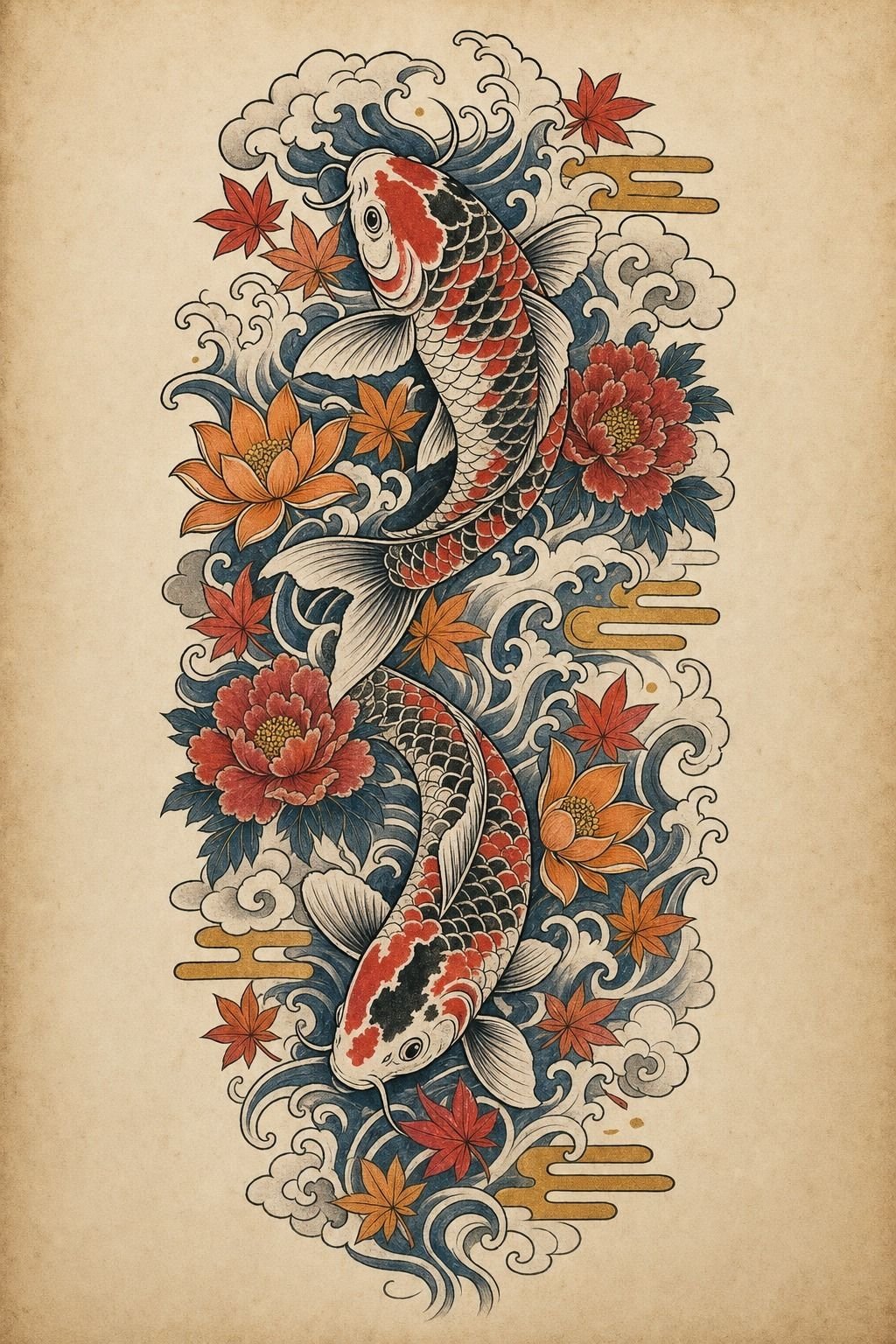
A koi sleeve is not a collection of separate fish stickers. It needs a current, a direction, and enough black to hold the whole story together.
For a Japanese koi fish sleeve tattoo, I’d send you to an artist who understands irezumi composition, not somebody copying a flash sheet off Pinterest. Koi, maple leaves, waves, and wind bars all need to wrap the arm as one piece. Marco’s lane, frankly.
Use saturated red, gold, and black only where they matter. Your skin needs resting areas, or the sleeve becomes visually loud from every angle.
A bold koi swimming upward reads powerful. A dozen tiny koi? Busy, then blurry.
6Push Contrast in a Blackwork Shark Silhouette Tattoo
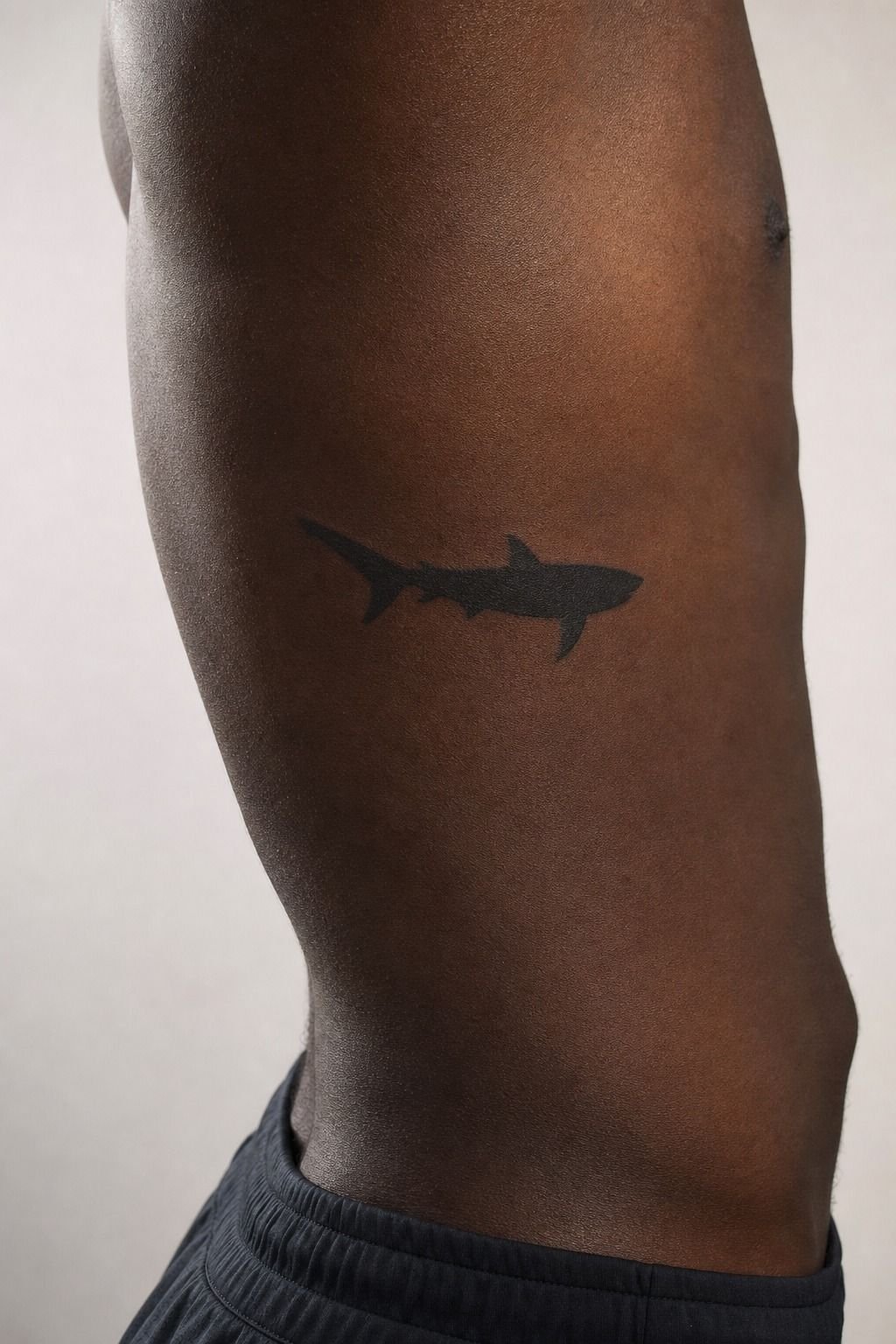
A shark silhouette on the ribs has to be bold enough to survive.
7Skip Tiny Details in a Seashell Ankle Tattoo
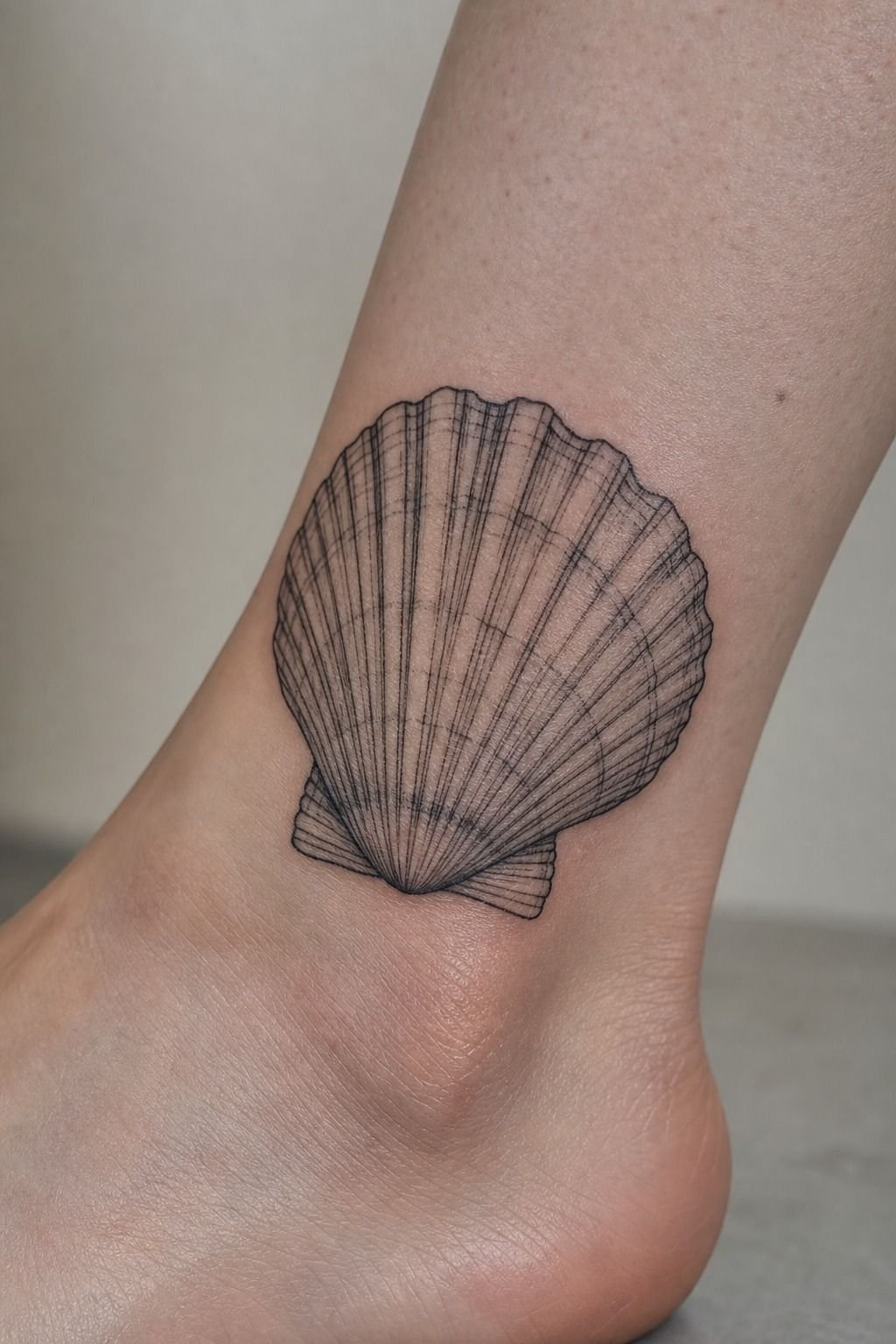
An ankle shell can look charming, but it’s a high-wear zone. Socks, shoes, shaving, and sun all work against tiny fine lines, so you need a shell with broad ridges.
Pick a scallop shell outline or one conch with thickened ridges. I’d avoid a full pile of little shells because your ankle doesn’t offer much calm skin.
One shell, one small shadow, maybe a short wave. That’s enough.
Your ankle can be spicy close to bone, especially around the outer edge. Keep the tattoo at least 2 inches wide, and you’ll have a more timeless result. If you’re worried about fading, read why tattoos blur over time.
8Build a Tiny Lighthouse Forearm Tattoo With Negative Space
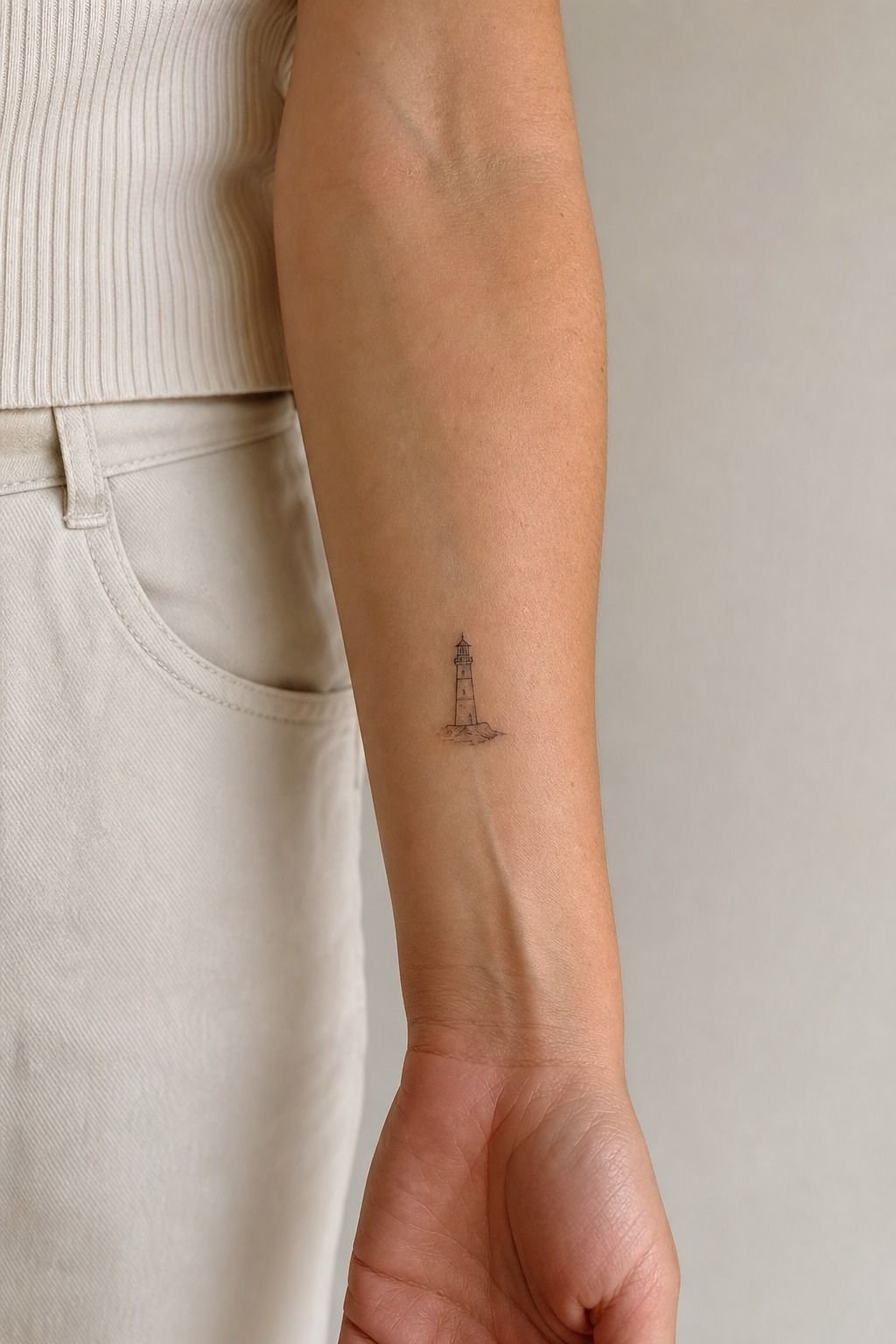
A lighthouse doesn’t need a whole coastline to tell the story. On your forearm, a crisp little tower with a clean beam can feel peaceful without getting precious.
Use black pigment linework for the tower and leave the light beam as bare skin. That negative-space beam is what makes the tattoo read fast.
Add only two wave marks at the base, then stop. I’ve seen artists overstuff this design with birds and clouds, and it loses its clean punch.
Two to three inches gives you enough room for a real doorway and a simple lantern cap. Your outer forearm is chill compared with ribs or feet, so it’s a good place to start.
9Let Realistic Octopus Thigh Tattoo Tentacles Breathe
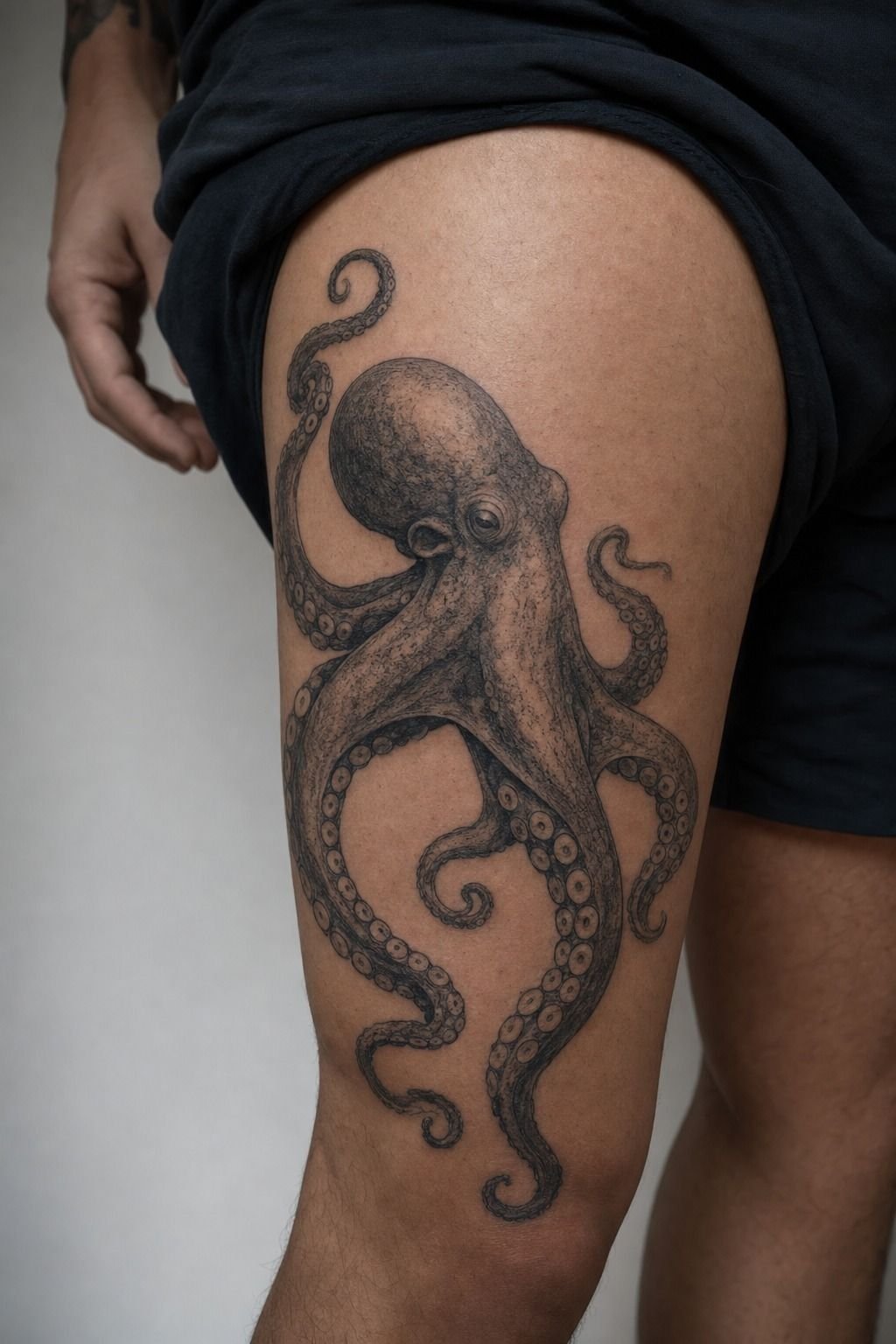
An octopus thigh tattoo can be breathtaking when the tentacles have room to curl. It can also become a dark knot if every sucker is outlined.
Ask for micro-realism grey wash with a strong dark eye, soft suckers, and a few tentacles disappearing around the thigh. Your artist should push the contrast near the head, then let the ends fade out. That creates depth without making your skin look chewed up.
The thigh is forgiving, low-wear, and usually more tolerable than the ribs. Eight to 15 hours is common for a large realism portrait or detailed octopus, often split across sessions. You don’t need every tentacle finished in one day.
10Make Ocean Coordinates Wrist Tattoo Numbers Legible
Ocean coordinates mean something only if you can still read them. The stencil might look delicate on paper, but your wrist isn’t paper.
Use clean serif lettering at a size your artist can pull in one pass. I’d pair coordinates with one thin wave rather than adding dates, maps, compass points, and a quote.
Your tattoo needs air. That size on a wrist is gonna mush out, so bump it up the forearm if the numbers look cramped.
A stencil-to-healed comparison matters here. Ask to see healed lettering in your artist’s portfolio, not just fresh work.
Fresh tattoos are shiny. Healed work tells you whether those lines stayed crispy.
11Frame an Underwater Coral Reef Tattoo Along the Collarbone
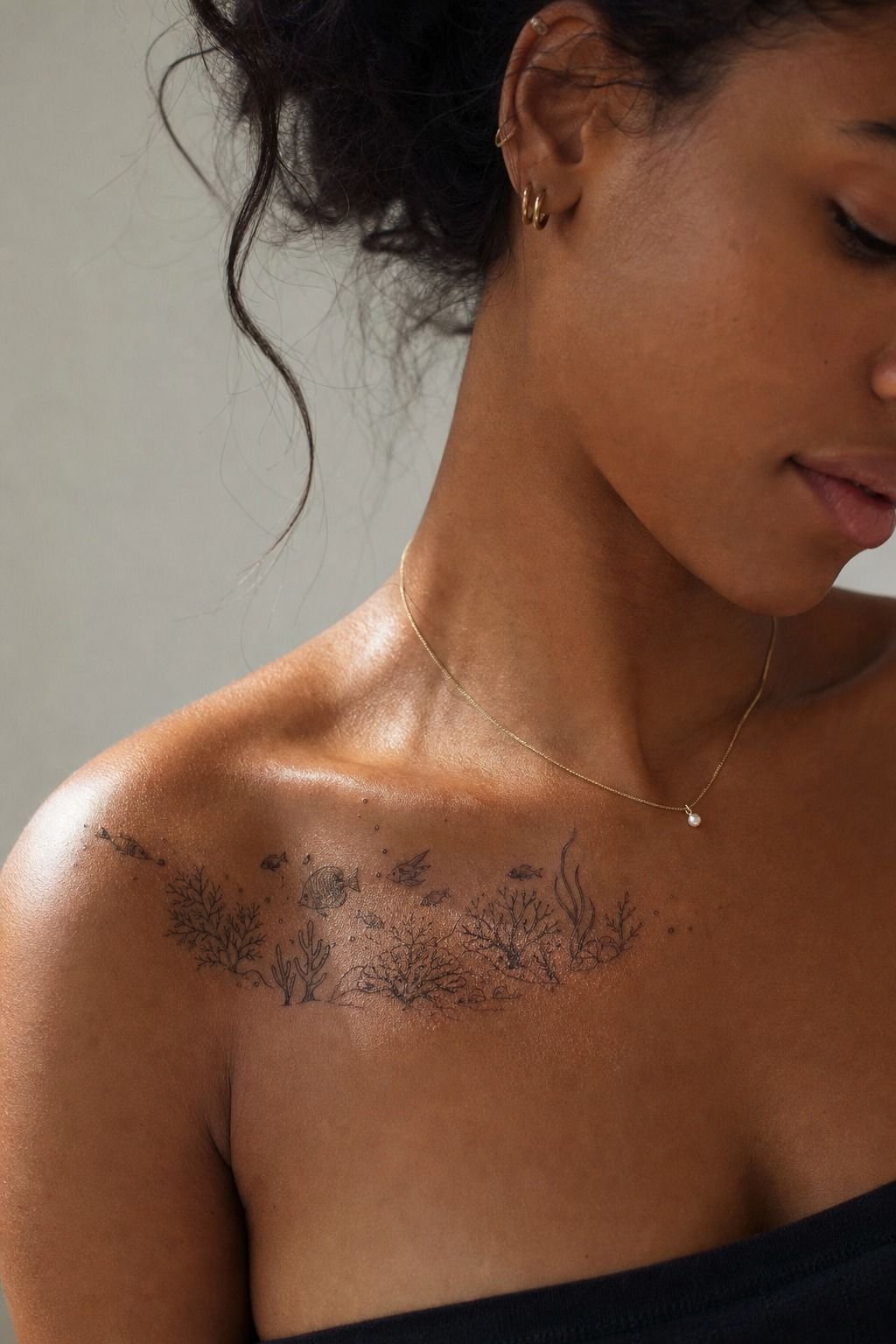
Your collarbone gives a coral reef tattoo a natural horizon. Use it. A reef that follows the bone looks intentional and soft, while a square reef block can feel pasted on.
Start with illustrative coral branches in black and grey, then add one small fish or a sea fan. Your artist can use pepper shading between branches so the reef stays airy. I’d skip packing color into every coral tip, because the collarbone gets a lot of sun and movement.
This is a moderately spicy placement, especially right over bone. But you’ll get a captivating piece that frames your upper chest beautifully. And it works well with upper arm tattoos for women if you want to build outward later.
12Use the Moon-Tide Method for a Moonlit Sea Back Tattoo
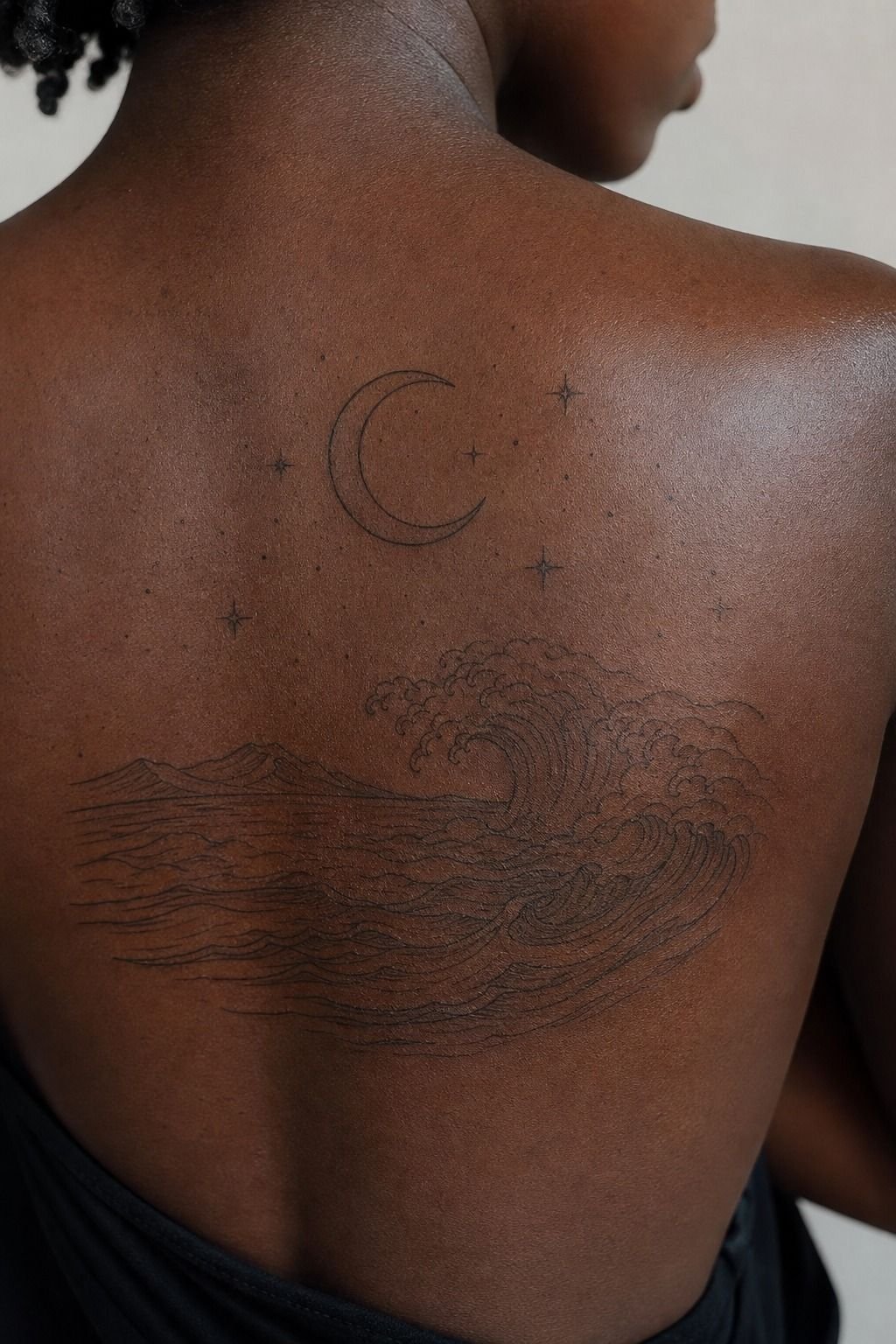
The Moon-Tide Method is simple: one dark moon, a few calm wave bands, and plenty of open skin.
13Match Dolphin Wave Tattoos Without Making Them Identical
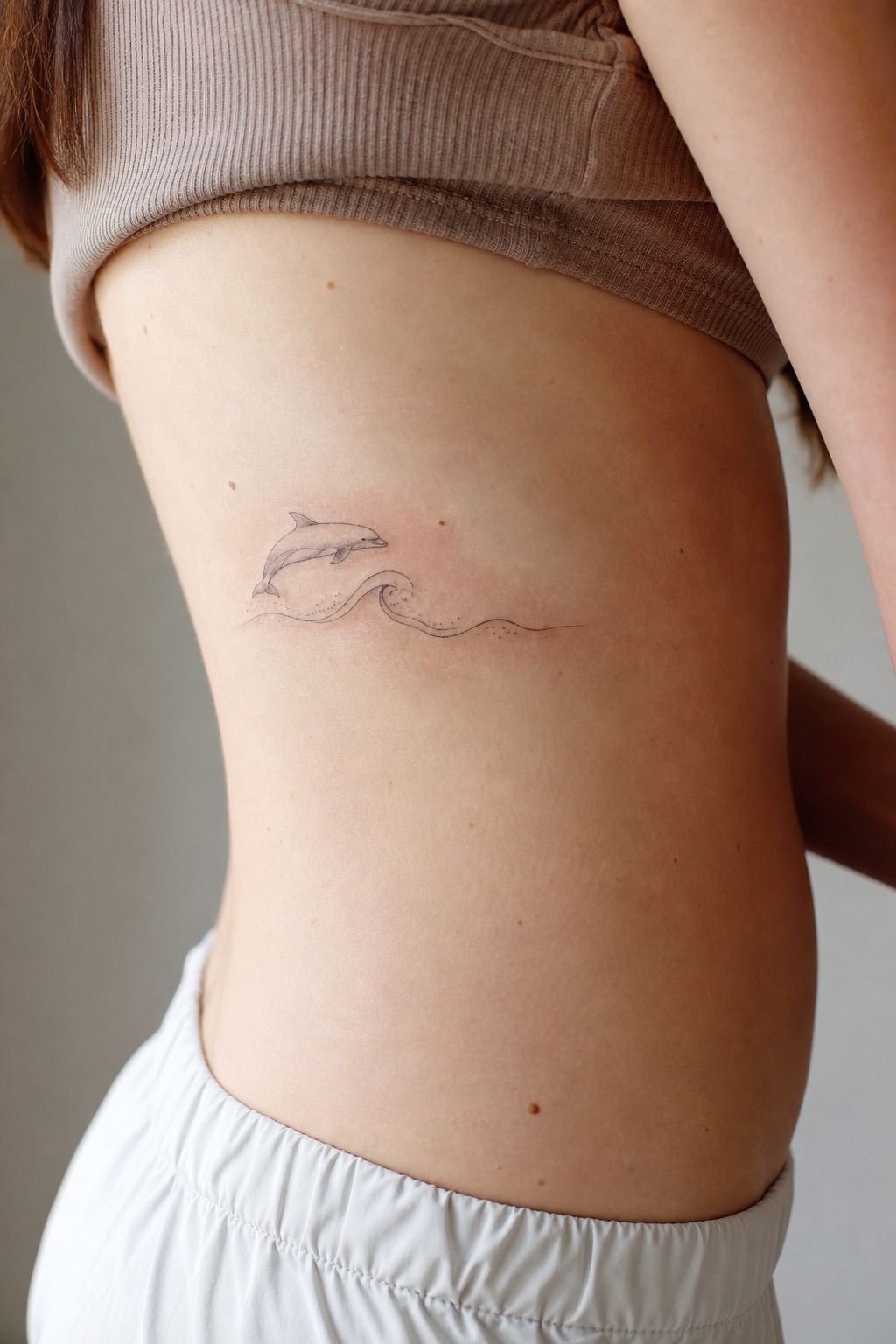
Matching dolphin wave tattoos don’t need to be carbon copies. Your bodies aren’t identical, so the design should flex with each person’s placement.
Choose the same single-needle dolphin silhouette, then let one tattoo face left and one face right. A shared wave shape keeps the connection obvious. Your ribs can hold a longer design, while another person’s forearm may need a tighter curve.
But don’t let the tattoo become too tiny just because it’s matching. Two inches is a practical floor for dolphin and wave detail.
The sentimental part stays. The lines stay visible too. That’s a win.
14Wrap Mermaid Scale Hip Tattoo With the Flow, Not a Grid
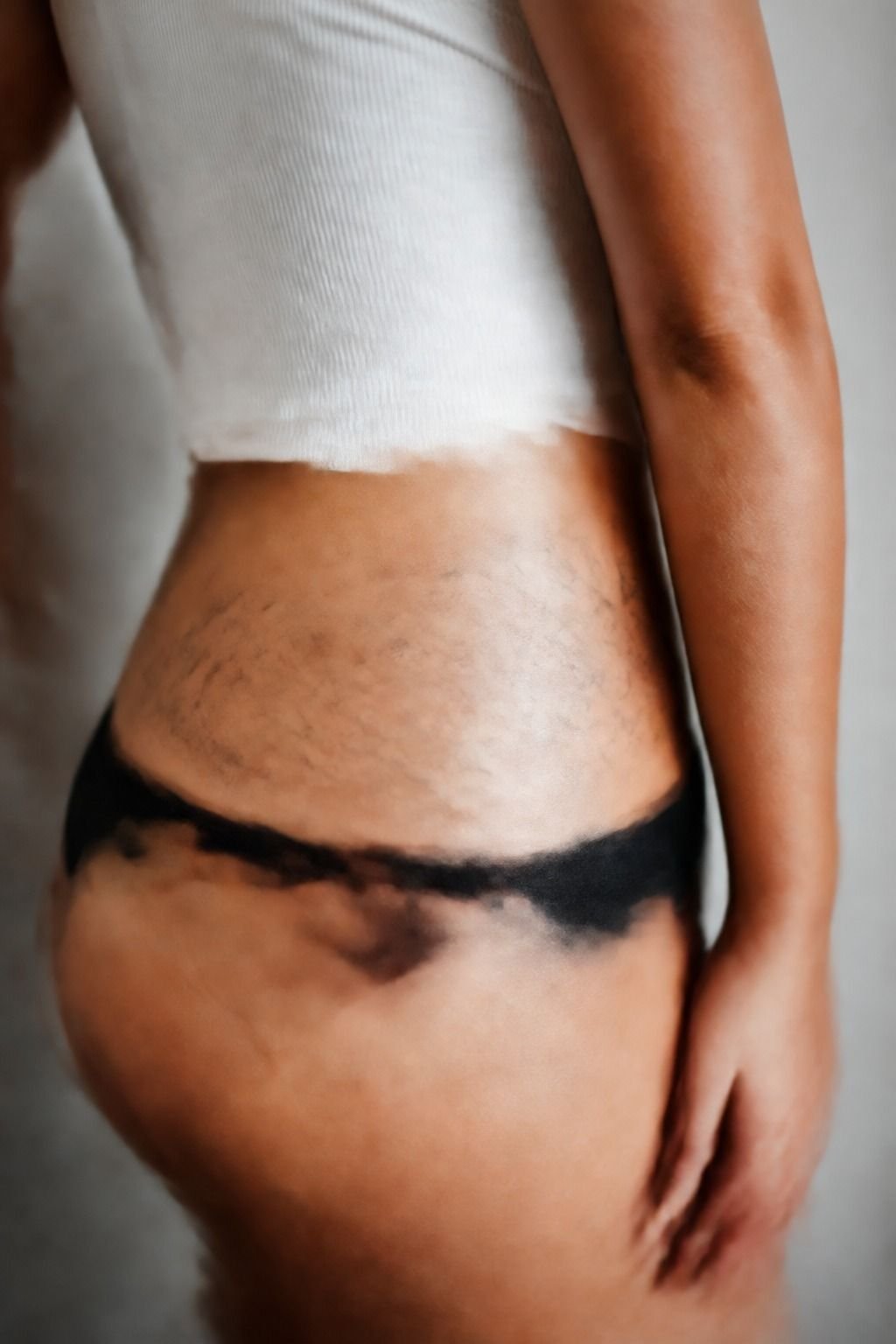
Mermaid scales belong to your hip’s curve. A rigid checkerboard of scales will fight the body and look awkward every time you move.
Ask for fine-line overlapping scales that widen near the hip bone and taper toward the waist. Your artist can add a few soft grey shadows at the scale bases, but a fully shaded patch gets heavy fast. You want flow, not armor.
This placement is intimate and can be spicy near the hip bone. Still, it ages nicer than fingers or feet because clothes protect it from direct sun.
A sea sleeve tattoo is louder. This is the quieter, more personal option.
15Try the Botanical Current Rule With a Seahorse Tattoo
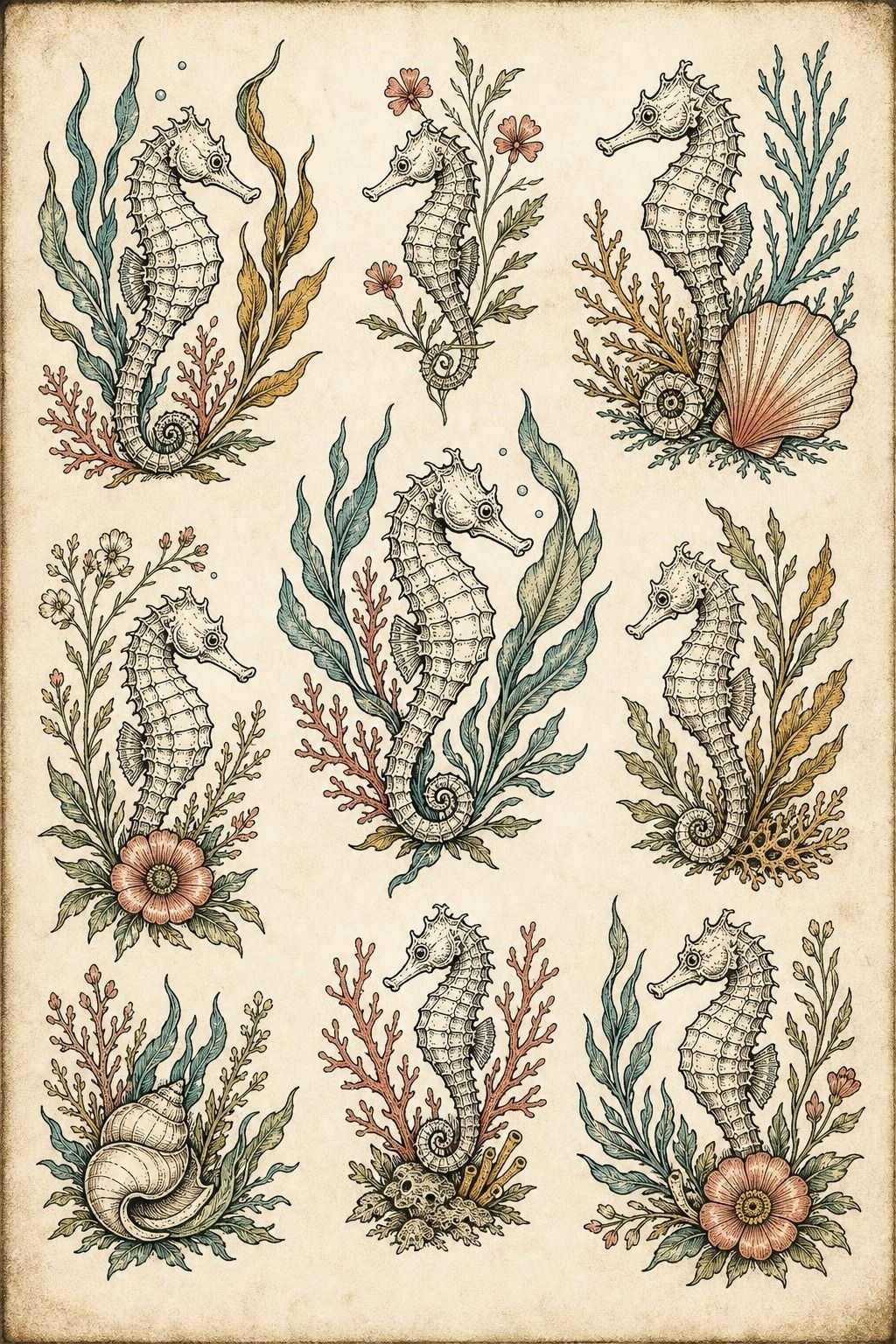
The Botanical Current Rule means your seahorse should look like it belongs inside the plant life, not perched beside it. Wrap soft kelp or sea grass around the body and let the tail hook into the movement.
Use fine-line botanical stems and one bolder seahorse contour. Your artist should keep the face simple, because tiny eyes and snouts are the first details to soften.
I’d skip watercolor without line here. The design needs a solid skeleton.
A flash sheet can give you a starting point, but make it yours. Bring references for vibe only. If you want Pinterest-exact, I’m not your artist.
For another delicate option, browse unique butterfly tattoos.
16Anchor a Compass Overlapping Ocean Waves Tattoo
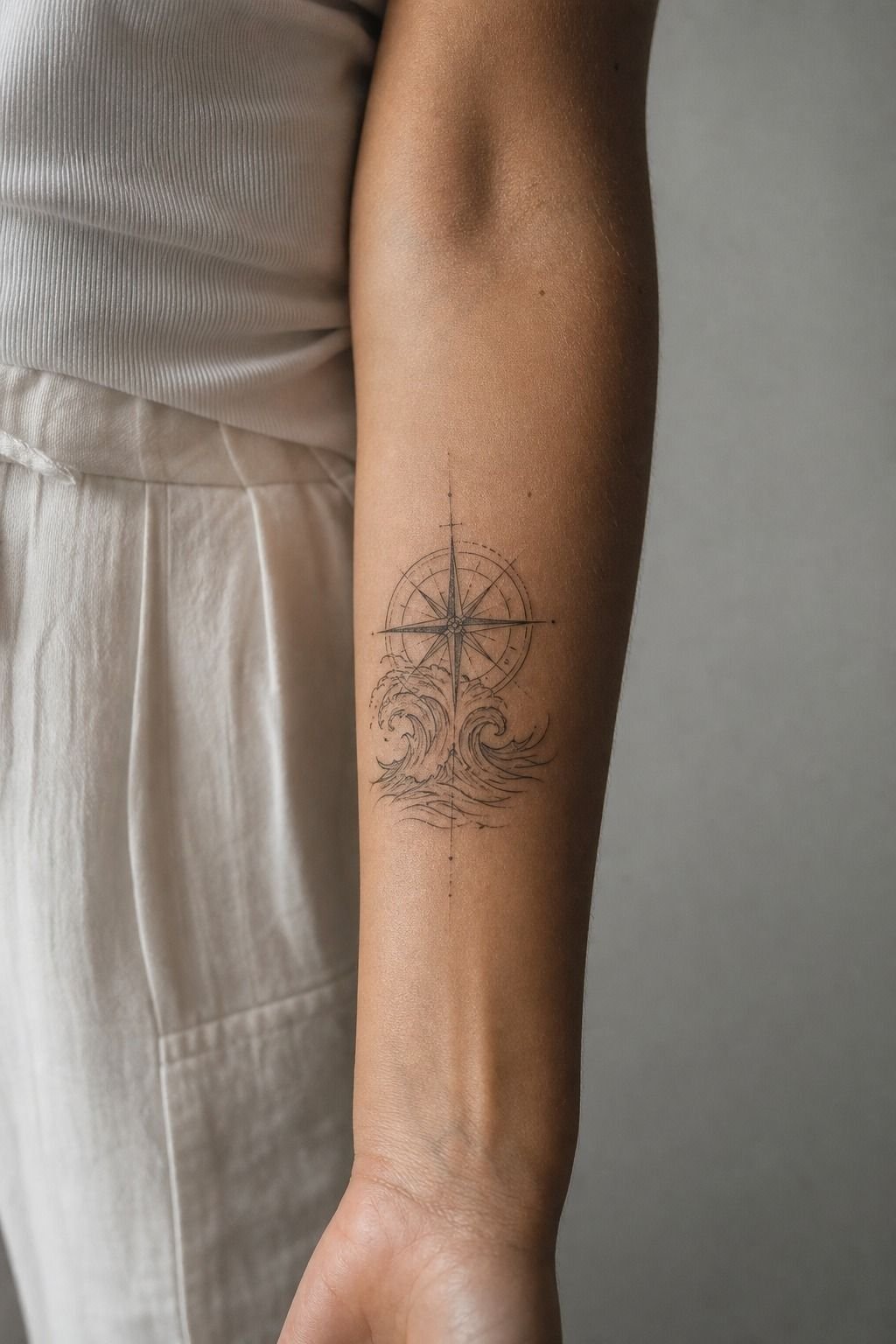
A compass with ocean waves works when the compass stays readable first. It’s tempting to hide every cardinal point under water, but then neither element gets its moment.
Use crisp black compass lines with two wave bands crossing the lower half. Your inner forearm gives the circle a flat enough area to stay round. Keep the north point dark and decisive, then make the waves softer with grey wash.
Three inches is a safer size than two. You’ll preserve the directional letters and avoid a muddy center. And if this is your first symbolic tattoo, your forearm lets you check it daily without fighting the pain.
17Choose Beach Sunset Shoulder Tattoo Color Over Extra Detail
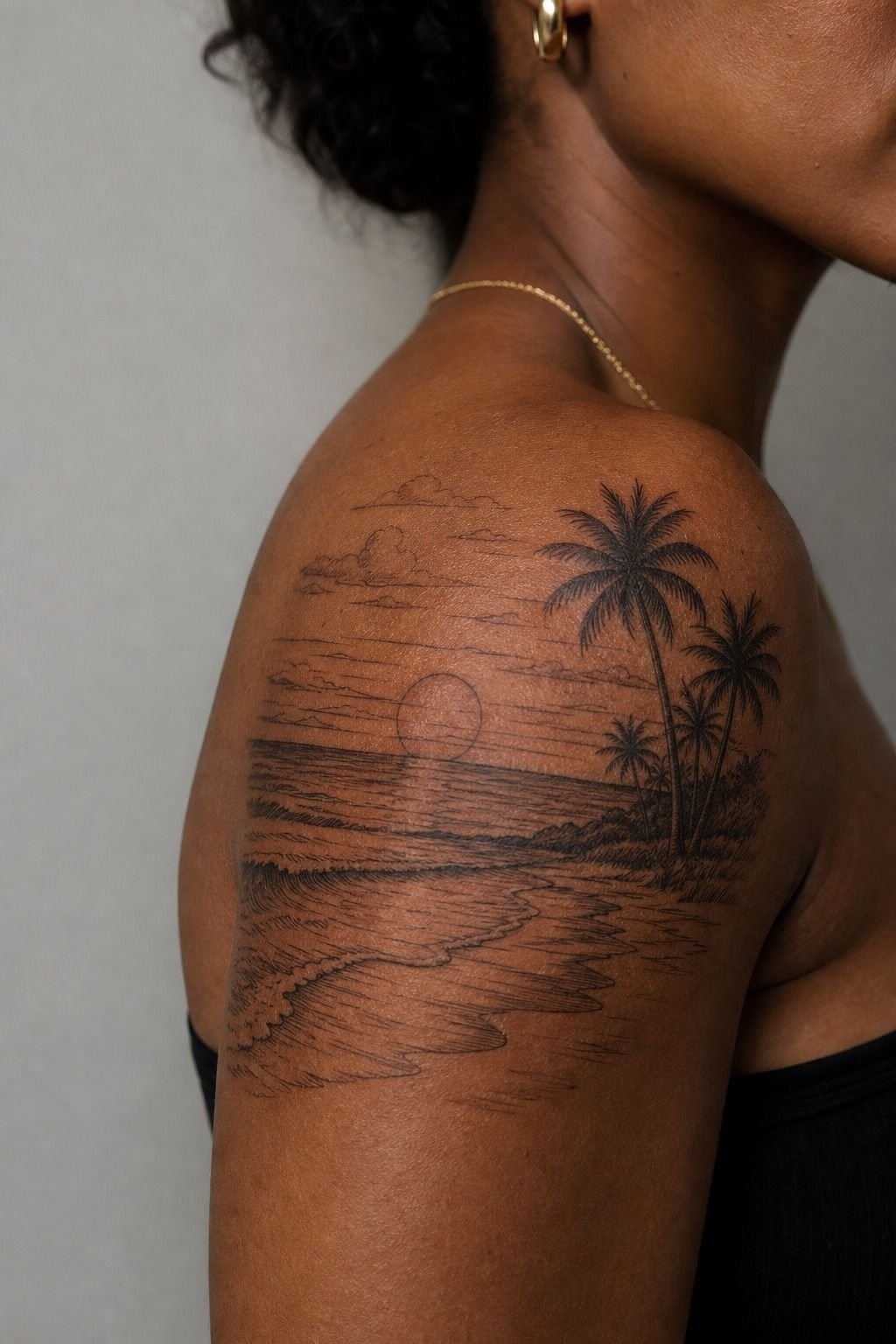
A beach sunset shoulder tattoo needs fewer elements than you think.
18Float a Jellyfish Fine Line Tattoo Along the Collarbone
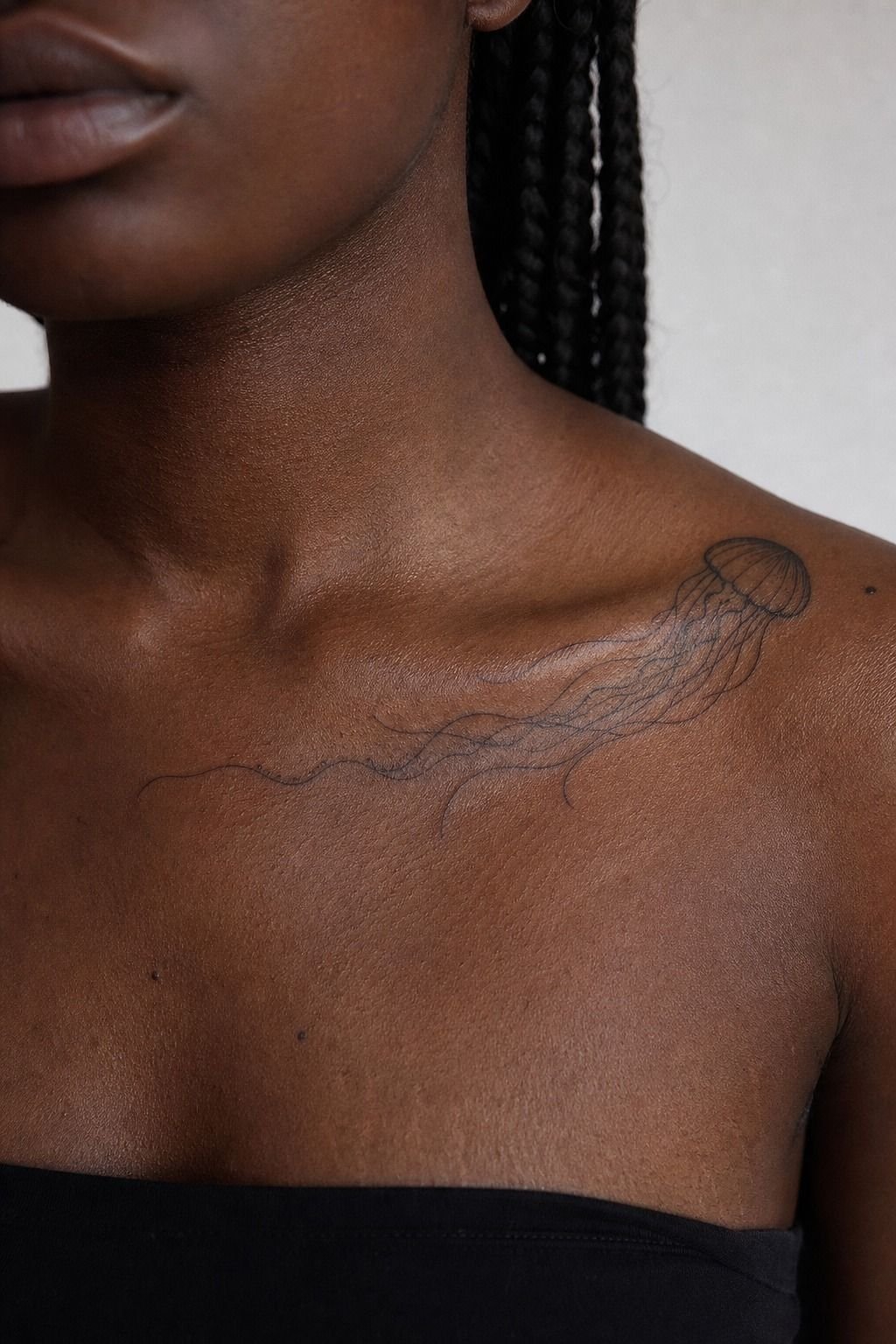
A jellyfish belongs on the collarbone because its tentacles can drift with the line of your body. The bell stays centered, then the tentacles trail without looking forced.
Ask for a single-needle jellyfish bell with four to six longer tentacles, not thirty thread-thin ones. I’ve watched overly detailed jellyfish become a fuzzy chandelier after healing. Fewer tentacles look more elegant and give your skin breathing room.
Your collarbone is bony, so expect sharper lines there. But the payoff is a serene tattoo that moves when you do. Keep the first few days simple: gentle unscented soap, a thin layer of ointment, clean loose fabric.
19Build an Ocean Lover Sleeve in Connected Chapters
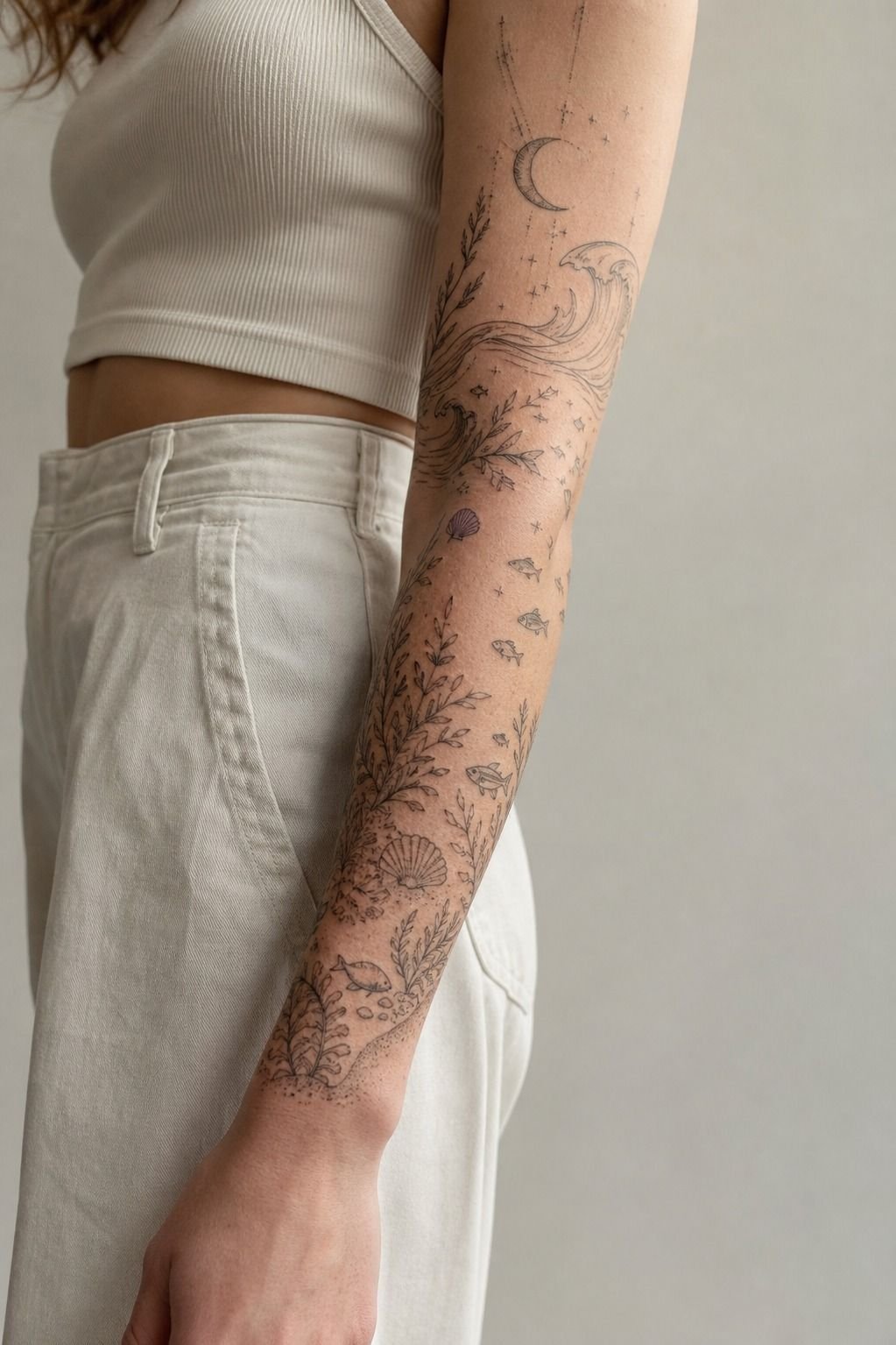
An ocean lover sleeve should have chapters: waves, one creature, a horizon, maybe a shell or lighthouse. It shouldn’t be nineteen unrelated Pinterest saves stacked on your arm.
Start with black-and-grey illustrative waves as the connective tissue, then add larger pieces over time. Your artist can leave soft gaps of skin between each chapter, so the sleeve feels inviting rather than packed solid. This is where planning beats impulse.
I’d begin at the outer forearm and work toward the upper arm. It’s low-wear, easier to heal, and lets you see the story build. If you prefer bolder imagery, traditional tattoos for women can show you how solid color holds.
What Your Ocean Tattoo Will Cost and Heal Like
Here are typical US tattoo benchmarks. Your artist, city, placement, and design detail will move the number.
First few days, it’s an open wound. Wash with gentle unscented soap, use a thin layer of ointment, and don’t suffocate it. Pools, gym friction, picking, and sun are how you turn a clean tattoo into a rough heal.
My No-Bullshit Rule for Ocean Tattoos
I’ve tattooed plenty of ocean references where the client loved every single image but hadn’t decided what mattered most. A shark, a turtle, a compass, a shell, a quote, a sunset.
All good images. One confused tattoo.
The real decision is whether you want your piece to read as a symbol, a scene, or a sleeve chapter. Pick one first.
If you want symbolism, keep the image simple and let the placement carry some emotion. A whale tail on the ribs or coordinates on the forearm says more than a full postcard scene squeezed into three inches. If you want a scene, give it room.
A moonlit ocean on the upper back can hold distance, black, and soft shading in a way a wrist never will.
I’m also firm about color. Blue looks great fresh, but it isn’t magic.
It needs black structure, decent size, and sun care if you want it to stay clear. Blackwork is less fragile, and it gives you contrast on nearly every skin tone.
That doesn’t mean every ocean tattoo should be black. It means you should know what you’re choosing.
And I won’t promise that a tiny, hyper-detailed design will stay exactly like the reference. Skin moves.
Ink spreads a little. A good artist designs for that future version of your tattoo. Ask for healed photos, ask what they’d simplify, and listen when they say a line needs more room.
That’s not them killing your vision. That’s them protecting it.
A Few Things Worth Answering
How much does an ocean themed tattoo usually cost?
A small ocean tattoo usually costs about $100 to $300, depending on placement and your artist. A clear budget starts with the shop minimum.
– Typical shop minimum: $50 to $100 – Typical US hourly rate: $100 to $250 – Custom shading, color, and larger coverage: more time
Are ocean themed tattoos good for a first tattoo?
Yes, especially if you choose a simple wave, shell, turtle, or lighthouse. A clean design is easier to heal and easier to love long-term. Your outer forearm, thigh, or shoulder will usually feel more manageable than ribs or feet.
How do I choose a tattoo artist for ocean themed tattoos?
Look for healed work in the exact style you want. Crispy healed lines matter more than fresh photos. Check their fine-line, blackwork, watercolor, or realism portfolio, then make sure their studio is clean and their advice sounds practical.
How much do ocean themed tattoos hurt?
Pain depends on placement. Outer arm, thigh, and shoulder are usually more tolerable. Ribs, feet, hands, sternum, elbows, and knees are spicier because bone, movement, and thin skin all show up at once.
How long do ocean themed tattoos take to heal?
The surface usually heals in 2 to 3 weeks, while full settling can take 2 to 3 months. Gentle aftercare protects your lines and color. Wash softly, moisturize lightly, avoid pools and sun, and don’t pick flakes.
What’s the best placement for ocean themed tattoos?
Outer forearm and thigh are strong choices because they’re visible, low-wear, and give your design room. More room means cleaner aging. For a smaller piece, the shoulder also works well. Avoid fingers if you don’t accept touch-ups.
Where I’d Start First
If I had to pick one, I’d start with the sea turtle on the inner forearm. Its larger shell shapes won’t turn to soup, and you can keep the lines clean without hiding it in a painful spot. Pin it for later and compare it with why tattoos blur over time.