Traditional tattoos for women hit different now than they did twenty years ago. What used to be a boys’ club of anchors and pin-ups has opened into something genuinely inclusive, same bold lines, same limited color palette, but with motifs and placements that speak to whoever’s sitting in the chair. I’ve tattooed enough women over the years to know the questions are different, the concerns are different, and the results can be absolutely killer when done right. This is the stuff I actually tell clients when they walk in asking about old-school work.
Origins & History
From Sailors to Shop Floors
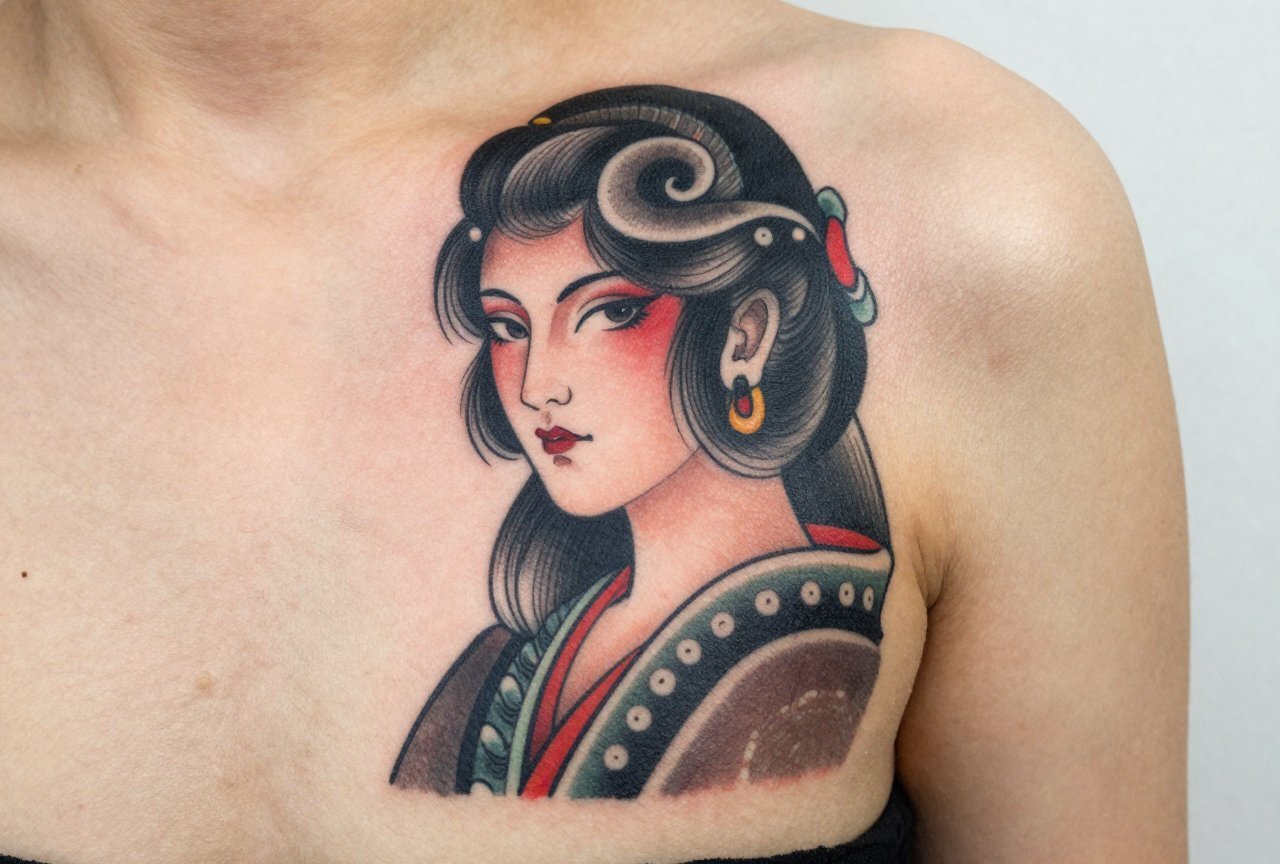
Traditional American tattooing comes from the early 1900s, Sailor Jerry, Bert Grimm, the whole flash sheet culture. Bold black outlines. Saturated red, yellow, green. Limited shading. These guys worked fast on rough skin, and the style evolved to survive. That’s why traditional holds up. The contrast is aggressive. The simplicity is functional. I’ve seen sailor tattoos from the ’40s that still read clear as day on ninety-year-old arms.
Women have always been part of this history, but they were mostly the subjects, pin-ups on men’s biceps, mermaids on chests. The shift happened gradually. By the ’90s, women were getting traditional work, but it was still niche. Now I’d say half my traditional appointments are women, and they’re not asking for “feminine versions.” They want the real thing.
What “Feminine” Even Means Here
Here’s the truth: traditional tattoos don’t have a gender. The style is the style. What changes is placement, scale, and sometimes subject matter. I’ve done fierce panthers on women’s thighs and delicate roses on men’s throats. The lines don’t care who’s wearing them. What matters is if you’re committing to the aesthetic, bold, graphic, unapologetic.
Key Characteristics & Motifs
Traditional work has rules. Break them and it’s not traditional anymore. These are the non-negotiables I explain to every client:
- Black outlines, thick and consistent. The line weight varies by artist, but that outer contour is everything. It’s what keeps the tattoo readable at ten feet and at ten years.
- Limited color palette. Red, yellow, green, sometimes blue or brown. No gradients, no photorealism. Each color sits in its own zone, separated by black.
- Minimal shading. When we do shade, it’s usually black whip-shading or sparse greywash. Not smooth, not blended. Graphic.
- 2D and flat. Traditional images read like icons, not photographs. Perspective is simplified. Depth is suggested, not rendered.
Popular motifs for women right now: snakes, tigers, butterflies, daggers through roses, swallows, hearts with banners, panthers, celestial imagery. I did a traditional moon and moth on a woman’s forearm last month that hit perfectly, simple, bold, readable from across the room.
Color vs Black and Grey
This is the conversation I have almost daily. Color traditional pops. It’s the classic look. But black and grey traditional has its own thing going, more moody, more versatile with wardrobe, sometimes faster to execute.
Color saturation on women tends to hold well. Lighter skin shows red and yellow vibrantly. But color also means more sessions for large pieces, more healing vigilance, and eventual fading that needs touching up. I’ve seen bright traditional sleeves on women that look incredible at year five, and I’ve seen red roses turn pinkish that need a refresh.
Black and grey traditional ages like a photocopy, still readable, just softer. For women who want that bold graphic quality without the commitment of color maintenance, it’s a smart move. I usually recommend black and grey for first large pieces, color for collectors who know they’ll be back.
Best Placements
Where It Actually Works
Traditional tattoos need room to breathe. The bold lines and open skin between elements aren’t accidental, they’re part of the design. Too small and the lines blur together. Too detailed and it won’t read as traditional.
- Upper arms and shoulders. Classic placement. The muscle gives the design structure, and sleeves or strapless looks frame it perfectly.
- Thighs. Huge canvas, less sun exposure than arms, and the pain is manageable. I’ve done massive traditional pieces on thighs that would never fit elsewhere.
- Forearms and calves. Visible, versatile, enough flat space for the style to work. These spots age well because they’re not constantly rubbing against clothing seams.
- Chest and sternum. Bold choice. The sternum hurts, no way around that, but the symmetry of traditional designs works beautifully centered.
- Hands and feet. I try to talk people out of these unless they’re committed. Traditional can work here, but the skin is different, the healing is harder, and the longevity is compromised. We see a lot of touch-ups on hands.
What to Avoid
Ribs and stomach are tough for traditional. The skin stretches, the breathing moves the design, and the bold simplicity of the style can look distorted. I’ve done it, but I warn clients. Armpit area? Same. The skin there is thin and mobile, not ideal for thick black lines.
Who It Suits
Traditional tattoos suit people who want their work to last and to read clearly. That’s it. There’s no body type requirement, no age limit, no style pre-requisite. I tattooed a sixty-year-old woman last year with her first traditional rose on her wrist, she’d waited decades because she thought it wasn’t “for her.” It looked perfect.
What does matter: commitment to the aesthetic. If you want soft, flowing, organic work, traditional will feel wrong. If you want something that looks like a stamp, a badge, a symbol, this is it. The women who love traditional in my chair are usually decisive. They know what they want. They don’t ask for “something pretty.” They bring reference, they trust the process, and they sit still for the bold lines.
Modern Variations
Neo-Traditional
This is where traditional structure meets expanded subject matter and technique. Neo-traditional allows for more detail, more color range, more dimensionality. Women gravitate here when they want the boldness of traditional but with more personal symbolism, portraits of pets, specific flowers, mythological figures. The outlines are still there, but the shading gets more complex. I do a lot of neo-traditional work that reads as “traditional-inspired” to civilians but satisfies my trained eye.
Japanese Influence
Some artists blend traditional American with Japanese imagery, koi, cherry blossoms, waves, using the bold line and flat color of old-school. This hybrid works especially well on women’s arms and legs, where the wrap-around potential of Japanese composition meets the graphic punch of American traditional. It’s not pure either style, but it’s popular for a reason.
Choosing an Artist
This matters more than almost anything. Traditional looks simple. It’s not. The line confidence, the color packing, the negative space balance, these take years to develop. I can spot a beginner’s traditional work from across a convention floor: wobbly lines, inconsistent saturation, colors bleeding into each other.
- Look at healed photos, not just fresh. Every tattoo looks good when it’s new. Ask to see work from six months, a year, five years back.
- Check their flash. Real traditional artists draw their own sheets or collect vintage flash. If they only do custom everything, they might not actually love the style.
- Ask about their machine setup. Traditional is usually done with coils, not rotaries. The punch of a coil machine packs color differently. Any artist worth their salt will explain their preference.
- Shop culture matters. Walk in. Feel the vibe. Are they talking to you or at you? Do they listen when you say you want something smaller, or do they push for what photographs well? Trust your gut.
I tell every client: the best tattoo you’ll ever get is from someone who genuinely wants to do that style. A portrait artist doing traditional for the money won’t have the same energy as someone who lives and breathes flash sheets.
Final Thoughts
Traditional tattoos for women aren’t a trend. They’re a continuation of something that never stopped being relevant. The bold lines, the limited colors, the graphic simplicity, these qualities don’t age out. They age in, settling into skin like they were always meant to be there.
What I’ve learned in my years behind the machine: women who choose traditional usually know exactly why. They want the permanence, the badge-like quality, the confidence of a style that doesn’t apologize. The best sessions in my chair are the ones where someone commits fully to that vision, no hesitation, no “make it softer.” Just bold lines and saturated color, the way it was always meant to be.
Bring your references. Know your placement. Find an artist who actually loves this work. Then sit back and let them earn their living. The result will outlast every trend that comes after it.
Frequently Asked Questions
Do traditional tattoos hurt more than other styles?
Not necessarily. The pain depends on placement and your personal tolerance, not the style itself. Traditional work does use bold, saturated lines that require multiple passes, which can feel more intense in the moment, but sessions are often shorter than detailed realism.
Will traditional tattoos look good as I get older or if I gain or lose weight?
Traditional tattoos age better than most styles because the bold lines and simple shapes maintain readability even as skin changes. Significant weight fluctuations can affect any tattoo, but the graphic nature of traditional work means it distorts less noticeably than fine detail or script.
Can I get a small traditional tattoo, or does it need to be big?
There’s a minimum size for traditional to work, usually palm-sized or larger. Too small and the lines merge during healing, losing the crisp separation that defines the style. Your artist can tell you the workable minimum for your specific design.
How do I know if an artist is actually good at traditional, not just claiming they are?
Ask to see their flash collection and healed traditional work specifically. Look for consistent line weight, solid color saturation without patchiness, and clean negative space. Good traditional artists usually have a distinct, confident line quality that shows in every piece they do.
Related Style Guides
- Great Tattoo Ideas That Actually Work
- Unique Tattoo Ideas for Females
- Abdominal Tattoo Ideas for Every Body
- Explore more