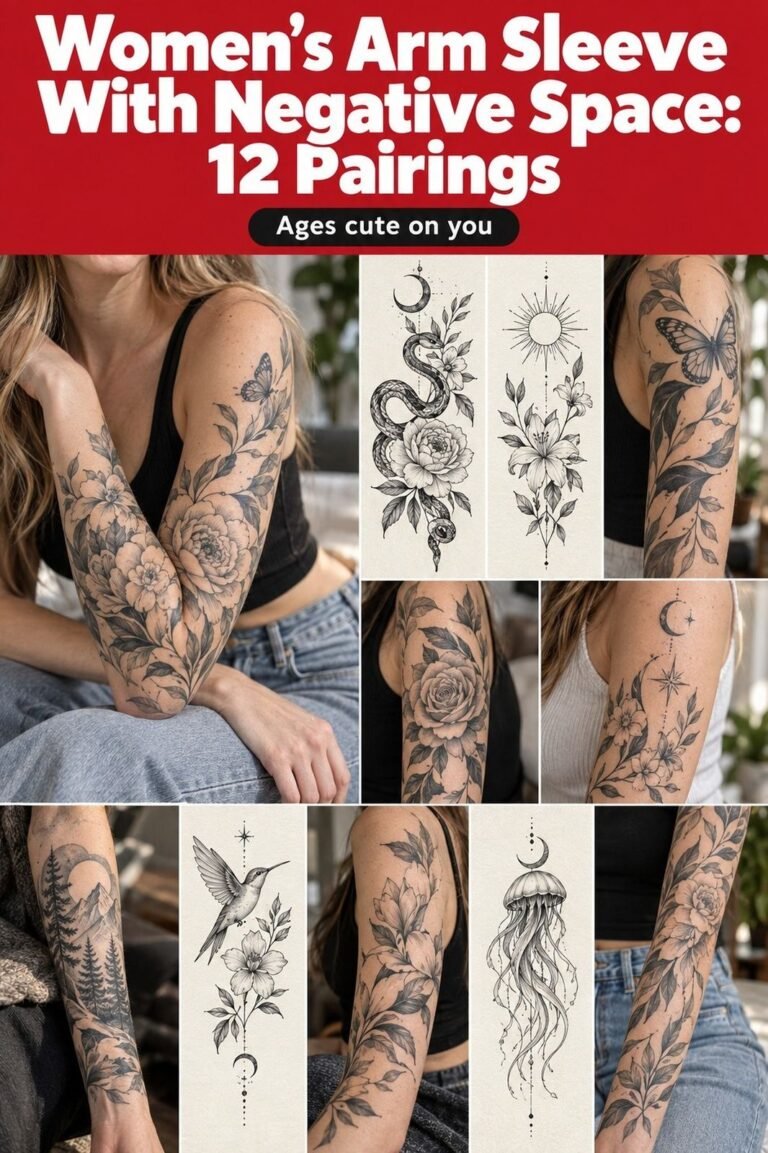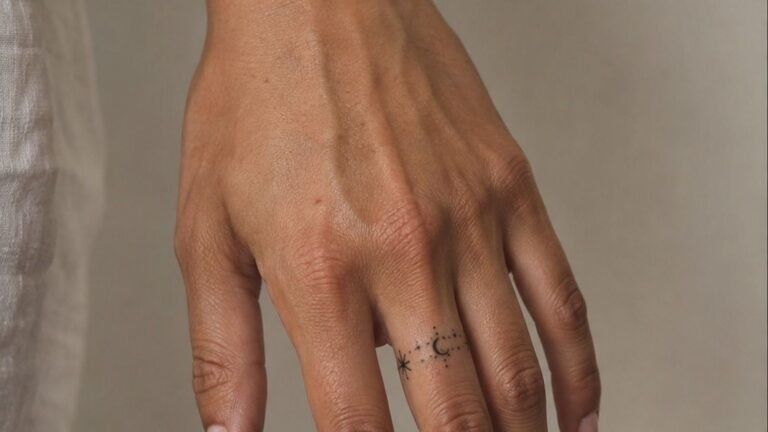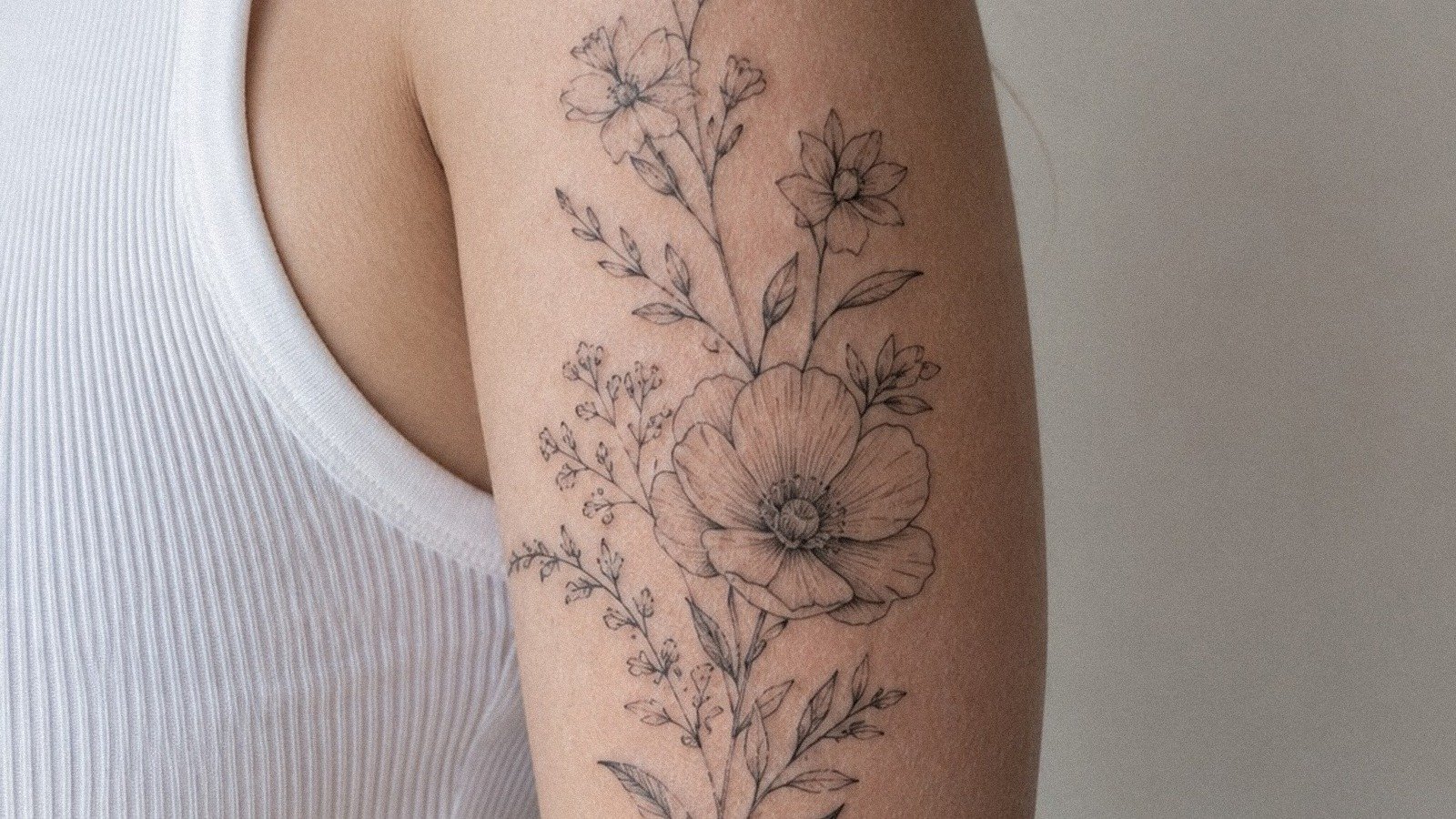
I almost didn’t get my first upper arm tattoo. I dragged my heels for a year because every artist I followed kept saying the same thing: “the outer arm is forgiving, you’ll heal great.” That’s true. It’s also the only thing they said. Nobody warned me that the shape of the design matters more than the size, or that my fine line fern was going to look like a smudge in three years if I didn’t commit to the right aftercare. So I’m writing this for you, because I wish someone had spelled it out before I booked.
If you’re scrolling Pinterest at midnight wondering whether an upper arm tattoo will hold up, will hurt, will fit your body, will age clean, will match your other pieces, and here’s the honest list. These are the 13 designs I keep seeing tattooed well, by artists I trust, on bodies that look like yours and mine. We’ll talk placement, line weight, ink, healing, what fades first, and which ones I’d push you toward if you can only pick one.
- Float a Fine Line Floral on the Outer Deltoid
- Wrap a Quarter Sleeve Wildflower Vine (The Three-Pass Method)
- Anchor the Piece with Blackwork Roses
- Wrap a Single Needle Lavender Sprig (The Botanical Shortcut)
- Build a Birth Flower Bouquet From Flash
- Frame a Delicate Butterfly on the Upper Arm
- Layer a Minimalist Moon Phase Arc
- Anchor a Soft Watercolor Peony Quarter Sleeve
- Loop a Tiny Daisy Chain Around the Bicep
- What Makes an Ornamental Mandala Hold Up for a Decade?
- The Fine Line Script Rule for Picking a Font That Heals Clean
- Why Does a Cherry Blossom Quarter Sleeve Age Like Iron?
- Crown a Tiny Red Ink Heart on the Outer Arm
1Float a Fine Line Floral on the Outer Deltoid
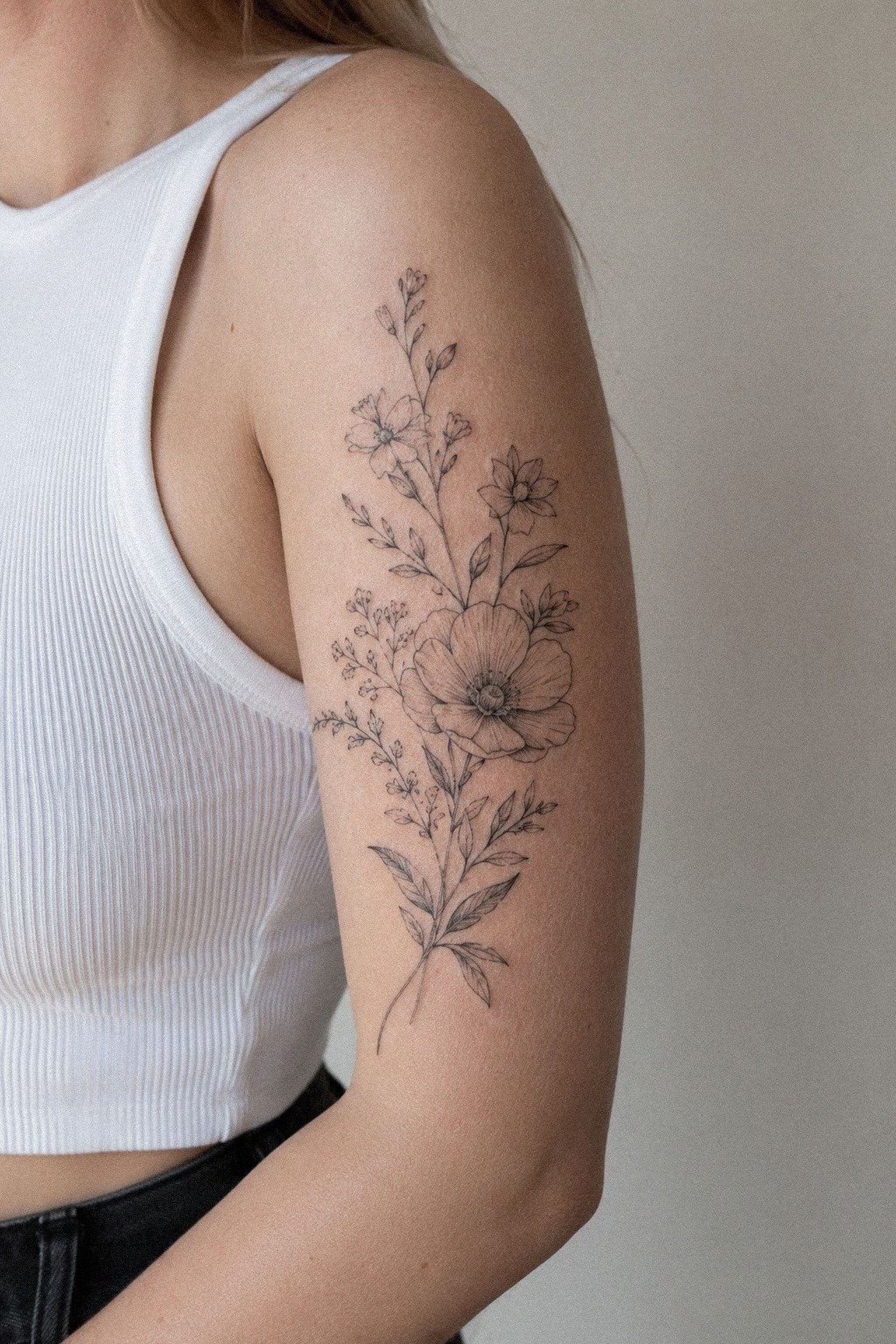
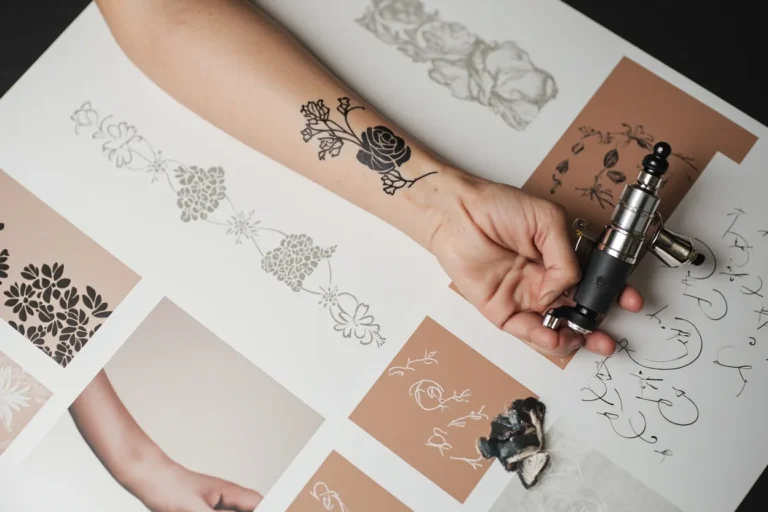
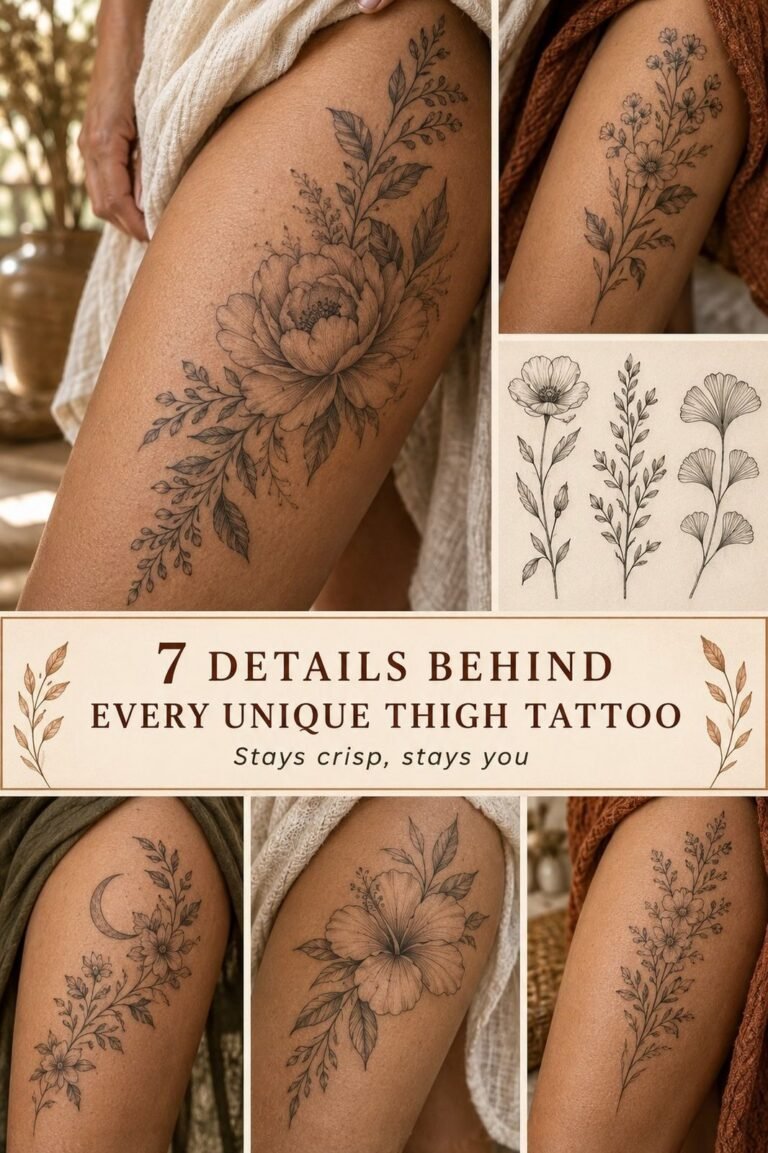
Fine line floral upper arm work is having a real moment, and the reason is simple: it reads soft from across the room and sharp up close. A single-needle peony, fern, or trailing vine mapped to the outer deltoid sits on one of the lowest-friction zones of your body.
Bumps happen, but the skin there is thick enough to hold a hairline stroke for years if the artist doesn’t go too shallow. If you’re building a sleeve later, you can read more about arm tattoos for women to plan how the floral connects to what’s next.
Here’s the part I learned the hard way. Single needle lines on a fair, cool-pink arm will look grey within 18 months unless your artist commits to a slightly heavier hand than feels right at the appointment.
Ask for a true 3-round liner, not a 1-round mag. The difference is one millimeter of healed ink, and it’s the difference between a tattoo that ages into a whisper and one that ages into a smudge.
I’d skip the wrist-to-elbow continuous vine on a first piece. Break the design into two sittings if you want coverage. Let each section heal fully before you add the next, or you’ll get scar tissue buildup that mutes the line.
That’s the part nobody warns you about. Worth it for a first piece, yes.
2Wrap a Quarter Sleeve Wildflower Vine (The Three-Pass Method)
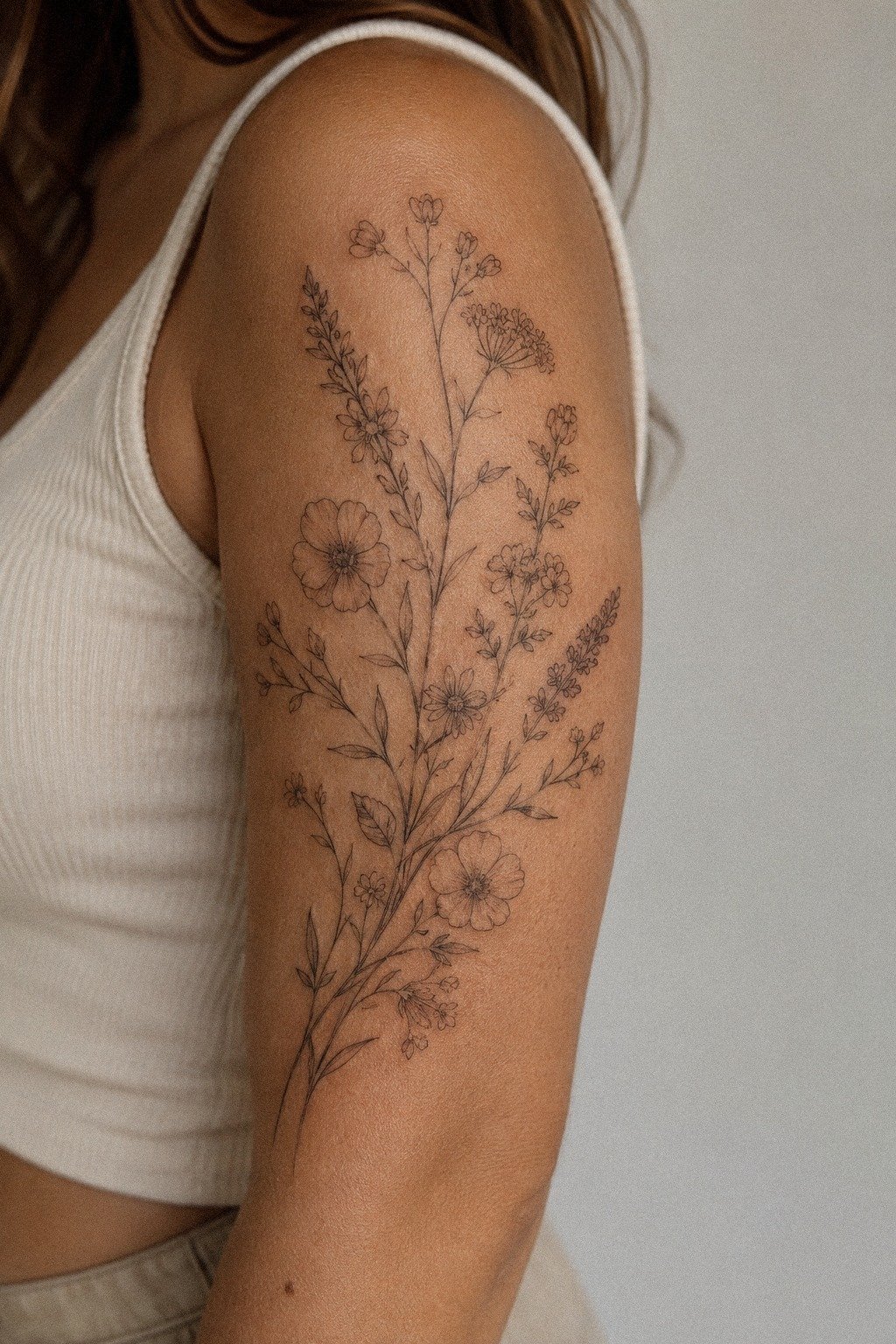
A wildflower vine wrapping the upper arm from shoulder to elbow is one of the most forgiving tattoo layouts you can pick, and the one I send every nervous first-timer toward.
3Anchor the Piece with Blackwork Roses
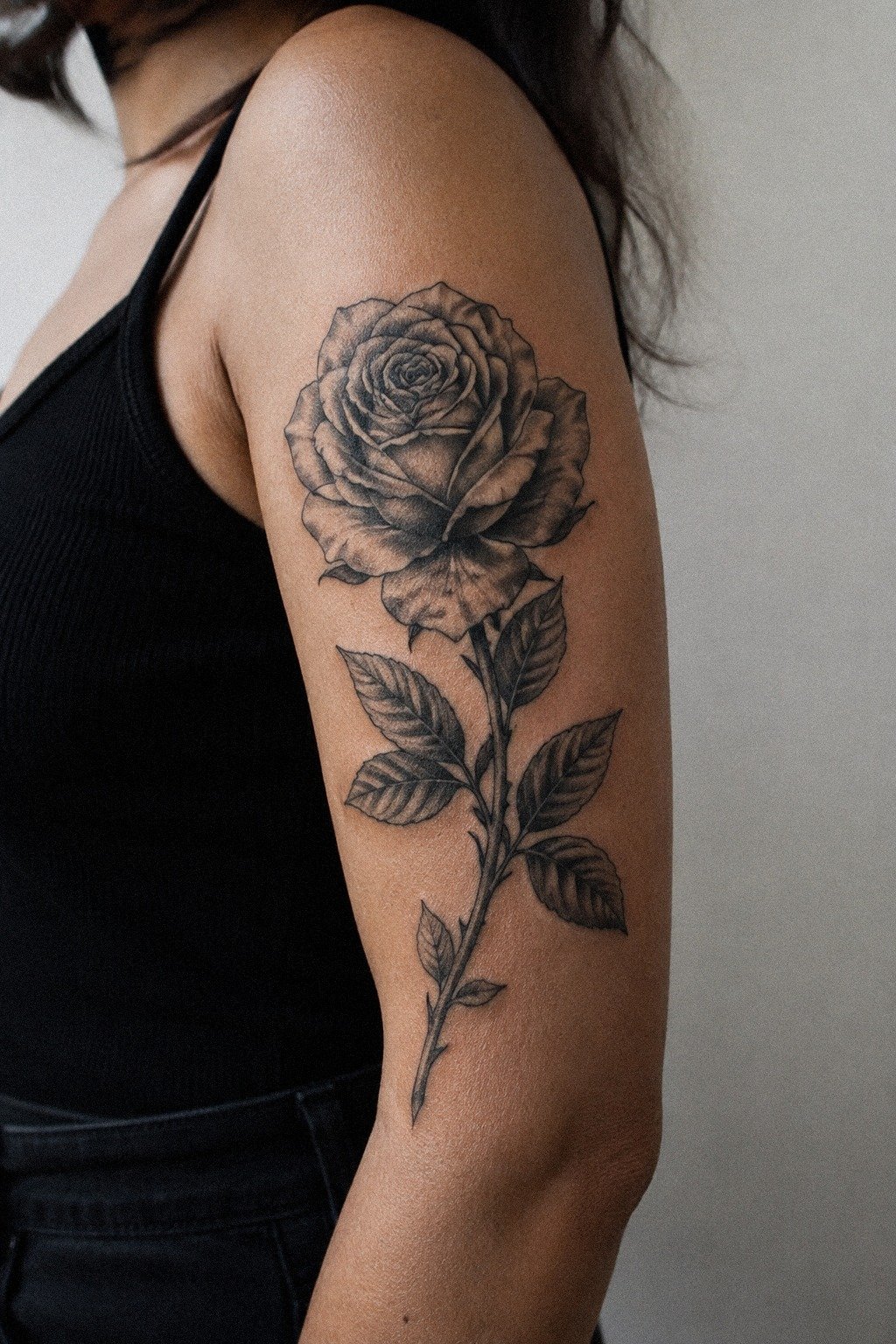
Blackwork roses are bold, and bold will hold. If you want something that still looks crisp in a decade, this is the move.
A healed blackwork rose on a medium olive arm looks like it was etched into the skin, and that’s the contrast the ink wants. Solid black fill, smooth grey shading, no dotwork fills. Just a heavy, confident piece that doesn’t ask for touch-ups.
I’d push you toward a traditional blackwork build (American trad roots) rather than a “modern minimal” rose. Modern minimal tends to mean thin lines that the skin will absorb.
Traditional means the line is heavy enough to survive sun, sweat, and years of forgetting sunscreen. If you’re someone who runs hot or works out daily, traditional is your friend.
Placement matters. Anchor the rose on the upper third of the outer arm, not the lower bicep. The lower bicep moves more during a workout and the petals will distort slightly over years.
Higher up means less flex, less fade. For folks planning multiple pieces, our guide on shoulder tattoos for women covers how to position a blackwork rose so it flows into a future shoulder cap. Blackwork sits beautifully against small finger tattoos if you ever decide to extend the line down the arm.
Skip the script banner underneath. Banners age faster than the rose.
Let the rose be the rose. The cost is reasonable: $200 to $500 for a solid blackwork rose, and it holds for 5 to 8 years before a touch-up.
4Wrap a Single Needle Lavender Sprig (The Botanical Shortcut)
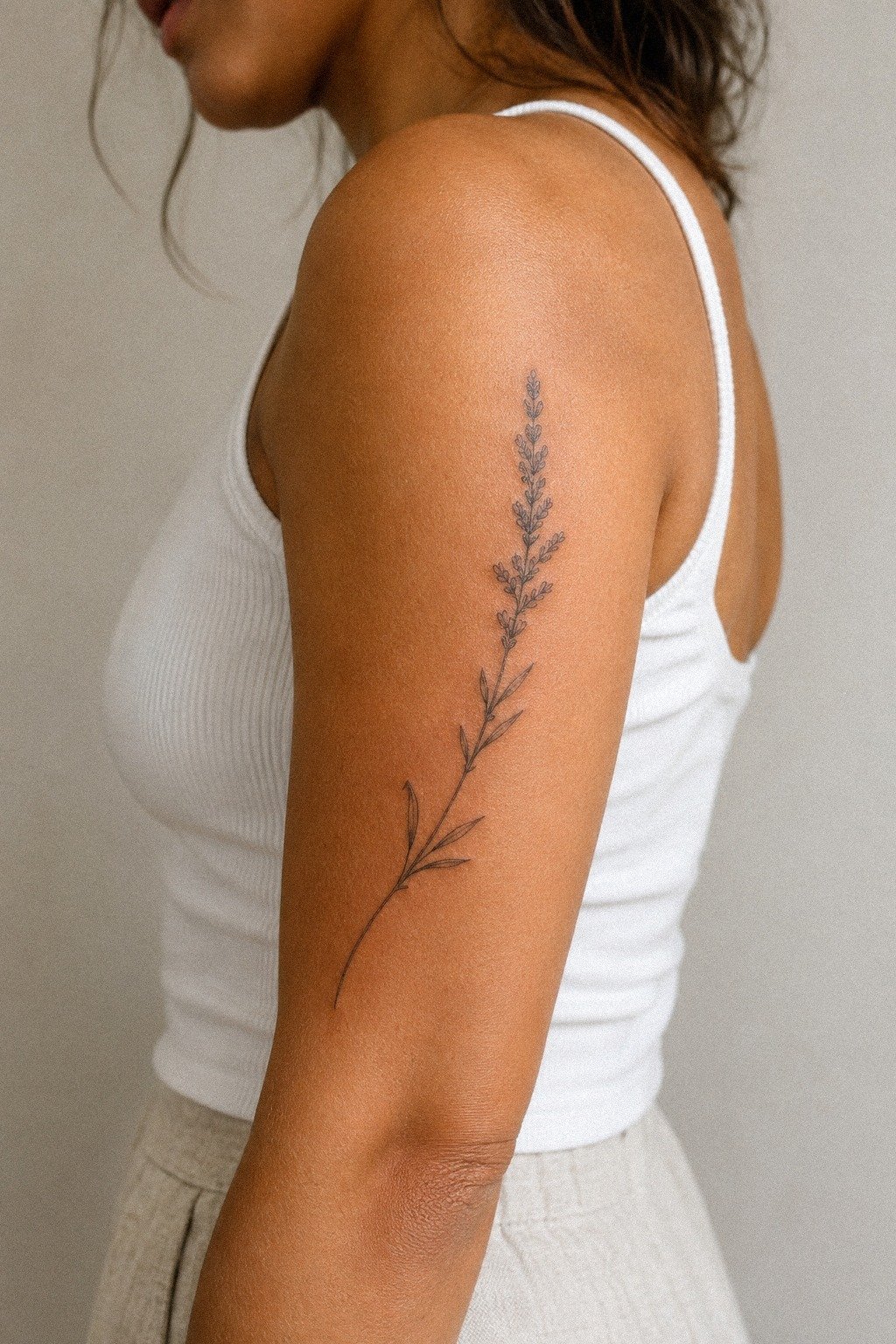
A single needle lavender sprig wrapping the upper arm looks gorgeous on golden tan skin because the warm undertone makes the violet ink pop.
5Build a Birth Flower Bouquet From Flash
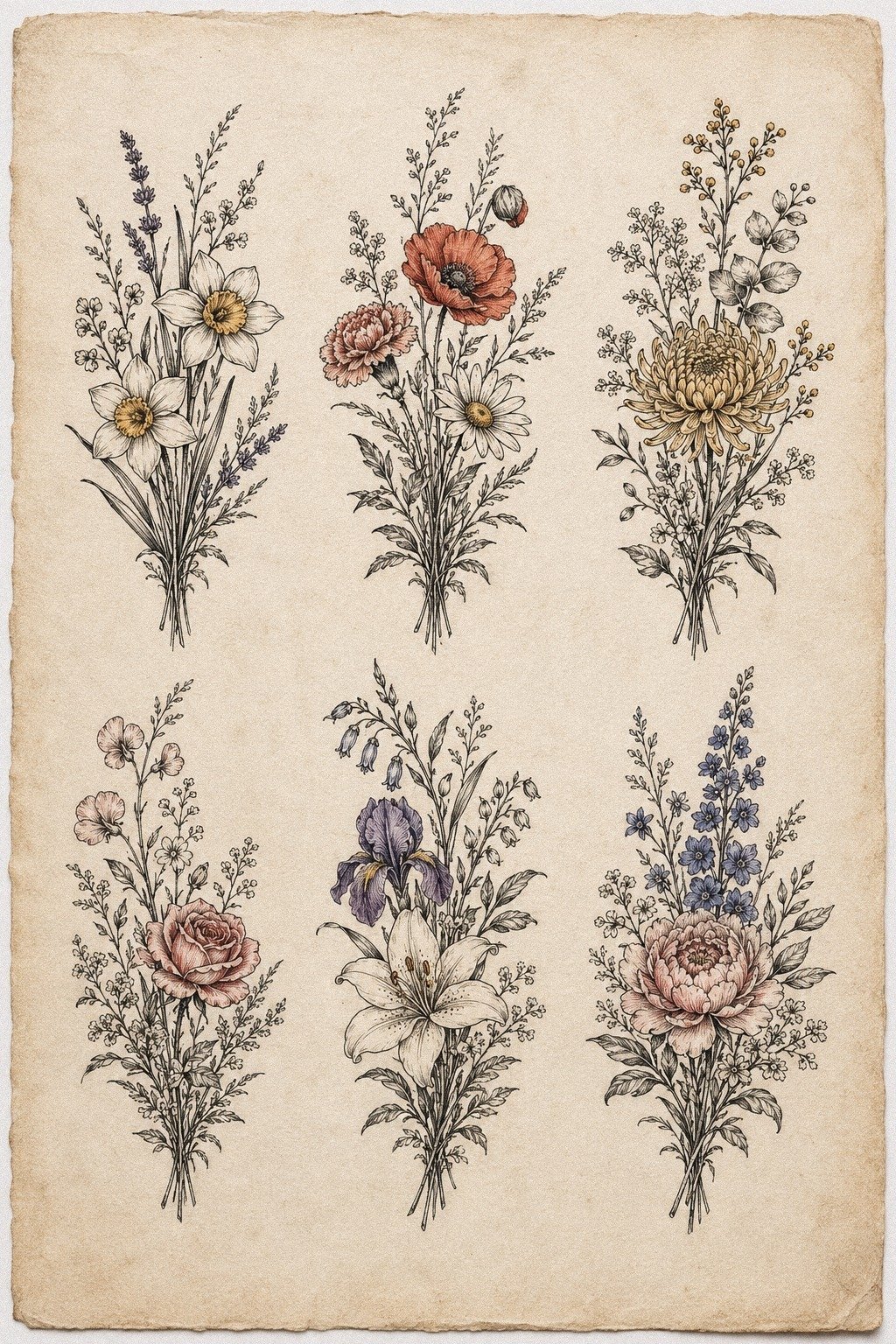
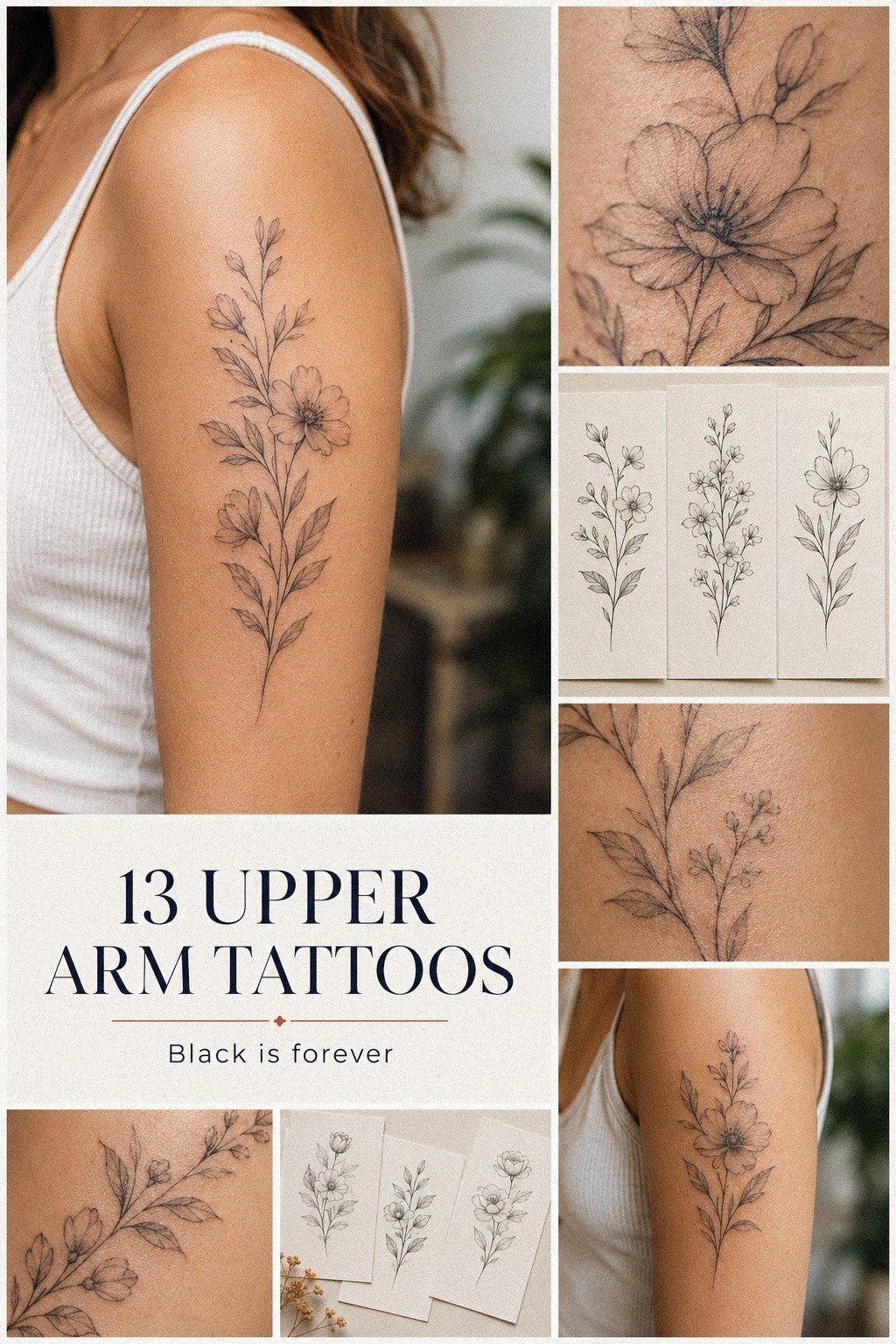
Birth flower bouquets are one of those designs that look better when they’re built from a flash sheet rather than custom. Flash sheets are pre-drawn designs the artist already knows will heal well, and birth flowers are a classic flash subject. Walk into a studio, point at the flower for your month, and the artist does the rest.
It’s faster, cheaper, and often heals cleaner than a custom piece because the linework has been refined over hundreds of tattoos.
If you want multiple birth flowers (your kid, your mom, your best friend), bundle them on the upper arm into a bouquet rather than scattering them. The bundle reads as one composition.
Scattered birth flowers look like a phone wallpaper. Bundle them.
Keep the line weight consistent across all the flowers so nothing looks like an afterthought.
Flash is also where the smart spend lives: you pay the artist’s hourly, you don’t buy a kit, you don’t ship anything. Most flash birth flowers run about $80 to $250 for a small bouquet (1 to 2 hours of work, depending on the artist and your city).
That’s the floor. Higher-end shops in NYC, LA, or Miami push $250 to $400 for the same design because you’re paying for the artist’s name.
If you want a deeper explore what flash vs custom actually means in 2026 (and why flash is no longer the “cheap option”), our arm tattoos for women breakdown covers it. You can also pair this with smaller wrist tattoos if you want the floral theme to continue down the arm without crowding.
6Frame a Delicate Butterfly on the Upper Arm
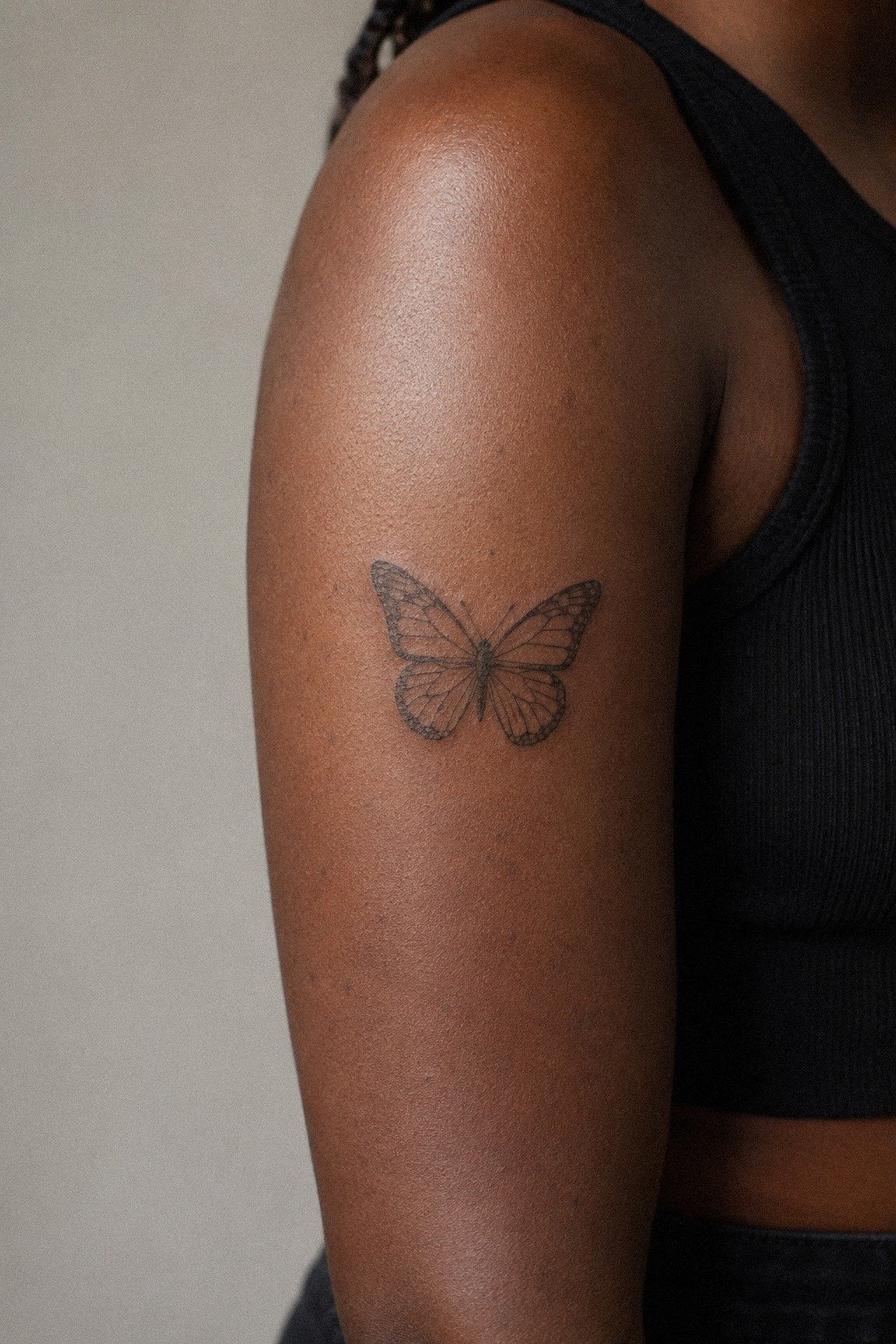
Delicate butterflies are deceptively hard to tattoo well, and the difference between a beautiful one and a sad one is line confidence.
7Layer a Minimalist Moon Phase Arc
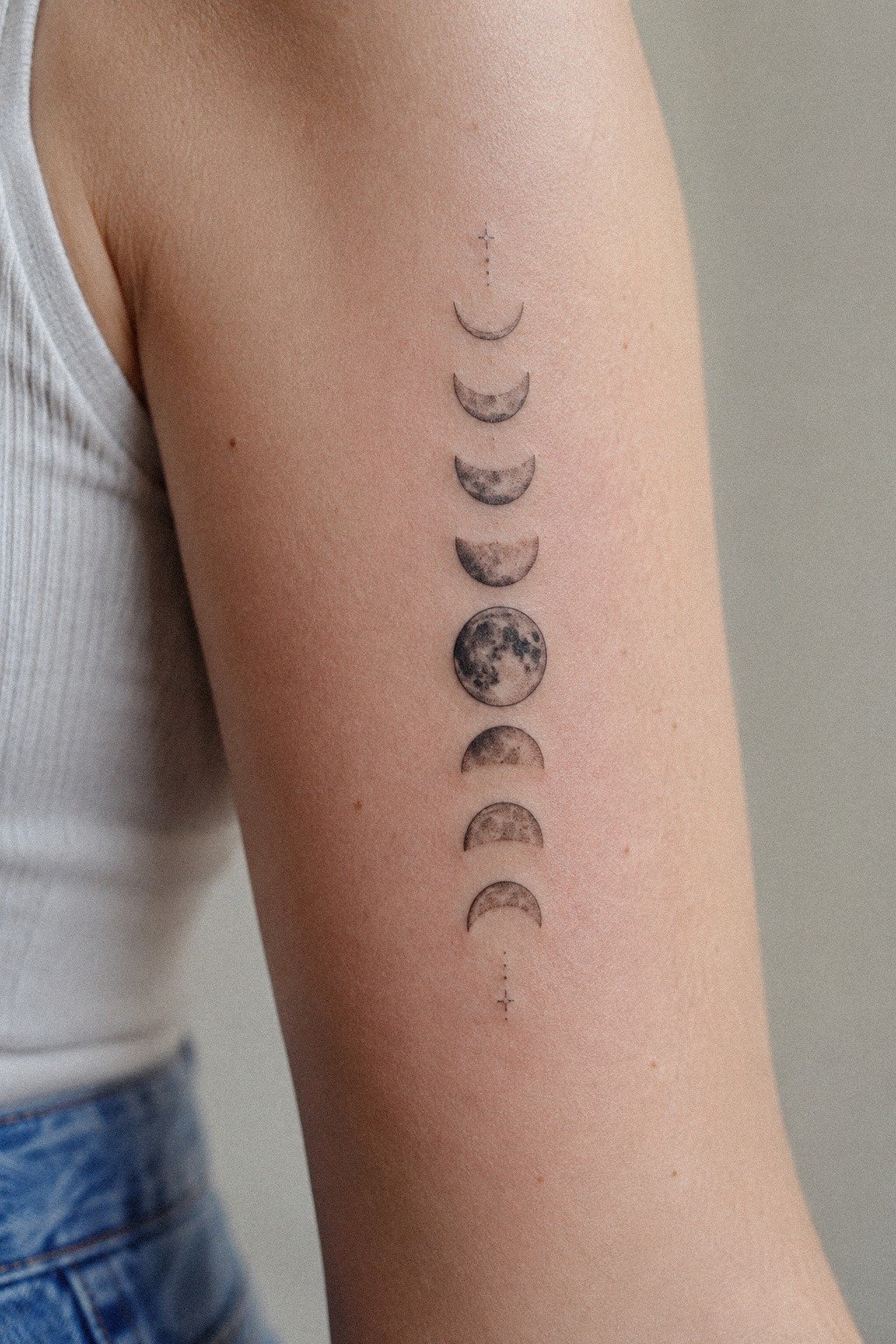
A minimalist moon phase arc running along the upper arm is one of those designs I push first-timers toward because it’s small, meaningful, and ages like iron if done right. Each moon phase is a separate element with breathing room between, so the skin holds the line and the design doesn’t blur into a band.
The move is size. Moon phases work at 2 to 3 inches total length, not 6.
When artists scale them up, they have to add detail to fill the space, and that detail is what turns to soup by year five. Keep it small.
Keep the moons as simple geometric shapes (full circle, half circle, crescent). Add one tiny dot for the new moon.
That’s it.
On fair cool-pink skin, the black ink reads crisp without heavy saturation. Ask your artist for a 3-round liner at 0.30mm depth, which is enough to hold the line without scarring.
Lighter and it’ll fade. Heavier and you’ll see raised lines after healing.
The middle ground is the detail.
Moon phase tattoos also work as the “starter” piece before a larger celestial sleeve, and our neck tattoos for women guide covers the reverse: small pieces you can hide at work that scale up into a full celestial theme later.
Honestly, I wish I’d gotten my moon phase arc before any of my bigger pieces. It taught me what healed ink looks like on my skin. Worth it on every front: cheap, small, gentle, and the best affordable way to learn how your skin holds ink.
8Anchor a Soft Watercolor Peony Quarter Sleeve
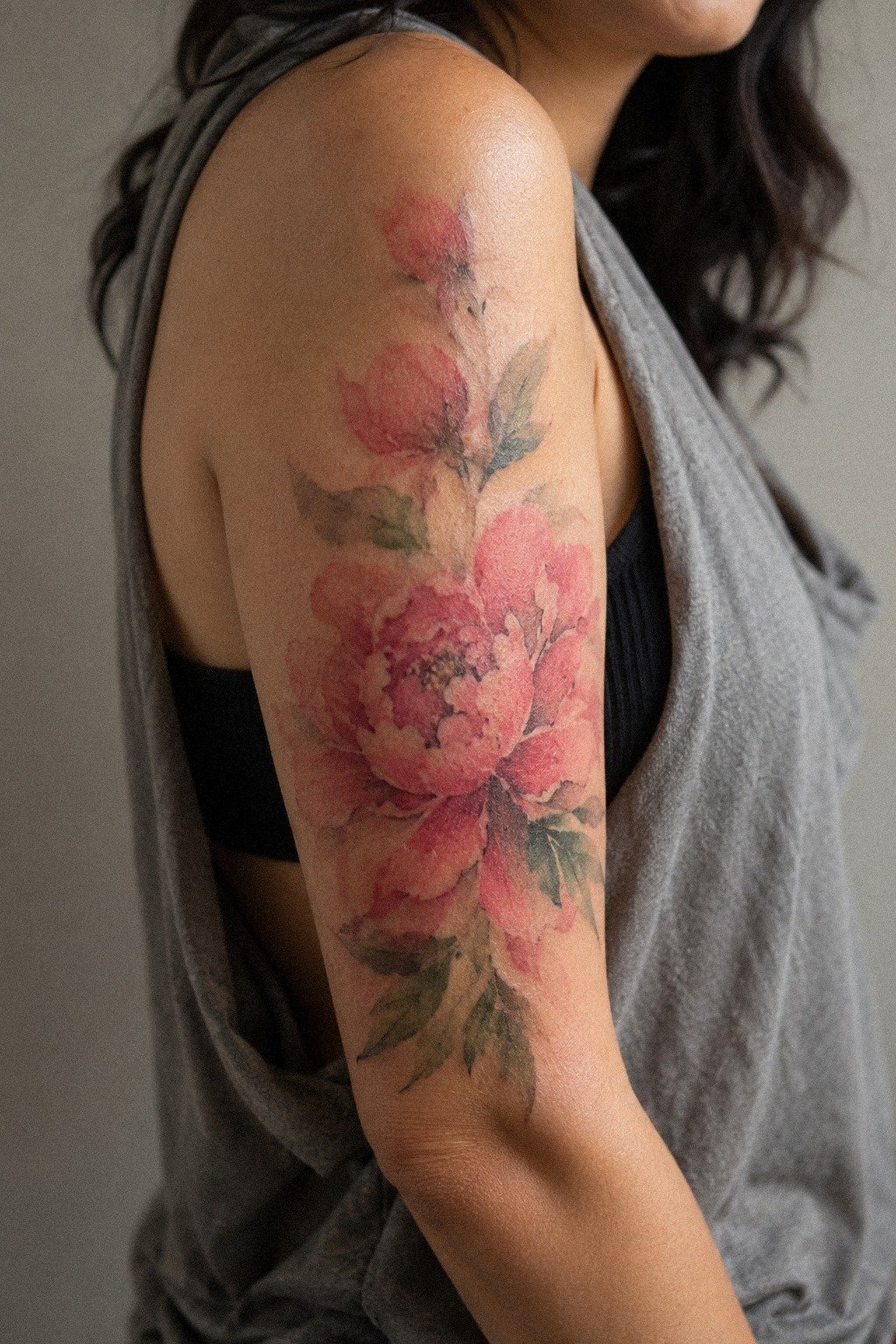
Watercolor tattoos get a bad rap because most of them are muddy soup by year three.
9Loop a Tiny Daisy Chain Around the Bicep
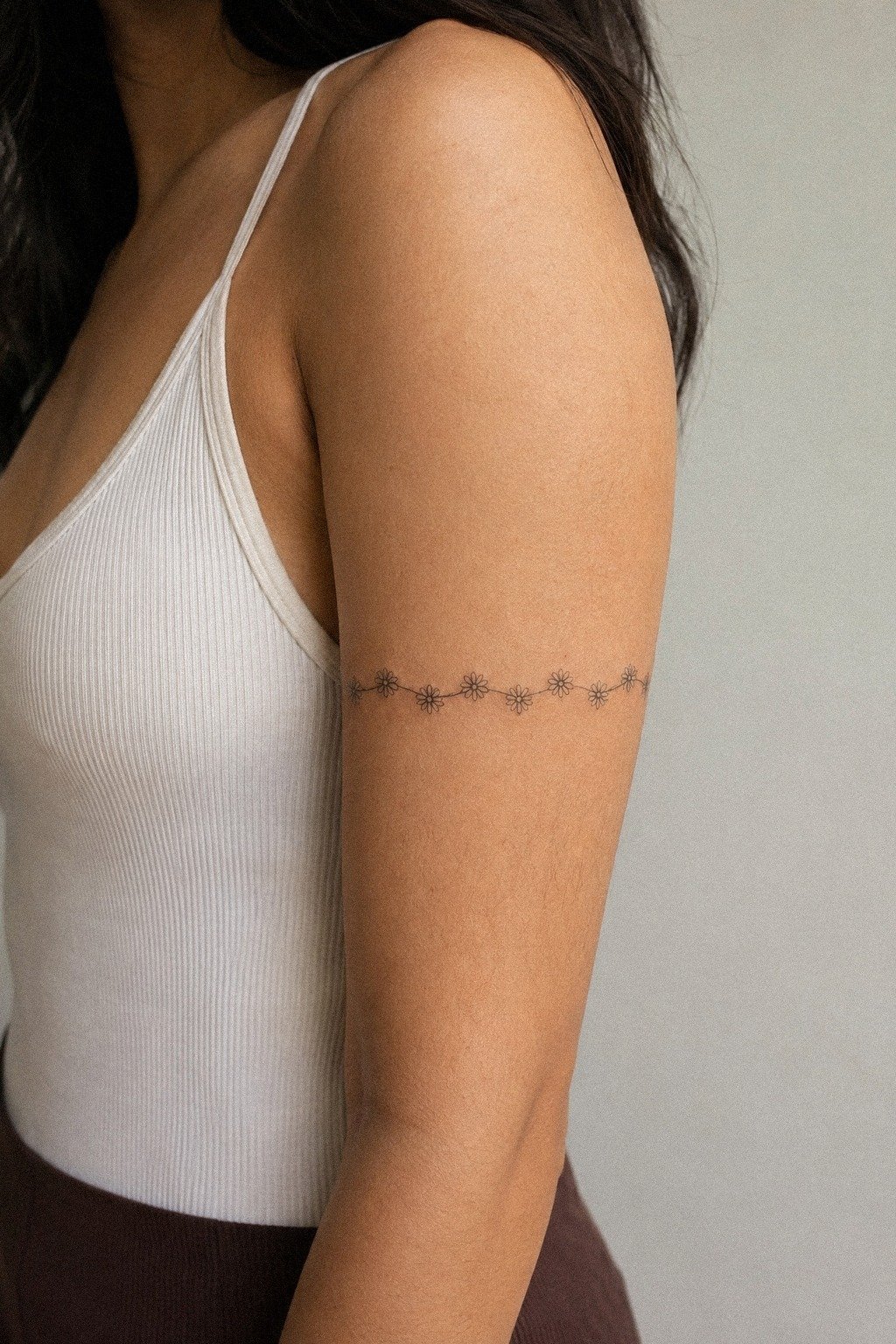
Tiny daisy chains are what I’d call a “starter tattoo with teeth.” They look simple, but they’re actually a test of the artist’s hand. Each daisy is small enough that any wobble shows, and the chain needs to follow the bicep curve without looking stamped on. On medium olive skin, the contrast is naturally warm, so even a thin line reads clearly.
The play is consistency. Every daisy should be the same size, the same number of petals, the same spacing.
If the artist is rushing, the daisies will drift in size as they move around the arm. A good artist measures twice.
A rushed one eyeballs and you’ll see the difference at year three when the inconsistent daisies age at different rates.
Placement-wise, the daisy chain works best as a wraparound at the mid-bicep, not the lower bicep. Mid-bicep flexes less during daily life. Lower bicep moves every time you lift anything.
That motion is what softens tiny lines into blur over years. Higher up = longer hold.
If you’re pairing the daisy chain with another piece later, our arm tattoos for women guide covers how small florals connect into bigger compositions without looking like an afterthought. I love this design for first tattoos. Budget around $150 to $400, and you’ll wear a charming little welcoming ring of daisies for years.
10What Makes an Ornamental Mandala Hold Up for a Decade?
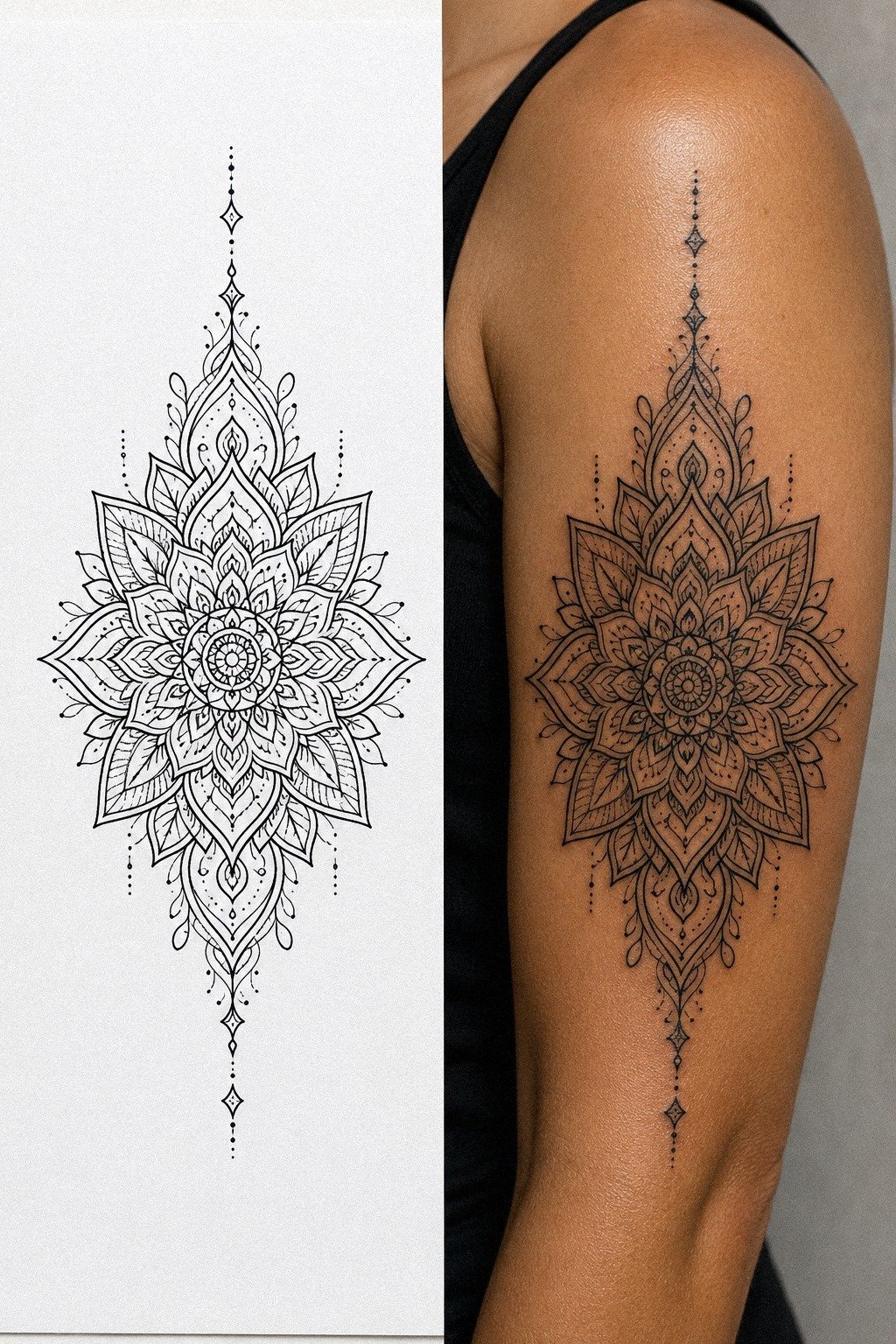
Ornamental mandalas are having a real moment, and for good reason: they’re geometric, they age beautifully, and they read from across the room. The move is the stencil-to-skin transfer.
A clean mandala tattoo starts with a precise stencil. If the stencil smudges before the artist starts, the mandala will be crooked and there’s no hiding it.
Ask your artist to let the stencil dry for at least 10 minutes before they start inking.
On any skin tone, a mandala done in solid black with no grey wash will hold its shape for 10+ years. That’s the longevity test. Grey wash mandalas age softer but lose definition.
Pure black mandalas stay crisp. Pick your trade-off honestly.
I always pick pure black for longevity. You can always add grey later; you can’t subtract muddy grey.
The split-view reference (stencil on paper, healed on skin) is the standard I judge every mandala by. If the artist’s portfolio doesn’t show both, they’re hiding the healing quality.
Walk away. For context on how geometric tattoos age versus softer styles, our upper arm tattoo ideas gallery has examples across both styles. Pairing the mandala with a smaller foot tattoo lets the geometric theme continue down the body.
Don’t get a mandala smaller than 4 inches across. Below that, the inner geometry collapses into noise.
Bigger is better here, within reason. The cost runs $300 to $800, and it’s worth it because the harmonious geometry holds decade after decade.
11The Fine Line Script Rule for Picking a Font That Heals Clean
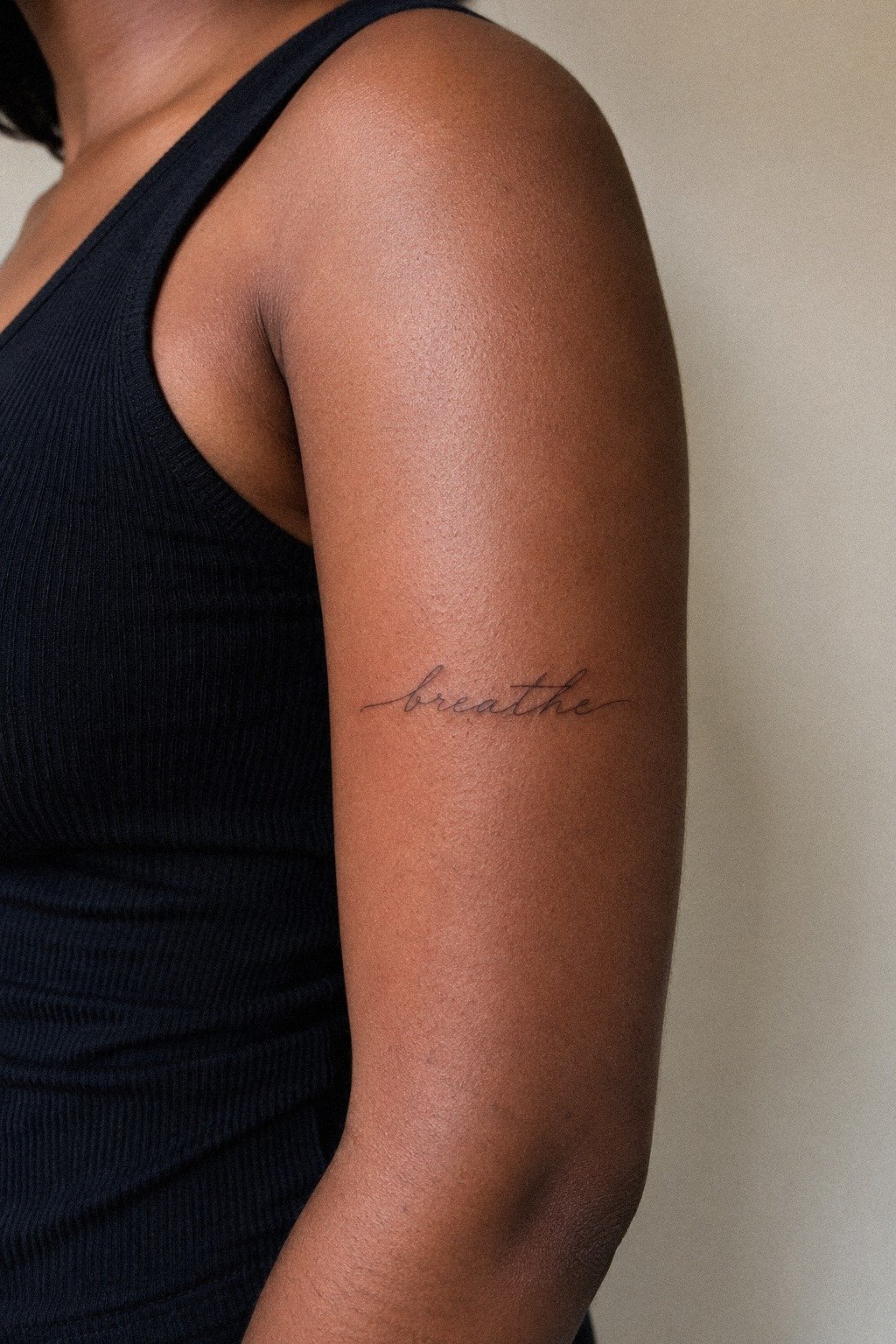
Fine line script on the upper arm is one of those designs where the difference between “looks great” and “looks like a ransom note” is the artist’s font choice. Skip the calligraphy fonts.
They’re beautiful on paper and a disaster on skin because the thin downstrokes disappear by year two. Pick a clean sans-serif (Helvetica, Futura, Avenir) or a simple serif (Times, Garamond) with consistent line weight throughout.
On deep brown skin with warm undertones, black ink reads beautifully against the natural undertone. The contrast is high, and the script stays legible for years.
The risk is that the artist tries to “compensate” by going heavier, which then leads to thick script that looks like bold print instead of fine line. Ask for 3-round liner at standard depth.
Trust the process.
Length matters more than people think. A 4-word quote heals cleaner than a 12-word quote. The longer the line, the more chances for a wobble, and a wobble in script is forever.
Keep it short. Keep it true.
If you want to study how script ages versus other styles, our small arm tattoos ladies guide covers the longevity data across font types and sizes. For pairing ideas, our forearm tattoos guide shows how script flows into a sleeve without crowding.
And one last thing on script: spell-check it three times. I mean it. Tattoos are not where you want to be surprised by a typo.
12Why Does a Cherry Blossom Quarter Sleeve Age Like Iron?
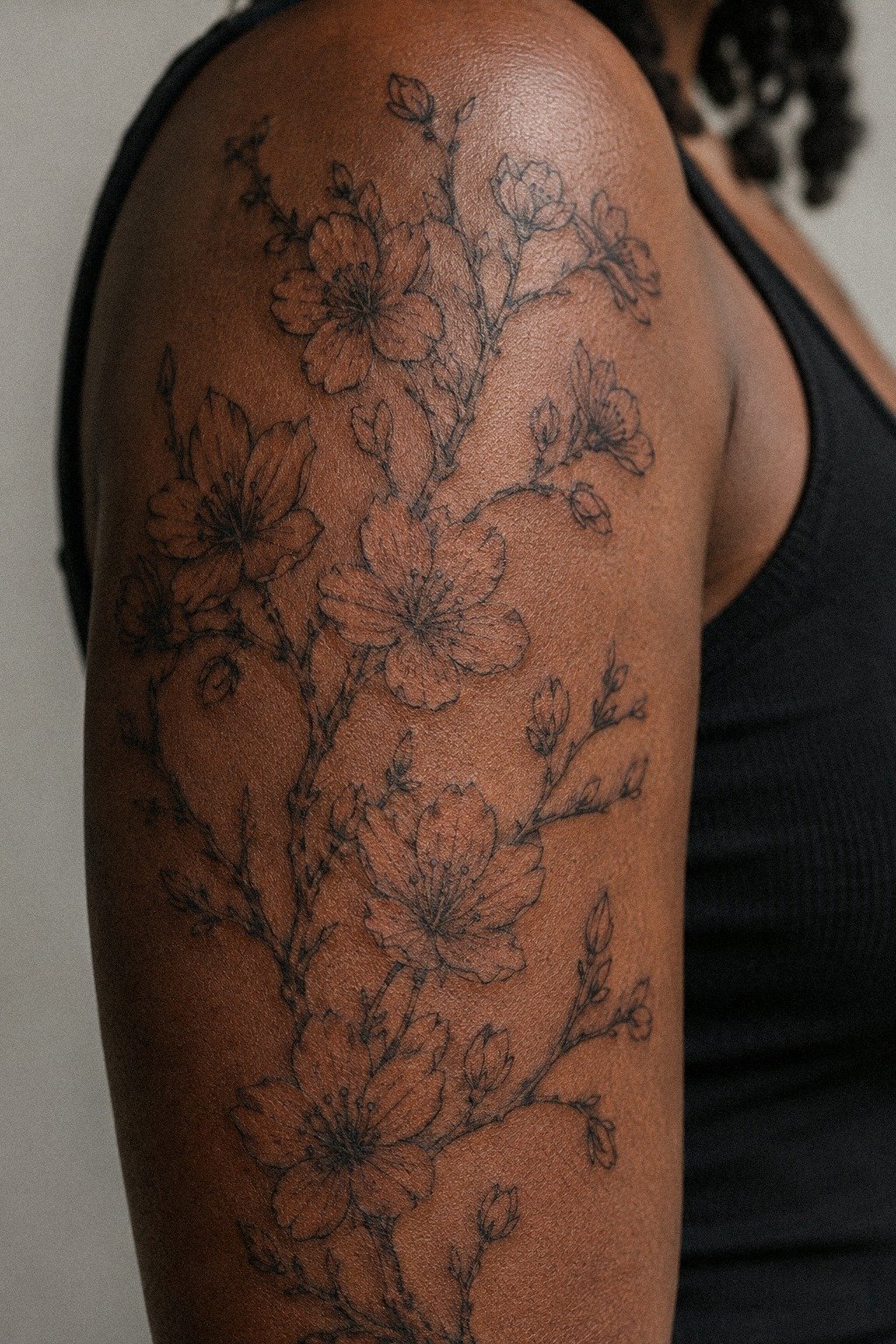
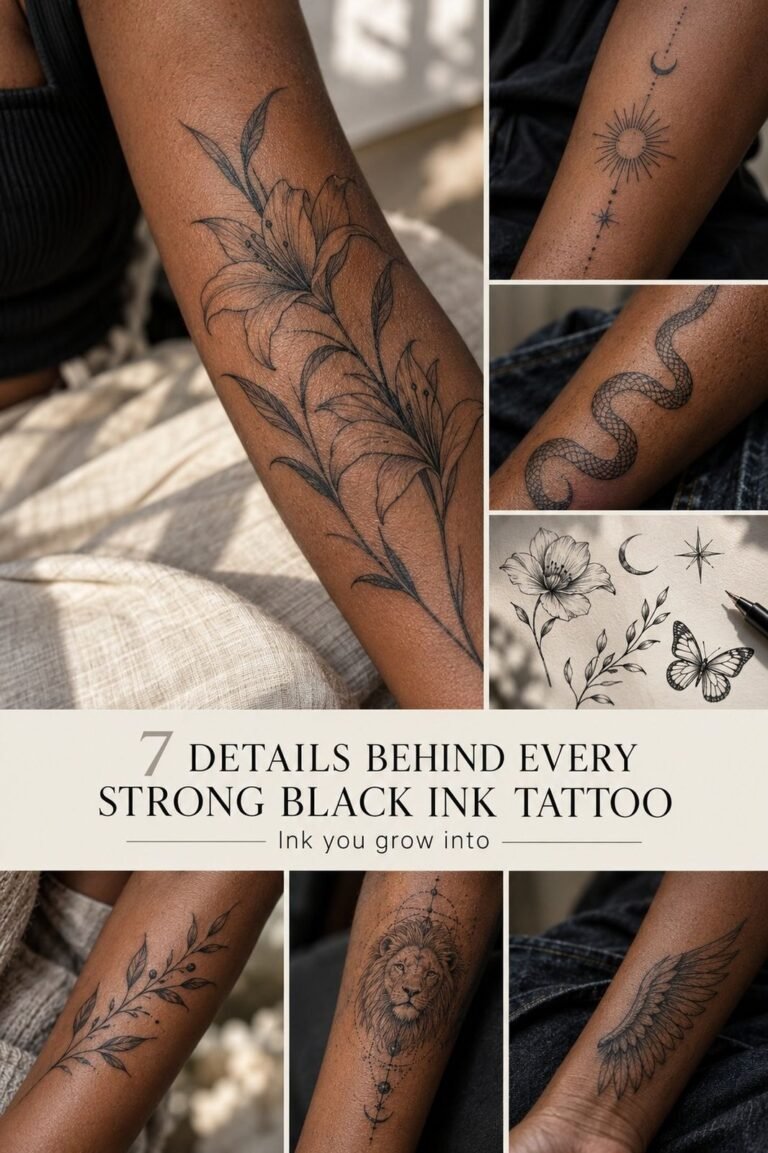
Cherry blossom quarter sleeves are one of the most popular designs in tattooing right now, and the reason is simple: they age like iron when done right, and they read beautifully on melanin-rich skin. The branch is structural (heavy black lines that hold), the blossoms are soft (light color washes that fade gently), and the negative space between petals is generous so the skin breathes.
The play on deep ebony skin is layered color builds. A cherry blossom on lighter skin can be a single pink wash. On deeper skin, the artist needs to build the pink up in 2-3 passes to get the same visual brightness.
That takes more time, more skill, and a higher hourly rate. Don’t cheap out here.
This is one design where the artist’s hourly matters.
Plan for 2 to 4 sessions of 2 to 4 hours each. Cherry blossom quarter sleeves are not a one-and-done piece.
If someone tells you they can do it in a single 4-hour sitting, they’re going to overwork the skin and the blossoms will heal patchy. Walk away.
For context on how cherry blossoms pair with other Asian-inspired pieces (dragons, koi, waves), our upper arm tattoo ideas gallery has reference photos across styles. And if you’re considering a Japanese traditional piece later (irezumi, dragons, koi), I’d recommend Marco Ferrer’s work.
He’s trained in Japan and specializes in the heavy blackline builds that age best on melanin-rich skin. Our irezumi guide has more on that tradition if you’re curious.
Honestly, this design is on my shortlist for my own next piece. I keep coming back to it. The cost is the splurge of the list, $600 to $2,000, but the exquisite result is worth the investment if you commit to the right artist.
13Crown a Tiny Red Ink Heart on the Outer Arm
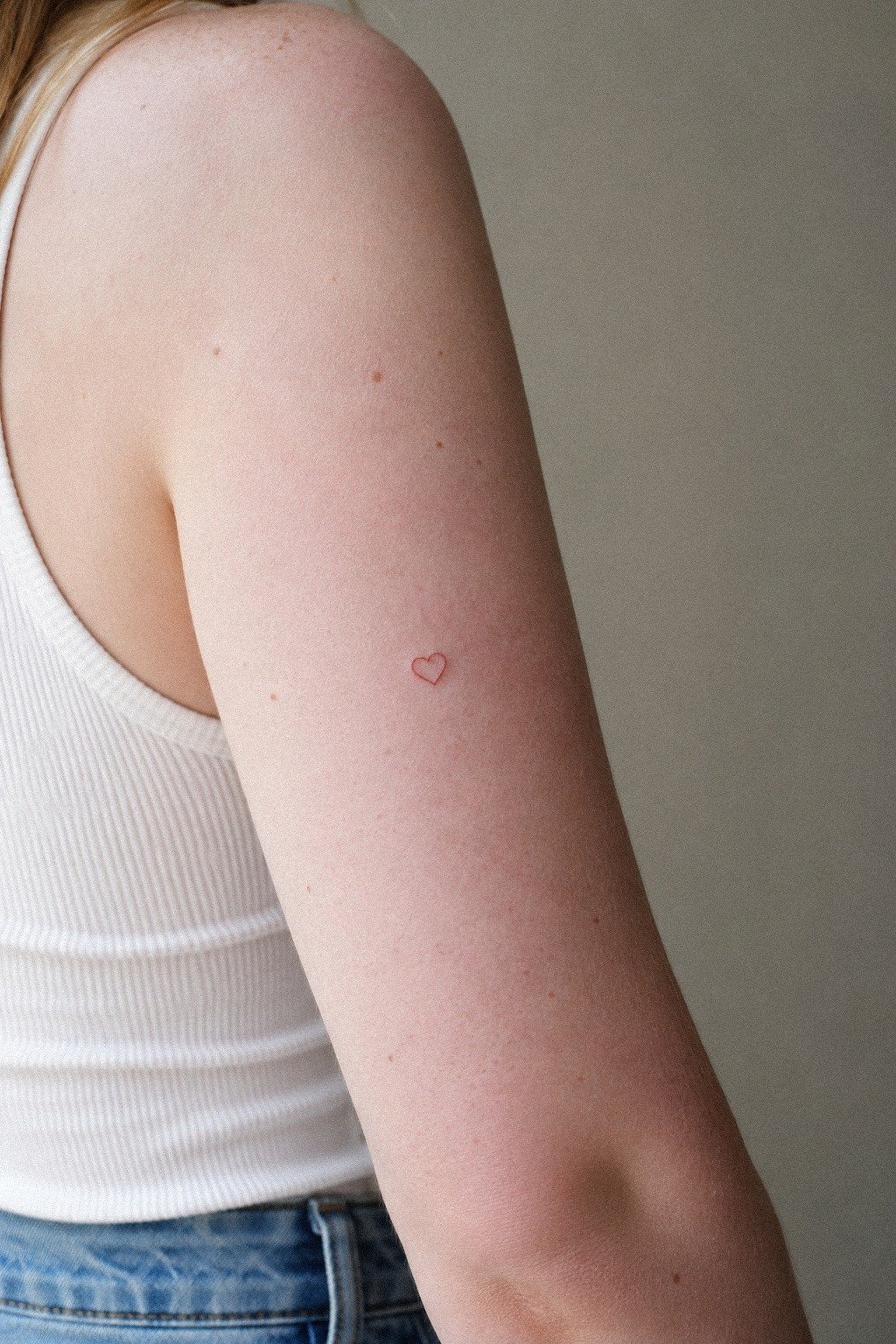
Tiny red ink hearts are the perfect “I want a tattoo but I’m scared” tattoo, and I’m not being dismissive.
The Honest Pricing Breakdown (US Averages, 2026)
Here’s what these designs typically run in a US studio in 2026. Use it as a sanity check before you book, not a quote. Your artist’s rate depends on their experience, your city, and how busy their books are.
Hourly rates by city tier (2026 rough averages): small/mid Midwest and Southern cities run $100 to $160/hr; mid-tier metros (Denver, Atlanta, Portland) run $150 to $200/hr; top-tier coastal cities (NYC, LA, San Francisco, Miami) run $200 to $300/hr for established artists. Apprentice and junior artists often run $50 to $100/hr but with less experience. Minimum shop fees are typically $50 to $100 even for tiny pieces.
The question I get asked most is how to budget for a meaningful first piece: the answer is set aside $200 to $400 for a small, well-healed first tattoo with an artist whose healed portfolio you trust. Anything cheaper than that, you’re gambling on the artist, not the design.
Why These Designs Keep Showing Up (And Why That’s Okay)
There’s a reason you’re seeing the same 13 designs recirculate across Pinterest, Instagram, and studio flash sheets: they work. They’re the designs that artists have refined over years of tattooing them on actual bodies, in actual healing conditions, with actual sun exposure. They’re not the only options.
But they’re the ones with the longest track record of aging well.
Trend-wise, fine line and small florals are still climbing in 2026, but the pendulum is shifting toward anchored minimalism, designs that look minimal but have solid structural linework underneath. Pure minimalism (hairline lines, no anchor) is fading as people realize how fast those pieces mush out. Blackwork and traditional continue to hold strong because bold will hold.
Watercolor stays niche because the maintenance is real and the artists who do it well are rare.
If you’re choosing your first upper arm piece in 2026, here’s my honest read: pick the design that connects to something real for you (a birth flower, a moon phase, a phrase, a person), pick an artist whose healed portfolio matches your skin tone, and don’t cheap out on the hourly. The hourly buys you the artist’s eye, not just their hand.
Most regretted tattoos I see aren’t bad designs. They’re good designs done by artists who weren’t ready for them.
The cost-vs-value balance here is real: an affordable design done by the wrong artist costs you more in touch-ups and cover-ups than a slightly expensive design done right the first time. Spend on the artist, save on the trend.
What People Always Want to Know
How much does an upper arm tattoo for women usually cost?
Most small upper arm pieces (under 3 inches) run $80 to $300 at typical US shops in 2026. Quarter sleeves and larger pieces run $400 to $2,000+ depending on the artist, city, and detail. Hourly rates span $100 to $250 for most established artists, with top coastal talent pushing $300+/hr.
Always ask about the artist’s minimum shop fee before booking.
Are upper arm tattoos a good idea for a first tattoo?
Yes, and here’s why. The outer upper arm is one of the most forgiving placements on the body: thick skin, low daily friction, easy to cover at work if needed, and the pain level is on the mellow end of the spectrum.
You’ll feel a scratchy hot sensation, not the bone-deep sting of a rib or sternum piece. Most first-timers I work with are surprised by how manageable the upper arm is.
How do I choose a tattoo artist for an upper arm piece?
Look at healed photos (not fresh tattoos), check their specialty matches your style (don’t book a realism artist for fine line), and read recent reviews about studio hygiene. If an artist only shows fresh work in their portfolio, they’re hiding the healing quality.
Walk away. A good artist will have 50+ healed photos of the exact style you’re booking.
How much do upper arm tattoos hurt?
Honest scale: outer arm, shoulder, and upper back are on the mellow end: most people rate them 3-5 out of 10. The closer you get to the armpit, inner bicep, or elbow, the spicier it gets. Those zones rate 6-8 out of 10 for most folks.
Lines feel sharper than shading. Color packing is the spiciest part because the needle stays longer in one spot.
Take breaks if you need them. Tap out for five minutes rather than pass out on me.
How long does an upper arm tattoo take to heal?
Surface healing takes 2 to 3 weeks: the skin closes, peeling finishes, and the tattoo stops feeling like a sunburn. Deep healing takes 2 to 3 months: the ink settles into the dermis fully and the color evens out.
During those first 2 weeks, treat it like an open wound: gentle unscented soap, thin layer of aftercare ointment, no sun, no pools, no gym friction. Don’t pick the flakes or you’ll pull color out.
Sun is the #1 tattoo killer over a lifetime.
What’s the best placement for an upper arm tattoo?
The outer upper arm (deltoid and mid-bicep) is the sweet spot for most designs. It’s thick-skinned, low-friction, ages well, and easy to cover with a sleeve if needed.
The lower bicep and inner bicep see more flex and more sun exposure through daily wear, so they age faster. The shoulder cap is great for pieces you want to extend into a sleeve later.
Avoid the elbow ditch and the armpit unless you’re committed to more frequent touch-ups.
Where I’d Start First
If I had to pick one, I’d start with the fine line moon phase arc. Here’s the honest reason.
It’s the cheapest piece on the list ($80 to $200), the smallest commitment (under 90 minutes), the easiest to cover at work, and it’ll teach you exactly how your skin heals ink before you commit to anything bigger. You can’t layer warmth on a tattoo collection that starts with regret.
Every piece after the first should build on a foundation you trust. Get the moon phase.
Heal it for three months. Watch how it ages.
Then book the bigger one. If you want a deeper dive on first-tattoo strategy, our small arm tattoos ladies guide walks through the same logic.