
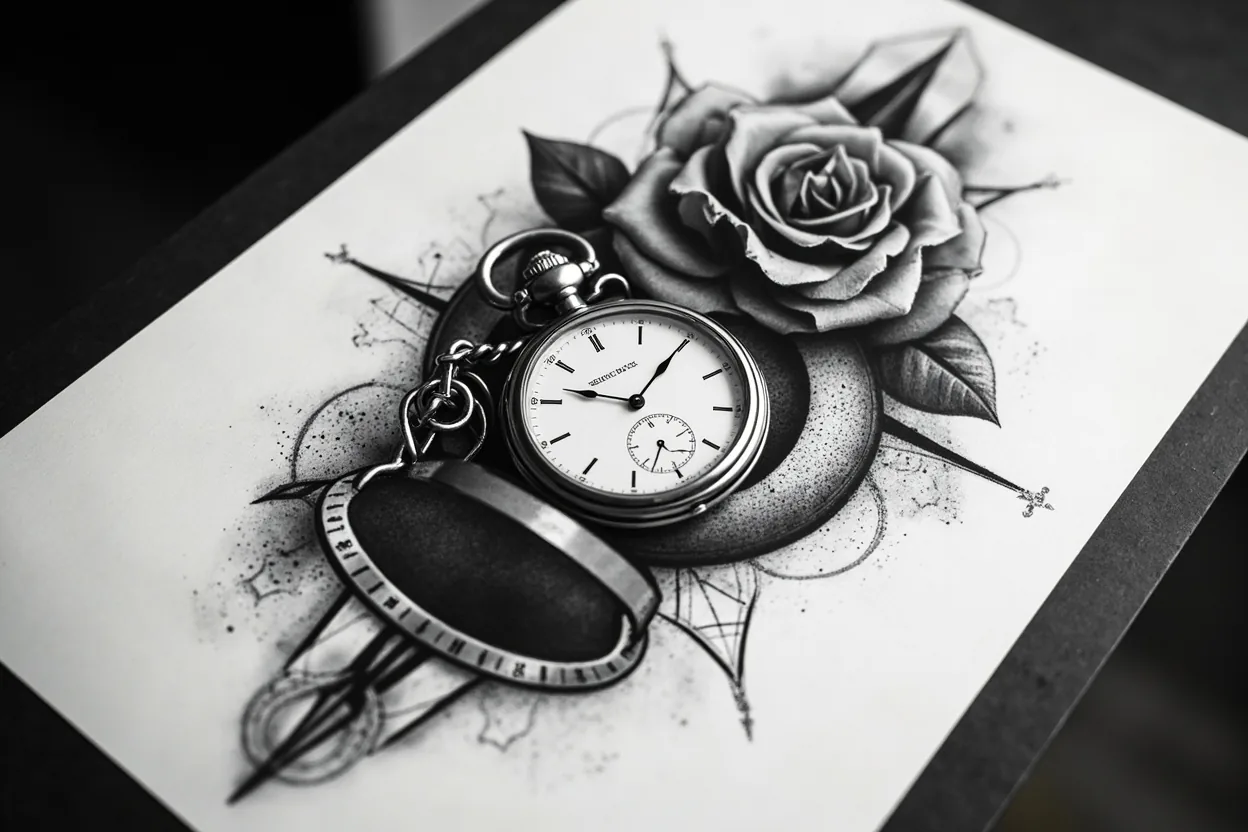
A pocket watch tattoo carries more weight than a standard clock. The object itself suggests something carried close, passed down, deliberately checked. That intimacy shapes its meaning: memory, mortality, a fixed moment, family lineage, or the sense that one particular hour still deserves your attention.
Quick answer: A pocket watch tattoo usually signals time, memory, mortality, or legacy. The strongest designs combine a readable clock face, a clear chain shape, and one supporting symbol, a rose, compass, eye, or specific date.
What a Pocket Watch Tattoo Actually Means
The clock face matters. So do the objects around it. A rose, a skull, a compass, broken glass, a banner with a date, each shifts the story in a different direction. Before you settle on imagery, you should know what each element tends to communicate, and where the design risks hide.
| Design element | Meaning angle | Design risk |
|---|---|---|
| Stopped time | Memorial date, turning point, grief | Hands must be readable at final size |
| Pocket watch with rose | Love, memory, beauty against time | Can become too busy below 3 inches |
| Broken pocket watch | Mortality, loss, time running out | Glass cracks need enough scale to hold |
| Pocket watch and compass | Direction, travel, fate | Two round objects can fight for focus |
| Vintage chain | Family history, heirloom feeling | Tiny chain links blur easily over time |
Mortality and the Passage of Time
A pocket watch is often linked to memento mori traditions, though the connection is looser than with hourglasses or skulls alone. The watch says you are measuring something finite. That resonates differently at twenty than at sixty. Some people choose this imagery after a health scare, a near-death experience, or simply the quiet realization that their time is not unlimited. The pocket watch frames that awareness as something personal and carried, not abstract.
Memory and Fixed Moments
This is where pocket watch tattoos separate themselves from other clock designs. A wristwatch or wall clock feels public, standardized. A pocket watch feels owned, inherited, tucked away and brought out deliberately. That quality makes it natural for memorial work: a stopped face marking an hour of death, birth, sobriety, or some private turning point. The meaning lives in the specificity. A watch stopped at 3:47 because that is when someone you loved stopped breathing carries a weight that a decorative vintage prop cannot touch.
Craft and Vintage Aesthetic
Not every pocket watch tattoo needs heavy symbolism. Some people simply respond to the object itself: the engraved case, the bow and crown, the chain, the mechanical complexity visible through an open face. Victorian and steampunk aesthetics draw on this appreciation for visible craftsmanship. If you are drawn to the style rather than a specific meaning, that is valid. Just be honest with your artist about priorities so the design does not accidentally signal grief you do not intend.
Why Memory Dominates This Design
A pocket watch feels personal because it looks possessed. It carries an heirloom quality that a digital display or standard wall clock does not have. That is why people so often use it for memorial pieces, family history, birthdays, sobriety dates, or the hour something changed.
If the watch hands point to a real time, make sure your artist draws them clearly. A meaningful hour loses its point if the hands blur into decorative lines. Roman numerals generally hold better than Arabic numerals at smaller scales because the thick and thin strokes remain distinct even as ink spreads slightly during healing. A stopped face at 3:15 should read as 3:15 from across a room, not require explanation.
The specificity of reference matters enormously. If you have an actual pocket watch, your grandfather’s, perhaps, or one from an estate sale, photograph it from multiple angles before your appointment. Worn scratches on the case, a cracked crystal, a monogram on the inner lid, the particular font of the numerals. These details transform a stock image into something that actually belongs to your history. Without them, you risk a generic vintage prop that says nothing in particular.
Fine-line portrait work can blur significantly over ten years, especially on high-movement areas. Bold clock numerals, by contrast, hold their shape for decades if properly executed. That practical durability is one reason memorial clients gravitate toward stopped clocks rather than faces alone.
Design Ideas That Actually Work
The Classic: Watch with Rose
The most common pairing is time plus love or memory. The rose softens the mechanical object, adds organic curves that contrast with the circular face, and provides natural color if you want it. The risk is overcrowding. Below three inches, the rose petals and watch details start competing for space. If you want this combination small, simplify the rose to a bud or a single fallen petal rather than a full bloom.
Mortality: Skull and Broken Glass
A skull incorporated into the watch or reflected in the crystal moves the piece toward memento mori territory. Broken glass can work but needs room. Tiny cracks on a small watch face will not hold; they will heal as blurry scratches. If you want fractured crystal, plan for at least palm-sized scale so the artist can vary the crack weights and give them real geometry. Otherwise, keep the face intact and let the skull carry the mortality theme.
Direction: Compass Pairing
Compass and pocket watch share circular geometry and travel associations, but two round objects can fight for dominance. The usual solution is to make one clearly primary and the other secondary: the watch face large and central, the compass smaller and tucked into the chain loop or background. Alternatively, merge them conceptually with the compass needle emerging from the watch center, though that requires an artist comfortable with custom drafting.
Style Considerations
Black and grey remains the safest approach for vintage pocket watches. The tonal range suits metal, shadow, and aged materials. Color can work through flowers, gemstones, or background washes, but the clock face itself should stay readable. A bright yellow face with black numerals might seem striking fresh, but yellow fades fastest and can leave you with a washed-out disc in five years.
The classic execution is a half-open watch face in black and grey with whip shading on the case and crisp linework on the numerals. Add a chain that wraps naturally with body contour rather than floating flat. Roses, swallows, banners, and small compasses all combine well if scaled to support rather than compete.
For steampunk-influenced work, gears, springs, and exposed mechanical parts add visual complexity. These look impressive fresh but demand skilled negative space management. Fine detail packed tight will muddy over time if the artist does not leave enough breathing room between elements. If you want heavy mechanical detail, go larger and accept that the piece will need occasional touch-ups to keep the intricacies legible.
Placement and Practical Concerns
Forearm and Upper Arm
The forearm is the most practical placement for visibility. The oval watch shape fits the flat plane well, and you can see it without a mirror. The tradeoff is wear. Forearm tattoos face sun exposure, sleeve friction, and frequent washing. Plan to touch up fine detail every five to seven years. The upper arm offers similar visibility with less daily abrasion, and the rounded muscle surface complements the circular watch face naturally. Both work well within larger sleeves or as standalone pieces.
Thigh and Calf
The thigh is ideal for larger, more detailed work that you want to keep somewhat private. The canvas is generous, healing tends to be clean because the skin is low-friction, and you can build serious detail without scale constraints. The calf works similarly but is more visible in shorts and heals with more movement-related irritation during the first two weeks.
Chest and Ribs
Chest placement suits memorial pieces that feel close to the heart literally and figuratively. The surface is relatively flat for the watch face, though pectoral movement during healing can be uncomfortable. Rib placement is more painful and harder to heal because of constant torso flexion, but it keeps the piece private. A pocket watch on the ribs often reads as something you carry inwardly, not for display.
Size Minimums
Avoid making the watch face too small. Roman numerals, hands, chain details, and case engraving all need physical room. As a rough guide, the watch face alone should be no smaller than two inches in diameter if you want any interior detail. At under that scale, you are better off with a simplified silhouette or a different design entirely.
Before You Decide
A pocket watch tattoo rewards patience in the design phase. The difference between a meaningful piece and a forgettable one usually comes down to specificity: a real time, a real object referenced, a real reason for the imagery. The vintage aesthetic is easy to imitate and hard to authenticate. If you do not have a personal connection to the object, consider whether another timepiece or symbol might serve you better.
Talk through the clock face time with your artist before the appointment. Bring reference photos of actual watches if you have them. Decide whether the chain wraps, hangs, or disappears into background. Choose one supporting symbol, not three. The pocket watch is already doing significant visual work; it does not need competition.
Healing takes two to four weeks depending on placement and your aftercare discipline. During that time, the fine lines and numerals are vulnerable. Follow your artist’s instructions precisely; a smudged 4 that heals into a 9 will bother you for years. The best pocket watch tattoos are the ones that still read clearly at distance, still carry their specific hour, and still feel like something you own rather than something you wore for a season.
Frequently Asked Questions
What does a pocket watch tattoo with no hands mean?
A pocket watch without hands or with blank space where hands should be often suggests timelessness, a moment outside normal measurement, or sometimes a feeling of being unstuck from schedule. It can also simply be an unfinished design, so if you see this, ask the wearer what they intended.
Is a pocket watch tattoo only for memorials?
No. While memorial work is common, people also choose pocket watches for vintage aesthetic appreciation, steampunk style, reminders to value time, or family history without a specific death. The meaning depends on what you bring to it.
Do pocket watch tattoos age well?
Better than many detailed designs, but with caveats. Bold numerals and strong chains hold up. Fine mechanical gears, tiny chain links, and small cracks in glass tend to blur over years. Plan for touch-ups if you want intricate detail to stay crisp.
What time should I set my pocket watch tattoo to?
A meaningful personal time: a birth, death, sobriety date, or private turning point. Avoid 12:00 unless it genuinely matters to you; it reads as the default setting and can make the piece feel generic.









