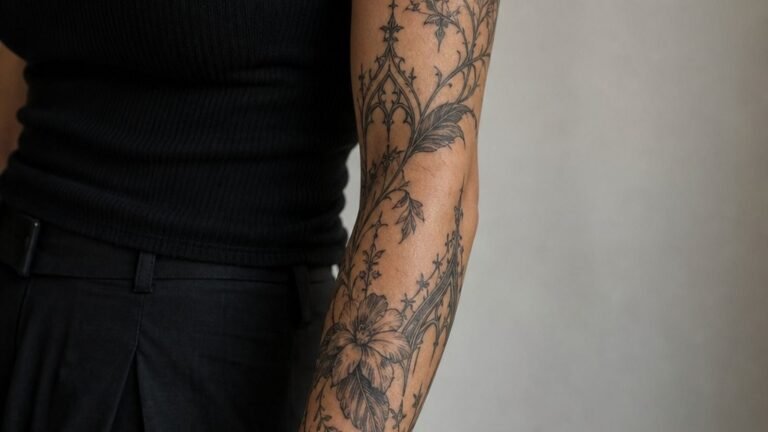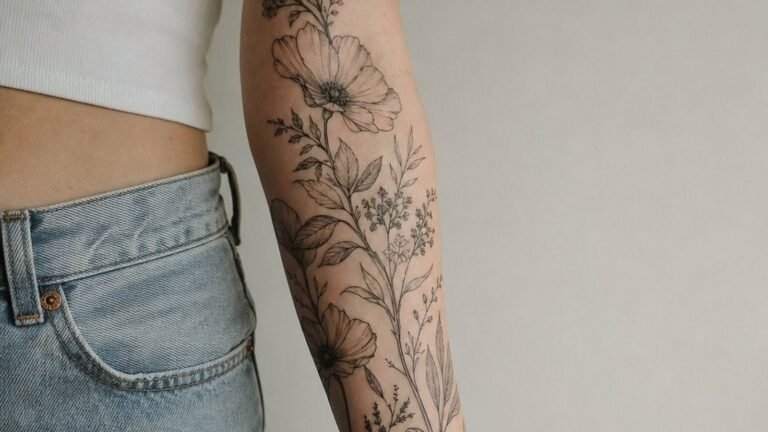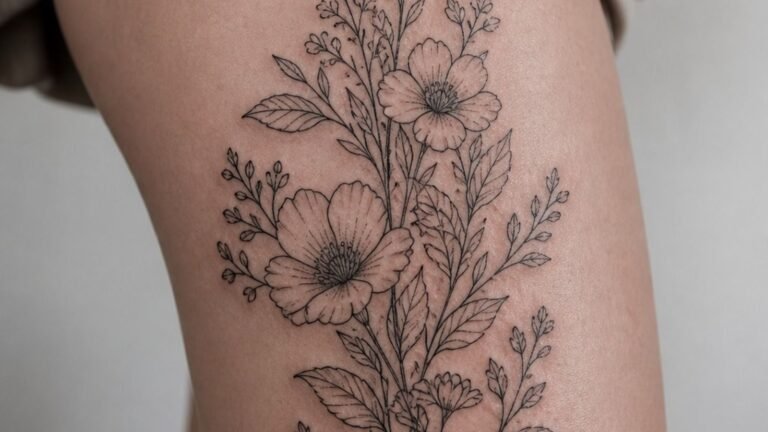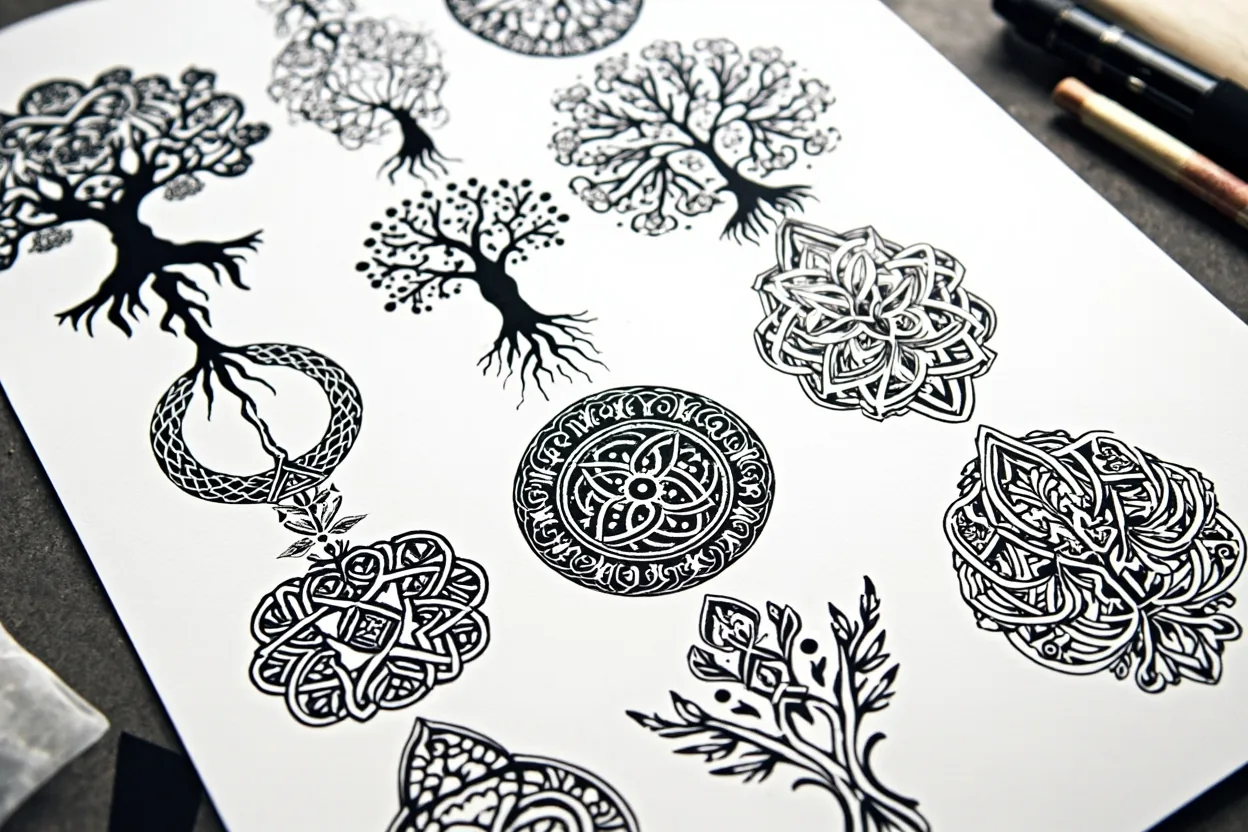
A tree of life tattoo carries weight because the image itself does explanatory work: roots below, trunk steady, branches reaching. It can mark family, survival, spiritual grounding, or the simple fact that you kept growing. The symbol is old, but the tattoo only works if the design matches your specific reason for wearing it.
Quick answer: A tree of life tattoo usually means growth, roots, family, renewal, endurance, and the connection between past and future. The strongest designs keep root structure, trunk, and crown readable at a distance instead of collapsing into decorative detail.
What the symbol actually means
The tree of life appears across many traditions, often linked to Norse mythology (Yggdrasil), Celtic art, and Kabbalistic imagery. In tattooing, most people draw on a general idea rather than a strict religious reference: the tree as a living bridge between what is buried and what is possible.
That flexibility is useful but also risky. Without a clear personal anchor, the tattoo can become a generic wellness symbol. Before you commit, know which aspect matters to you.
Roots and ancestry
Roots suggest where you come from: family, homeland, early survival, inherited traits you accept or resist. In a tattoo, roots need visual space. Cramped roots look like decorative filler rather than a deliberate foundation. If ancestry is your focus, ask the artist to draw the root system first and build the crown around it.
Growth and change
Branches reaching upward can signal personal development, recovery, parenthood, career change, or spiritual practice. The direction matters: a tree with branches extending evenly reads as balance; one with branches reaching predominantly in one direction suggests momentum or struggle against something.
Cycle and renewal
The circular tree of life, with roots and crown meeting, emphasizes wholeness and repetition: seasons, generations, attempts and restarts. This version works well for people who have circled back to something, left and returned, or who want to mark a process rather than a single achievement.
How design choices change the meaning
The same symbol can say opposite things depending on proportion, style, and detail density.
Root-to-crown ratio
A tree with heavy roots and a small crown reads as grounded, protective, perhaps defensive. A small root system with an expansive crown suggests ambition, outward focus, or a desire to grow beyond origins. Neither is better, but they are different. Many people instinctively want balance, which is fine, but be aware that perfect symmetry can feel static rather than alive.
Circle or no circle
The enclosing circle turns the tree into a contained system. It can feel complete, but it can also feel trapped. If you choose a circle, make sure the tree has enough internal space to breathe. A dense tree crammed into a tight circle often heals into a dark oval with no readable structure.
Adding names, dates, or secondary symbols
Initials, birth years, or small memorial elements can work, but they need planned placement. Adding text after the tree is drawn usually forces awkward positioning: squeezed into roots, floating outside the circle, or shrinking to illegibility. Decide on lettering before the tree structure is finalized.
Birds, sun, moon, and similar additions are common. Limit yourself to one or two. Each added symbol competes for attention, and a tree overloaded with icons becomes a clip-art collage rather than a coherent statement.
Family and memorial versions
For family-focused designs, the tree of life offers a structure that can include multiple people without requiring literal portraits. Two strong roots can represent parents. Linked branches can suggest siblings or children. A missing leaf or empty branch can mark loss without explicit mourning imagery.
Memorial trees need restraint. One date, one name, or one altered element usually carries more weight than a banner crowded with text. Grief is specific; overexplaining it in a tattoo often generalizes the feeling.
If your family is large, resist the urge to represent everyone. Choose a subset, use generational markers, or accept that the tree stands for the family as a whole rather than a census. Six names in a three-inch design will blur together within a few years.
Placement and practical constraints
The tree of life needs vertical space to separate roots, trunk, and crown. Horizontal placements (wrist, ankle, collarbone) force compression that loses the metaphor.
Strong placements
Forearm, upper arm, outer thigh, calf, and back shoulder allow the full vertical structure. The ribcage and sternum work for more private, spiritual versions but require tolerance for pain and a willingness to accept some distortion from body movement.
Risky placements
Wrist and ankle can hold a simple outline tree, but detailed roots and leaves will blur or migrate. Finger and hand placements are generally not recommended; the symbol is too complex for that scale and the healing environment is poor.
Size minimums
For a readable tree with roots, trunk, and open branches, plan on at least four to five inches in height. Smaller than that, and the artist must either eliminate roots or reduce branches to a blob. Circular versions need sufficient diameter, typically four inches or more, to keep the interior from healing solid.
Style choices and aging
Different tattoo styles handle the tree of life with varying success over time.
Blackwork and bold traditional styles last longest because the structure relies on strong lines and negative space. The risk is overdarkening: if every branch and root is filled solid, the tree becomes a silhouette with no interior detail.
Fine line is popular for this subject but requires discipline. Too many hairline branches will disappear or blur together. A fine line tree needs fewer, stronger branches and significant open space between them.
Watercolor or soft color effects need a dark structural underdrawing. Color alone, especially light or pastel tones, will fade and leave no readable tree shape. If you want color, plan for reworking the structure periodically.
Geometric or mandala-influenced trees can work but often sacrifice organic flow for pattern. Ask whether the geometry serves the meaning or merely decorates it.
Working with your artist
Bring reference images that show the feeling you want, not exact copies of someone else’s tattoo. Explain which aspect of the tree matters most to you: roots, growth, cycle, family, survival. A good artist will adjust proportions accordingly.
Request a sketch at actual size before the appointment. Photograph the stencil on your body from a normal viewing distance (three to six feet). If the tree reads as a tree from that distance, the detail will add meaning. If it only resolves when you hold your arm close, the design is too dense.
Discuss aging explicitly. Ask which lines are likely to spread or which small elements might need reinforcement later. Experienced artists know this and will not be offended by the question.
What to Remember
The tree of life is a strong symbol because it is structurally honest: something holds you, something sustains you, something extends beyond you. The tattoo works when the design preserves that honesty. Compress it too small, overload it with symbols, or choose it because it feels safe, and you will wear a pleasant image with no particular weight.
Take time to know which part of the metaphor is yours. Then find an artist who can draw it with enough space, enough darkness, and enough restraint to let it age alongside you.
Frequently Asked Questions
What does a tree of life tattoo symbolize?
It usually symbolizes growth, roots, family, renewal, endurance, and the link between past and future. The specific meaning depends on which elements you emphasize: roots for ancestry, branches for growth, or a full circle for life’s cycles.
Where should a tree of life tattoo go?
Forearm, upper arm, back shoulder, calf, and thigh work best because they provide vertical space. Rib and sternum placements suit more private designs. Wrist and ankle only work for very simple versions without detailed roots.
Can a tree of life tattoo be a memorial?
Yes. Many people use a missing leaf, an empty branch, or a single date or name to mark loss. Restraint usually works better than crowding the design with multiple names or explicit mourning imagery.
How much should a tree of life tattoo cost?
In the US, expect roughly $200 to $800 depending on size, detail, and the artist’s rate. Large custom pieces with extensive roots or family elements can run higher. Price varies significantly by region and artist experience.
Do fine line tree of life tattoos last?
They can, but they require careful design. Too many thin branches blur together over time. A fine line tree needs fewer, stronger lines and more open space than a blackwork version. Expect to need touch-ups eventually.