What Anubis Actually Represents
The jackal-headed figure you are considering has been guarding cemeteries and guiding the dead for roughly four millennia. Anubis is not a god of death in the sense of bringing it. He is the god who manages it: protection of the body, fairness in judgment, and safe conduct through what comes after. That distinction matters for a tattoo you will wear for decades.
In the earliest Egyptian religious texts, Anubis held the primary role of lord of the dead. As Osiris grew in importance and took rulership of the underworld, Anubis shifted to a more practical station. He became the embalmer, the tomb guardian, and the escort who leads souls to the place of judgment. A tattoo of Anubis therefore speaks to transition and stewardship rather than dominion. It suits people who have passed through a major change, who work in caregiving or protective roles, or who want a reminder that integrity is measured privately, not performed publicly.
The jackal head itself carries specific logic. Egyptians observed jackals and wild dogs circling desert burial grounds. Rather than treat them as scavengers, the priests made them sacred. Anubis turns a threatening presence into a protective one. The black color of his depictions is not naturalistic. It references the fertile black silt of the Nile and the darkened skin of a well-preserved body after embalming. So the color carries dual meaning: the decay that has been arrested, and the renewal that follows.
From embalming to personal preservation
The myth of Anubis as inventor of mummification is often linked to his restoration of Osiris. According to Plutarch’s later account, Anubis prepared and wrapped the body of the murdered king, preserving him sufficiently for Isis to work her reviving magic. Priests who performed actual embalming wore jackal masks during the ritual, stepping into the role of the god. For a tattoo, this layer adds meaning around keeping something intact through transformation: a marriage that ended but taught you something, a body that changed, a name you refuse to let disappear. The image becomes less about Egyptian tourism and more about your own continuity.
Reading the Symbols You Pair With Anubis
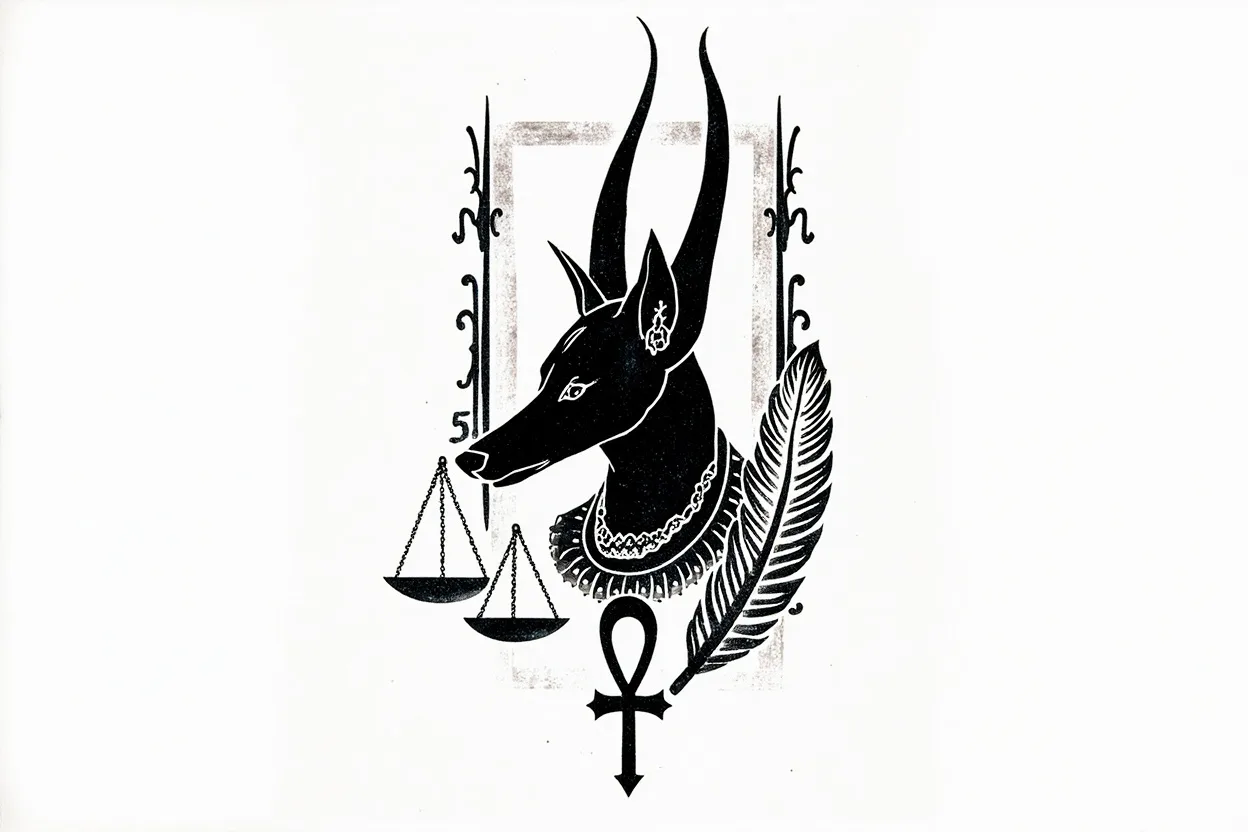
Anubis rarely works alone in tattoo design. The object beside him usually determines which meaning a stranger will read first.
| Pairing | Meaning angle | Technical watch |
|---|---|---|
| Anubis with scales | Judgment, fairness, accountability for your actions | Thin chains and pans blur under half an inch; plan for palm-sized minimum |
| Anubis with feather of Maat | Truth, justice, living in balance | The feather needs negative space to read as a feather, not a leaf |
| Anubis with ankh | Life after death, continued existence, vitality | Keep the loop and cross in clean proportion; a stretched loop looks like a key |
| Anubis jackal head alone | Vigilance, guardianship, the threshold between states | The snout and ears do the identifying work; a soft profile reads as generic canine |
| Anubis with hieroglyphs | Heritage, ritual, memory, legacy | Random or invented glyphs undermine the entire piece; verify with a source |
Why the scales matter most
The weighing of the heart is the central scene in most Anubis tattoo requests. In the Hall of Two Truths, the deceased’s heart is placed on one pan of a scale. The feather of Maat, representing truth and cosmic order, sits on the other. Anubis adjusts and watches. A heart lighter than or equal to the feather passes to the blessed state. A heavy heart is given to Ammit, the devourer, and the soul ends there.
For tattoo purposes, this scene carries weight beyond the Egyptian frame. It speaks to the idea that your actions have mass. Not legal consequences, which are external, but the internal accounting that happens whether you acknowledge it or not. People who choose this image often have a specific event in mind: a moral choice they made, a person they failed, a standard they now hold themselves to. The tattoo becomes private record-keeping.
If you want this meaning to read, the scales must be legible. Many artists over-detail the jackal head and leave the balance as a thin afterthought. Ask your artist to rough in the scales first and confirm they read at a glance before adding fur texture or headdress detail. The meaning lives in the balance, not in the face.
Anubis and Osiris: Keep Them Separate
Clients regularly confuse the two, and some artists do as well. The result is a hybrid figure that satisfies no one: too regal for Anubis, too feral for Osiris.
Osiris is the resurrected king, the green-skinned ruler of the underworld who presides over the divine court and offers paradise to justified souls. His iconography includes the crook and flail, the white atef crown, and often a mummified lower body. He sits in judgment; he does not operate the scales.
Anubis is the worker. He mummifies the dead, protects the tomb, escorts souls to the tribunal, and manages the weighing ceremony itself. He stands, he moves, he acts. His attributes are the jackal head, the embalming hook, the scales he holds rather than sits beneath. For a tattoo, the difference is practical. Anubis suits protection, guidance, and personal integrity. Osiris suits triumph over death, agricultural cycles, and royal authority. Choose based on which relationship you actually have with the material, not which image looks more dramatic on Pinterest.
The common wolf-man mistake
Without the pointed ears, the narrow jackal snout, and the specific stance, Anubis collapses into a generic wolf or werewolf. The ears are the giveaway: jackal ears are taller and more tapered than wolf ears, and they stand more upright. The snout is longer and finer. If your artist defaults to a muscular wolf head with Egyptian jewelry pasted on, push back. The iconography has survived four thousand years because it is precise. A sloppy Anubis is just a Halloween costume.
Placement and Technical Considerations
Anubis designs range from small blackwork profiles to full back pieces showing the weighing of the heart. The complexity you choose should match the skin you have available and the aging you are willing to accept.
Black ink holds well but spreads over time. Fine hieroglyph details and thin scale chains are the first elements to blur. If you want legibility at small sizes, simplify. A clean jackal head with a solid ankh reads longer than a crowded scene with six symbolic elements competing for space.
The forearm and outer thigh offer flat surfaces where the profile view works naturally. The chest allows frontal poses with the scales held forward, but sternum and rib skin moves substantially and hurts more during the session. Hands and feet are poor choices for detailed Egyptian work; the small bones shift the needle, and the high-wear skin sheds ink faster than almost anywhere else.
Healing follows standard timelines: two to four weeks for the surface, three to four months for the full depth. The black saturation in Anubis designs often looks patchy during weeks two and three as the top layer peels. Do not panic and over-moisturize. Let it flake naturally, keep it clean, and trust the process.
Before You Decide
Anubis is a guardian, not a punishment. The tattoo works best when you understand that distinction yourself. If you are drawn to the image because it looks dark or intimidating, you may be disappointed; the mythology offers protection and measurement, not aggression. If you are drawn to it because you have passed through something, guarded someone, or hold yourself to a private standard, the image will continue to mean something as your life changes.
Verify any hieroglyphs you include. Random symbols or mirrored copies from the internet tattoo you with nonsense. A reputable artist will want to confirm the source, or will know enough to refuse invented text. The same care applies to the scales and feather: they should be proportioned like functional objects, not decorative jewelry.
Spend time with the mythology before you commit. Read the actual Pyramid Texts or Coffin Texts if you want primary grounding, or a reliable translation of Plutarch for the later synthesis. The more you understand, the less you will need to explain. The tattoo should speak for itself, but it speaks clearly only when the design is accurate and your own reason for wearing it is specific.
Frequently Asked Questions
Does an Anubis tattoo mean death or evil?
No. Anubis protects the dead and guides souls through judgment. He is a guardian figure, not an agent of destruction or chaos. The meaning centers on safe passage, integrity, and transition rather than death itself.
What is the difference between Anubis and Osiris tattoos?
Anubis is the guardian, embalmer, and scale-operator who manages the practical work of death and judgment. Osiris is the resurrected king who rules the underworld and offers paradise. Anubis suits protection and personal accountability; Osiris suits triumph and renewal.
What symbols pair best with Anubis?
Scales for judgment, the feather of Maat for truth and balance, the ankh for life after death, and verified hieroglyphs for heritage and memory. Each pairing shifts the meaning, so choose based on which aspect matters to you.
How do I keep an Anubis tattoo from looking like a generic wolf?
Insist on the specific jackal proportions: taller, more tapered ears than a wolf, a longer and finer snout, and the correct stance. Without these details, the figure reads as a werewolf with Egyptian accessories.
Where is the best placement for an Anubis tattoo?
Forearm and outer thigh work well for profile views. Chest allows frontal poses with scales but hurts more and heals slower. Avoid hands and feet for detailed work due to needle instability and rapid ink loss.