
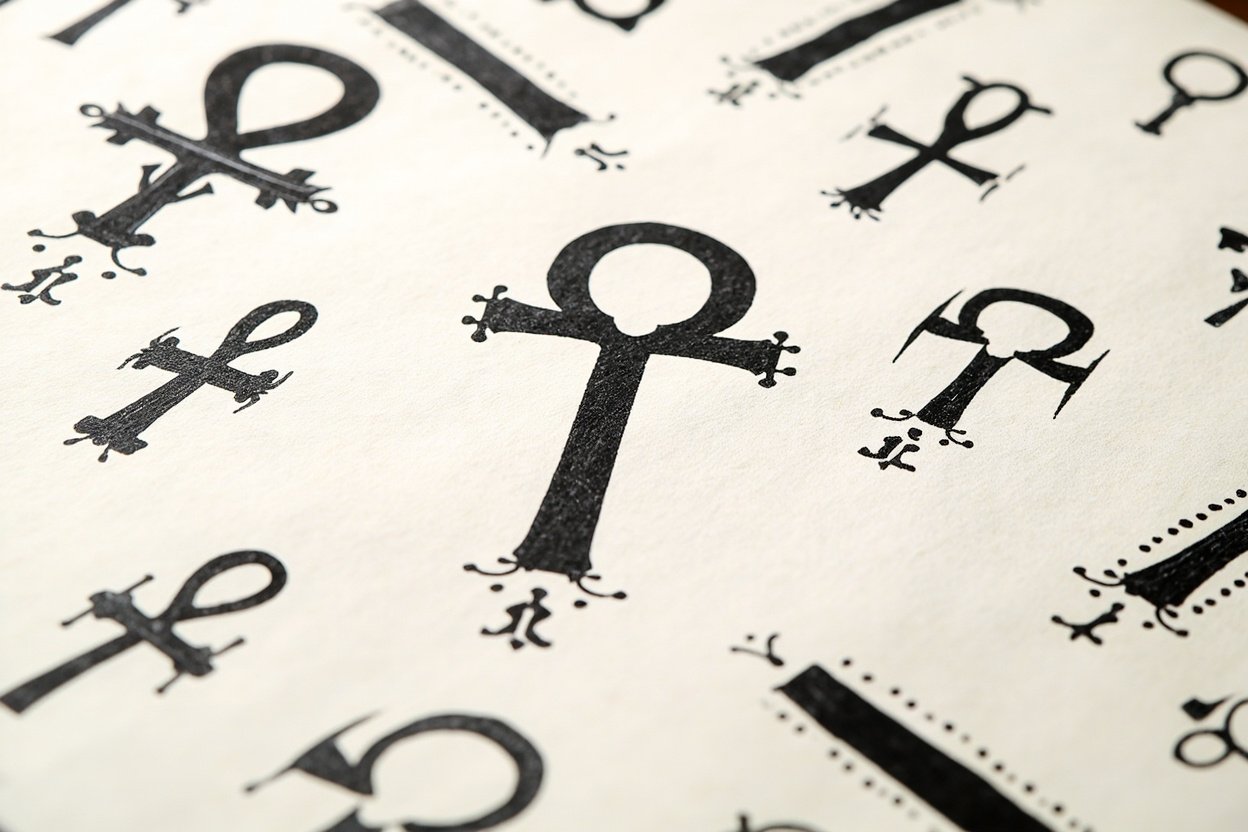
An ankh tattoo carries the Egyptian word for life itself, later adopted by Coptic Christians as the looped cross. The symbol holds layers: breath, endurance, the passage into what comes after, and the quiet balance between two states of being.
What the Ankh Actually Meant
The ankh is a genuine Egyptian hieroglyph, read as ꜥnḫ, the word for “live” or “life.” It appears in the record from the Early Dynastic Period onward, often linked to the Old Kingdom and the step pyramid complex at Saqqara, though precise earliest examples remain a matter of scholarly discussion. What is clear is its persistence: gods in temple reliefs hold the ankh to the nose or lips of a pharaoh, a gesture understood as giving the breath of life. The symbol appears on tomb walls, mirror cases, amulets, and royal furniture across three millennia of pharaonic use.
An honest note if accuracy matters to you: Egyptologists concur on the ankh’s meaning as “life” in its broadest sense, but its physical origin is unsettled. Theories include a sandal strap, a ceremonial girdle knot, a bull’s vertebra, and a few other possibilities. No single explanation has won out. You can wear the symbol knowing its significance is well grounded even if its first shape remains uncertain.
The breath of life and royal ritual
In scenes from temple walls, the ankh is not merely decorative. A god extends it toward the king’s face as a literal transmission of vitality. This is not metaphor in the modern sense; it is an action depicted as real and repeatable. The ankh therefore carries a weight that abstract “life” symbols often lack. It is tied to specific ritual, specific belief in divine participation in human existence.
Eternal Life and the Threshold
The ankh gained its lasting power through funerary context. In tombs it functions as a threshold marker, positioned at the crossing between the living world and the afterlife. It promises the deceased not survival in shadow but active, vital existence beyond death. This is the reading that makes the ankh compelling for memorial tattoos: it does not deny loss. It sits at the seam between presence and absence and treats that seam as a passage rather than an end.
Designing for this reading
If your intent is memorial or contemplation of mortality, let the ankh stand as the visual anchor. A single ankh on the inner forearm or along the spine carries the idea without commentary. Anubis, the guardian of the embalming hall and the passage westward, pairs naturally here because he occupies the same liminal space. The two motifs reinforce rather than compete if handled with restraint. Avoid crowding the ankh with too many secondary symbols; the power is in the shape’s own silence.
What negative space does for the loop
The loop at the top of the ankh is its most distinctive feature. Leaving that loop as negative space rather than filling it solid preserves readability at smaller sizes and ages better over decades. A solid black loop tends to blur into the crossbar as ink spreads; open space keeps the symbol intact.
Balance, Polarity, and the Key of Life
The ankh’s structure invites interpretation. The loop above and the vertical bar below have been read as complementary pairs: sky and earth, feminine and masculine, the visible and the hidden. How literally the ancient Egyptians understood these pairings is debated among scholars, and it is fair to treat such readings as later interpretation rather than recovered doctrine.
What is less disputed is the ankh’s consistent placement at points of contact between two realms: human and divine, temporal and eternal. This is why it is called the “key of life” in some translations. A god holds it as one holds a key, and it opens or permits passage. For a tattoo, this “key” idea offers a way to express balance without borrowing language from traditions that are not yours.
Why the shape lasts on skin
Blackwork, dotwork, and clean geometric treatments suit the ankh because its meaning is essentially structural. Symmetry carries the idea visually. Symbols that depend on fine shading or photographic realism blur faster than bold outlines with clear interior space. The ankh’s own logic, endurance, is served by giving it a form that endures physically.
A practical warning: scaling the ankh too small with delicate linework causes the crossbar and loop to bleed together within a few years. What begins as a precise symbol becomes an unreadable shape. Minimum size depends on placement and your artist’s needle grouping, but the loop must remain visibly distinct from the horizontal bar.
The Ankh and Coptic Christianity
The ankh’s afterlife in religious use is real but not instantaneous. After pharaonic religion faded, the shape was adopted by Coptic Christians, often called the crux ansata, the handled or looped cross. The timeline of this adoption is not as clean as some summaries suggest; it developed over centuries rather than arriving as a single decision. The looped cross became a mark of Egyptian Christian identity, distinct from the Latin or Greek cross forms.
This matters for tattoo choices because the ankh now carries two coherent but separate histories. A minimalist line-work ankh on the wrist can read as Coptic heritage or quiet faith. The same symbol in a sleeve of pharaonic imagery reads as Egyptian identity. Neither is wrong, but the surrounding context signals which lineage you are entering. Mixing the ankh with unrelated occult motifs, however, tends to muddy both histories into visual noise.
Placement and scale for faith-related pieces
For Coptic or Christian readings, smaller scale and quieter placement suit the symbol’s character: wrist, side of the neck, behind the ear. These locations keep the ankh personal rather than declarative. The looped cross does not need to dominate to communicate; its shape is already distinctive.
Choosing Your Own Reading
The ankh’s strength is its refusal to collapse into a single meaning. Life, breath, eternal existence, balance between states, passage through loss, cultural identity, Christian heritage: these readings coexist because the symbol was used across so many contexts for so long. Your tattoo does not need to resolve this into one slogan. It can hold several layers at once, readable differently by different viewers or by you at different times.
What does help is clarity of intent during design. If breath and vitality matter most, consider placement near the heart or throat. If the threshold and passage matter most, the spine or a vertical alignment emphasizes crossing. If balance is central, strict symmetry in the tattoo’s execution makes the idea visible without words. If heritage matters, the surrounding imagery should belong to the same tradition rather than borrowing scattershot from unrelated sources.
What to Remember
The ankh is not a modern invention posing as ancient. It is a real hieroglyph with documented use, real uncertainty about its physical origin, and a real second life in Coptic Christianity. Its meanings are layered, not contradictory: life, the breath that sustains it, the passage beyond death, and the balance between what we see and what we believe continues.
For a tattoo, the symbol rewards simplicity. Bold outline, open loop, clean proportions, and enough scale to keep the crossbar distinct from the loop. Surround it with restraint. The ankh has carried meaning for roughly five thousand years; it does not need your design to add more. It needs your design to let what is already there remain visible.
Frequently Asked Questions
Is the ankh a religious symbol or can anyone get it?
The ankh has both religious and secular histories. It began as an Egyptian hieroglyph for life, was used in pharaonic ritual, and later became the Coptic Christian cross. Many people wear it for its general meaning of life and endurance without religious affiliation. If you are drawn to the symbol, understanding its histories lets you wear it with awareness rather than appropriation.
What is the best placement for an ankh tattoo?
The ankh works well on the forearm, upper arm, chest, spine, behind the ear, or back of the neck. Vertical placements like the spine or forearm emphasize the symbol’s passage or threshold quality. Smaller, quieter placements suit Coptic or minimalist readings. The key constraint is size: the loop must remain large enough to stay distinct from the horizontal bar as the tattoo ages.
Does the ankh mean the same thing as the Christian cross?
Not exactly. The Coptic cross adopted the ankh’s looped shape, but the original Egyptian ankh predates Christianity by millennia and meant “life” in a broader sense, including vitality, breath, and existence after death. The meanings overlap in Coptic use but are not identical. Your surrounding imagery and intent clarify which lineage you are referencing.
How much does an ankh tattoo typically cost?
In the United States, a simple ankh ranges from roughly $80 to $250 depending on size, detail, and the artist’s rate. Small, minimalist line work falls at the lower end. Larger pieces with surrounding Egyptian or Coptic imagery cost more. The ankh’s simplicity is an advantage here; it does not require elaborate color or shading to communicate.









