
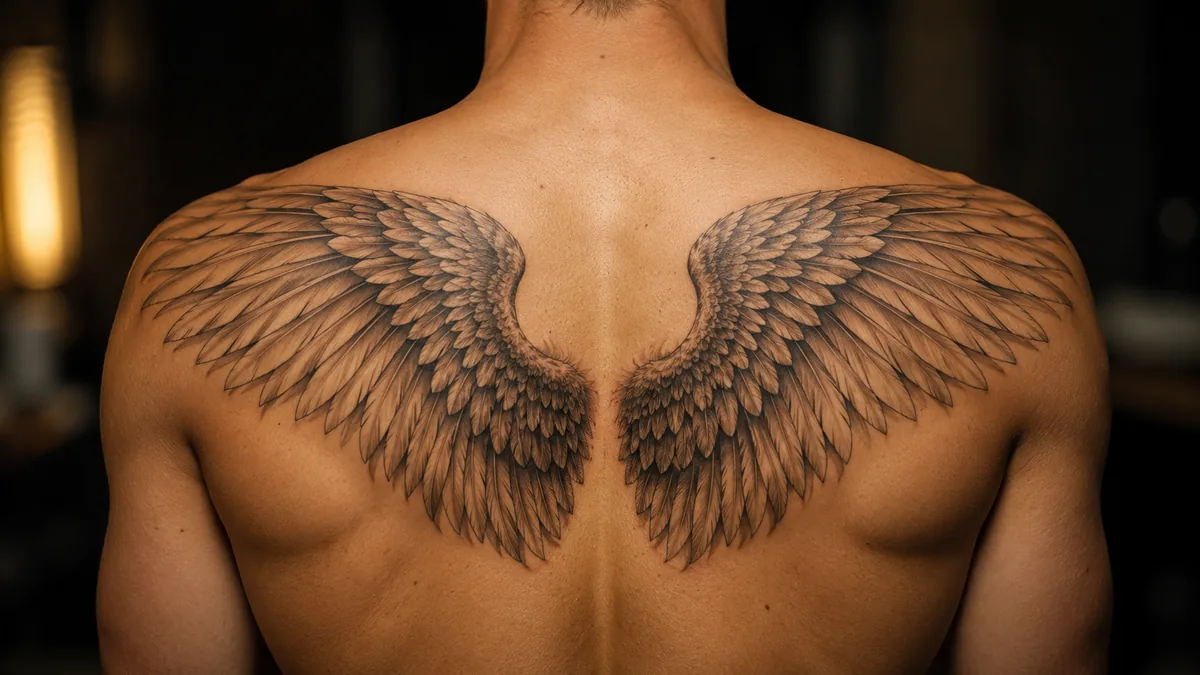
Angel wings tattoos are one of the most loaded pieces of imagery in the game. People get them for protection, for grief, for faith, for the feeling that something bigger is watching over them. The meaning hits different depending on who’s sitting in your chair, and that’s exactly what makes this subject worth breaking down properly.
Whether you want a crisp, symmetrical pair across your upper back or a delicate fine-line set behind your ear, knowing what those wings actually stand for helps you own the tattoo. Let’s get into the real symbolism, the history that actually checks out, and everything you need to make smart decisions before you commit to skin.
Core Symbolism: What Angel Wings Actually Mean
Angel wings as a tattoo symbol center on a handful of consistent meanings. Protection is the biggest one. Angels in most major Western traditions exist to guard, guide, and intervene. Wings are the visual shorthand for that role, so wearing them says you feel watched over, or that you’re asking to be. Freedom and transcendence are close behind, because wings let you leave the physical world behind.
Faith is the other pillar. For a lot of clients, angel wings aren’t decorative, they’re devotional. The tattoo is a statement of belief, a permanent expression that the wearer takes the spiritual seriously. Some people also use wings to represent a personal transformation, a chapter they’ve closed, or a version of themselves they’ve moved past. The imagery is flexible enough to carry all of it.
Memorial Tattoos: Wings as a Tribute to the Lost
Wings without intention are just decoration. Wings with a name behind them are a covenant.
One of the most common reasons people request angel wings is grief. When someone you love dies, there’s a pull toward imagery that places them somewhere safe and raised. Angel wings do that work visually and emotionally. Often paired with a name, a birthdate, a portrait, or a halo, they read as a direct statement: this person is now an angel, watching over me.
This is genuinely the most personal version of the tattoo, and it deserves careful execution. A memorial piece should be built to last. Bold linework, solid blacks, and well-placed negative space will keep it reading clean decades out. Fine-line memorial wings can be beautiful, but they demand an experienced hand because thin strokes in certain skin types will spread over time. Talk honestly with your artist about what heals well in your skin tone and zone.
Cultural and Religious Background That Actually Holds Up
Winged divine figures show up across multiple ancient traditions, from Egyptian depictions of Isis spreading her wings over the dead to the Greek winged messengers and the angelic orders described in Jewish and Christian scripture. Cherubim in the Hebrew Bible are described as multi-winged beings guarding sacred space. The angel as protector and messenger is not a modern invention; it’s a thread running through thousands of years of human religious writing.
The specific image of a human figure with feathered wings that most tattoo clients picture comes heavily from Renaissance and Baroque Christian art, where painters like Raphael and Caravaggio made that visual language mainstream. That’s the tradition most Western angel wing tattoos are drawing from, consciously or not. Knowing that background doesn’t change the tattoo, but it gives you something real to stand behind when someone asks what it means.
Design Variations: From Realistic to Graphic
Realistic feathered wings are the most popular request. Detailed primary feathers layering down into secondary rows, built in black and grey with careful whip shading to give volume and depth. Done well, they read from across the room and age gracefully because the tonal range gives the piece structure even as the skin shifts over time. The upper back is the natural canvas for this style because the flat plane lets a large symmetrical piece breathe.
Graphic and illustrative styles are gaining serious ground. Bold outlines with flat fill or minimal shading, neo-traditional wings with thick linework and controlled color, geometric interpretations that break the feathers into angular shapes. Fine-line wings, especially small ones behind the ear or on the wrist, are extremely popular right now. They look crispy fresh off the needle, but they require realistic conversations about longevity, because ultra-thin lines in high-wear zones will blur faster than you want.
Color vs. Black and Grey: What Holds and What Fades
Black and grey is the dominant choice for angel wings, and there are practical reasons for that. Shaded grey tones build dimension and texture across a large feathered surface in ways that are hard to replicate with color. Black and grey also tends to age more predictably, holding structure longer in most skin types. A well-executed black and grey wing piece with strong linework can still look solid fifteen years in.
Color angel wings exist and can be stunning, especially in neo-traditional or illustrative styles where the palette is bold and saturated rather than soft and pastel. Soft pastel color, particularly light blues and whites, is the toughest to maintain because light pigments fade faster and can get muddy as the skin ages. If you want color, go saturated. Talk to your artist about which colors hold best in your specific skin tone, because a color that pops on pale skin can disappear on deeper tones.
Placement, Pain, and How It Wears Over Time
The upper back is the classic placement for large angel wings. It’s a wide, relatively flat surface, low-wear, and the skin doesn’t stretch and distort the way it does on ribs or stomach. It does get spicy between the shoulder blades if you’re working close to the spine, so be ready for that. Chest placements, spreading across both pec areas, are another strong option, especially for clients who want the wings visible in a V-neck.
Smaller wing placements are all over the map: behind the ear, on the wrist, the forearm, the ankle, behind the shoulder. High-wear zones like wrists and ankles will need touch-ups sooner. The inner wrist especially sees a lot of sun and friction. Behind the ear is lower-wear but the skin there is thin, which means blowout risk if the needle pressure isn’t dialed in. A tattoo behind the ear on the wrong artist is a nightmare, so vet your person carefully for that placement.
Who Gets Angel Wings and How to Make It Personal
The range of people who request angel wings is genuinely wide. Grieving parents, religious clients marking their faith, people coming out of dark periods, military families. The imagery crosses demographics because the core meanings, protection, memory, transcendence, are human universals. That also means the tattoo is common, and if you want yours to stand apart, the personal details are what do the work.
Adding a name, a date, a specific bird species meaningful to the deceased, a particular style of feather that references something personal, these are the moves that turn a familiar image into something that belongs entirely to you. Talk to your artist about the person you’re honoring, about what the wings mean to you specifically. The best memorial and devotional tattoos come from that conversation. Don’t just hand over a Pinterest screenshot and walk away from it.









