
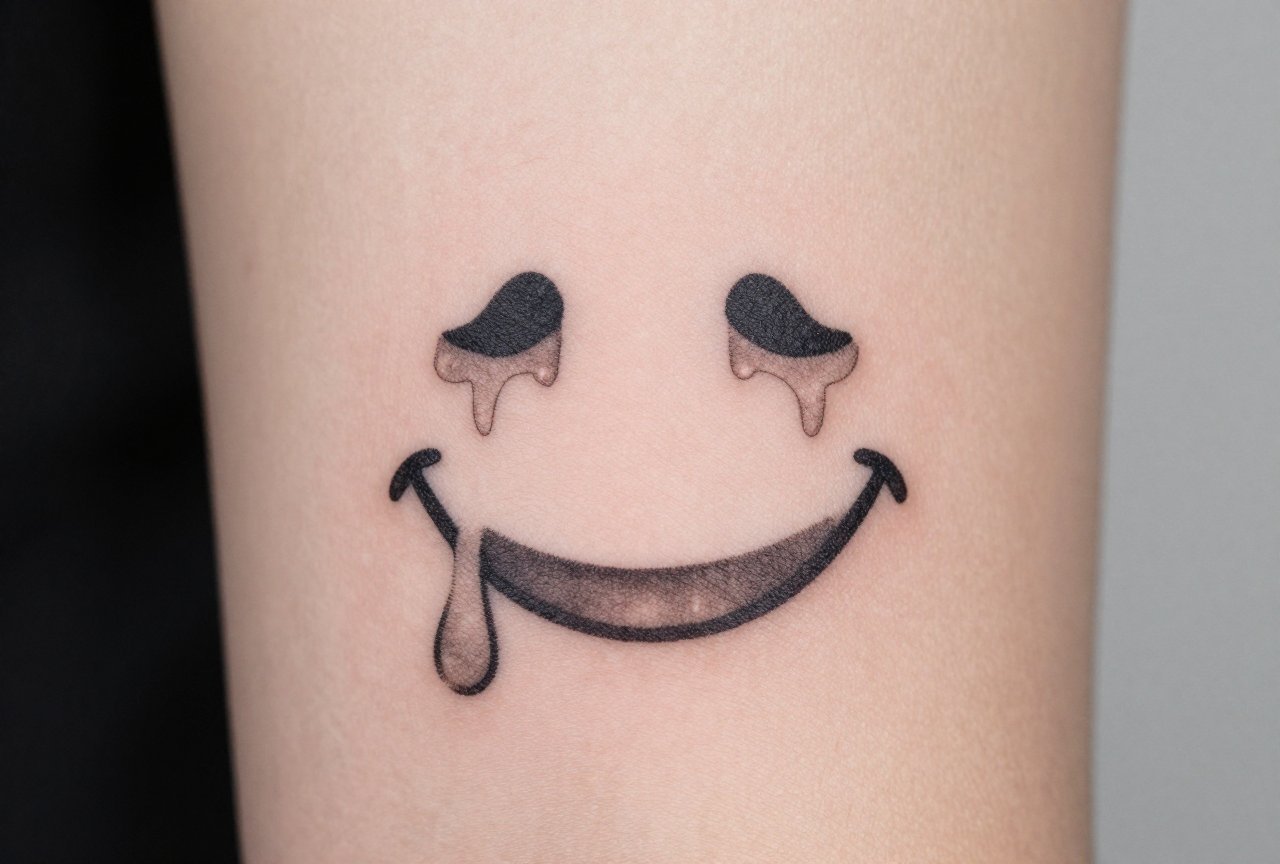
The smile now cry later tattoo shows two theatrical masks: one grinning, one weeping. The pairing comes from ancient Greek drama, where comedy and tragedy sat side by side in every festival. The tattoo’s premise is simple and hard to argue with. You cannot have one without the other. Joy and grief do not take turns. They overlap, sometimes they arrive together, and the person still standing usually figured that out the hard way.
Symbolism and History
The theatrical mask tradition dates to Greek drama, where the smiling mask represented Thalia, muse of comedy, and the weeping mask represented Melpomene, muse of tragedy. These became universal shorthand for the full range of human emotional experience long before anyone inked them onto skin.
In tattoo culture specifically, the smile now cry later design gained traction through Chicano art and street culture in 1970s and 1980s Southern California. The imagery spoke to communities where showing weakness publicly was a liability, where you kept your face composed while carrying grief privately. The phrase evolved into something like a philosophy: face the world with confidence today, even knowing tomorrow might be harder.
What the design actually means on skin varies by wearer. Common threads include:
- The gap between public performance and private experience
- Survival of something specific, addiction, incarceration, loss, mental health struggles
- Acceptance that good and bad periods are both temporary
- Living fully in the present rather than dreading what comes next
Common Variations and Styles
Traditional Chicano work is the reference point most artists start from. Bold black and gray shading, fine line details, the masks often shown in profile, connected by flowing ribbons or banners with the phrase written out. Sometimes roses or religious iconography fill the background. The style rewards patience in the chair because the detail is where the meaning lives.
Contemporary takes go in several directions. Some artists render the masks as hyper-realistic portraits, creating faces that feel genuinely alive in the skin. Others simplify them into graphic, almost icon-like shapes that work at smaller scales. Neo-traditional versions keep the strong outlines but push the color further, deep blues, burgundies, forest greens, colors that hold better over time than the pastels that started appearing after watercolor styles became popular.
Popular additions to the core design:
- Clock or hourglass elements to underline the time aspect
- Playing cards or dice, both connect to Chicano folk art and the idea of chance
- Religious imagery, praying hands, crosses, rosaries
- Personal portraits replacing the generic masks, turning the concept into a memorial piece
Best Placements
The design needs room to read properly. The two masks together are the whole point. Compress them too small and you lose the contrast that makes the image work.
Chest and upper back give the most space for elaborate versions. The chest placement also carries historical weight in Chicano tattooing, the heart proximity reads as emotional investment rather than just decoration. Forearms are the most common choice for practical reasons: visible enough to see yourself, coverable for work.
Upper arm and shoulder accommodate medium-sized pieces that can be shown or concealed depending on the situation. Smaller interpretations show up on hands, necks, and behind ears, though these spots demand simplified forms, since the face detail blurs at that scale.
One consideration worth thinking through before you commit: which mask faces outward? Some people want the smiling mask visible to others and the weeping mask turned inward, a statement about the face you show the world. Others flip it. Neither reading is wrong, but it is worth deciding before the stencil goes on.
Who Chooses This Tattoo
Musicians and performers show up with this design regularly. The theater connection is literal for them, the gap between the stage persona and the person offstage. Hip-hop culture has referenced it for decades, which means a younger generation often encounters it through that lens rather than through its Chicano roots. Both paths are legitimate.
A significant portion of the people sitting for this tattoo have been through something specific. The design appeals to people on the other side of a hard period who want to mark it without a direct narrative. The masks say everything without spelling anything out. You know what it cost. Other people who have paid a similar price recognize it.
I have also tattooed this on people who just connect with the philosophy. Not everyone has a dramatic survival story. Some people simply appreciate the honesty of the image, that it refuses the social media version of life where everything is either triumph or crisis.
Related Designs
Several other tattoos explore the same territory from different angles:
- Yin-yang: balance of opposing forces in Taoist philosophy, similar premise but without the narrative drama of the masks
- Jester or clown tattoos: related Chicano iconography, the payasa figure specifically carries its own history in that tradition
- Memento mori imagery: skulls, hourglasses, the phrase “remember you must die,” all use mortality awareness to reframe present experience
- Cherry blossoms: the Japanese concept of mono no aware, the bittersweet awareness of impermanence, covers similar philosophical ground with different visual language
Final Thoughts
The smile now cry later tattoo has lasted because it is honest in a way that most tattoo concepts are not. It does not promise strength or resilience or healing. It just acknowledges that both things exist, that you carry them both, and that showing up anyway is the whole game.
If you are considering it, look at Chicano tattooing specifically before settling on a style. The tradition it comes from has a depth that gets lost when artists approach it without that reference. Find someone who has done this image before, who understands the balance between the two expressions, and who can render faces at whatever scale you are working with. The masks should look like they have something to say.
Frequently Asked Questions
Is the smile now cry later tattoo culturally appropriative for non-Latino people?
The design has Chicano cultural roots, and it is worth knowing that history before you choose it. Approaching any borrowed tradition with genuine respect matters more than heritage alone. Seeking out a Chicano artist, learning the actual origins, and avoiding shallow imitation of the aesthetic are the relevant considerations.
What size works best for this tattoo?
Large enough that both masks read as faces. I would not go smaller than palm-sized for the pair. The expression detail is what gives the design its emotional weight. Shrink it too much and you just have two abstract oval shapes.
Can I get just one mask instead of both?
Yes. A single smiling or weeping mask stands on its own. It loses the duality that gives the full design its specific meaning, but a solo theatrical mask has its own long tradition in tattoo art. The weeping mask alone often appears in memorial contexts.
How does this tattoo age over time?
Traditional Chicano-style work with bold outlines ages well. The black and gray shading holds up better than color, and the strong graphic structure means the image stays readable even as detail softens over the years. Avoid overcrowding the negative space if longevity matters to you.









