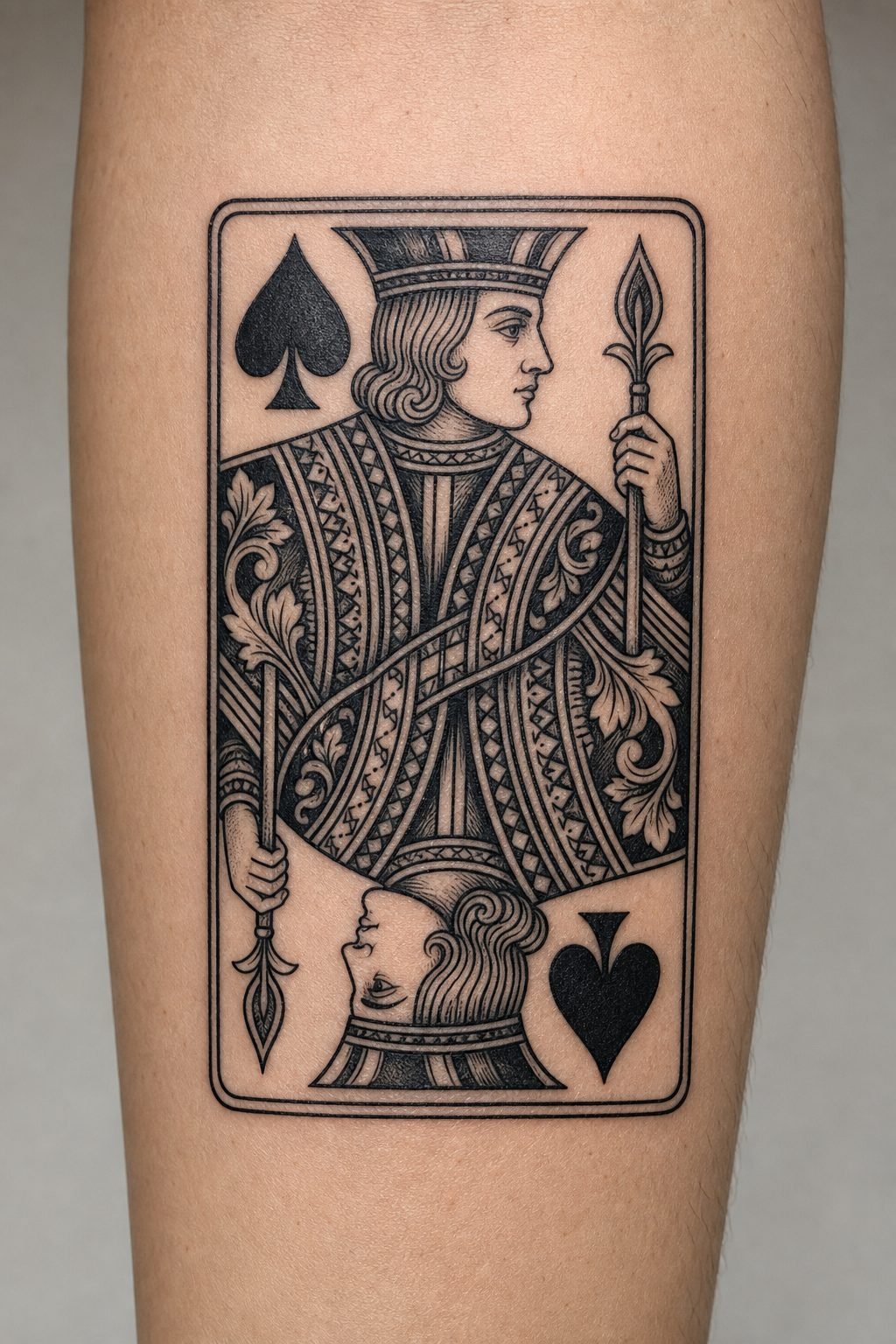
The jack of spades tattoo carries a mix of meanings that shift depending on context, personal intent, and cultural background. this design represents the playing card’s traditional associations with cunning, strategy, and the trickster archetype embodied by the knave figure. For many wearers, it serves as a permanent emblem of intellect over brute force, or as a marker of belonging to specific communities that have adopted the symbol for their own purposes.
Symbolism & History
The jack of spades descends from centuries of playing card tradition, where the spade suit itself evolved from the Italian swords suit and became linked to nobility, military prowess, and the winter season in French cartomancy. The jack, historically called the knave, occupied a liminal social position – not a king, not a commoner, but a servant with access to power and the ability to move between worlds.
This in-between status fuels much of the tattoo’s symbolic weight. The jack operates through wit, observation, and calculated action rather than open authority. In cartomancy and fortune-telling traditions, the jack of spades often signifies a young person with dark hair and eyes, someone clever but potentially deceptive, or a messenger bringing news that requires careful interpretation.
The spade’s pointed shape has accumulated additional associations over time: digging, burial, and the earth itself. Combined with the jack’s trickster energy, the card can represent someone who works from below, who operates in shadows, who transforms situations through unexpected moves rather than frontal confrontation.
Common Variations & Styles
Tattoo artists render the jack of spades through remarkably diverse approaches, each carrying subtle shifts in meaning:
- Traditional American: Bold lines, limited color palette, often paired with dice, skulls, or banners bearing names or dates. This style emphasizes the gambling and risk-taking associations.
- Black and grey realism: Photographic detail capturing the texture of actual cards, sometimes showing wear, creases, or burning edges. This approach highlights mortality and the passage of time.
- Minimalist line work: Reduced to essential spade shape and jack figure, often quite small. Favors personal, private significance over public statement.
- Neo-traditional or illustrative: Exaggerated features, custom elements replacing the standard jack face, incorporation of personal symbols or portraits.
- Combined compositions: Multiple cards, full house or royal flush arrangements, integration with other gambling imagery like poker chips or casino scenes.
Some wearers incorporate specific numbers, dates, or initials into the design, transforming the generic card into a memorial piece or commemorative marker. Others deliberately damage or alter the card image – torn, burning, or blood-stained – to suggest a particular narrative of loss, survival, or transformation.
Best Placements
The jack of spades adapts to numerous body locations depending on desired visibility and scale:
- Forearm or wrist: Highly visible, allows for regular self-viewing and serves as a personal reminder or public statement of identity.
- Upper arm or shoulder: Classic placement with room for detailed rendering, easy to conceal or reveal as situations demand.
- Chest or ribcage: More intimate placement, often chosen for deeper personal significance or protective symbolism.
- Hand or fingers: Bold visibility, sometimes chosen for the “card up your sleeve” or “hand you’re dealt” wordplay.
- Behind the ear or neck: Subtle, discovered rather than announced, suggesting hidden knowledge or private identity.
Scale considerations matter significantly. A full-color realistic card demands adequate space for detail work, while minimalist designs can succeed at very small sizes. The card’s rectangular format naturally suits certain body areas better than others.
Who Chooses This Tattoo / Personal Meanings
Demographics for this design span unexpectedly wide territory. Professional poker players and gambling enthusiasts represent the most straightforward adoption, marking passion for the game or significant wins. Military personnel, particularly from certain units with playing card traditions, sometimes select specific cards for unit identification or deployment memorials.
Within some subcultures, particularly certain LGBTQ+ communities, the jack of spades has developed specific coded meanings around identity and preference that outsiders may not immediately recognize. This reclaimed usage demonstrates how tattoo symbols continuously evolve beyond their origins.
Individual narratives frequently center on personal resonance with the trickster archetype – people who have survived through adaptability, who pride themselves on reading situations accurately, who have been underestimated and proven others wrong. The jack’s underdog quality appeals to those who have advanced despite lacking traditional advantages.
Some wearers reference specific literary or musical connections, from the Jack of Spades in Boogie Down Productions’ hip-hop track to various fictional characters bearing the name or persona. These cultural touchstones provide entry points that feel less arbitrary than pure gambling association.
Similar Symbols
Those drawn to the jack of spades often consider related imagery:
- Joker cards: Wilder, more chaotic trickster energy, less structured than the jack’s defined role.
- Ace of spades: Death card associations, military history, more dominant and singular power rather than cunning adaptation.
- Skull and playing card combinations: Memento mori traditions, gambling with mortality, more explicitly macabre.
- Court cards generally: Kings, queens, and other jacks offer different social positionings and symbolic registers.
- Chess pieces: Similar strategic and intellectual associations, different cultural connotations of class and globalism.
The ace of spades particularly invites comparison as the most iconic playing card tattoo, but the jack offers more nuanced identity positioning – clever rather than dominant, surviving rather than conquering.
Final Thoughts
The jack of spades tattoo rewards thoughtful consideration before commitment. Its meanings layer densely: gambling heritage, trickster mythology, subcultural signaling, personal narrative of intellectual survival. The same design might read entirely differently across contexts, and wearers should understand both traditional associations and contemporary evolutions.
Quality execution matters significantly for this subject. The familiar playing card format leaves little room for artistic error – proportions, symmetry, and detail work must satisfy viewers who have seen thousands of card images. Research artists with demonstrated strength in the chosen style, whether traditional, realistic, or illustrative.
Ultimately, the jack of spades succeeds as tattoo imagery because it operates on multiple registers simultaneously: immediately recognizable yet personally customizable, historically grounded yet continuously evolving, visually striking yet symbolically dense. For those who identify with its particular blend of cunning, adaptability, and underestimated capability, it offers a durable and meaningful mark.
Related Tattoo Meanings
Frequently Asked Questions
What does a Jack of Spades tattoo mean in general?
The Jack of Spades tattoo often represents a love of card games, gambling culture, or a rebellious spirit. It can also symbolize someone who identifies as a trickster or cunning figure, since the Jack is traditionally seen as a clever, youthful character in the deck.
Is the Jack of Spades tattoo associated with any specific subcultures?
Yes, it has been adopted by some within the hotwife and cuckold lifestyle communities as a discreet symbol with sexual connotations. This meaning is not universal, so context and placement often matter when interpreting the tattoo.
Does the Jack of Spades have any historical or military significance?
During the Vietnam War, U.S. soldiers sometimes left the Ace of Spades on enemy bodies as a psychological tactic, but the Jack specifically lacks strong military ties. Historically, the spade suit itself is linked to nobility and the military class in European card traditions.
What are common placements and styles for a Jack of Spades tattoo?
Popular placements include the forearm, hand, and chest, often rendered in traditional American, neo-traditional, or minimalist blackwork styles. Many people choose to incorporate playing card elements like flames, dice, or roses to enhance the gambling or risk-taking theme.