
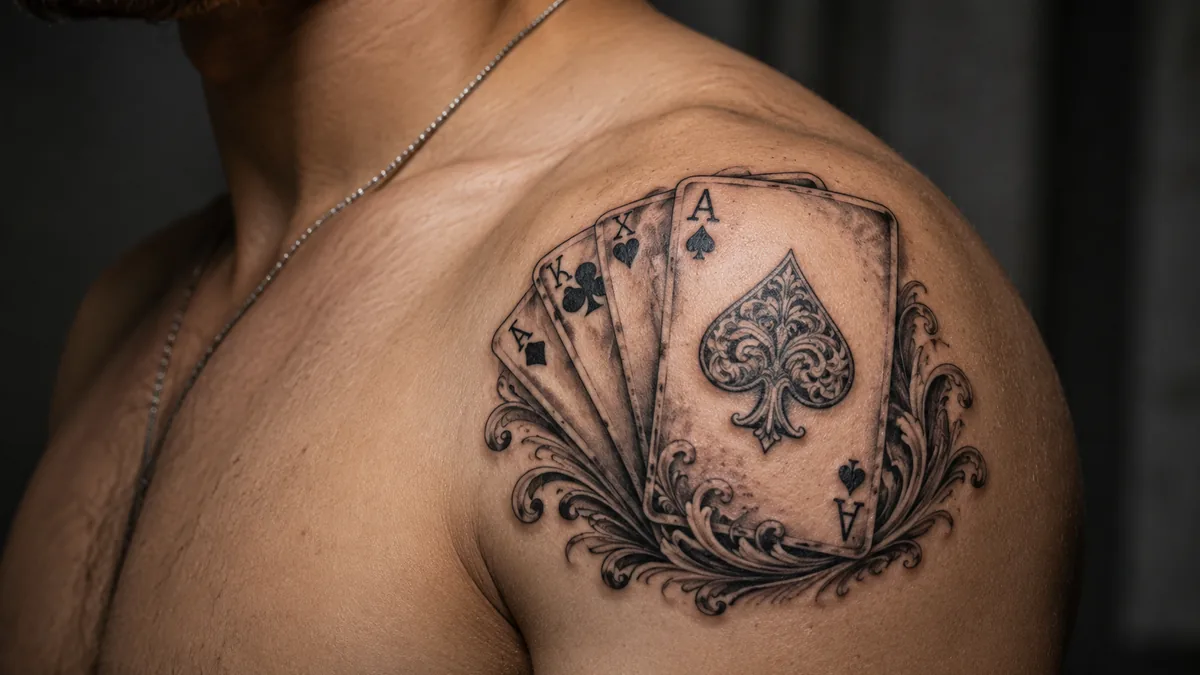
Playing card tattoos have been a staple of American traditional tattooing for over a century. They mean something specific: luck, chance, and the willingness to play the hand life deals you. People don’t get these on a whim. There’s usually a story behind it.
The symbolism shifts depending on the card you pick. Aces, face cards, suits, even a full spread of five cards, each one carries its own weight. This guide breaks down the real meanings, the history, the styles that work, and how to make sure your card tattoo still looks clean in ten years.
Core Meaning: Luck, Fate, and Risk
Playing cards as tattoos boil down to a few universal themes: luck, fate, gambling with life, and accepting outcomes beyond your control. The card is a symbol of chance. You didn’t pick what was in the deck. You play what you’re given. A lot of people get card tattoos after surviving something rough, a reminder that they drew a hard card and stayed in the game.
Risk and reward run through all of it. Cards represent the gamble, not always money, but decisions, relationships, choices made under pressure. The tattoo is a way of owning that. It says the person wearing it understands life isn’t guaranteed, and they’re okay with that tension. Honest, grounded symbolism. No fake mysticism required.
What Each Suit Actually Symbolizes
The card on your skin is the one hand you chose to keep.
The four suits carry distinct meanings that most card tattoo collectors think about before picking one. Spades are the most popular. They read as ambition, intelligence, and sometimes death, borrowed from tarot where spades connect to swords and conflict. Clubs represent power, luck in some traditions, and hard work. Diamonds point to wealth, material success, and value. Hearts cover love, emotion, and passion.
These aren’t invented meanings. They’ve been consistent in Western card symbolism for centuries and bleed directly into tattoo culture. A lot of clients want hearts for romantic reasons or after a loss. Spades attract people who like the darker edge. Mix suits intentionally and the tattoo tells a layered story. Pick one at random and it’s just decoration. Know why you chose it and it means something.
The Ace: Why It Dominates Card Tattoo Culture
The Ace of Spades is probably the most tattooed playing card on the planet. It’s been a symbol of death, luck, and the unknown since at least World War II, when American soldiers in Vietnam wrote it on helmets and left it on enemy bodies as a psychological symbol. The meaning stuck. Today it reads as fearlessness, living close to the edge, and a willingness to stare down bad odds.
The Ace of Hearts runs a close second and carries almost the opposite energy, love, life, the highest emotional value in the deck. Ace of Diamonds signals ambition and material drive. Ace of Clubs leans toward luck and strength. All four aces represent the extremes of their suit, so tattooing one says you’re not playing it safe. You’re going all in on whatever that suit represents.
Face Cards, Jokers, and the Dead Man’s Hand
Kings, Queens, and Jacks give card tattoos a personal character. A Queen of Hearts is one of the most classic feminine tattoo designs in American traditional, representing a powerful, loving woman, often dedicated to a mother, partner, or the person getting inked. Kings suggest authority and control. Jacks carry a trickster energy, clever, adaptable, not always playing by the rules.
The Joker stands apart. It’s the wild card, literally, and that’s how people wear it. Unpredictable, unclassifiable, outside the normal hierarchy. It suits people who don’t fit a clean box. Then there’s the Dead Man’s Hand, aces and eights, the cards Wild Bill Hickok held when he was shot in 1876. That one is historical fact, not legend. People get it as a tribute to fate, the West, or the idea that your number comes up when it comes up.
Style Variations: Traditional, Fine Line, and Black and Grey
American traditional is the natural home for card tattoos. Bold outlines, flat saturated color, clean graphic shapes. A traditional ace of spades heals exceptionally well. The bold lines hold for decades, and the high contrast reads from across the room even as the skin ages. This is the style built for card designs. It respects the history and the iconography at the same time.
Fine line card tattoos have become popular in the last decade, especially on forearms and hands. They look incredible fresh, crisp detail, delicate shading. Be honest with clients, though: fine line fades faster, especially in high-wear zones. Black and grey is a strong middle ground. Whip shading on the card face gives depth without the risk of fine line migration. Geometric or neo-traditional interpretations work well for people who want something more custom while keeping the card readable.
Color vs. Black and Grey: What Holds and What Fades
Saturated color card tattoos are bold statements. Red hearts and diamonds pop hard against black outlines in a traditional style. That red holds well in the first few years, but all reds shift warm and need touching up more than black ink. Blacks and greys on card tattoos are the most stable long-term. The contrast stays readable even as the skin changes over time.
If you’re doing a full card with intricate face card illustration, black and grey gives you the most detail control. Color suits pipping, the symbols on the card face, hold their shape well because they’re simple geometric forms. Avoid packing too much fine color detail into small areas of a card. It muds out when it heals. Keep the linework clean, keep the shapes bold, and it will look solid for years.
Best Placements and How They Age
The forearm is the classic home for a playing card tattoo. It’s flat, it reads clean, and the card’s vertical shape fits the anatomy perfectly. The upper arm and bicep work just as well, especially for larger designs like a full hand of cards or a card with additional elements like flames, roses, or skulls. The chest and ribs give you space for detailed face card designs.
Avoid the palm side of the hand and the fingers for detailed card work. Those are high-wear zones with constant friction. Ink blows out fast there and the fine details of a card face will blur within a few years. The back of the hand fares better but still fades quicker than the forearm. Stick to simpler, bolder designs in those areas if you’re committed to hand placement. Behind the knee and the inner elbow are spicy spots but the card shape can distort as the tattoo moves with the joint.
Who Gets Card Tattoos and How to Make Yours Personal
Card tattoos cross every demographic. Gamblers and poker players get them for the obvious connection. Veterans carry the Dead Man’s Hand or the Ace of Spades for its wartime history. People who’ve been through serious hardship get them as a symbol of playing through a bad deal. Collectors of classic Americana get them because they respect the tradition. The symbolism is broad enough to carry personal weight across totally different lives.
To make yours specific, choose the card with intention. Pair it with elements that tighten the meaning, a rose for love, a skull for mortality, dice for pure chance, flames for passion or destruction. Add a date, initials, or a name if you’re dedicating it to someone. A card with a name across the banner turns a classic design into a personal memorial or tribute. The design is the vehicle. The card you pick, the elements around it, that’s where your story lives.









