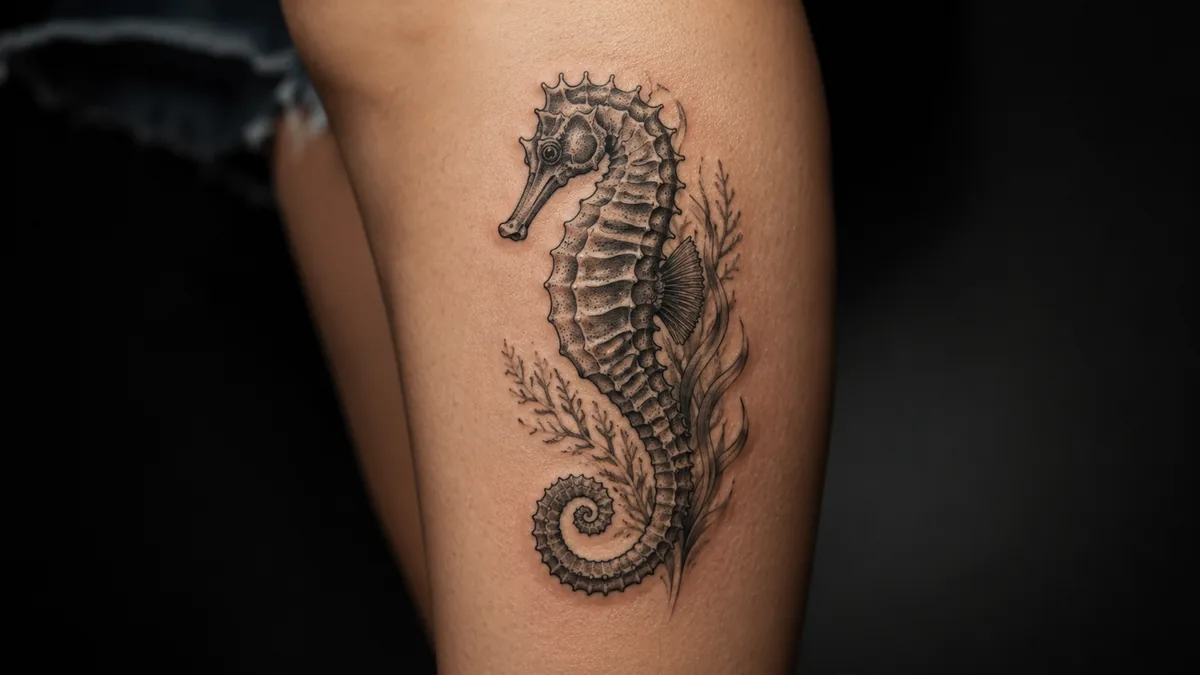
The seahorse is one of those tattoos that looks delicate but carries serious weight. People assume it’s just a cute ocean creature, but the symbolism runs deep, and most collectors who get it have thought it through.
the seahorse represents patience, persistence, and quiet strength. It’s not loud. It doesn’t need to be. And that’s exactly why it connects with so many people.
Core Symbolism: What the Seahorse Actually Means
The seahorse moves slowly and holds on hard. It anchors itself to coral with its tail when currents get rough, and that image translates directly into what most people mean when they get this tattoo: resilience, groundedness, holding your position when everything around you is pulling you loose. It’s a tattoo about surviving by staying calm, not by fighting the tide.
Patience is probably the number-one meaning collectors name when they sit down for this piece. Beyond that, you’ll hear good luck, protection at sea, and contentment with going your own pace. Some people connect it to navigating by instinct rather than speed. All of those readings are legitimate and widely recognized.
Fatherhood and Masculine Nurturing
The only creature where dad gives birth, wear that with intention.
The male seahorse carries and births the young. The female deposits eggs into his pouch, and he gestates them, sometimes hundreds at a time, until they’re born. That’s real, documented biology, not mythology, and it’s the reason the seahorse has become a meaningful symbol of fatherhood and paternal love.
Dads get this one. So do people raised by single fathers, or men who identify strongly with a nurturing role. It reads as a quiet, powerful statement about what fatherhood looks like when it’s done right. Not performative, not aggressive. Just present and protective.
Cultural and Historical Background
In ancient Greek and Roman mythology, seahorses pulled the chariot of Poseidon and Neptune. Sailors treated them as good omens, believing they kept watch over the spirits of the dead crossing into the afterlife. That connection to safe passage and divine protection stuck and shaped how Western cultures have viewed the creature for centuries.
In Chinese tradition, the seahorse is considered a type of sea dragon, carrying associations with power, good luck, and strength. Sailors across Asian coastal cultures kept dried seahorses as protective talismans. The creature consistently shows up as a protective symbol across wildly different cultures, which tells you the symbolism isn’t arbitrary.
Popular Design Styles and Variations
Traditional American and neo-traditional are the two styles that suit a seahorse best. Bold outlines, solid fills, saturated color. The organic, curved shape of the seahorse body works perfectly in that idiom, reads from across the room, and holds up over time. Neo-trad gives you room to add florals, waves, or decorative fins without the piece getting muddy. A traditional seahorse on the forearm or upper arm is a guaranteed healer.
Fine line and blackwork are also popular, especially for smaller placements like the wrist, ankle, or behind the ear. Fine line looks crisp fresh but requires a skilled hand, because a seahorse has a lot of detail packed into a small silhouette. Geometric interpretations, watercolor washes, and Japanese-influenced versions with waves and koi-style scales all show up regularly, each one shifting the meaning slightly.
Color vs. Black and Grey
Color seahorses give you a lot to work with. Real seahorses come in yellow, orange, pink, purple, and spotted patterns, so there’s no need to invent anything. Bold yellows and oranges read well on most skin tones and stay saturated if you go with a good artist using quality ink. Some collectors load the background with deep ocean blues and greens, which frames the subject without overcomplicating the design.
Black and grey is a strong choice if you want something timeless and serious. The texture of scales, fins, and the curled tail translates beautifully into whip shade and stipple work. A well-executed black and grey seahorse, even a small one, can look incredibly refined. It also ages more predictably than color in high-friction zones, so if you’re putting this on a wrist or ankle, black and grey is the safer long-term bet.
Placement, Pain, and How It Ages
The seahorse is a vertical subject by nature, which makes it ideal for the forearm, calf, upper arm, shin, or ribcage. The elongated shape follows the body’s natural lines in those spots. Behind the ear and on the ankle work for smaller versions, but you have to keep the design simple or details will blur as it heals. The ribcage placement is spicy, no question, but it gives you real estate to add detail around the piece.
In terms of aging, placement matters more than almost anything. The forearm and calf are low-wear zones, meaning the ink gets less daily friction and UV exposure than hands or feet. A bold, solid seahorse on the outer forearm will still look clean a decade out if aftercare was solid. Fine line in high-wear zones like wrists and ankles will require touch-ups sooner. Bold will hold.
Who Gets This Tattoo and How to Make It Personal
Collectors who get seahorse tattoos tend to be introspective, steady types who connect with the idea of strength that doesn’t announce itself. New parents, especially fathers, gravitate toward it for obvious reasons. So do people who have survived something slow and grinding, a long illness, a difficult relationship, situations where patience wasn’t optional. The seahorse fits that narrative without being heavy-handed.
To make it personal, think about what you add alongside it. A specific birth flower wrapped around the tail for a fatherhood tribute. A compass or anchor nearby if the maritime protection angle is the point. Coordinates of somewhere meaningful written into the negative space. The creature itself does the talking. What you surround it with tells your specific story. Talk to your artist about layout before you commit.