
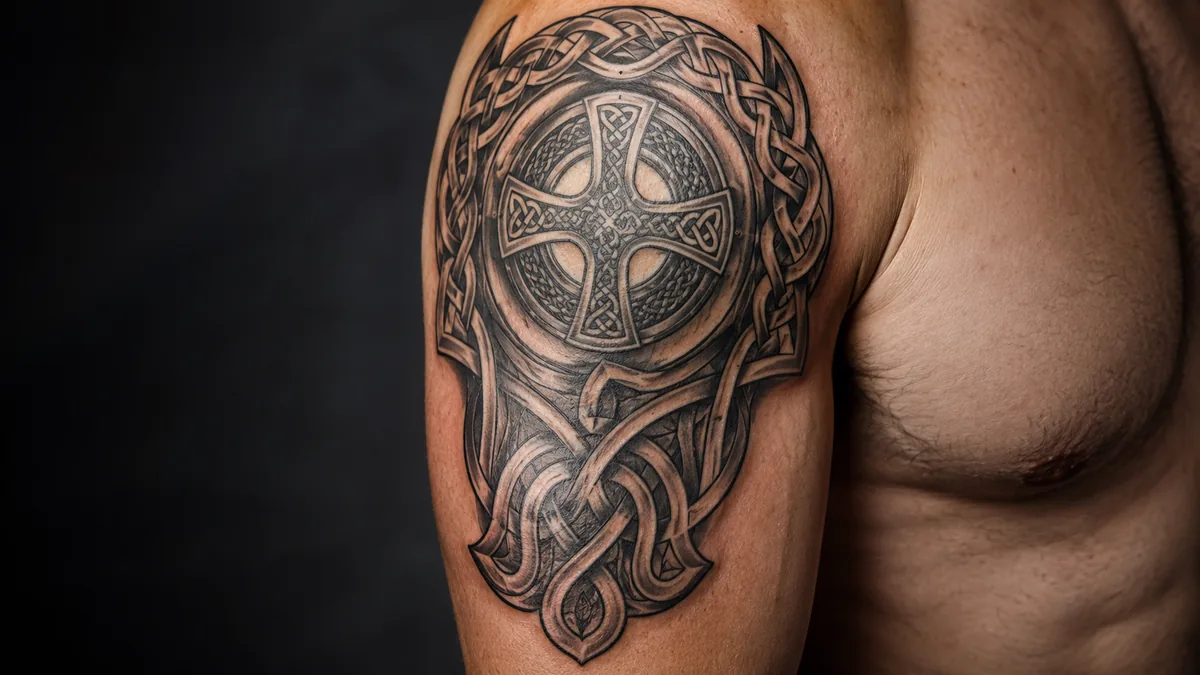
Celtic tattoos aren’t just pretty patterns. Every knot, spiral, and interlace in Celtic art was built to carry meaning, and that tradition holds up today on skin. People get these pieces for the symbolism, the heritage, or just because Celtic linework is some of the most visually striking geometry in the tattoo world.
The core themes run through all Celtic imagery: continuity, connection, the cycle of life and death, and the natural world. If you’re pulling from Irish, Scottish, or Welsh traditions, you’re tapping into a visual language that’s thousands of years old and still reads strong in fresh ink.
What Celtic Tattoos Actually Mean
The through-line in all Celtic symbolism is eternity and interconnection. Knotwork has no beginning and no end, which represents the infinite cycle of life, death, and rebirth. Spirals signal growth and the movement of time. Triple symbols, including the triquetra and the triskelion, represent the power of three: mind, body, spirit or past, present, future, depending on who you ask.
These aren’t invented meanings. They’re rooted in how Celtic peoples understood the world, where the physical and spiritual were braided together. When someone gets a Celtic piece today, they’re usually reaching for something about permanence, legacy, or connection to something bigger than themselves. That’s a solid reason to sit in a chair.
The Real Historical and Cultural Background
Every knot has no beginning and no end, that's the whole point.
Celtic art developed across Iron Age Europe, roughly 800 BCE through the early medieval period. The intricate knotwork most people associate with Celtic tattoos actually flourished in illuminated manuscripts like the Book of Kells, produced by Christian monks in Ireland around 800 CE. The monks wove pre-Christian spiral motifs into Christian iconography, which is why you see so much crossover between Celtic knotwork and the Celtic cross.
The ancient Celts themselves did practice tattooing, though the historical record is thin. Roman writers documented Pictish body art in Scotland, and Celtic warriors reportedly used woad for markings. Most of the visual vocabulary people tattoo today comes from that medieval manuscript tradition, not directly from warrior culture. That’s still a legitimate lineage. It’s just accurate to know the source.
Most Popular Celtic Designs and What They Symbolize
The Celtic knot in its general form stands for eternity and loyalty. The triquetra, three interlocked arcs, is one of the most tattooed Celtic symbols and carries meanings of trinity, be it Father, Son, Holy Spirit in a Christian context or the triple goddess in a pagan one. The triskelion, three spiraling arms from a center point, represents motion, progress, and the cycle of life. The Celtic cross adds a circle at the intersection, symbolizing the union of heaven and earth or the eternal sun.
Claddagh designs, though technically Irish folk jewelry first, get tattooed for love, loyalty, and friendship. The tree of life shows up constantly, representing the connection between the earthly and spiritual worlds and the strength of roots. Each of these reads cleanly as a tattoo because the original artists designed them to be bold, symmetrical, and visually cohesive.
Black and Grey vs. Color, and How Line Quality Makes or Breaks It
Black and grey is the dominant choice for Celtic work, and for good reason. The geometry depends entirely on clean, precise linework. Tight, crispy lines with consistent weight read from across the room and age the best. Celtic knotwork in black ink stays sharp because the design is built on contrast, not color gradients. A solid black fill inside knotwork keeps it bold and legible as the skin ages.
Color Celtic pieces exist, mostly in green, blue, and gold to reference Irish or manuscript traditions. They can look great fresh, but fine color detail inside complex knotwork tends to blur over time, especially in high-wear spots. If you want color, keep it in larger open areas rather than packed into the knot itself. Whip shading around the design adds dimension without sacrificing line integrity. Your artist’s linework skill matters more here than almost anywhere else.
Best Placements and How Celtic Work Ages
Celtic knotwork holds up best in medium to large formats on flat, stable skin. The upper arm, forearm, chest, back, and thigh are all solid placements. The geometry needs room to breathe. Cramming a complex knot into a small area risks blowout on the tight curves and muddying as the skin changes over years. Sleeve placements are extremely popular because Celtic work tiles naturally, letting you build out a full arm with interlocking designs that actually make compositional sense.
Avoid placing intricate Celtic linework on high-wear zones like the inner wrist, fingers, or feet if you want it to last. The constant friction and skin movement breaks down fine lines fast in those spots. Bold will hold here, same as anywhere else. A slightly thicker line gauge on Celtic knotwork means it stays readable ten years out instead of fading into a gray smudge. Ask your artist to size up the linework a touch if you’re going on a joint or a high-movement area.
Celtic Cross Meaning Specifically
The Celtic cross deserves its own section because it’s one of the most requested Celtic tattoos and carries layered meaning. The basic read is Christian faith combined with older pre-Christian sun worship. The circle represents the eternal sun or the halo of divinity, depending on your tradition. Many people get it purely as a symbol of Irish or Scottish heritage with no religious intent attached. Both are valid.
The design itself is strong. It’s symmetrical, bold, and scales from a small chest piece to a full back centerpiece. It also ages exceptionally well because the main lines are thick and the structure is simple enough to stay readable as the skin softens over time. If you want to personalize it, adding knotwork inside the quadrants or integrating family names into the arms is a natural extension that artists do well regularly.
Who Gets Celtic Tattoos and How to Make Yours Personal
Celtic tattoos attract a wide range of people. Those with Irish, Scottish, Welsh, or Breton heritage get them as an identity anchor. Spiritual people drawn to pagan or Celtic reconstructionist traditions use them as devotional pieces. Plenty of others just connect with the symbolism of eternity, strength, and cycles without any ethnic tie. All of those are legitimate entry points.
To make a Celtic piece yours, be specific about which symbol you choose and why. A triskelion because you’re honoring three siblings hits different than a generic knot filler. Consider integrating Ogham script, the ancient Irish alphabet carved in stone, to add a name or word that only reads if you know what you’re looking at. Talk to your artist about custom knotwork built around a shape or image that’s personal to you. A skilled artist who knows Celtic geometry can build original interlace that carries your meaning while still looking authentically traditional.
Pain Level by Placement for Celtic Pieces
Pain varies by zone, same as any tattoo, but Celtic work has a specific challenge: the sessions run long. Detailed knotwork requires precision passes and often multiple outlines to nail the geometry. That means more time under the needle than a comparable size of simpler work. The upper arm and forearm are the easiest spots, moderate sensation, stable skin, artist has great access. The chest and back ribs get spicy fast. The sternum and spine are genuinely rough for extended sessions.
Thighs are a solid middle ground, decent padding and manageable sensation for most people. Inner arm and inner bicep areas tend to be more sensitive than the outer arm. If you’re planning a large Celtic sleeve or backpiece, break it into multiple sessions rather than grinding through eight hours at once. Clean, precise Celtic linework suffers when the skin is swollen and irritated from a marathon session. Your artist does better work on fresh skin, and the final piece shows it.









