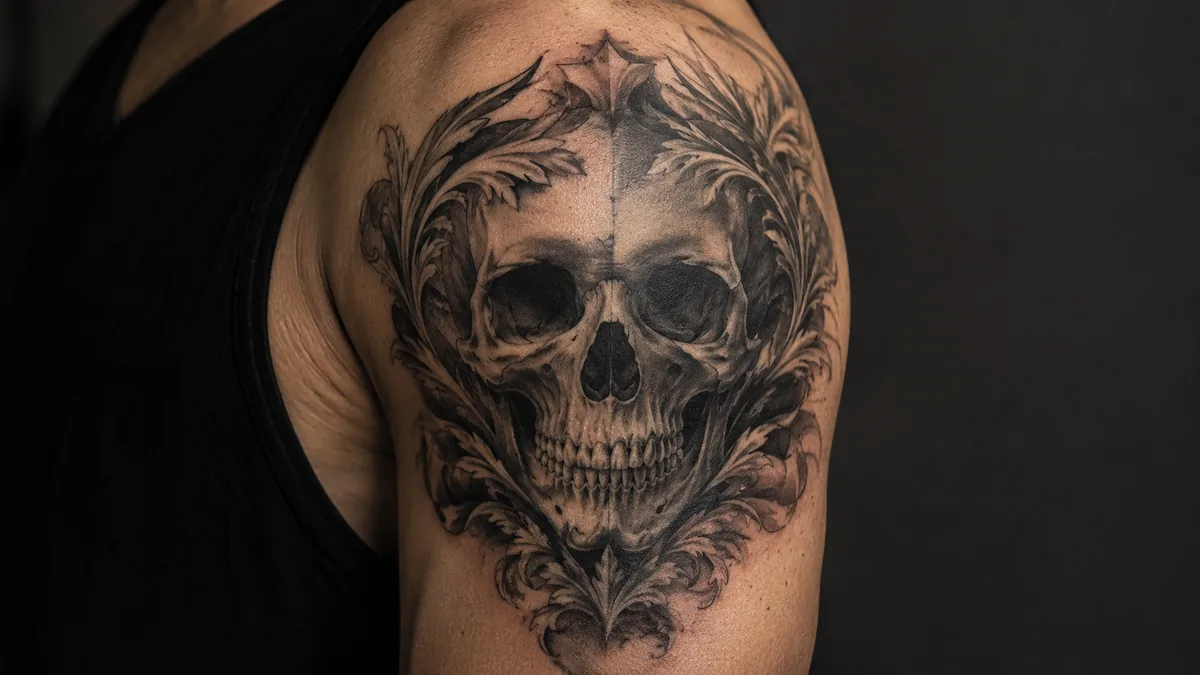
The totenkopf is a German word that translates directly to “death’s head,” and that’s exactly what it is: a skull, usually rendered as a bare human skull facing forward. It’s one of the oldest and most loaded symbols in Western culture, and as a tattoo it carries a whole stack of meanings depending on design, context, and the person wearing it.
Some people get it for the heavy historical weight. Others go pure memento mori. A few just think a clean skull with crossed bones reads like a masterpiece in black ink. All of those are valid starting points, but you should know what you’re putting on your body before you sit in the chair.
Core Meaning: Mortality and the Skull Symbol
At its most basic, the totenkopf is a memento mori symbol. Latin for “remember you will die,” memento mori art has been around since ancient Rome and runs straight through European painting, jewelry, and architecture into modern tattooing. The skull is the universal shorthand for human mortality. Wearing it says you’ve made peace with that fact, or at least you’re staring it down.
For a lot of people, that translates into a positive philosophy. You’re not nihilistic, you’re realistic. Life is short, so you live hard, love hard, and don’t waste time on nonsense. That’s the most common meaning a totenkopf tattoo carries today: a reminder to stay present and take nothing for granted.
Historical Background: The German Military Connection
Every skull tattoo has a history, make sure yours is the one you mean to wear.
The totenkopf became internationally infamous through its use by German military units. The Prussian cavalry used skull and crossbones imagery on their uniforms and helmets as early as the 18th century, meant to project fearlessness in the face of death. That tradition carried into World War I with several German units adopting the symbol.
The SS-Totenkopfverbände in World War II made the image globally notorious. The Third SS Panzer Division Totenkopf wore it on their collar tabs, and concentration camp guards also used the insignia. This history is real and documented. Anyone getting a totenkopf tattoo needs to understand that association exists and that some people will read it that way, regardless of personal intent.
Reclaiming the Symbol: Bikers, Pirates, and Counter-Culture
Long before the Nazi era, skulls and crossbones meant piracy. The Jolly Roger flew on ships as a psychological weapon: surrender or die. That outlaw energy never went away. Biker culture adopted skull imagery heavily starting in the post-WWII American motorcycle scene, and the totenkopf specifically landed in that world as a badge of brotherhood, defiance, and riding until your last breath.
Punk, metal, and tattoo culture absorbed it further. By the 1980s and 90s, a totenkopf on skin was more likely to signal someone deep in underground music or tattoo culture than anything political. Context matters enormously with this design. The way it’s rendered, what surrounds it, and where it sits on the body all shape how it reads.
Design Variations: From Traditional to Realism
The classic American traditional version features a bold skull with thick black outlines, solid black shadows, and sometimes red or yellow accents. It reads from across the room, holds up through decades, and bold will hold where fine line will fade. Old school flash-style totenkopf with crossed bones or a dagger is a tried-and-true choice that never looks dated in a well-lit studio.
Realism and black and grey open up a completely different lane. A hyperrealistic skull with deep value work, smooth whip shading, and fine-line bone detail can look like a photograph under good light. Neo-traditional adds decorative line work, floral elements, or ornamental borders. Geometric and blackwork versions strip it down to graphic shapes and solid fills. Every style changes the tone from vintage bravado to modern fine art.
Color vs. Black and Grey
Black and grey is the dominant choice for totenkopf work, and for good reason. The skull is fundamentally a high-contrast image. Deep blacks against pale bone tones, smooth grey gradients in the eye sockets, crisp lines on the teeth. A skilled artist in black and grey can make this piece look three-dimensional and alive, which is a satisfying irony for a death symbol.
Color adds personality but changes the read. A traditional piece with bold red and black hits aggressive and graphic. Watercolor washes can make it feel ethereal. Colored gemstones set into the eye sockets is a popular decorative move that softens the skull without losing the edge. Whatever direction you go, make sure the artist you pick specializes in that specific style. Technique matters more on this image than almost any other.
Placement and How It Ages
The chest, upper arm, and outer forearm are the workhorses for totenkopf placements. These are all relatively flat, low-wear zones with good surface area. A skull portrait needs room to breathe, especially if you want facial structure detail to stay crispy over time. High-wear zones like fingers, hands, and feet will fade and blow out faster, losing the fine detail that makes a realistic skull worth the money.
The upper back and thigh give you the most real estate and the least sun exposure, which means the piece heals nice and stays saturated longer. The ribs are a popular choice for people who want it visible only when they want it, but that zone is spicy and the skin flexes a lot. Whatever placement you pick, commit to the aftercare. A totenkopf that heals badly looks tragic for all the wrong reasons.
Who Gets This Tattoo and How to Make It Your Own
The people in the chair for a totenkopf are all over the map. Veterans, bikers, metalheads, tattoo collectors, and people who just lost someone important. The mortality angle hits different after a loss. It also shows up heavily in people with dangerous occupations, military backgrounds, or a philosophy built around accepting risk and living fully because of it.
Making it personal is straightforward. Add a banner with a name, a date, or a short phrase that’s specific to your life. Incorporate flowers that carry meaning: roses for love, marigolds for remembrance, black poppies for sleep or death. Frame it with imagery from your cultural background or your passions. A totenkopf surrounded by music notes, mechanical gears, or traditional nautical elements tells a story that’s yours alone. The skull is a universal symbol. What you wrap around it is where identity lives.