
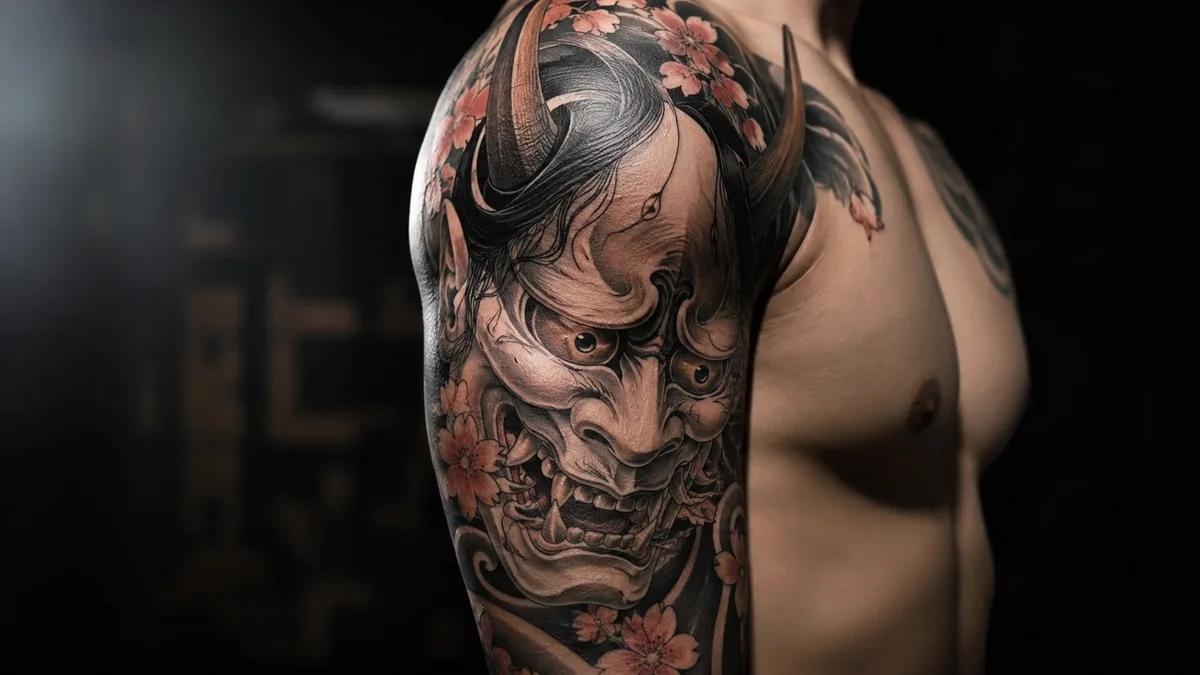
The hannya mask tattoo is one of the most loaded images in Japanese tattooing. It looks like a demon, but it started as something else entirely: a woman. A woman so consumed by jealousy and obsession that she transformed into something monstrous. That backstory is exactly what makes this piece hit different from a standard demon skull or generic horror face.
People get it for a lot of reasons. Protection, transformation, a record of pain they lived through, or just because it’s one of the most technically stunning designs in the catalog. All of those are valid. But if you’re going to wear it for life, you should know what it actually means.
The Core Meaning: Jealousy and Transformation
The hannya mask represents a woman who was consumed by jealousy, obsession, or heartbreak so intense it turned her into a demon. In Japanese tradition, the transformation is literal. She becomes a vengeful spirit called an oni. The mask captures her mid-change: still recognizably human in the brow and mouth, but twisted into something terrifying. That duality is the whole point.
As a tattoo, it carries that same meaning. People wear it to acknowledge darkness they’ve been through, jealousy they’ve felt, or a transformation they came out of. It’s not a celebration of evil. It’s an honest look at what extreme emotion can do to a person. That’s why it resonates so hard with people who’ve been in real pain.
Where the Mask Actually Comes From
She is not a monster. She is what grief looks like when it has nowhere left to go.
The hannya mask originates in Noh theater, a classical form of Japanese performing arts that dates back to the 14th century. Noh actors wore carved wooden masks to portray different characters, and the hannya was used specifically for women who became demons through jealousy or sorrow. The name is commonly linked to a monk named Hannya-bo who was said to have carved early versions of the mask.
The most famous Noh plays that feature the hannya include Aoi no Ue and Dojoji, both about women destroyed by obsession over a man. These stories were tragedies about how suffering can hollow a person out. That context matters when you’re choosing this as a permanent piece.
Duality: Demon and Human at the Same Time
Look at the mask closely. The eyes are wide and golden, full of fury. The horns mark it as supernatural. But the brow is furrowed in grief, not just rage. The open mouth reads as a scream or a sob, depending on how you angle it. That’s intentional. The hannya is supposed to hold two states at once: the human emotion underneath and the monstrous form it’s become.
This duality is a big reason clients pick it. It captures something that’s hard to say in words: I’ve been through something that changed me. It can also read as a warning. Some people wear it to signal that there’s more beneath the surface than what people see on first look.
Color Meanings: Red, Green, and Gold
Color is not decoration on a hannya. It carries specific meaning. A red hannya represents the highest level of rage and jealousy, a woman nearly fully consumed by her demon nature. Green signals a lower level of transformation, closer to the human side, more grief than fury. White or pale versions lean toward aristocratic Noh characters, more refined but still dangerous. Gold eyes appear across most versions and signal the supernatural.
In the tattoo world, a fully saturated red hannya in traditional Japanese style, with bold outlines and solid color fills, is the most common execution. It reads from across the room and holds up over decades when done right. Black and grey versions trade the color symbolism for raw texture and shadow depth. Both are legitimate. Your artist’s strength in one style versus the other should factor into the call.
Design Styles and How They Age
Traditional Japanese irezumi style is the natural home for this mask. Bold will hold. Thick outlines, flat color fills, and clean negative space mean the design stays readable after 10 or 20 years. Fine line and realism versions can look stunning fresh but need honest conversations about longevity, especially in high-wear areas. Blowout on fine lines around the face details will blur the expression over time, and the expression is everything on this piece.
Neo-traditional and American traditional adaptations are popular, often giving the mask a slightly Western edge with heavier shading or more stylized horns. Blackwork hannya masks lean into the graphic quality of the design. Whip shading in black and grey can give the mask real dimensional drama without color. Whatever style you choose, make sure the artist has a portfolio that shows clean, healed results in that specific style, not just fresh photos.
Best Placements and Pain Levels
The hannya mask needs space. It’s a portrait-style piece with a lot of vertical detail: horns on top, open jaw at the bottom, expression in the middle. Backs of thighs, outer thighs, upper arms, backs, chests, and ribcages are the classic choices. The back of a calf works well and heals nice on most people. Avoid squishing it into a spot where the proportions get compressed. A cramped hannya loses its expression, and the expression is the whole tattoo.
Pain varies a lot by zone. Outer thigh and upper outer arm are lower on the spicy scale for most people. Ribs, chest, and inner arm are significantly more intense. The back is a long sit but generally manageable. Wherever you place it, the face needs to be oriented so it reads correctly. Talk that through with your artist before you commit to a direction.
Who Gets This Tattoo and How to Make It Personal
People who get hannya masks tend to have a real connection to the idea of transformation through suffering. Breakups, grief, addiction recovery, trauma, periods of obsession they came out the other side of. It’s not the kind of piece you slap on because it looks cool, though it absolutely does look cool. The people who wear it best usually have a story they can point to.
You can personalize it without losing the symbolism. Incorporating chrysanthemums or peonies keeps it in the Japanese tradition. Adding koi or waves underneath plays into the broader narrative of struggle and flow. Some people pair it with a snake. Snakes and hannya together signal danger and cunning. Keep the mask itself clean and legible. Let the background tell the rest.









