
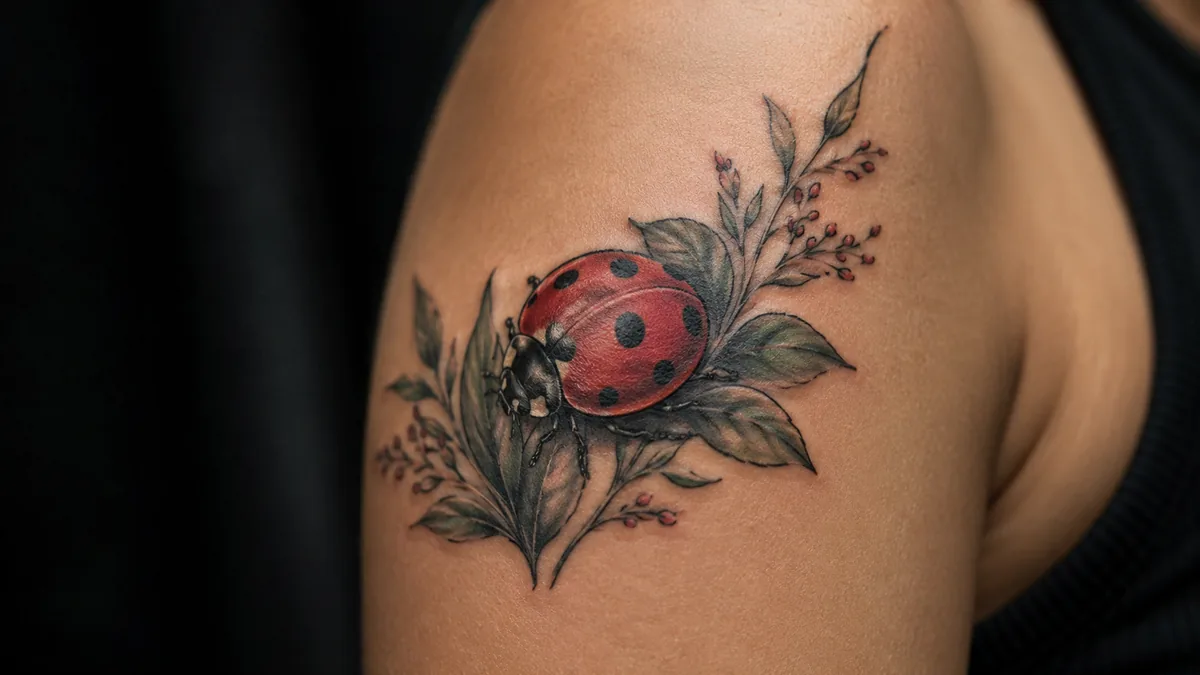
The ladybird tattoo punches way above its size. That tiny red beetle with black spots carries real symbolic weight, and it’s been on skin for decades for good reason. Good luck, protection from harm, love landing your way. Those aren’t invented meanings. That’s what the ladybird has represented across multiple cultures for centuries.
People sometimes call it a ladybug depending on where they’re from. Same insect, same symbolism. If you’re considering this piece, you’re picking a design with genuine depth. It reads clean at a small scale, ages better than most fine-detail work, and carries a personal story for almost everyone who gets it. Here’s what it actually means.
Core Symbolism: What a Ladybird Tattoo Actually Means
The central meaning is luck. A ladybird landing on you is considered a good omen in most Western traditions, and that carries straight into the tattoo. People get this piece during a turning point, after surviving something hard, or simply to keep a little good fortune permanently on their skin. It’s not superstition for most wearers. It’s a statement about optimism.
Beyond luck, the ladybird represents protection. Its bright red coloring is a natural warning signal in the insect world, and humans have long read that as a guardian quality. Some wearers tie it to protection over children or family. Others connect it to resilience. The spots are sometimes read as counting blessings, each one representing something or someone meaningful.
Cultural and Historical Background
Seven spots, one wish, the ladybird has carried hope longer than most religions.
In European folk tradition, the ladybird has been linked to the Virgin Mary for centuries. The red cloak was seen as Mary’s mantle, and the seven spots on the most common species were associated with her seven joys and seven sorrows. The name ‘Our Lady’s bird’ is where ‘ladybird’ and ‘ladybug’ both originate. That’s documented etymology, not invented lore.
In Asian cultures, particularly in parts of China, the ladybug signals luck in love. If one lands on you, the direction it flies is said to point toward your true love. Some tattoo wearers, especially those who’ve found a significant relationship after a rough period, carry this meaning deliberately. It gives the piece a romantic layer that goes deeper than just a pretty bug.
Design Variations: From Classic to Modern
The traditional American style ladybird is bold, saturated, with thick outlines and a solid red body. It reads from across the room even at a small size. That bold-will-hold approach means this version ages the best. The colors stay punchy for years. You’ll see them on wrists, ankles, and behind the ears constantly, and the old ones still look sharp.
Fine line ladybirds are popular right now, especially in black and grey or with delicate single-needle detail. They look incredible fresh. The trade-off is longevity. Fine line work in high-wear zones like fingers or wrists can blur and spread within a few years. If you want fine line, go for lower-wear placements like the upper arm, collarbone, or ribcage. A solid artist will tell you the same.
Color vs. Black and Grey
A fully saturated red ladybird with crisp black spots is a classic for a reason. The color contrast is naturally bold, the shape is immediately readable, and red holds well when packed solid by a skilled hand. Some artists add a tiny highlight dot to the shell to give it dimension without overcomplicating the design. Simple, clean, effective.
Black and grey ladybirds have their own quiet power. Without the red, the piece leans more introspective, less flashy. Some people pair a black and grey ladybird with fine shading and a soft background, maybe a small botanical element. The whip shade on the wings can look beautiful. It photographs well and suits people who want something that reads subtle rather than cheerful. Both approaches are legitimate depending on what the piece means to you.
Placement, Pain, and How It Ages
The ladybird is a compact design, which gives you flexibility. Common placements include the wrist, inner forearm, ankle, behind the ear, collarbone, shoulder blade, and upper arm. The inner forearm and upper arm are forgiving spots. Good circulation, not too much sun exposure, and the skin doesn’t stretch dramatically. These placements age cleanly and are easy to touch up.
Behind the ear and on the ankle are popular but spicier than people expect. The cartilage zone behind the ear is bony and tight. The ankle is thin skin over bone with almost no fat cushion. Both are manageable but not beginner-friendly. Fingers are the worst option for longevity. The constant movement and skin cell turnover chews up fine detail fast. A finger ladybird will need regular touch-ups to stay crispy.
Who Gets This Tattoo and Why
This piece attracts a wide range of people. Nature lovers, people marking a lucky break or a survived hardship, mothers getting something small and meaningful, collectors adding a delicate piece to a sleeve. It’s not a tattoo that belongs to one group. The symbolism is broad enough that almost anyone can make it personal without forcing it.
Some people get it in memory of someone. A grandmother who always said a ladybird landing meant good news, a child who loved collecting them. The tattoo becomes a private marker. Others just want a small, beautiful piece that ages well and doesn’t need a complicated explanation. That’s valid too. Not every tattoo needs a thesis. Sometimes a well-executed ladybird on your wrist is exactly enough.
Making It Personal Without Overdoing It
The ladybird works because it’s simple. Resist the urge to load it with extra elements to make it feel more significant. A tiny wildflower stem underneath, a small leaf, a subtle geometric border. One supporting element, maximum. Beyond that, the design starts competing with itself and the ladybird gets lost. Let the bug be the subject.
If you want to encode a personal meaning into the spots, some people work with their artist to adjust the spot count to a significant number. Birth dates, number of kids, years of sobriety. It’s subtle enough that most people won’t notice, but you will. That kind of quiet customization is what separates a meaningful piece from a flash sheet pull. Talk to your artist about what reads naturally on the size you’re planning.









