
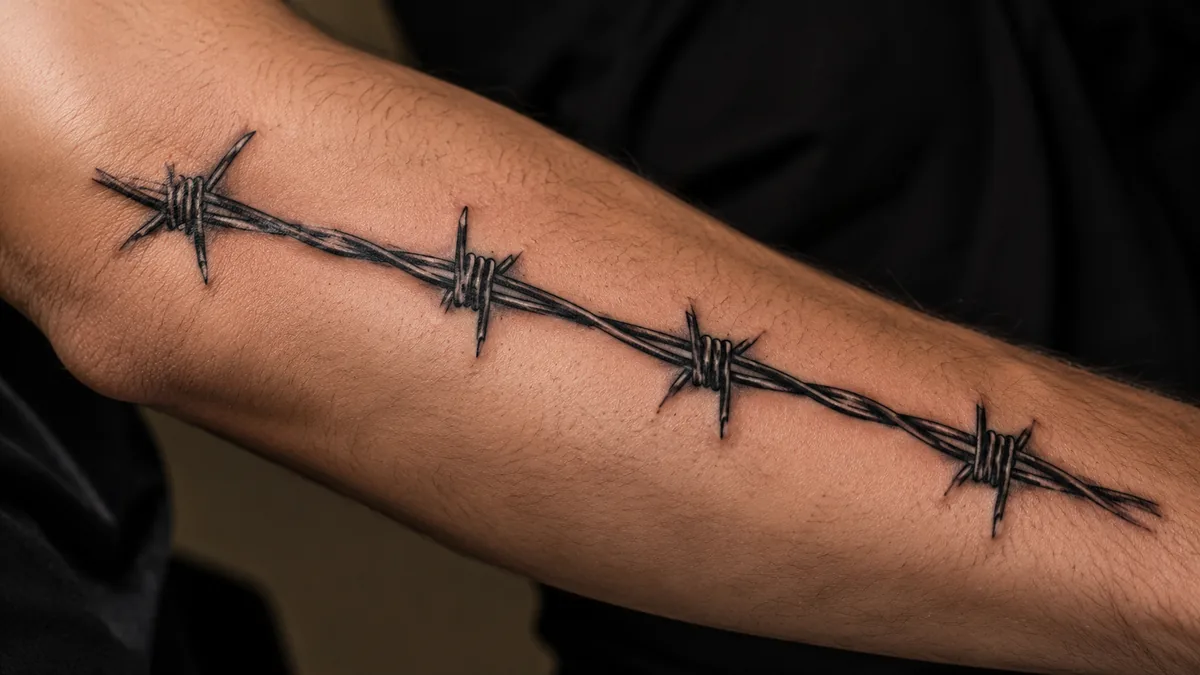
Barbwire tattoos have been a staple of American ink culture for decades. The image is simple, the message is not. a barbwire tattoo signals hardship survived, boundaries set, and a kind of toughness that doesn’t need to be explained.
You see it wrapped around arms, coiled at the bicep, strung across collarbones. The design reads instantly from across the room. That’s the power of it. Clean, bold, recognizable. But the meaning underneath that wire runs deeper than people give it credit for.
Core Symbolism: What Barbwire Actually Means
Barbwire is a symbol of containment and control, and the tattoo flips that energy. Most people wearing it are saying they’ve been through something that tried to hold them back and came out the other side. Struggle, resilience, endurance. It’s a visual shorthand for pain that didn’t break you.
It also carries a strong sense of protection. Barbwire keeps things out. Wearing it on your skin signals boundaries, that there’s a line people shouldn’t cross. Some wear it as a warning. Others wear it as armor. Both readings are valid and both land the same way.
Historical and Cultural Background
Barbwire does not decorate, it warns.
Barbwire itself was invented in the 1870s and transformed the American West by fencing off land that had been open range. It became a tool of control, conflict, and division. That history bleeds into the tattoo’s meaning, whether the wearer knows it or not. It carries the weight of something that cuts.
In military and prison contexts, barbwire is everywhere, literal and symbolic. Veterans and inmates both brought the image into tattoo culture, where it took on meanings of confinement survived, service rendered, and a life lived on hard terms. That association stuck. It’s never been a soft symbol.
Crown of Thorns and Spiritual Readings
One of the most common barbwire tattoo designs is the circle, a ring around the arm or head that echoes the crown of thorns. That reference is intentional for a lot of people. It signals suffering, sacrifice, and faith. You’ll see it on deeply religious clients and on people who just connect with the imagery of bearing something painful.
This reading adds weight to the design without changing the look. The barbwire circle around a bicep or forearm lands as both a physical barrier and a spiritual statement. It doesn’t need a cross or scripture alongside it to read that way. The shape does the work.
Design Variations and Style Options
You’ve got options with barbwire beyond the basic wrap. Traditional bold-line barbwire is high-contrast, saturated black, crispy edges, reads forever. Fine line barbwire is popular right now, delicate strands with micro-detail on the barbs, beautiful fresh but demands precise placement to age well. Blackwork and geometric styles give it an architectural feel, more structured and graphic.
Some clients mix in roses, skulls, or script woven into the wire. Roses with barbwire is a classic pairing, beauty and pain sharing the same space. Tribal-influenced barbwire uses negative space and thick fills. Whip shading behind the wire gives it depth and dimension without color. Each variation shifts the tone but keeps the core symbolism intact.
Black and Grey vs. Color
Most barbwire tattoos are done in solid black. That’s not a limitation, that’s the design working correctly. High-contrast black ink on skin reads bold, ages predictably, and stays sharp longer than color in most placements. Barbwire done in clean black with consistent line weight is a tattoo that holds.
Color is less common but not wrong. Red accents on the barbs, or a full color approach with rust tones to mimic aged metal, both work in the right artist’s hands. Grey wash behind solid black wire adds realism without overcomplicating it. Whatever you choose, the line quality is what carries this design. Thin, wobbly lines on a barbwire tattoo will blow out and go soft. You need confident linework from the start.
Placement and How It Ages
The bicep wrap is the classic placement and it works because the design follows the natural cylinder of the arm. Upper arm, forearm, and calf are all solid spots. These are relatively low-wear areas with stable skin, so the tattoo keeps its definition. Fine line barbwire on the forearm can drift over years, especially if the lines are too close together, so spacing matters.
High-wear zones like fingers, hands, and the inside of elbows are spicy to sit through and rough on the ink long-term. Barbwire around the ankle or calf heals nice and stays readable. Chest placements, across the collarbone or the sternum, are bold choices that age well if the skin doesn’t get too much sun exposure. Always factor in how your skin moves and stretches in a given spot.
Who Gets It and How to Make It Yours
Barbwire tattoos attract people who have been through something real. Veterans, survivors, people coming out of addiction or loss, athletes who connect with the grind-over-comfort mentality. It’s also popular with people who just respond to the visual, tough imagery with a clean graphic quality that works on any skin tone.
To make it personal, think about what the wire represents to you specifically. Incorporate a date in the wire as a small hidden barb. Add initials. Change the number of wraps to mean something. Let your artist know what you’re carrying into the design because a good artist can adjust the weight and style of the line to match the emotional weight you want it to carry. That conversation makes the difference between a tattoo that’s generic and one that’s actually yours.









