
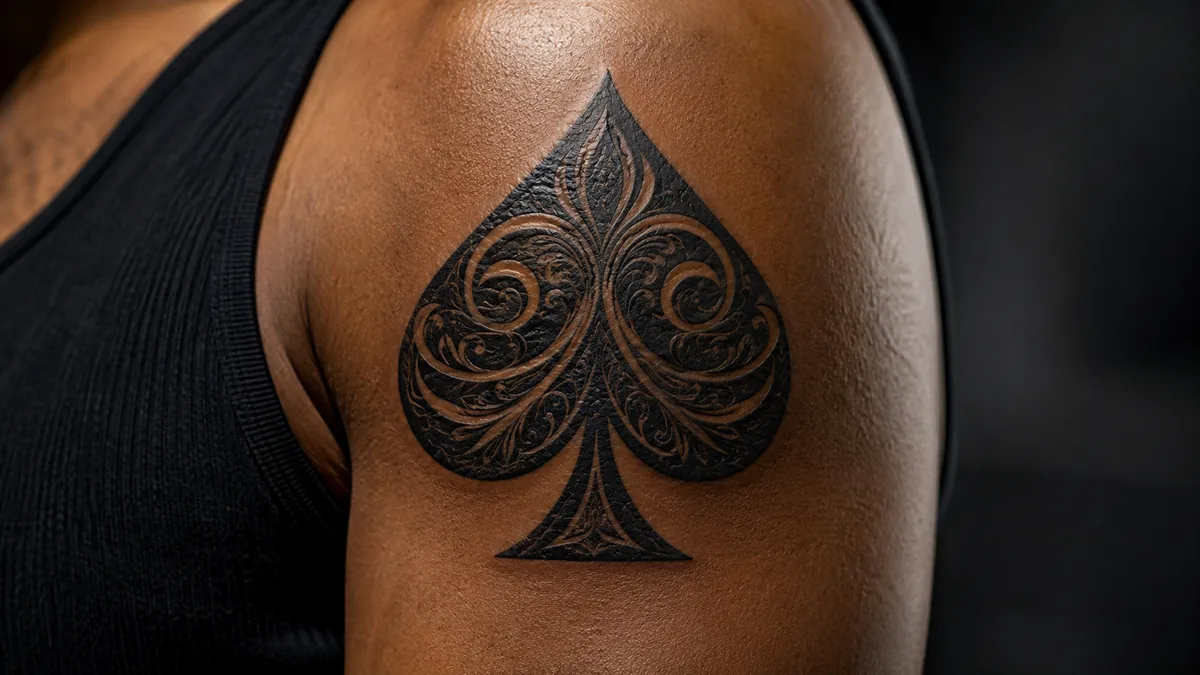
The black spade is one of the most loaded symbols you can put on your skin. It reads clean, it holds forever in solid black, and it carries real weight behind it. That’s the combination that keeps it on flash sheets and custom requests alike.
Most people who ask for a spade have a meaning in mind. Some are chasing good luck, some are nodding to mortality, some want the card-game grit, and some are reclaiming a darker history. Let’s break down what this symbol actually means so you walk into your appointment knowing exactly what you’re getting.
Core Symbolism: What the Spade Actually Represents
The spade is the highest-ranking suit in most card games, and that status bleeds straight into tattoo culture. At its most basic, a black spade tattoo means power, luck, and victory. It’s the suit that wins the hand. Gamblers, risk-takers, and people who back themselves hard tend to gravitate toward it for exactly that reason.
On the flip side, the spade has a long connection to death. Historically, the spade shape is linked to a digging shovel, the tool for graves. Old European cartomancy, the practice of reading meaning from playing cards, treated the spade suit as the harbinger of conflict, loss, and endings. Both readings are real and both are out there on people’s skin every single day.
Historical and Cultural Background
A spade does not promise luck. It just proves you showed up to play.
The playing card spade itself traces back to 15th-century Europe, likely derived from the Italian suit of swords, which represented military power and the aristocracy. That lineage is why the spade carries connotations of war, force, and authority even now. It wasn’t just a game piece. It was a class symbol.
In American tattoo tradition, the spade became a staple of traditional flash art alongside anchors, roses, and daggers. Sailors and soldiers picked it up. By the mid-20th century, it was firmly planted in classic Americana tattooing as a symbol of fate, fortune, and the acceptance that life is a gamble. That roots-deep history is part of why the design still hits hard today.
The Ace of Spades: A Meaning of Its Own
The ace of spades deserves its own section because it carries extra weight beyond the plain spade symbol. The ace is the highest card in the deck, so an ace of spades tattoo emphasizes supremacy and confidence. You’re the top card. Full stop. It also has heavy military symbolism. During the Vietnam War, US soldiers reportedly used the ace of spades as a psychological warfare tool, placing cards on fallen enemies, believing Vietnamese soldiers feared the symbol as a death omen.
Motorhead made it immortal in 1980 and that association never fully left. An ace of spades tattoo today can mean any combination of those things: living fast, facing death without flinching, being the best at the table, or honoring a loved one lost. Context and design details do the heavy lifting on which meaning lands strongest.
Design Variations and Style Options
A plain solid black spade is the purest version and arguably the boldest. It reads from across the room, heals crispy, and never gets confusing. Traditional American style gives you bold outlines with thick fills, sometimes paired with roses, flames, dice, or banner text. Neo-traditional adds color, shading, and ornate detail while keeping that strong graphic quality.
Fine line spades are popular right now, especially with added geometric or dot-work elements inside the shape. They look sharp fresh but you need to be honest about longevity. Fine line work in high-wear zones blurs faster than bold traditional. Black and grey spades with whip shading or gradient fills can add real dimension while staying in the dark palette that keeps the symbol feeling heavy and serious.
Placement and How It Ages
The spade shape is versatile. It stacks vertically which makes it perfect for the forearm, calf, sternum, and upper arm. Small spades work well on fingers, hands, and the back of the neck, though those zones are spicy and chew through fine line work fast. A small solid spade on the finger or hand is a high-wear zone, so go bold or plan for touch-ups.
Larger spades on the thigh, back, chest, or ribs give you room to add real detail and they heal beautifully in those lower-friction spots. A solid black spade in a protected zone like the upper chest or inner arm can look just as crispy at ten years as it did fresh. Bold will hold. That’s the principle to keep in mind when you want something intricate in a spot that sees daily friction.
The Spade in Biker and Outlaw Culture
The spade holds a specific place in biker culture and it’s worth being upfront about it. Various motorcycle clubs have used the spade as a patch symbol, sometimes representing the acceptance of death or living outside mainstream society. If someone comes in referencing a specific club’s version, it’s worth knowing what you’re tattooing and who might see it.
Beyond clubs, the spade has been adopted broadly in general outlaw and counter-culture aesthetics, which is separate from any specific affiliation. Most people getting a spade tattoo today are not signaling club membership. They just like the symbol. But the historical overlap is real, so knowing the context matters when the conversation heads that direction.
Who Gets It and How to Make It Personal
Spade tattoos attract a wide range of people. Gamblers, card players, people who’ve beaten bad odds, people honoring someone lost, and people who simply want a strong clean black symbol with staying power. The meaning is personal enough to bend toward whatever the wearer needs without losing the core visual punch.
You can personalize a spade with initials inside the shape, a birth year, a banner with a name, or design elements that speak to the person’s story. A spade with a hummingbird inside means something totally different from one wrapped in thorns. That flexibility is what keeps the design fresh. Work with your client to figure out which version of the symbol belongs to them, then execute it clean.









