
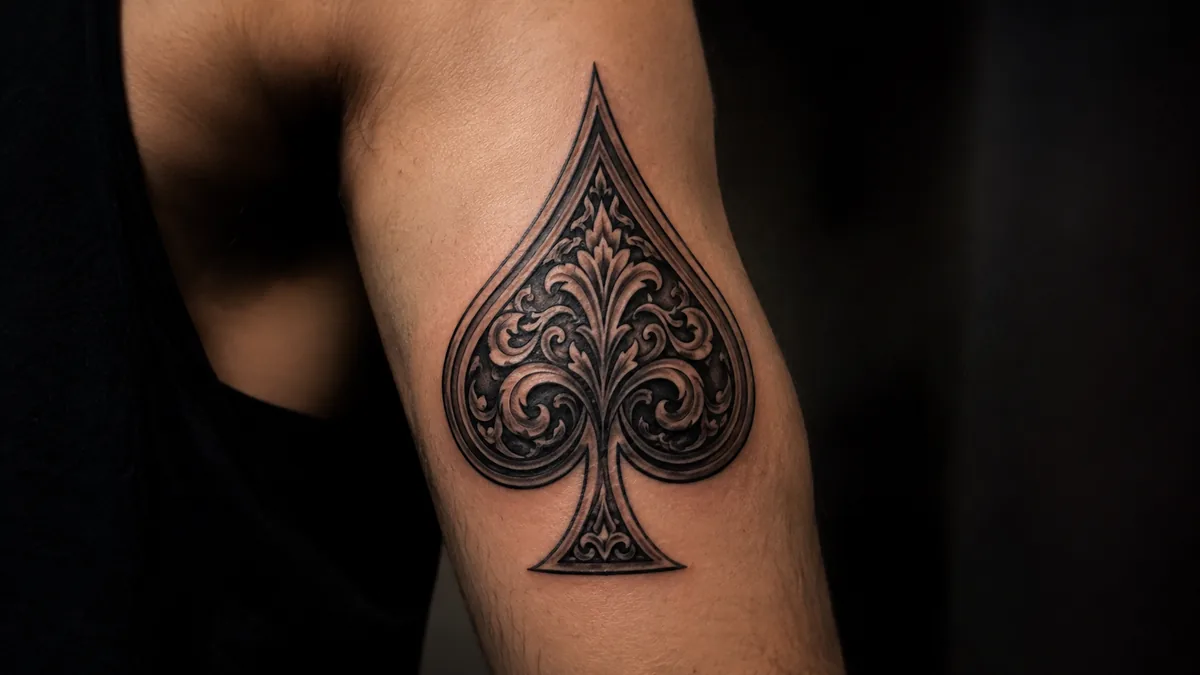
The spade is one of the oldest, most loaded symbols you can put on skin. Simple shape, serious weight. Most people know it from a deck of cards, but the meaning runs a lot deeper than poker night.
Whether you want luck, a nod to mortality, or just a bold geometric that reads clean from twenty feet away, the spade delivers. Here’s what it actually means and what you need to know before you sit down for one.
Core Symbolism: What the Spade Actually Represents
The spade’s primary meaning in tattoo culture is death and mortality. That’s not dark for shock value. It comes from centuries of the spade being associated with digging graves. The shape itself, that inverted heart with a stem, looks like a shovel blade. A lot of people wear it as a reminder that life is short, a memento mori they carry every day.
The second big reading is luck and power. In card games, spades is the highest suit. An ace of spades wins the hand. So for plenty of people, the spade means dominance, good fortune, or being dealt a strong hand. Both meanings are legitimate. Which one fits you depends entirely on the design and what you pair it with.
Historical and Cultural Background
A spade doesn't promise good luck, it proves you're ready for whatever card gets flipped.
Playing cards arrived in Europe around the 14th century, adapted from Middle Eastern and Asian decks. The spade as a suit symbol likely derived from the Italian word spada, meaning sword. Swords carried connotations of military rank, nobility, and combat. That lineage stuck. The spade became the suit of warriors and, later, the highest trump in games like Whist and Bridge.
By World War II, the ace of spades had taken on extra military mythology. American troops famously scattered them on battlefields as psychological symbols. That history fed into biker culture, military tattoo traditions, and ultimately mainstream ink. The association with luck under pressure, being the last card standing, became a cornerstone of its tattoo symbolism.
Popular Design Variations
The ace of spades is the most requested version. Crisp card corner, sharp pip, sometimes a number or letter inside. It reads bold, it reads classic, and it scales up or down without losing legibility. A lot of artists add skulls, roses, flames, or dice inside the spade shape itself, stacking multiple meanings into one contained design.
Standalone geometric spades are huge right now, especially in fine line and blackwork. Symmetrical, precise, no ornament. Just the shape, saturated solid or outlined clean. Some clients want a playing card with suit symbols all four in a banner, or just the single spade paired with a number 13 for extra luck-and-death energy. Each variation reads differently, so know your intent before you pick one.
Black and Grey vs. Color
Most spade tattoos live in black and grey or straight solid black, and honestly that’s where they shine. The shape is geometric and graphic. Black ink makes it pop hard against any skin tone. A fully packed black spade holds up over time better than almost any other design you can choose. Bold will hold, and the spade proves it.
Color versions exist. Red and black playing card aesthetics are classic, especially if you’re referencing the card suit directly and want that casino visual. Gold fill inside a black outline gives a regal feel. Fine line spades sometimes use a single color accent. Just know that lighter colors in high-friction zones like fingers or palms will fade faster and need touch-ups. Plan the placement around the style you choose.
Placement and How It Ages
The spade is versatile. The hand is the most traditional spot, especially the back of the hand or between thumb and index finger, classic gambler placement. Forearm, upper arm, and chest give you more real estate to work with and age cleanly. A mid-size spade on the forearm in solid black will still look sharp fifteen years in. High-wear zones on the hand or inner wrist will soften over time, so go slightly bolder than you think you need.
Smaller spades on the neck or behind the ear are popular but those spots are spicy pain-wise and the skin is thin, which means potential blowout if the artist isn’t precise. Ribs and sternum are lower on the pain scale for bony areas but move a lot with breathing, so bring a steady artist. For fine line spades, avoid palms and fingers entirely. The ink will ghost out within months in those zones regardless of aftercare.
Who Gets Spade Tattoos and How to Make Yours Personal
Spade tattoos pull from a wide crowd. Gamblers and card players wear them for obvious reasons. Veterans and military get them for the historical symbolism and the idea of playing a difficult hand with composure. Plenty of people just want the memento mori angle, a clean reminder that their time here is finite so they’d better use it well. The symbol crosses subcultures without belonging exclusively to any one of them.
To make yours personal, think about what you add inside or around the shape. A birth date, initials, a skull that looks like someone specific, a flower that carries meaning for you. Or strip it all away and go pure geometric, letting the shape speak for itself. Talk to your artist about line weight and how filled-in you want it. A razor-thin outline and a fully packed solid black read like completely different tattoos. Both are right. Know which one is yours.









