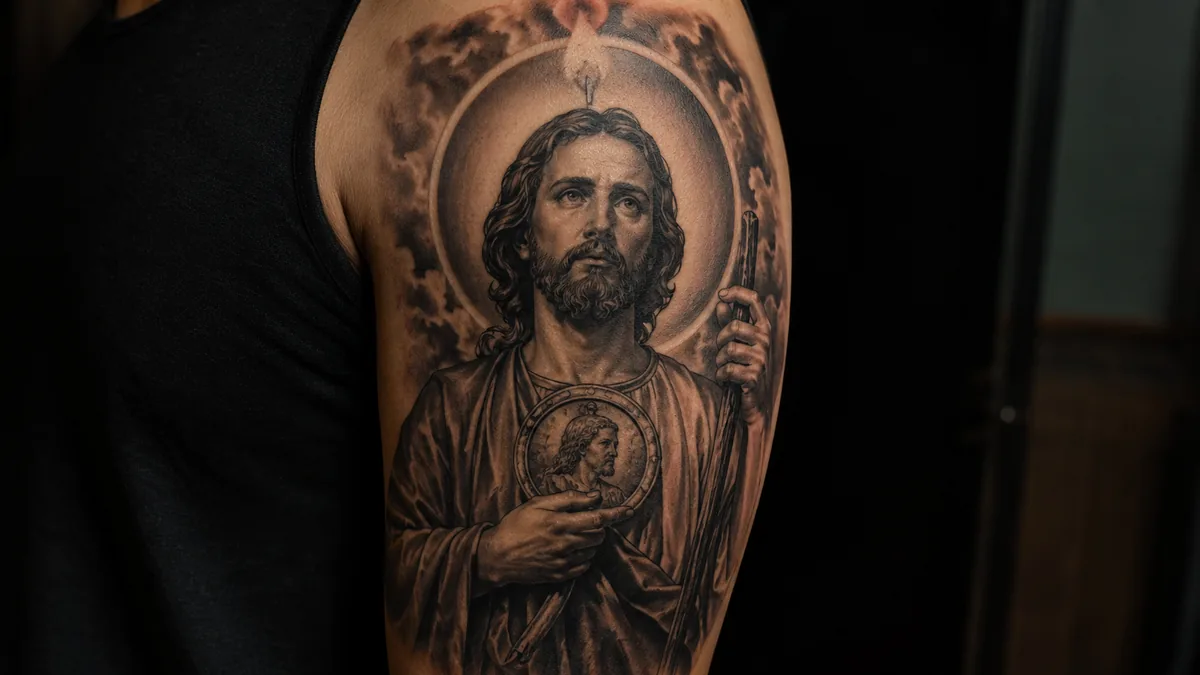
San Judas Tadeo, known in English as Saint Jude Thaddeus, is one of the most tattooed religious figures in Latin American and Mexican-American culture. He’s the patron saint of lost causes and desperate situations, and people get his image inked when they’ve been through something serious and came out the other side. This isn’t a casual tattoo. It carries real weight.
The name alone tells you something. San Judas, not to be confused with Judas Iscariot, got a bad reputation by association for centuries. That’s actually part of why he became the saint of hopeless cases. People prayed to him as a last resort because other saints weren’t responding. That history of being overlooked and misidentified runs straight through to why his tattoo resonates so hard with people who feel the same way.
Core Meaning of the San Judas Tattoo
San Judas is the patron saint of lost causes, desperate situations, and impossible odds. His tattoo is a declaration of survival. People who get it have usually been through addiction, incarceration, poverty, near-death, or serious hardship. The image says: I was written off, and I’m still here. It’s devotion, but it’s also defiance.
That dual meaning hits hard in communities where life can flip on you fast. The tattoo functions as a permanent prayer, a thank-you, and a shield all at once. For many wearers, it’s a vow to San Judas for coming through when nothing else did. You don’t need to be Catholic to get it. Plenty of people connect to the symbolism on a purely personal level.
Who San Judas Actually Is
He's the saint you call when every other door is closed.
Saint Jude Thaddeus was one of the twelve apostles of Jesus. He’s believed to have authored the Epistle of Jude in the New Testament. Historically, he’s been linked to the evangelization of Mesopotamia, Persia, and Armenia. His feast day falls on October 28th, shared with Saint Simon, which is why you’ll sometimes see them paired in religious iconography.
The confusion with Judas Iscariot, the apostle who betrayed Jesus, left Saint Jude Thaddeus largely overlooked for centuries. Believers started praying to him only when all other options were exhausted, which cemented his identity as the saint of hopeless cases. That reputation stuck and eventually became a point of pride. Being the saint no one called until things were truly dire gave him a particular kind of street credibility.
Traditional Iconography and What Each Symbol Means
The classic San Judas image shows him holding a medallion or image of Jesus on his chest, which represents his close relationship with Christ. He typically carries a club or axe, referencing the way he was martyred. A flame above his head symbolizes the Holy Spirit and the presence of divine fire. Some versions include a staff, a scroll, or a ship representing his missionary journeys.
Surrounding imagery matters too. Roses, particularly white ones, are common additions and tie to miraculous healing. Clouds and rays of light signal divine intervention. Many tattoos include his name in banner lettering, often stylized in Old English or script. Knowing what each element actually means lets you build a design that tells your specific story instead of just copying a generic reference.
Popular Styles and How They Render
Black and grey realism is the dominant choice for San Judas tattoos and for good reason. The fine details of his face, the texture of his robes, the glow of the flame above his head all benefit from smooth grey washes and tight linework. A skilled artist using black and grey can get incredible depth on this piece. It reads as serious, devotional, and timeless. Whip shading around the outer edges adds atmosphere without muddying the focal point.
Chicano style is the other major approach. Bold outlines, high contrast, fine line detailing on the face and hands, traditional script lettering. The Chicano style developed in California prison and barrio tattoo culture and has deep roots in exactly the communities that have long held San Judas close. Color versions do exist, usually featuring a green robe, golden halo, and warm skin tones. Color pops more fresh but demands perfect saturation to hold long-term. Bold will hold. Fine line color on the robe will fade and blur within a few years.
Placement, Pain, and Longevity
The chest is the most traditional placement for San Judas, sitting close to the heart. It’s a moderate pain zone and offers a large canvas for a full portrait with surrounding details. The upper arm and sleeve are also popular, giving you room to build a full religious composition over time. Forearm placements are common for smaller, cleaner versions when someone wants it visible every day.
The ribcage and sternum are spicy, no other way to put it. They also flex a lot, which can cause blowout on fine-line detail work over time if the skin isn’t stretched properly during the session. For longevity, avoid placing heavy detail work over high-wear zones like the inner wrist or fingers unless you’re committed to touch-ups. A chest or upper arm piece in solid black and grey will still be reading clean at twenty years. Plan around that.
Color vs. Black and Grey
Black and grey wins for most San Judas tattoos purely on aging. The grey wash technique can create an almost photographic quality on a skilled artist’s work, and it holds without the color shift you get from pigments breaking down under UV exposure. After five years in the sun, a green robe in color can shift to a muddy yellow-green. Black and grey just gets richer with age when the linework is solid.
That said, color done right is stunning on this subject. A fully saturated San Judas with a warm-toned face, deep green robes, and a glowing golden halo is a commitment to a bold, traditional aesthetic. If you go color, go saturated. Pastel or washed-out color on this image will look tired in a few years. Sunscreen on color tattoos is not optional if you want to keep them crispy.
Who Gets This Tattoo and How to Make It Personal
The core demographic is people with Mexican, Mexican-American, and broader Latin American roots, particularly those raised Catholic or in religious households. But this tattoo has moved well beyond those boundaries. Survivors of all kinds, people with religious convictions of their own, and people who simply connect to the idea of fighting through impossible situations all wear San Judas. The meaning translates even without the cultural background.
Personalizing it means adding elements that are specific to you. A date in the banner, a name of someone you lost or someone you got clean for, specific flowers tied to your region or family, a color palette that nods to your own flag or heritage. Talk to your artist about what the piece is for before you commit to a reference image. A good artist will help you build something that hits the symbolism you actually need, not just something that looks like every other San Judas on Instagram.