
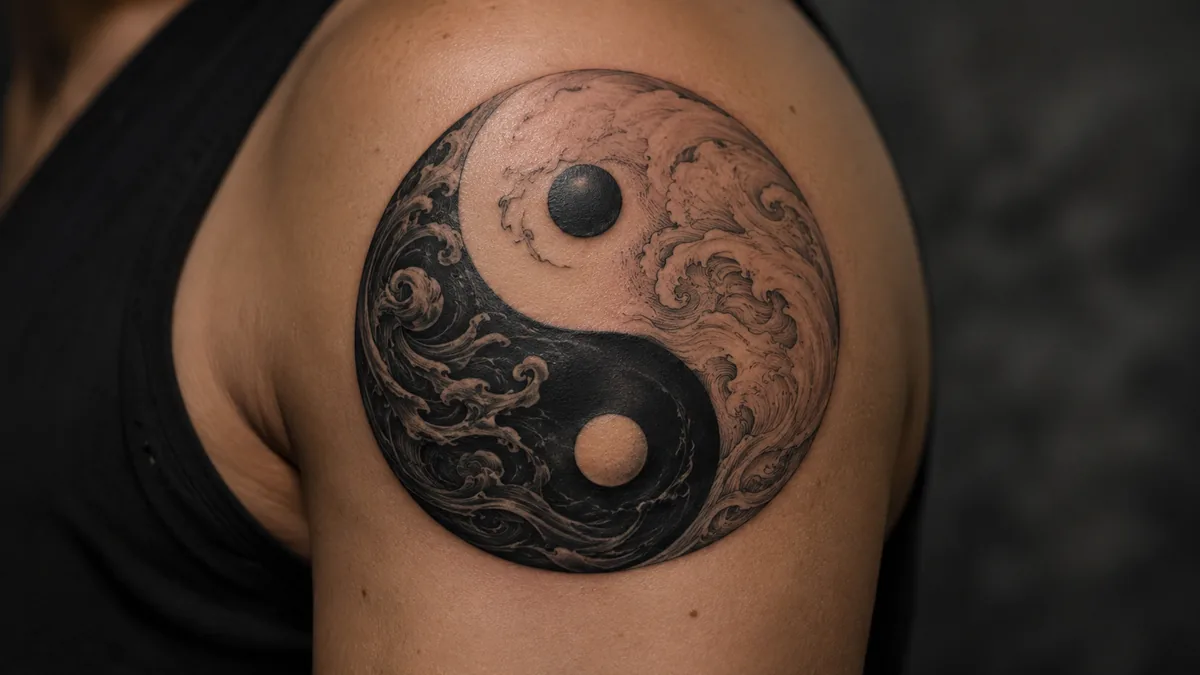
The yin yang is one of the most recognized symbols on the planet, and it translates to skin just as powerfully as it does anywhere else. it’s about balance. Two halves, opposite but dependent, each carrying a seed of the other. Simple concept. Deep roots.
People get this tattoo for a hundred different reasons, and most of them are genuinely personal. That’s what makes it stick around. It’s not a trend piece. It’s a symbol that actually means something, and it has for a very long time.
What the Yin Yang Symbol Actually Means
The yin yang, formally called the taijitu in Chinese philosophy, represents the idea that opposite forces are interconnected and interdependent. Yin is the dark half: associated with rest, receptivity, the moon, water, and feminine energy. Yang is the light half: associated with activity, heat, the sun, fire, and masculine energy. Neither is good or bad on its own.
The small circle of each color inside the other half is the critical detail. It says that nothing is purely one thing. There’s darkness inside light, stillness inside action. That’s the part that resonates with a lot of people, especially anyone who’s lived through real contrast in their life.
Historical and Cultural Background
Every shadow holds a point of light, that's the whole tattoo, right there.
The taijitu comes from Taoist philosophy in China, formalized around the 10th to 14th centuries CE, though the underlying concepts go back much further in Chinese cosmology. Taoism teaches that the universe operates through the interplay of complementary forces, and the symbol visualizes that principle in one clean, contained image.
It spread globally through the 20th century, picked up by Western counterculture movements in the 1960s and 70s, and landed in tattoo culture from there. It’s been adapted across martial arts communities, Buddhism-adjacent spaces, and general wellness culture. The core meaning hasn’t shifted much: duality, balance, the cyclical nature of existence.
Popular Design Variations
The classic circle is the starting point, but artists run with it in a lot of directions. Some clients want it traditional and clean, tight linework, perfectly symmetrical, crisp edges. Others want it incorporated into larger pieces: koi fish forming the two halves, wolves, tigers, elements like flames and water, celestial bodies. The koi version is especially popular and holds up well at most sizes.
Fine line yin yangs are having a major moment right now. Geometric interpretations with mandala elements, dotwork fills, or negative space designs are all solid options. Watercolor splashes inside each half add color drama without overcomplicating the read. Whatever variation you go with, the symbol needs to stay legible. If someone can’t recognize it from three feet away, the meaning gets lost.
Black and Grey vs. Color
Black and grey is the natural fit for a yin yang. The contrast is built into the design, so a clean black fill against healed skin already does the heavy lifting. Solid black with a white dot, or whip shaded transitions if you want something softer, both age well. Bold black areas stay saturated longer than fine detail, so if longevity matters to you, lean into the solid fills.
Color opens up creative options but requires more thought. Traditional red and blue, or custom palettes chosen for personal meaning, can look incredible fresh. Just know that color fades faster than black, especially on high-wear areas like hands or feet. If you’re going color, factor in touch-ups. A good artist will also tell you which pigments hold in your specific skin tone before they put the machine to you.
Best Placements and How It Ages
The yin yang works at a wide range of sizes, which gives you a lot of placement flexibility. Small and precise on the wrist, behind the ear, or at the base of the neck. Medium-sized on the forearm, upper arm, calf, or chest. Large as a back piece centerpiece or thigh panel. Symmetrical designs like this one read especially well centered on the sternum, between the shoulder blades, or on the back of the neck.
Longevity comes down to placement more than almost anything else. Inner wrist, fingers, and the tops of feet are high-wear, high-sun zones. Fine lines in those spots blur faster. A clean, bold yin yang on the outer forearm or upper arm will still read sharply ten years from now. Avoid blowout risk by not going too small with intricate linework, especially on soft or stretchy skin. Simple holds. Bold will hold.
Personalizing the Meaning
Most people bringing in a yin yang reference have a specific reason behind it. Healing after a hard period. Honoring a relationship where two people balance each other. A reminder that struggle and peace coexist. Some clients connect it to a Taoist or Buddhist practice they actually follow. Others just know the feeling of being two things at once, and they want it on their body permanently.
You can personalize it without losing the symbol. Add a birth date in the negative space, incorporate a memorial element into one half, or pair it with a phrase along the arc. Some people split the halves to represent two people or two phases of their life. Talk to your artist about how to integrate personal details without cluttering the core image. The cleaner it stays, the stronger it reads.
Who Gets This Tattoo and Why It Holds Up
The yin yang client is all over the map, which says something about the symbol’s reach. Martial artists who’ve trained for years. People coming out of a rough stretch. Couples getting matching pieces. Philosophy students, meditation practitioners, folks who just find real meaning in the concept of balance. It’s not a trend that spikes and disappears. It’s been on skin for decades and it’s not going anywhere.
The reason it holds up culturally is the same reason it holds up on skin: the idea is solid. Balance between opposites is a universal human experience. Everyone knows what it feels like to carry two contradictory truths at once. A symbol that captures that in one image, with no words needed, has staying power. Done right by a skilled hand, this tattoo is one of the ones people never regret.









