Pinoy tribal tattoos aren’t decoration. They’re a language. These designs come from a pre-colonial Filipino tradition called batok, practiced by indigenous groups across the islands, and every element you see on skin carries a specific meaning tied to identity, rank, protection, or connection to ancestors and land.
People get these tattoos for a lot of reasons today, heritage pride, honoring family roots, marking personal milestones. But the symbolism behind the patterns is real, earned through centuries of cultural practice. Here’s what you’re actually looking at.
What Pinoy Tribal Tattoos Actually Mean at the Core
The word ‘pinoy’ is Filipino slang for Filipino. When people say Pinoy tribal tattoo, they mean designs rooted in pre-colonial Philippine indigenous tattooing, specifically the batok tradition. At the core, these tattoos meant three things: who you are, what you’ve done, and what protects you. Tribal affiliation, warrior rank, spiritual guardianship. That was the original purpose, and those meanings still carry weight today.
A tattoo wasn’t decorative art you picked off a wall. It was earned. More tattoos on a warrior meant more victories, more raids survived, more respect from the community. For women, specific patterns marked beauty, fertility, and social standing. The ink was proof of your story on your skin. That’s the fundamental meaning people are reaching for when they get this work done now.
The Historical Roots: Batok, Los Pintados, and Colonial Suppression
Every line in a Pinoy tribal tattoo was earned before it was drawn.
Filipino tattooing predates Spanish colonization by thousands of years. When Spanish explorers arrived in the Visayas in the 1500s, they encountered so many heavily tattooed people they called them Los Pintados, the painted ones. Hand-tapping with thorns, bone, or metal needles, using soot-based inks, performed with prayers to ancestral spirits called anito. That was batok, and it was sacred, not casual.
Spanish and later American colonization pushed hard against indigenous practices. Christianity stigmatized these tattoos. The tradition nearly disappeared in lowland areas. But highland groups, particularly the Kalinga, Bontok, and Ifugao of the Cordillera mountains, kept it alive. Today, the revival is strong. Artists like the legendary Apo Whang-Od of Kalinga represent living links to this tradition. The tattoo community is bringing it back on purpose.
Common Symbols and What They Stand For
The centipede, called ginatungan in Kalinga tradition, is one of the most recognized motifs. It means protection from evil spirits. Waves represent the life journey, sea travel, and origin myths. Mountain lines signal tribal belonging and connection to ancestral homeland. The sun and stars point toward divine guidance and leadership. The scorpion in Ifugao tradition marks a fearless warrior. Rice and terrace patterns mean fertility, abundance, and the steps between the human world and the sky world.
Geometric bands, spirals, and repeating chevron patterns show up across multiple regional traditions. Crocodiles represent power and spiritual guardianship. Snake motifs carry transformation and ancestral connection. Most large compositions stack multiple symbols into chest panels, arm bands, and back pieces that together tell a complete personal story. No symbol is filler. Each element was chosen and placed with intention.
Regional Differences: Kalinga, Visayan, Ifugao, and Beyond
Not all Pinoy tribal designs are the same. The Kalinga style from northern Luzon is bold and geometric, featuring dense armband compositions and chest panels. Kalinga men earned tattoos through headhunting; Kalinga women received them for beauty and fertility markers. The Visayan tradition, practiced by the Pintados people, featured full-body coverage with elaborate interlocking patterns across the chest, arms, and legs. These were distinct from Cordillera highland work.
Ifugao designs include the scorpion and other animal motifs tied directly to warrior achievement. Coastal and lowland groups had their own regional vocabulary of waves, sun symbols, and plant-based patterns. When a client walks in asking for a Pinoy tribal piece, asking which tradition they want to reference matters. Kalinga armband versus Visayan chest panel versus Ifugao animal motif, these are different conversations with different cultural weight behind them.
Design Styles: Bold Traditional vs Modern Interpretations
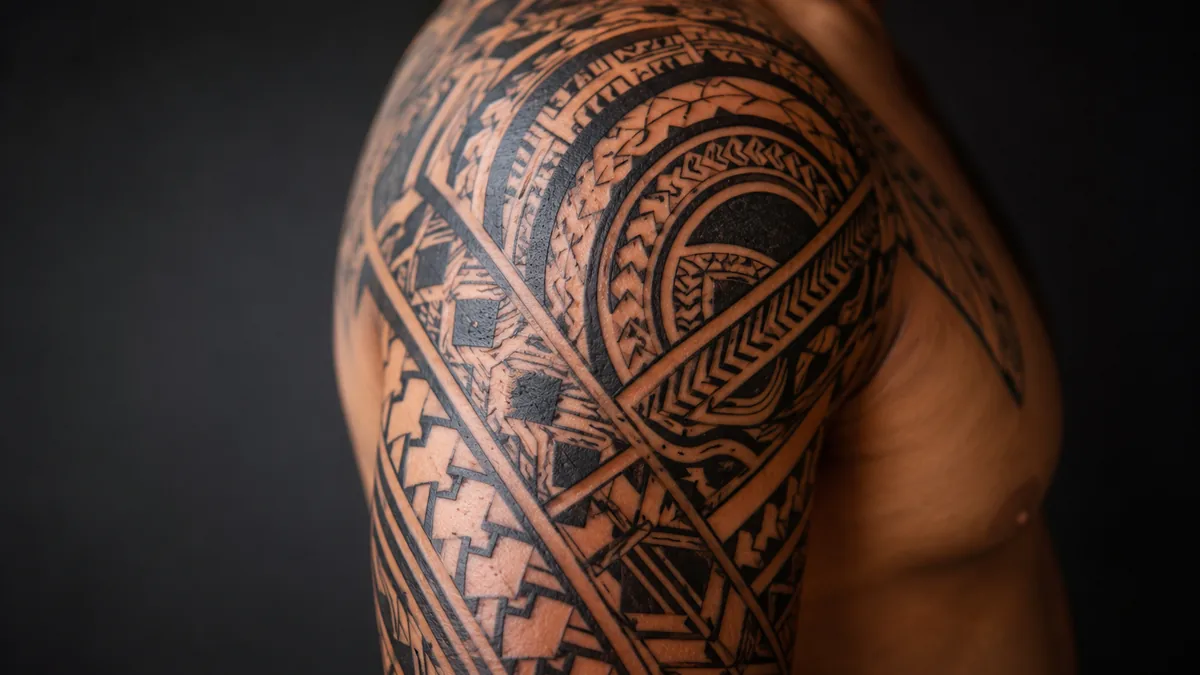
Traditional batok work uses thick, confident lines. Solid black fill, strong negative space, patterns that read clean from across the room. That bold approach isn’t just cultural, it’s smart tattooing. Thicker line weights hold up over time. Fine-line Filipino tribal work looks tight fresh off the needle but softens faster, especially on high-movement areas. If you want this style to look good in ten years, go bold. Bold will hold.
Modern interpretations often blend traditional Kalinga or Visayan elements with contemporary sleeve layouts or Polynesian-influenced spacing. Some artists incorporate geometric whip shading behind the main linework for depth. Black and grey is the standard, and it suits these designs well, clean and saturated. Color is rare in traditional batok work and not the default call here. If you want cultural accuracy as part of the piece, stick to solid black. It’s the authentic choice.
Best Placements and How the Work Ages
Upper arm and shoulder cap are the gold standard for Pinoy tribal. Low distortion, minimal sun exposure if you wear sleeves, and the skin holds well over decades. Chest panels are traditional and dramatic, great for big compositions. Upper back works well too. These are the zones where bold geometry stays crisp longest. Forearm is popular and highly visible, but sun exposure softens the lines over years if you’re not consistent with sunscreen.
High-wear zones like hands, fingers, and ankles are rough on any tattoo, but especially on geometric linework where straight edges and precise spacing matter. Friction, sun, and constant movement blur those crisp lines fast. It’s your call, but go in knowing the maintenance situation. Ribs are spicy pain-wise and can distort with major weight changes. If longevity is the priority, stay upper body. The work holds better, heals cleaner, and reads stronger for longer.
Cultural Respect and Making It Personal
These designs come with real cultural weight. Some elements were historically earned through specific deeds or belonged to specific roles. If you’re Filipino or part of the diaspora, this is your heritage and you have every right to reclaim it. Research which regional tradition speaks to your family background. Talk to an artist who understands the context. A Kalinga-style piece from someone who knows the tradition is a completely different experience than a generic tribal pattern off a flash sheet.
If you’re not Filipino, that’s a conversation worth having with your artist. Plenty of non-Filipinos get this work out of genuine appreciation and put in the research, and that shows in the final piece. The difference is intention and knowledge. Know what each element means. Understand which designs were earned versus decorative. Choose elements that connect to something real in your own story, resilience, protection, family, survival. That’s how any tribal work becomes personal instead of just pattern.
Healing Process and Aftercare for Geometric Linework
Bold tribal linework heals more forgiving than fine-line work. Days one through three, the tattoo weeps plasma and looks oversaturated. Keep it clean, use the wrap method your artist recommends, moisturize lightly. Days four through ten, the skin peels like a sunburn. Lines look patchy and grey during this phase. That’s normal. Don’t pick it. Weeks two through four bring the silver skin phase, a thin new layer that makes the tattoo look foggy before it clears.
After roughly six to eight weeks, the ink settles into the dermis and you see the real result. Bold Filipino tribal patterns are particularly satisfying at this stage because the geometry locks in clean. Micro-gaps or light spots in the linework show up clearly and your artist can address them at a touch-up. Stay out of pools, avoid direct sun on fresh work, and don’t over-moisturize. The aftercare basics don’t change with the style.