What a Joker Tattoo Says First
Before style, before placement, a joker tattoo sends one message: you do not have me figured out. It is the mark of someone who keeps a card in reserve, who refuses a fixed role, and who would rather improvise than follow a script written by someone else.
This reading comes from the playing card itself. The joker sits in the deck but stands outside the rules. It can rewrite a hand, ruin a sure thing, or deliver a win from nowhere. On skin, that usually translates to rebellion against rigid expectations, or a turning point where someone stopped following the obvious path.
There is weight underneath the swagger. Many joker and jester tattoos are about laughing at hardship deliberately. The grin is a coping tool. People who have walked through grief, addiction, bad luck, or long stretches of chaos often choose this symbol because it marks them as someone who picked dark humor over collapse.
Pick your axis before the stencil
A joker piece that tries to say everything at once usually reads as a costume, not a statement. Decide which thread you want loudest: the gambler’s wild card, the jester who speaks truth under a joke, or the fool who laughs through pain. Your artist needs this clarity to make the design hold together.
The Four Figures Hiding Behind One Word
The word “joker” covers four distinct characters, and your artist will design very differently depending on which one you mean. This is where most people skip a step, and where a piece either gains a clear message or loses it entirely.
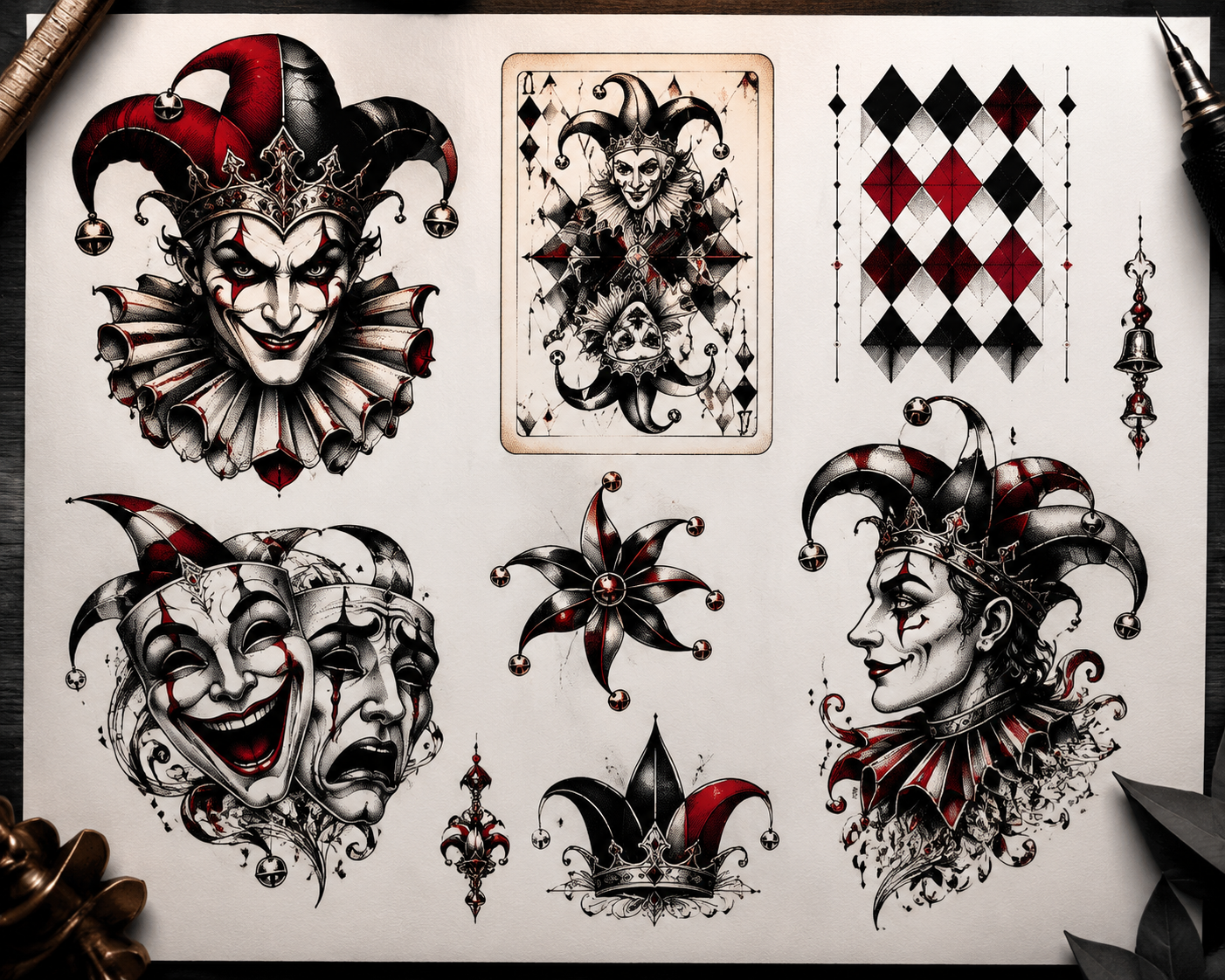
The playing card
Meaning: fate, risk, the wild card, refusing fixed rules. Best placement: forearm, calf, ribs. Risk to avoid: a generic card with no personal mark that looks like clip art.
The court jester
Meaning: truth under cover of a joke, hidden wit, defiance of power. Best placement: upper arm, chest, back. Risk to avoid: cluttered bells and patterns that fight the face for attention.
The theatrical fool and masks
Meaning: the social mask, joy and sorrow as one continuous experience. Best placement: chest, forearm, thigh. Risk to avoid: masks that look stock rather than expressive, with frozen expressions.
The harlequin and diamond pattern
Meaning: many-sided self, playful cunning, the trickster who adapts. Best placement: sleeve filler, ribs, spine. Risk to avoid: diamonds that read as flat wallpaper instead of dimensional fabric.
The Playing Card: Fate, Risk, and the Wild Card
If you want the most direct version of the symbol, the joker card delivers it. Playing card tattoos in general treat life as a game of chance and strategy, where the odds are rarely fair and the deck is rarely clean. The joker card pushes that idea to its limit.
A joker card usually means something like: I am the unpredictable factor here, or I refuse to play the standard hand. Pair it with kings, queens, skulls, or a crown and the message tilts toward mocking authority or surviving a system built to beat you. It is a common choice for people who live close to risk, whether that risk is literal gambling or just a temperament that courts uncertainty.
For a card-led piece, the design lives or dies on framing. A clean border, a confident silhouette of the figure inside, and one personal detail carry far more weight than a busy card crammed with extras. If you want a second symbol beside it, choose something that earns its place rather than crowding the composition.
Technical note on card realism
If you want a specific cinematic joker reference, your artist needs to know which era. Ledger’s smeared greasepaint, Nicholson’s theatrical grin, and Phoenix’s gaunt realism each demand different technical approaches. Skin is not paper; a photorealistic face at small scale often ages into a blotchy mess. A skilled artist will translate the reference into tattoo-readable contrast and line weight, not just copy a still frame.
The Jester and the Fool: Madness Next to Wisdom
The court jester occupies a strange historical position, often linked to medieval and Renaissance courts where the fool held license to mock the monarch. The jester could speak truths no advisor dared voice, provided the truth arrived wrapped in a joke. That tradition gives the jester tattoo its enduring appeal: the sharp mind hidden behind silly clothes, the critic who survives by pretending to be harmless.
On skin, this figure tends to attract people who feel they observe more than they are allowed to say. It suits the quiet analyst, the sarcastic survivor, the employee who sees through the company rhetoric but needs the paycheck. The jester’s bells and motley are not just decoration; they are camouflage.
The theatrical fool extends this idea. The comedy-tragedy mask pairing, often linked to Greek drama though popularized much later, speaks to the split between what you show and what you feel. A jester tattoo with twin masks can mark a history of depression survived, or a permanent alertness to how much performance social life requires.
Designing the jester face
The jester’s expression matters more than the accessories. A grin too wide reads as generic evil clown. A smirk with weight behind the eyes reads as intelligence and restraint. Work with your artist on the mouth and the eyes first; the ruffled collar and pointed hat are secondary. Color choices also shift the tone: traditional bright motley reads as playful resistance, while desaturated greens and purples lean toward melancholy and danger.
The Harlequin: Many Sides, No Fixed Self
The harlequin predates the modern joker and feeds into it through centuries of overlap. Originating in Italian commedia dell’arte, often linked to the sixteenth century though the precise lineage is debated, the harlequin was a servant character of nimble wit and shifting loyalty. The diamond pattern on his costume became a visual shorthand for a person who contains contradictions.
A harlequin-pattern joker tattoo usually speaks to duality or multiplicity: the self that plays different roles for different audiences, or the person who refuses to be pinned to one identity. The diamonds can fragment across the body, suggesting a self that reassembles differently depending on context.
This figure works well as a sleeve element or a back piece where the pattern has room to breathe. At small scale, the diamonds collapse into visual noise. If you want the harlequin specifically, commit enough skin real estate to let the geometry stay legible.
Placement and What It Changes
The joker’s meaning shifts with where you put it. A forearm joker card is a public declaration: I am the variable you did not account for. It is visible in handshakes, in gestures, in work that does not hide the arms. That placement suits someone who wants the symbol to function as a warning or an invitation, depending on who reads it.
The ribs or sternum hide the piece closer to the body. That placement tends to signal private significance: a reminder to yourself more than a message to others. The pain is sharper there, and the healing is slower because of movement and friction from clothing. People who choose this spot often have a specific story they are not obliged to share.
The calf offers a middle ground. Visible in shorts, hidden in formal pants, it lets you control the reveal. The muscle curve also gives the jester’s face or the card’s figure a natural roundness that flat planes like the forearm do not provide.
Hands, neck, and face
Hand tattoos of joker cards or small jester faces have gained popularity, but they carry practical costs. Fingers and palms shed ink rapidly; touch-ups are almost guaranteed. Neck and face placement makes the joker an unhideable identity claim. That works if you are committed, but it closes certain doors and opens others you may not want. Consider whether the symbol is a core identity or a phase before you put it where a collar cannot cover it.
Pairing the Joker With Other Symbols
The joker plays well with certain companions and poorly with others. Skulls paired with the card deepen the mortality angle: the wild card is temporary, the joke ends. Crowns or royal figures set beside the joker create a hierarchy where the fool outranks the king in hidden influence. Roses or thorns can soften the menace or sharpen it, depending on color and arrangement.
Avoid pairing the joker with too many other wild cards. Multiple jokers, chaos symbols, and anarchy signs in one composition read as adolescent rebellion rather than considered philosophy. One well-placed joker carries more weight than a collage of disruption.
What to Remember
A joker tattoo is not a costume choice. It is a claim about how you move through the world: unpredictable, self-aware, possibly damaged, refusing to be simplified. The symbol works when the design matches that complexity, and fails when it settles for a grinning face copied from a movie poster.
Before you book, know which figure you mean: the card, the jester, the fool, or the harlequin. Know what you want it to say about your history, not just your taste. And find an artist who understands that a joker’s eyes should look like they have seen something, not just like they are looking for trouble.
Frequently Asked Questions
Does a joker tattoo always mean something dark?
Not necessarily. The playing card version can simply mean unpredictability or a gambler’s temperament. But the jester and fool variants often carry weight related to survival, hidden intelligence, or coping through humor. The meaning depends on which figure you choose and what you bring to it.
Is a Joker portrait tattoo a bad idea?
It is risky. Cinematic portraits age poorly if copied directly from film stills. Skin cannot hold the subtle gradations of a photograph. A better approach is to find an artist who translates the character’s essence into tattoo-readable contrast and line work, rather than attempting photorealism at small scale.
What is the difference between a jester and a harlequin tattoo?
The jester traditionally carries bells, a pointed hat, and a connection to speaking truth to power. The harlequin is defined by diamond-patterned costume and suggests adaptability, multiple selves, and playful cunning. They overlap in meaning but demand different visual treatment from your artist.
Where should I place a joker tattoo if I want to keep it private?
The ribs, upper thigh, or upper arm under a short sleeve offer concealment. The sternum works too but heals more slowly due to movement and clothing friction. Avoid hands, neck, and face if you need control over when the piece is visible.