The key tattoo is one of those designs that never really goes out of style. It’s been inked on skin for generations, and it carries real weight. Keys open things, sure, but more than that, they represent access. Access to places, to people, to parts of yourself you’ve kept locked away. That dual nature, the locking and the unlocking, is what makes this symbol hit different for so many people.
If you’re going fine line on a wrist or a big bold skeleton key across your forearm, the meaning runs deep. This isn’t a design you grab off the flash wall without thinking. People who get key tattoos usually have something specific in mind. Let’s break down what that actually means.
Core Symbolism: What a Key Tattoo Actually Means
At its most basic, a key represents access and power. You hold the key, you control what gets in and what stays out. That’s why it’s been used for centuries as a symbol of authority, trust, and privilege. In tattoo culture, people wear it to represent personal freedom, the ability to open new doors in their life, or taking control of their own path. It’s confident without being loud.
The flip side is the lock. A key without a lock is just potential. A lot of people get the key as a symbol of something they’ve unlocked within themselves, a tough chapter they got through, an emotional barrier they finally broke down. Others pair it with a lock to show a relationship, two people who fit together. Both readings are valid and widely understood.
Historical and Cultural Background
A key tattoo means nothing until you decide what door it opens.
Keys have carried symbolic weight across cultures for a long time. In ancient Rome, being given the key to a city was a genuine honor, a sign of trust and raised status. The Catholic Church made the key central to papal imagery, with Saint Peter traditionally holding the keys to heaven. That’s where the skeleton key gets a lot of its mystical, almost sacred association. People weren’t just opening doors, they were accessing the divine.
In Japan, keys appear in artwork tied to concepts of good fortune and opportunity. In European folklore, keys protected against evil and were buried with the dead to ensure safe passage. None of this is trivia. It’s why the key tattoo reads as layered rather than simple. When you put it on skin, you’re tapping into that long chain of meaning, even if your personal reason is something completely modern.
Popular Design Variations
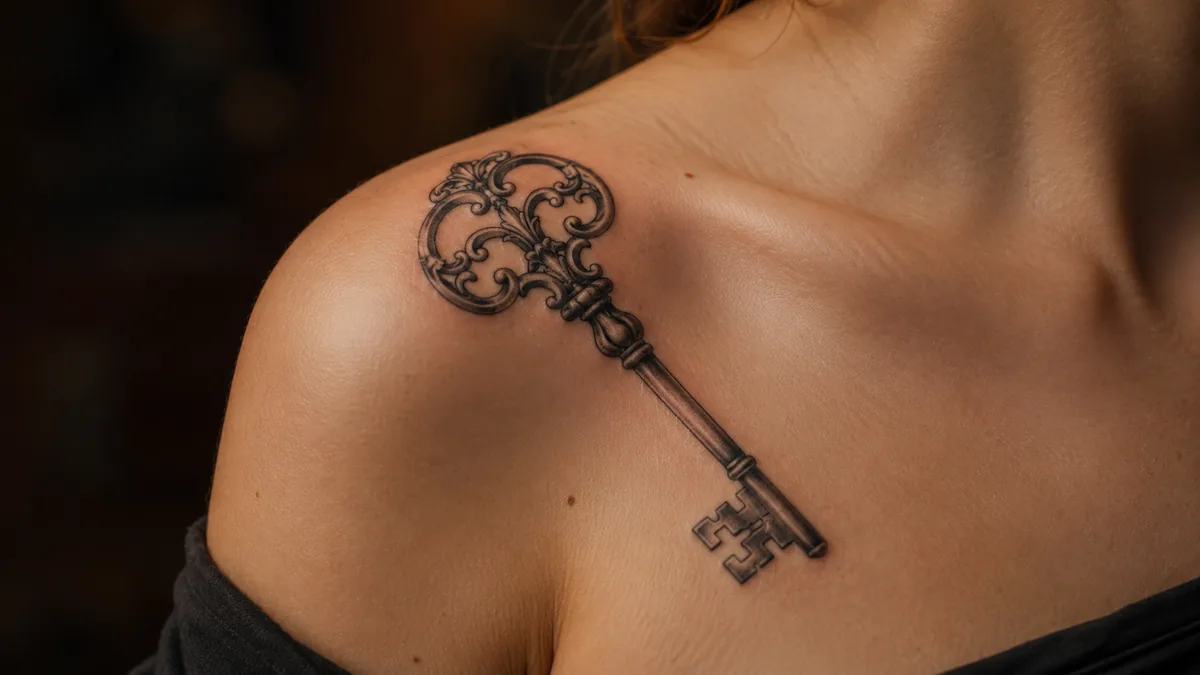
Skeleton keys are the most requested. That ornate, vintage look with the hollow bow and long barrel reads classic and timeless. They work in both fine line and bold traditional styles, and they age well because the silhouette is strong. Antique or Victorian-style keys are a close cousin, detailed and decorative, often paired with roses, clocks, or hearts for extra meaning. These lean romantic and work beautifully in black and grey.
Modern geometric or minimalist keys are popular for people who want clean and simple. A single fine-line key on the inner wrist or behind the ear reads subtle but intentional. Neo-traditional keys with bold outlines and saturated color, sometimes featuring ornate filigree or animals built into the design, make a statement. You can also go surreal, a key made of flowers, built from waves, melting like a Dali painting. The silhouette always carries the meaning regardless of the stylistic treatment.
Color vs. Black and Grey
Black and grey keys are the standard for a reason. The range of tones you can pull with whip shading or smooth gradients gives a key tattoo real depth, especially on a skeleton key with all its curves and negative space. A good artist can make that metal look genuinely three-dimensional. It heals crisp and holds up over years. For fine line work, pure black ink keeps the detail readable long-term, which matters on small keys.
Color opens up options depending on the style. Gold or bronze tones on a neo-trad key pop hard, especially on lighter skin tones. Some people go full saturated jewel tones to make the key look like an ornate antique. Watercolor keys exist but be realistic about longevity. Soft washes fade and blur faster than solid lines. If you want color, go with a bold outline to anchor it. Bold will hold. Color without structure turns to a blur in five years.
Best Placements and How It Ages
Keys work almost anywhere because the design scales well. Forearms and biceps give you room for detail and the flat surface heals nicely. The spine and sternum are popular for longer vertical keys, especially paired with lock and key designs split across the body. Ribs are a go-to for women who want something personal but usually covered, though that’s a spicy spot. Inner wrist, behind the ear, and ankle are the top picks for small fine line keys.
High-wear zones like fingers and the sides of hands are rough on any tattoo. A tiny fine line key on a finger will blur and fade faster than you want. Same with inner lip or foot placements. Placement matters for aging. A medium-sized solid key on the forearm or upper arm will still read clean in twenty years. A hairline fine line key in a crease will not. Talk to your artist about line weight based on where you’re putting it. Don’t let someone talk you into lines too thin for the placement.
Pairing the Key with Other Symbols
Keys almost always mean more when they’re paired with something. Lock and key is the most classic pairing, used to represent a relationship, a partnership, or two people who belong together. Some people split the set between two people as matching tattoos. The lock on one, the key on the other. It’s committed and it reads clearly. Just go in knowing that if the relationship ends, you’re carrying that ink regardless.
Heart locks are everywhere and for good reason. They hit the love and vulnerability angle directly. Roses paired with keys suggest romance with an edge of mystery or access to something protected. Compass and key combinations point toward freedom and direction. Chains attached to the key shift the meaning toward being held or holding something tight. Butterflies or birds near a key lean toward freedom from a past constraint. Think about what the key is unlocking in your story, then build the design around that narrative.
Who Gets Key Tattoos and Making It Personal
Key tattoos cross all demographics. They’re not gendered and they’re not age-locked. Older clients often come in with a specific meaning tied to a house, a person they lost, or a chapter of life they’re marking. Younger clients tend to go more abstract, freedom, potential, self-discovery. Prison alumni sometimes get keys as a symbol of freedom earned. People in recovery get them to mark a door they finally opened. Veterans get them. Survivors get them.
To make yours personal, get specific. What’s the key made of in your imagination? Is it old and rusted, or bright and clean? Is it opening something or locking something? Does it have an initial engraved on the bow? A date etched into the barrel? A word on the blade? These details are what separate a good tattoo from one that actually means something every time you look at it. Bring those specifics to your artist. A great artist turns your story into design, not the other way around.