The Virgin Mary is one of the most loaded images in tattoo history. She shows up on skin for a reason, sometimes many reasons at once. She’s not just a religious symbol. She’s grief, protection, motherhood, and resilience rolled into one image that reads clean from ten feet away.
People of all backgrounds get her. Devout Catholics, lapsed believers, folks who just lost their mom, people who grew up surrounded by the image and feel it in their bones. The meaning is personal every single time, but there are common threads running through all of it.
Core Meaning: What the Virgin Mary Tattoo Symbolizes
The Virgin Mary tattoo represents protection above almost everything else. She is the interceding figure, the one you turn to when things go sideways. People get her when they want a permanent guardian watching over them, somebody they can look down at before surgery, a flight, a fight, or a hard day. That protective instinct is the single most universal reason people choose her.
Beyond protection, she stands for purity, compassion, and unconditional love, specifically maternal love. She represents a mother who does not abandon. For people who lost their mothers, or who had complicated relationships with theirs, she fills that role on skin. She also carries sorrow. The Mater Dolorosa, the sorrowful mother, is a specific iconography built entirely around grief and loss.
Cultural and Historical Background
She is not decoration. She is armor.
Marian devotion goes back to early Christianity, but the visual tradition most tattoo artists draw from comes heavily out of Catholic Spain, Mexico, and Latin America. The image of Our Lady of Guadalupe, appearing to Juan Diego in 1531, is arguably the most tattooed version of Mary on the planet. She became a symbol of Indigenous and mestizo identity in Mexico, a figure that merged Catholic faith with pre-Columbian spirituality. That fusion is exactly why she reads as resistance as much as faith.
In Catholic Europe, particularly Southern Italy, Spain, and Poland, Mary imagery covered everything from cathedral walls to sailors’ skin. Sailors tattooed her for safe return home. Prisoners tattooed her for protection inside. That folk-religion grit is baked into the tradition. When you get a Virgin Mary tattoo, you are connecting to centuries of working-class devotion, not just church iconography.
Design Variations: Which Version Are You Getting?
Our Lady of Guadalupe is the most recognizable version. She stands on a crescent moon, wrapped in a star-covered mantle, surrounded by sunburst rays, hands pressed together, head bowed. Every element has meaning. The crescent moon signals her standing over darkness. The stars echo the sky at the moment of the apparition. The rays represent divine light. Artists can render her in traditional Chicano style, full neo-traditional color, or tight fine-line black and grey.
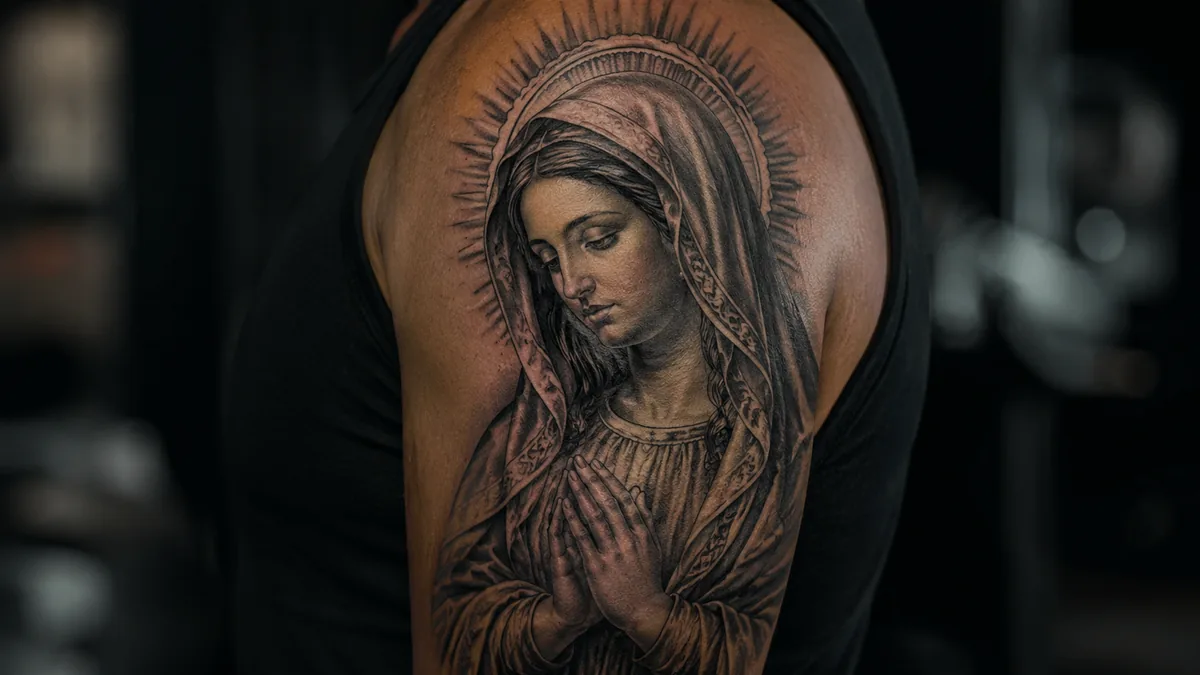
The Immaculate Heart of Mary is another major version. She holds or displays her own heart, pierced by swords, sometimes crowned with roses, sometimes ringed in flames. This one leans hard into sorrow and sacrifice. You also see the Mater Dolorosa, Mary weeping, often combined with crown-of-thorns imagery. Then there are simpler bust portraits, just her face in a veil, which work well in a smaller format and age exceptionally clean on the right skin.
Black and Grey vs. Color: How Style Changes the Message
Black and grey Virgin Mary tattoos have a long history in Chicano tattooing out of California and the Southwest. Done right, with smooth whip shading and solid contrast, they look timeless. The grayscale palette gives her a somber, reverent quality. Fine line black and grey is popular right now, but be straight with yourself: ultra-fine linework in high detail fades fast. If you want it crispy in ten years, you need a real black with some weight behind it.
Color versions, especially in neo-traditional or traditional American styles, hit differently. Saturated blues and golds, deep roses, vivid greens in her robe, they make her pop from across the room. Chicano color work with limited palette, maybe just a blue mantle and flesh tones, sits in its own lane and heals beautifully. Full realism in color is stunning fresh but demands a skilled artist and serious aftercare. Whatever style you pick, make sure the artist actually specializes in it.
Placement and How It Ages
The chest and sternum are the classic placements. She reads big, stays protected from sun, and has a naturally sacred feel at the center of the body. The upper arm and sleeve work too, especially when she anchors a larger religious piece. Back placements give you the most canvas if you want a full Guadalupe with all the surrounding imagery intact. These are all low-wear zones that age well and hold detail over time.
Avoid placing her anywhere that gets constant friction or sun exposure if you care about longevity. Hands, fingers, and wrists are spicy for pain and tough on ink. Inner forearm ages decent if you moisturize and stay out of the sun. Ribcage placements are brutal in the chair but hold well long-term if you have enough skin padding. Fine-line facial details and tiny text around her will blur over years. Bold will hold. Plan the design so the core image still reads clean if the fine details soften.
Who Gets This Tattoo and How to Make It Personal
Catholic and Latino communities have claimed this image for generations, but she shows up on all kinds of people now. Veterans, mothers, people in recovery, people mourning a loss, artists who grew up surrounded by religious iconography. The tattoo does not require active faith. It requires a genuine connection to what she represents, whether that is your culture, your grandmother, your own survival, or a promise you made to yourself.
Making her personal comes down to two things: the version you choose and what you put around her. Adding your mother’s name, a specific date, a rose variety your family grew, a flag element from your heritage, all of that grounds the piece in your story. Talk to your artist about it. A good artist will build references that reflect your relationship to the image, not just pull a flash sheet. Tell them what she means to you. That conversation is where the real tattoo starts.